AJHSME

1985 AJHSME

25 problems — read each, give it a real try, then peek at the hints.

Practice: Take as test →
Problem 1 · 1985 AJHSME Easy
Fractions, Decimals & Percents cross-cancel

(3 × 5)⁄(9 × 11) × (7 × 9 × 11)⁄(3 × 5 × 7) =

Show hint
Every factor in the top of one fraction shows up on the bottom of the other (or vice versa).
Show solution
  1. 3 and 5 cancel against the second denominator; 7 cancels against the first denominator's 9 × 11.
  2. What's left: 1.
A 1.
Mark: · log in to save
Problem 2 · 1985 AJHSME Easy
Arithmetic & Operations arithmetic-series

90 + 91 + 92 + 93 + 94 + 95 + 96 + 97 + 98 + 99 =

Show hint
Sum of an arithmetic run = (first + last)⁄2 × count.
Show solution
  1. Average = (90 + 99)⁄2 = 94.5; count = 10.
  2. Sum = 94.5 × 10 = 945.
B 945.
Mark: · log in to save
Problem 3 · 1985 AJHSME Easy
Fractions, Decimals & Percents power-of-ten-arithmetic

10⁷ ⁄ (5 × 10⁴) =

Show hint (soft nudge)
Subtract exponents of 10 first.
Show hint (sharpest)
10⁷ ⁄ 10⁴ = 10³, then divide by 5.
Show solution
  1. 10⁷ ⁄ 10⁴ = 1000. Divide by 5.
  2. = 200.
D 200.
Mark: · log in to save
Problem 4 · 1985 AJHSME Medium
Geometry & Measurement bounding-rect-minus-notch
ajhsme-1985-04
Show hint (soft nudge)
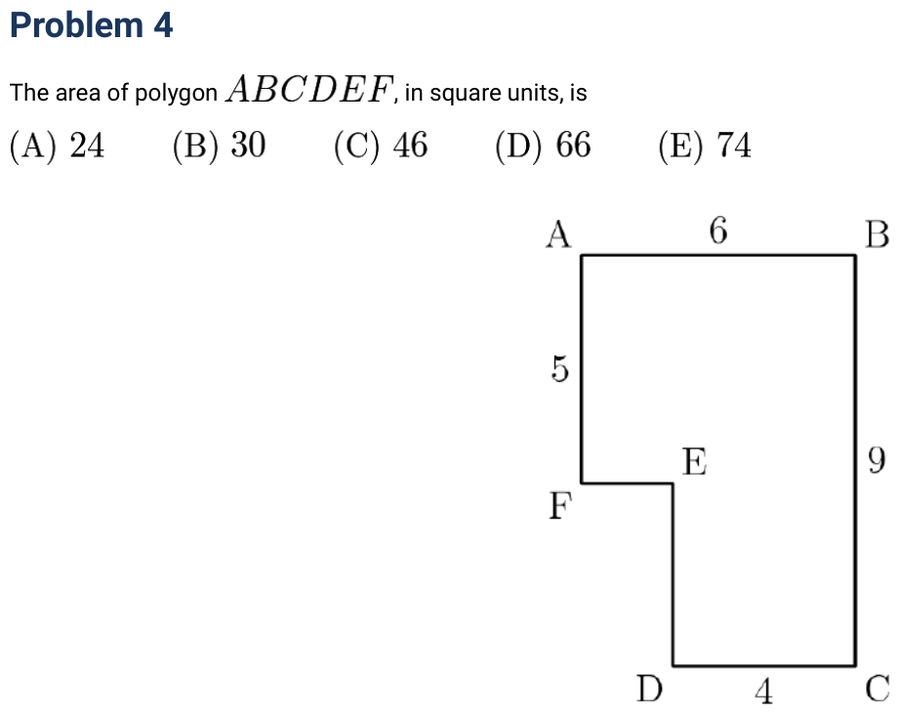
Inscribe the polygon in a 6-by-9 rectangle and subtract the missing notch.
Show hint (sharpest)
Notch is 2 wide × 4 tall.
Show solution
  1. The shape fits inside a 6 × 9 = 54 rectangle. The notch removed is 2 × 4 = 8 (from AB length 6, FE = 6−4 = 2 wide, and AF = 5 minus the matching segment to the bottom run leaves a 4-tall step).
  2. Area = 54 − 8 = 46.
C 46.
Mark: · log in to save
Problem 5 · 1985 AJHSME Easy
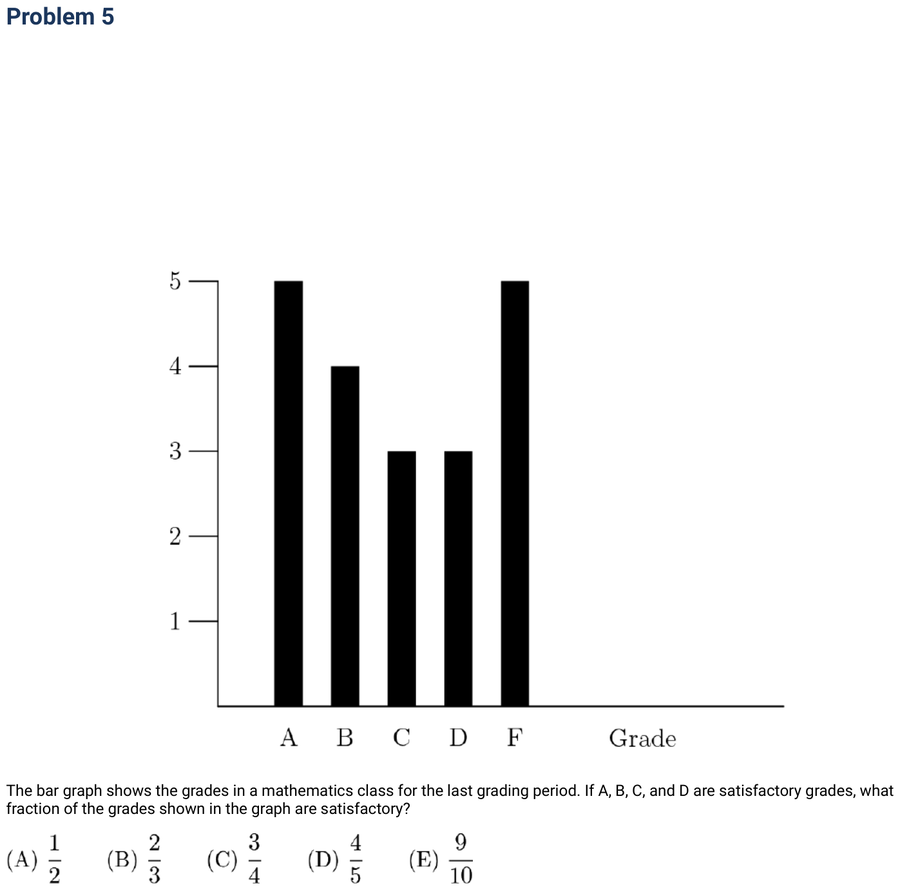
Fractions, Decimals & Percents read-bar-chart
ajhsme-1985-05
Show hint
Add the A, B, C, D bars to get the satisfactory count; total includes F as well.
Show solution
  1. Satisfactory: A + B + C + D = 5 + 4 + 3 + 3 = 15. Total including F (= 5) is 20.
  2. Fraction = 15 ⁄ 20 = 3⁄4.
C 3⁄4.
Mark: · log in to save
Problem 6 · 1985 AJHSME Medium
Ratios, Rates & Proportions sheets-per-cm

A stack of paper containing 500 sheets is 5 cm thick. Approximately how many sheets of this type of paper would there be in a stack 7.5 cm high?

Show hint
100 sheets per cm.
Show solution
  1. 500 sheets in 5 cm = 100 sheets/cm. In 7.5 cm: 100 × 7.5.
  2. = 750 sheets.
D 750.
Mark: · log in to save
Problem 7 · 1985 AJHSME Medium
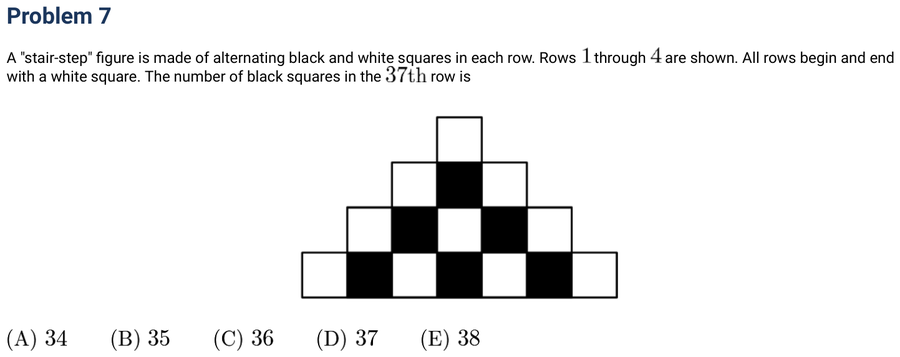
Algebra & Patterns pattern-by-row
ajhsme-1985-07
Show hint (soft nudge)
In row n the row has 2n − 1 squares; counting whites first, blacks are one fewer.
Show hint (sharpest)
Row n: n whites and (n − 1) blacks.
Show solution
  1. Row 1: 1 white, 0 black. Row 2: W B W (2 white, 1 black). Row n: n whites and (n − 1) blacks.
  2. Row 37: 37 − 1 = 36 black squares.
C 36.
Mark: · log in to save
Problem 8 · 1985 AJHSME Medium
Arithmetic & Operations substitute-and-compare

If a = −2, the largest number in the set −3a, 4a, 24⁄a, a², 1 is

Show hint
Substitute a = −2 in each expression and compare.
Show solution
  1. −3(−2) = 6, 4(−2) = −8, 24⁄(−2) = −12, (−2)² = 4, 1.
  2. The largest is 6 = −3a.
A −3a.
Mark: · log in to save
Problem 9 · 1985 AJHSME Medium
Fractions, Decimals & Percents telescoping-product

The product of the 9 factors (1 − 1⁄2)(1 − 1⁄3)(1 − 1⁄4) ⋯ (1 − 1⁄10) =

Show hint (soft nudge)
Rewrite each factor as (n − 1)⁄n, then watch what telescopes.
Show hint (sharpest)
Each numerator matches the previous denominator.
Show solution
  1. (1⁄2)(2⁄3)(3⁄4) ⋯ (9⁄10). All middle factors cancel, leaving 1⁄10.
  2. = 1⁄10.
A 1⁄10.
Mark: · log in to save
Problem 10 · 1985 AJHSME Medium
Fractions, Decimals & Percents average-two-fractions

The fraction halfway between 1⁄5 and 1⁄3 (on the number line) is

Show hint
The midpoint is the average — add and halve.
Show solution
  1. 1⁄5 + 1⁄3 = 3⁄15 + 5⁄15 = 8⁄15. Halve: 8⁄30 = 4⁄15.
C 4⁄15.
Mark: · log in to save
Problem 11 · 1985 AJHSME Hard
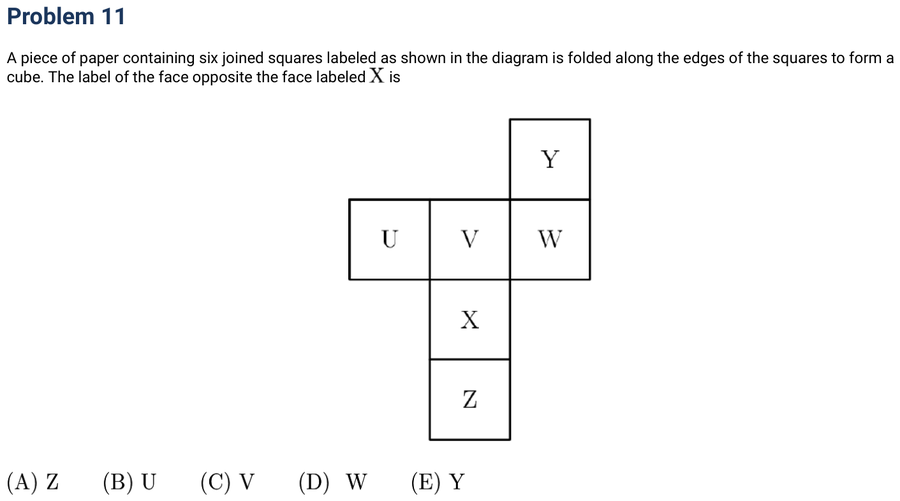
Geometry & Measurement cube-net opposite-faces
ajhsme-1985-11
Show hint (soft nudge)
With V as the front face, fold the four neighbors of V into the four sides.
Show hint (sharpest)
Y sits across the strip from X, so they end up on opposite faces.
Show solution
  1. Make V the front. U folds left, W folds right, X folds down to become the bottom, Z (below X) wraps around to become the back. That puts Y (the square attached to W's top) onto the top.
  2. Top ↔ bottom means Y is opposite X.
E Y.
Mark: · log in to save
Problem 12 · 1985 AJHSME Hard
Geometry & Measurement equal-perimeter square-area

A square and a triangle have equal perimeters. The lengths of the three sides of the triangle are 6.2 cm, 8.3 cm, and 9.5 cm. The area of the square is

Show hint
Triangle perimeter ÷ 4 = square side.
Show solution
  1. Triangle perimeter = 6.2 + 8.3 + 9.5 = 24, so square side = 24 ⁄ 4 = 6.
  2. Area = 6² = 36 cm².
B 36 cm².
Mark: · log in to save
Problem 13 · 1985 AJHSME Hard
Ratios, Rates & Proportions distance-rate-time

If you walk for 45 minutes at a rate of 4 mph and then run for 30 minutes at a rate of 10 mph, how many miles will you have gone at the end of one hour and 15 minutes?

Show hint
Convert each leg's minutes into a fraction of an hour, then multiply by the speed.
Show solution
  1. Walk: 4 × (45⁄60) = 3 miles. Run: 10 × (30⁄60) = 5 miles.
  2. Total = 3 + 5 = 8 miles.
B 8 miles.
Mark: · log in to save
Problem 14 · 1985 AJHSME Hard
Fractions, Decimals & Percents percent-of-fixed-amount

The difference between a 6.5% sales tax and a 6% sales tax on an item priced at $20 before tax is

Show hint
The difference is just 0.5% of $20.
Show solution
  1. 0.5% × $20 = 0.005 × 20.
  2. = $0.10.
B $.10.
Mark: · log in to save
Problem 15 · 1985 AJHSME Hard
Counting & Probability complement-counting digits

How many whole numbers between 100 and 400 contain the digit 2?

Show hint (soft nudge)
Count those that DON'T contain 2 and subtract from the total.
Show hint (sharpest)
Hundreds digit: 1 or 3 (2 choices). Tens, units: 9 choices each (any digit except 2).
Show solution
  1. From 100 to 399 there are 300 whole numbers. With no 2: 2 (hundreds) × 9 (tens) × 9 (units) = 162.
  2. 300 − 162 = 138.
C 138.
Mark: · log in to save
Problem 16 · 1985 AJHSME Hard
Ratios, Rates & Proportions ratio-parts

The ratio of boys to girls in Mr. Brown's math class is 2 : 3. If there are 30 students in the class, how many more girls than boys are in the class?

Show hint (soft nudge)
2 + 3 = 5 parts; each part holds 30⁄5 = 6 students.
Show hint (sharpest)
Difference of parts = 1 × (size of one part).
Show solution
  1. Each part = 30⁄5 = 6. Girls have one more part than boys.
  2. Extra girls = 1 × 6 = 6.
D 6.
Mark: · log in to save
Problem 17 · 1985 AJHSME Hard
Ratios, Rates & Proportions total-difference

If your average score on your first six mathematics tests was 84 and your average score on your first seven mathematics tests was 85, then your score on the seventh test was

Show hint
Convert each average to a sum, then subtract.
Show solution
  1. Total of first 7 = 7 × 85 = 595. Total of first 6 = 6 × 84 = 504. Seventh test = 595 − 504.
  2. = 91.
D 91.
Mark: · log in to save
Problem 18 · 1985 AJHSME Hard
Algebra & Patterns interval-from-inequalities

Nine copies of a certain pamphlet cost less than $10.00 while ten copies of the same pamphlet (at the same price) cost more than $11.00. How much does one copy of this pamphlet cost?

Show hint (soft nudge)
9p < 10 and 10p > 11 give a narrow interval for p.
Show hint (sharpest)
10⁄9 ≈ 1.111 and 11⁄10 = 1.10.
Show solution
  1. 9p < 10 → p < 10⁄9 ≈ 1.111. 10p > 11 → p > 1.10. So 1.10 < p < 1.111.
  2. Only choice in range: $1.11.
E $1.11.
Mark: · log in to save
Problem 19 · 1985 AJHSME Hard
Geometry & Measurement perimeter-scaling

If the length and width of a rectangle are each increased by 10%, then the perimeter of the rectangle is increased by

Show hint
Perimeter is linear in both sides — scale each by 1.10.
Show solution
  1. New perimeter = 2(1.10L + 1.10W) = 1.10 × 2(L + W).
  2. So the perimeter is multiplied by 1.10 — an increase of 10%.
B 10%.
Mark: · log in to save
Problem 20 · 1985 AJHSME Hard
Number Theory 31-day-month weekday-frequency

In a certain year, January had exactly four Tuesdays and four Saturdays. On what day did January 1 fall that year?

Show hint (soft nudge)
31 days = 4 weeks + 3 days. Three weekdays appear 5 times, the other four appear 4 times.
Show hint (sharpest)
For Tuesday and Saturday both to land at 4 times, neither can be among the first 3 days of the month.
Show solution
  1. The three weekdays starting on Jan 1 each appear 5 times in a 31-day January. For Tue and Sat both to appear only 4 times, neither can be in those first three weekdays.
  2. Only starting on Wednesday (Wed, Thu, Fri) leaves both Tue and Sat out of that group.
C Wednesday.
Mark: · log in to save
Problem 21 · 1985 AJHSME Stretch
Fractions, Decimals & Percents compound-percent

Mr. Green receives a 10% raise every year. His salary after four such raises has gone up by what percent?

Show hint (soft nudge)
Each year multiplies by 1.10 — apply that four times.
Show hint (sharpest)
1.10⁴ is more than just 1 + 4(0.10) = 1.40 because compounding earns interest on interest.
Show solution
  1. (1.10)⁴ = 1.4641 — that's about 46.4% above the original.
  2. Greater than 45%, so the answer is more than 45%.
E more than 45%.
Mark: · log in to save
Problem 22 · 1985 AJHSME Stretch
Counting & Probability restricted-count-ratio

Assume every 7-digit whole number is a possible telephone number except those that begin with 0 or 1. What fraction of telephone numbers begin with 9 and end with 0?

Show hint (soft nudge)
Count valid telephone numbers and those starting with 9 ending in 0, then take the ratio.
Show hint (sharpest)
Valid first digit: 8 choices. Last digit fixed: 1 choice. Middle five: 10 choices each.
Show solution
  1. Total: 8 · 10⁶. Starting with 9 and ending in 0: 1 · 10⁵ · 1 = 10⁵.
  2. Ratio = 10⁵ ⁄ (8 · 10⁶) = 1⁄80.
B 1⁄80.
Mark: · log in to save
Problem 23 · 1985 AJHSME Stretch
Ratios, Rates & Proportions double-counting

King Middle School has 1200 students. Each pupil takes 5 classes a day. Each teacher teaches 4 classes. Each class has 30 students and 1 teacher. How many teachers are there at King Middle School?

Show hint (soft nudge)
Count student-class slots two ways.
Show hint (sharpest)
1200 students × 5 classes = total student-class slots; that also equals (# classes) × 30.
Show solution
  1. Student-class slots: 1200 × 5 = 6000. Each class holds 30 students, so # classes = 6000 ⁄ 30 = 200.
  2. Each teacher teaches 4 classes → teachers = 200 ⁄ 4 = 50.
E 50.
Mark: · log in to save
Problem 24 · 1985 AJHSME Stretch
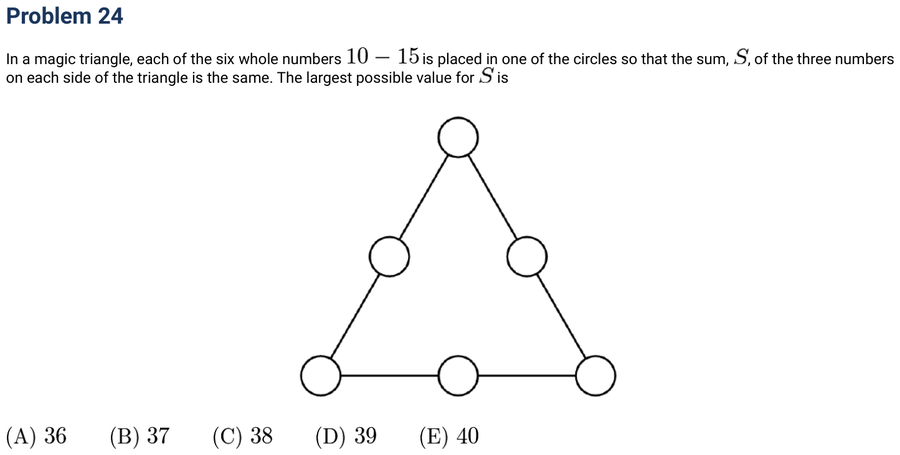
Algebra & Patterns double-count-vertices
ajhsme-1985-24
Show hint (soft nudge)
Add the three side-sums: each vertex is counted twice, each midpoint once.
Show hint (sharpest)
3S = 2·(vertex sum) + (midpoint sum) = (vertex sum) + 75.
Show solution
  1. Total of all 6 numbers 10 + 11 + ⋯ + 15 = 75. Adding the three side-sums gives each vertex twice and each midpoint once, so 3S = (vertex sum) + 75. Maximize by putting the three biggest at the vertices: 13 + 14 + 15 = 42.
  2. 3S = 42 + 75 = 117 → S = 39 (with midpoints 12, 10, 11 between the matching vertex pairs).
D 39.
Mark: · log in to save
Problem 25 · 1985 AJHSME Stretch
Logic & Word Problems contrapositive find-counterexample
ajhsme-1985-25
Show hint (soft nudge)
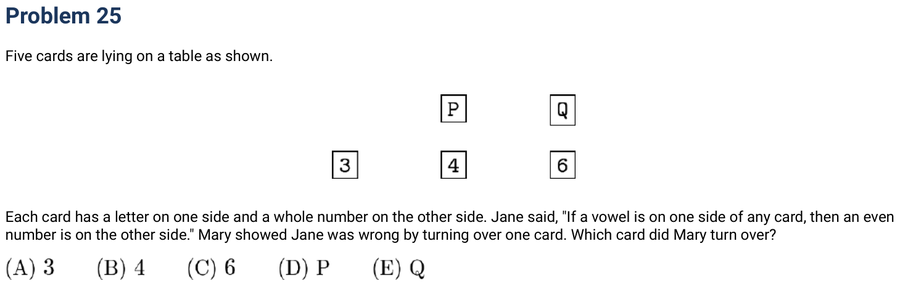
The claim is "vowel → even". A counterexample needs a vowel paired with an odd number.
Show hint (sharpest)
Turning over a card with a consonant or an even number can never disprove the claim — focus on the odd-numbered cards.
Show solution
  1. To find a vowel paired with an odd number, check the odd cards (only one is showing). If 3's reverse is a vowel, the claim is false.
  2. So Mary turned over 3.
A 3.
Mark: · log in to save