25 random problems — one per position, pulled from random authored years. Hints and solutions are locked until you submit. Retake as often as you want — every attempt is saved to your test history (if you're logged in).
650 students were surveyed about their pasta preferences. The choices were lasagna, manicotti, ravioli and spaghetti. The results of the survey are displayed in the bar graph. What is the ratio of the number of students who preferred spaghetti to the number of students who preferred manicotti?
How many integers between 2020 and 2400 have four distinct digits arranged in increasing order? (For example, 2347 is one integer.)
Show hint (soft nudge)
Pin down the leading digits first. The thousands digit is forced; the hundreds digit has only one valid value.
Show hint (sharpest)
First digit = 2. For the digits to be increasing and the number ≤ 2400, the second digit must be 3 (since it must exceed 2 and be ≤ 3). Then the last two digits are any two distinct digits from {4,5,6,7,8,9}.
Show solution
Digits must be increasing, so they're strictly ascending. First digit = 2 (number is between 2020 and 2400). Second digit must be > 2 and ≤ 3 (else the number exceeds 2400): second digit = 3.
Last two digits: any 2 distinct values from {4, 5, 6, 7, 8, 9}, arranged in increasing order. That's C(6, 2) = 15.
Six pepperoni circles will exactly fit across the diameter of a 12-inch pizza when placed. If a total of 24 circles of pepperoni are placed on this pizza without overlap, what fraction of the pizza is covered by pepperoni?
Show hint
Each pepperoni has diameter 12/6 = 2, so its area is π, compared to the pizza's 36π. Each pepperoni is 1/36 of the pizza.
Show solution
Pepperoni radius: 1. Pizza radius: 6. Area ratio: (1/6)2 = 1/36 per pepperoni.
In the small country of Mathland, all automobile license plates have four symbols. The first must be a vowel (A, E, I, O, or U), the second and third must be two different letters among the 21 non-vowels, and the fourth must be a digit (0 through 9). If the symbols are chosen at random subject to these conditions, what is the probability that the plate will read "AMC8"?
Show hint (soft nudge)
Count the total number of allowed plates by multiplying choices for each slot. The probability of AMC8 is 1 over that total.
The ratio of the number of games won to the number of games lost (no ties) by the Middle School Middies is 114. To the nearest whole percent, what percent of its games did the team lose?
Show hint (soft nudge)
Turn the ratio into parts: 11 won and 4 lost make 15 games in all.
Show hint (sharpest)
The lost fraction is 4 out of 15.
Show solution
Treat the ratio as 11 wins and 4 losses, so 15 games total.
How many subsets of two elements can be removed from the set {1, 2, 3, 4, 5, 6, 7, 8, 9, 10, 11} so that the mean (average) of the remaining numbers is 6?
Show hint (soft nudge)
Original sum is 1 + 2 + ... + 11 = 66. After removing 2 elements, 9 remain with mean 6, so the remaining sum is 54.
Show hint (sharpest)
The removed pair must sum to 66 − 54 = 12. Count two-element subsets of {1, ..., 11} with sum 12.
Show solution
Sum of 1 through 11 is 66. After removing 2 numbers, 9 remain; mean 6 means remaining sum is 9 × 6 = 54.
So the removed pair sums to 66 − 54 = 12.
Pairs from {1, …, 11} summing to 12: {1,11}, {2,10}, {3,9}, {4,8}, {5,7}. That is 5 pairs.
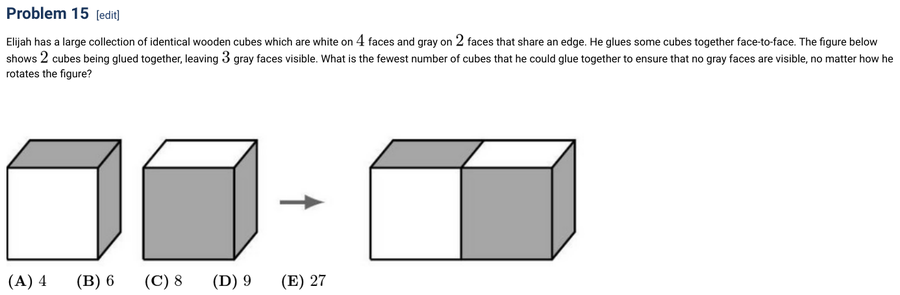
A cube's two shaded faces share an edge, so both must be glued to neighbors to hide them.
Show hint (sharpest)
Look for an arrangement where every cube has two glued faces that meet at an edge.
Show solution
To hide a cube's two shaded faces — which meet at an edge — it must be glued to neighbors on two faces sharing an edge.
Four cubes arranged in a 2 × 2 square give each cube exactly two such adjacent glued faces; with three or fewer, some cube has only one glued face (or two opposite ones), so a shaded face shows.
Each of the digits 0, 1, 2, 3, 4, 5, 6, 7, 8, and 9 is used only once to make two five-digit numbers so that they have the largest possible sum. Which of the following could be one of the numbers?
Show hint
Higher place values dominate. To maximize the sum, put the two biggest digits in the ten-thousands place (one each), the next two in the thousands place, etc.
Show solution
Pair digits by descending size for each place: {9, 8}, {7, 6}, {5, 4}, {3, 2}, {1, 0}.
Each number gets one from each pair. So the digits of each number (left to right) come from {9, 8}, {7, 6}, {5, 4}, {3, 2}, {1, 0}.
Only 87431 matches: 8∈{9,8}, 7∈{7,6}, 4∈{5,4}, 3∈{3,2}, 1∈{1,0}. ✓
Cookies for a Crowd. The recipe makes a pan of 15 cookies, and only full recipes are made. Normally 108 students each eat 2 cookies, but a concert cuts attendance by 25%. How many recipes should Walter and Gretel make for the smaller party?
Show hint (soft nudge)
A 25% drop leaves three-fourths of the 108 students.
Show hint (sharpest)
Find their cookies, then round up to whole pans of 15.
Show solution
Three-fourths of 108 is 81 students, eating 81 × 2 = 162 cookies.
A whole number larger than 2 leaves a remainder of 2 when divided by each of the numbers 3, 4, 5, and 6. The smallest such number lies between which two numbers?
A list of 8 numbers is formed by beginning with two given numbers. Each new number in the list is the product of the two previous numbers. Find the first number if the last three numbers are 16, 64, 1024.
Show hint (soft nudge)
Each term is the product of the two before it, so divide to step backward.
Show hint (sharpest)
From 16, 64, 1024 work back: the term before 16 is 64 ÷ 16, and so on.
Show solution
Since 1024 = 16 · 64, the term before 16 is 64 ÷ 16 = 4, then 16 ÷ 4 = 4, then 4 ÷ 4 = 1, then 4 ÷ 1 = 4, and finally 1 ÷ 4 = 1/4.
On a twenty-question test, each correct answer is worth 5 points, each unanswered question is worth 1 point, and each incorrect answer is worth 0 points. Which of the following scores is NOT possible?
Show hint (soft nudge)
Start from the top: what's the maximum score, and the next one just below it?
Show hint (sharpest)
There's a gap right under the maximum that no score can land in.
Show solution
All 20 correct scores 20 × 5 = 100. The next-best is 19 correct plus 1 unanswered: 95 + 1 = 96.
So 97, 98, 99 are unreachable — 97 is the impossible score (90, 91, 92, 95 are all attainable).
A bag contains four pieces of paper, each labeled with one of the digits 1, 2, 3, or 4, with no repeats. Three of these pieces are drawn, one at a time without replacement, to construct a three-digit number. What is the probability that the three-digit number is a multiple of 3?
Show hint
Divisible by 3 iff digit-sum divisible by 3. The chosen 3 digits' sum is what matters; the order is irrelevant for divisibility.
Show solution
Subsets of size 3 from {1, 2, 3, 4}: 4 total ({1,2,3}, {1,2,4}, {1,3,4}, {2,3,4}).
Digit sums: 6 ✓, 7, 8, 9 ✓ ⇒ 2 subsets give a multiple of 3.
Three generous friends redistribute their money as follows: Amy gives Jan and Toy enough to double each of their amounts; then Jan gives Amy and Toy enough to double theirs; finally Toy gives Amy and Jan enough to double theirs. Toy had $36 at the beginning and $36 at the end. What is the total amount the three friends have?
Show hint (soft nudge)
The total never changes — you only need to find it at one moment.
Show hint (sharpest)
Toy's money doubles in the first two rounds, so track it up to just before his own turn.
Show solution
Toy's $36 doubles in each of the first two rounds: 36 → 72 → 144 just before his turn.
He ends with $36, so he gave away 144 − 36 = 108, which exactly doubled Amy and Jan — meaning they held $108 then.
The total, unchanged throughout, is 144 + 108 = $252.