AJHSME · Test Mode

1986 AJHSME

Test mode — hints and solutions are locked. Pick an answer for each, then submit at the bottom to see your score.

← Exit test mode No hints or solutions until you submit.
Problem 1 · 1986 AJHSME Easy
Ratios, Rates & Proportions per-unit

In July 1861, 366 inches of rain fell in Cherrapunji, India. What was the average rainfall in inches per hour during that month?

Show hint (soft nudge)
Hours in July = 31 days × 24 hours/day.
Show hint (sharpest)
Average per hour = total ÷ hours.
Show solution
  1. July has 31 × 24 hours, so the per-hour average is total inches divided by total hours.
  2. = 366 ⁄ (31 × 24).
A 366 ⁄ (31 × 24).
Mark: · log in to save
Problem 2 · 1986 AJHSME Easy
Fractions, Decimals & Percents reciprocal-monotonicity

Which of the following numbers has the largest reciprocal?

Show hint
Smaller positive number ↔ larger reciprocal.
Show solution
  1. Among positives, the reciprocal is largest for the smallest number.
  2. 1⁄3 is the smallest of the choices, so its reciprocal (3) is largest.
A 1⁄3.
Mark: · log in to save
Problem 3 · 1986 AJHSME Easy
Arithmetic & Operations pick-smallest

The smallest sum one could get by adding three different numbers from the set {7, 25, −1, 12, −3} is

Show hint
Pick the three smallest numbers in the set.
Show solution
  1. The three smallest are −3, −1, and 7.
  2. Their sum: −3 + (−1) + 7 = 3.
C 3.
Mark: · log in to save
Problem 4 · 1986 AJHSME Easy
Arithmetic & Operations round-and-multiply

The product (1.8)(40.3 + .07) is closest to

Show hint
The small .07 barely changes the sum; round 40.37 ≈ 40.
Show solution
  1. 1.8 × 40.37 ≈ 1.8 × 40 = 72.
  2. Closest of the choices is 74.
C 74.
Mark: · log in to save
Problem 5 · 1986 AJHSME Easy
Number Theory time-arithmetic

A contest began at noon one day and ended 1000 minutes later. At what time did the contest end?

Show hint (soft nudge)
Convert 1000 minutes to hours and minutes.
Show hint (sharpest)
1000 = 16·60 + 40.
Show solution
  1. 1000 minutes = 16 hours 40 minutes.
  2. Noon + 16 h 40 m = 4:40 a.m. (the next day).
D 4:40 a.m.
Mark: · log in to save
Problem 6 · 1986 AJHSME Medium
Fractions, Decimals & Percents simplify-complex-fraction

2 ⁄ (1 − 2⁄3) =

Show hint (soft nudge)
Simplify the denominator first.
Show hint (sharpest)
1 − 2⁄3 = 1⁄3.
Show solution
  1. Denominator: 1 − 2⁄3 = 1⁄3.
  2. 2 ÷ 1⁄3 = 2 × 3 = 6.
E 6.
Mark: · log in to save
Problem 7 · 1986 AJHSME Medium
Number Theory bound-square-roots

How many whole numbers are between √8 and √80?

Show hint (soft nudge)
√8 sits between 2 and 3; √80 sits between 8 and 9.
Show hint (sharpest)
Count the integers strictly between.
Show solution
  1. 4 < 8 < 9, so 2 < √8 < 3. 64 < 80 < 81, so 8 < √80 < 9.
  2. Whole numbers strictly between √8 and √80 are 3, 4, 5, 6, 7, 8 — that's 6.
B 6.
Mark: · log in to save
Problem 8 · 1986 AJHSME Medium
Number Theory ones-digit guess-and-check
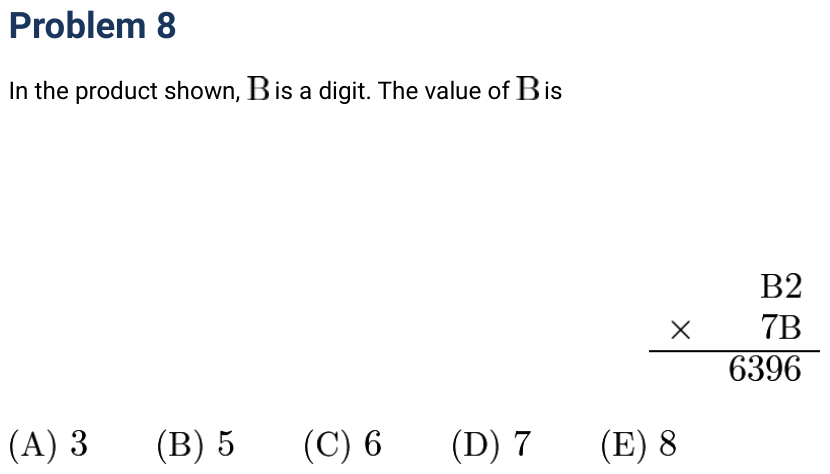
ajhsme-1986-08
Show hint (soft nudge)
The ones digit of the product is 2 · B, which must end in 6.
Show hint (sharpest)
Then check that B2 × 7B actually equals 6396.
Show solution
  1. Product ends in 6, and 2 × B ends in 6 only for B = 3 or B = 8.
  2. Test: 82 × 78 = 6396. ✓ So B = 8.
E 8.
Mark: · log in to save
Problem 9 · 1986 AJHSME Medium
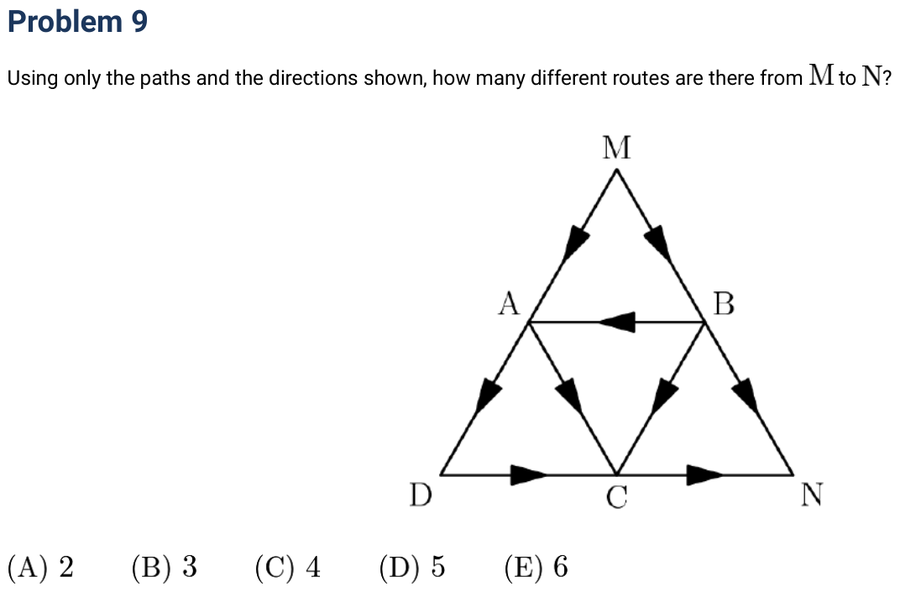
Counting & Probability count-paths directed-graph
ajhsme-1986-09
Show hint (soft nudge)
Trace each path from M to N, following arrow directions only.
Show hint (sharpest)
From each split, enumerate where you can go next.
Show solution
  1. Following the arrows carefully and listing each distinct path from M to N gives 6 routes.
  2. Answer: 6.
E 6.
Mark: · log in to save
Problem 10 · 1986 AJHSME Medium
Geometry & Measurement centering

A picture 3 feet across is hung in the center of a wall that is 19 feet wide. How many feet from the end of the wall is the nearest edge of the picture?

Show hint
The leftover wall is split evenly on both sides of the picture.
Show solution
  1. Leftover wall = 19 − 3 = 16 feet, split into two equal margins.
  2. Each margin = 16 ⁄ 2 = 8 feet.
B 8.
Mark: · log in to save
Problem 11 · 1986 AJHSME Hard
Algebra & Patterns custom-operation

If A ✶ B means (A + B) ⁄ 2, then (3 ✶ 5) ✶ 8 is

Show hint (soft nudge)
Apply the inner operation first, then the outer.
Show hint (sharpest)
3 ✶ 5 is the average of 3 and 5.
Show solution
  1. 3 ✶ 5 = (3 + 5)⁄2 = 4. Then 4 ✶ 8 = (4 + 8)⁄2 = 6.
  2. = 6.
A 6.
Mark: · log in to save
Problem 12 · 1986 AJHSME Hard
Fractions, Decimals & Percents diagonal-sum
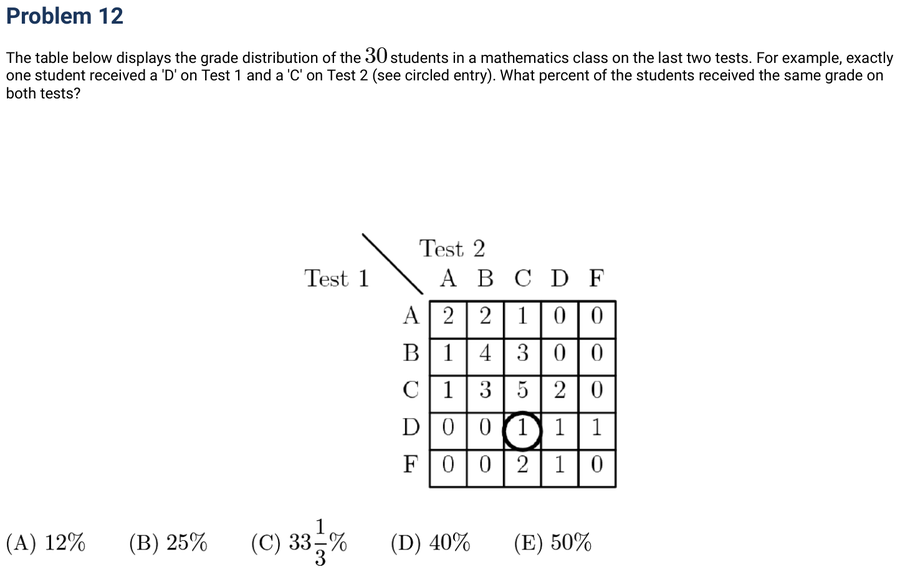
ajhsme-1986-12
Show hint (soft nudge)
Students with the same grade on both tests sit on the table's diagonal (A-A, B-B, …).
Show hint (sharpest)
Add those five diagonal cells, then divide by 30.
Show solution
  1. Diagonal: 2 (A-A) + 4 (B-B) + 5 (C-C) + 1 (D-D) + 0 (F-F) = 12.
  2. 12 ⁄ 30 = 40%.
D 40%.
Mark: · log in to save
Problem 13 · 1986 AJHSME Hard
Geometry & Measurement perimeter-equals-bounding-box
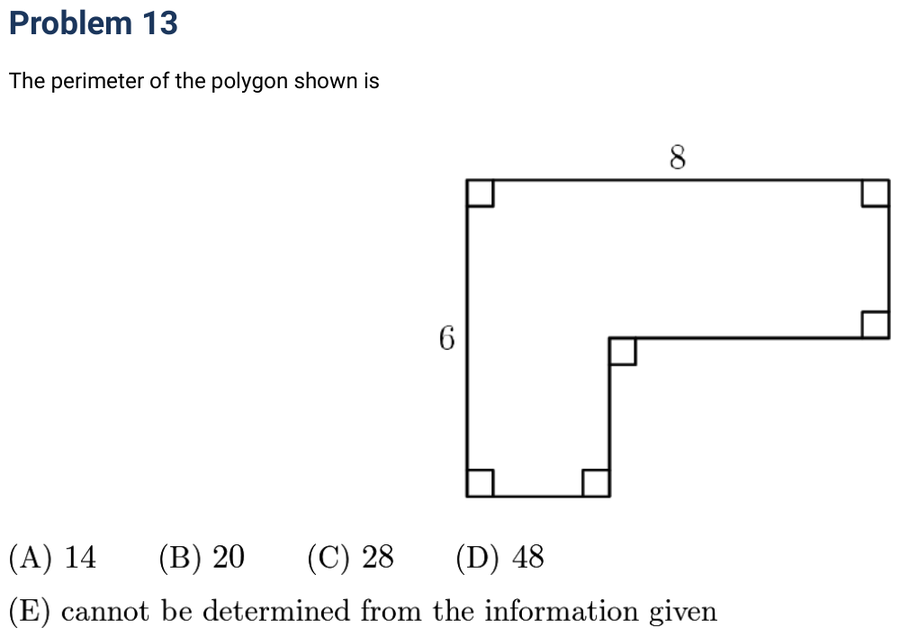
ajhsme-1986-13
Show hint (soft nudge)
The inner step has matching horizontal and vertical pieces that line up with the outer corners — so the perimeter equals that of the bounding rectangle.
Show hint (sharpest)
Bounding rectangle: 8 wide, 6 tall.
Show solution
  1. Slide each piece of the inward step to the matching outer edge: the horizontal step segment fits onto the top edge, the vertical step segment onto the right edge.
  2. Perimeter = 2(8 + 6) = 28.
C 28.
Mark: · log in to save
Problem 14 · 1986 AJHSME Hard
Fractions, Decimals & Percents maximize-fraction

If 200 ≤ a ≤ 400 and 600 ≤ b ≤ 1200, then the largest value of the quotient b ⁄ a is

Show hint
Maximize a fraction by maximizing the numerator and minimizing the denominator.
Show solution
  1. Take b = 1200 (the maximum) and a = 200 (the minimum).
  2. b ⁄ a = 1200 ⁄ 200 = 6.
C 6.
Mark: · log in to save
Problem 15 · 1986 AJHSME Hard
Fractions, Decimals & Percents multiply-discount-factors

Sale prices at the Ajax Outlet Store are 50% below original prices. On Saturdays an additional discount of 20% off the sale price is given. What is the Saturday price of a coat whose original price is $180?

Show hint
Apply each discount as a multiplier: 0.5 then 0.8.
Show solution
  1. Sale price = $180 × 0.5 = $90. Saturday price = $90 × 0.8.
  2. = $72.
B $72.
Mark: · log in to save
Problem 16 · 1986 AJHSME Hard
Fractions, Decimals & Percents percent-of-total
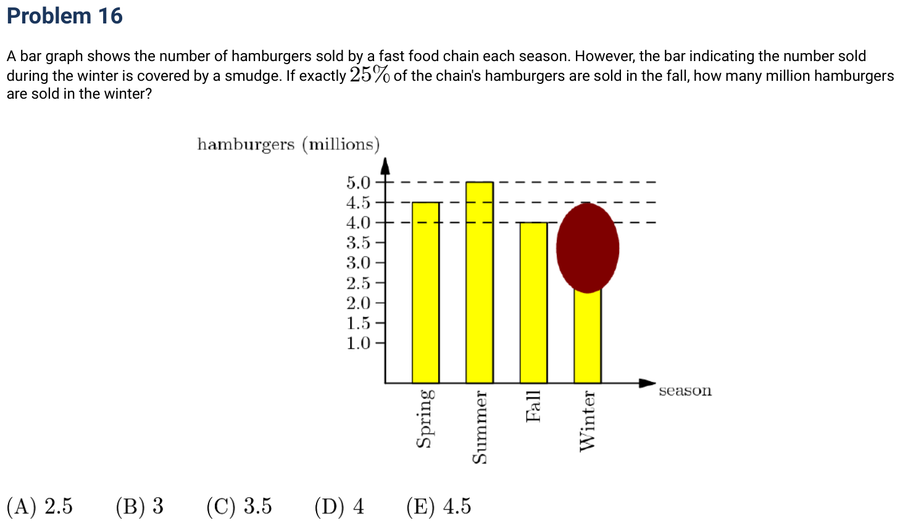
ajhsme-1986-16
Show hint (soft nudge)
Fall = 25% of total means total = 4 × Fall.
Show hint (sharpest)
Read Spring, Summer, Fall from the graph and subtract from total.
Show solution
  1. Fall ≈ 4 million, and fall is 25%, so total = 4 × 4 = 16 million. Spring ≈ 4.5, Summer ≈ 5.
  2. Winter = 16 − 4.5 − 5 − 4 = 2.5 million.
A 2.5.
Mark: · log in to save
Problem 17 · 1986 AJHSME Hard
Number Theory factor-out parity-of-product

Let o be an odd whole number and let n be any whole number. Which of the following statements about the whole number (o² + no) is always true?

Show hint (soft nudge)
Factor: o² + no = o(o + n).
Show hint (sharpest)
o is odd, so the product is odd iff (o + n) is odd, which means n is even.
Show solution
  1. o(o + n) is odd ⇔ both factors odd. o is already odd, so the product is odd iff o + n is odd, i.e. iff n is even.
  2. So the expression is odd only if n is even — answer E.
E it is odd only if n is even.
Mark: · log in to save
Problem 18 · 1986 AJHSME Hard
Counting & Probability posts-on-path
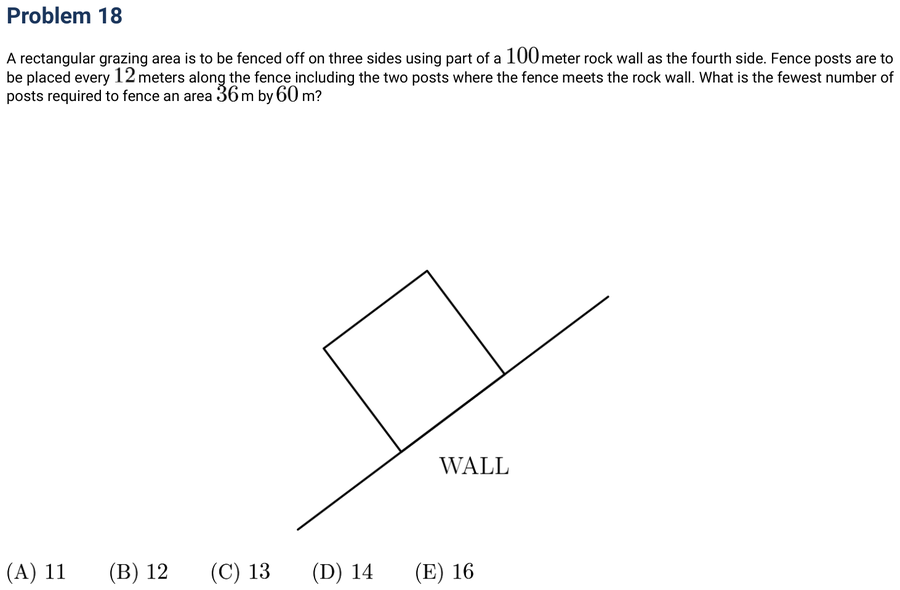
ajhsme-1986-18
Show hint (soft nudge)
Place the long 60 m side against the wall so the fence runs 36 + 60 + 36 = 132 m.
Show hint (sharpest)
Posts every 12 m on a 132 m path including both ends = 132⁄12 + 1.
Show solution
  1. With the 60 m side along the wall, the fence has length 36 + 60 + 36 = 132 m. Posts every 12 m including both endpoints give 132⁄12 + 1 = 12 posts; the corners (at 36 m and 96 m) are multiples of 12, so no extras.
  2. Fewest = 12 posts.
B 12.
Mark: · log in to save
Problem 19 · 1986 AJHSME Hard
Ratios, Rates & Proportions miles-per-gallon gas-used-only

At the beginning of a trip, the mileage odometer read 56,200 miles. The driver filled the gas tank with 6 gallons of gasoline. During the trip, the driver filled his tank again with 12 gallons of gasoline when the odometer read 56,560. At the end of the trip, the driver filled his tank again with 20 gallons of gasoline. The odometer read 57,060. To the nearest tenth, what was the car's average miles-per-gallon for the entire trip?

Show hint (soft nudge)
The first 6-gallon fill-up only tops off the tank — gas used during the trip is what was refilled afterwards.
Show hint (sharpest)
Miles ÷ gallons used.
Show solution
  1. Miles driven = 57,060 − 56,200 = 860. Gas used (the two refills) = 12 + 20 = 32.
  2. MPG = 860 ⁄ 32 ≈ 26.9.
D 26.9.
Mark: · log in to save
Problem 20 · 1986 AJHSME Hard
Fractions, Decimals & Percents round-then-estimate

The value of the expression (304)⁵ ⁄ ((29.7)(399)⁴) is closest to

Show hint (soft nudge)
Round 304 ≈ 300, 399 ≈ 400, 29.7 ≈ 30.
Show hint (sharpest)
Then (3⁄4)⁴ × 300⁄30 simplifies the powers.
Show solution
  1. Approximate: 300⁵ ⁄ (30 · 400⁴) = (300⁄400)⁴ · 300⁄30 = (3⁄4)⁴ · 10 = (81⁄256) · 10 ≈ 3.16.
  2. Closest choice: 3.
D 3.
Mark: · log in to save
Problem 21 · 1986 AJHSME Stretch
Geometry & Measurement net-of-topless-cube
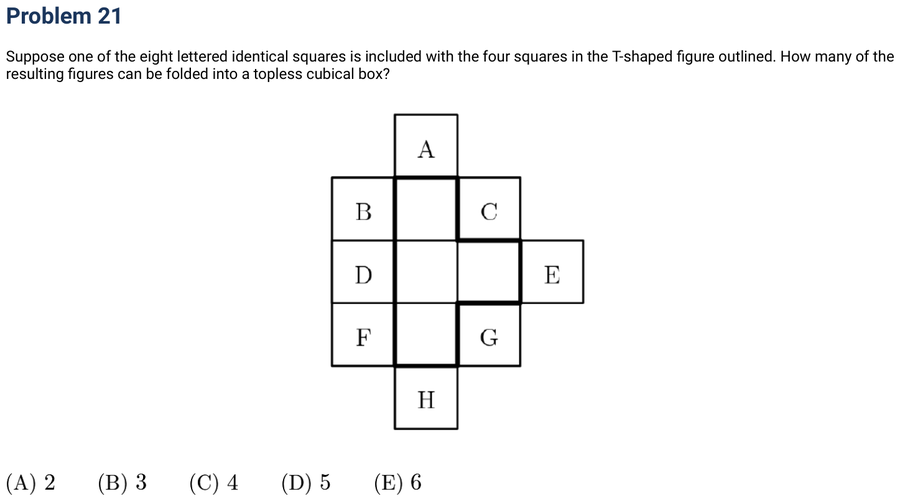
ajhsme-1986-21
Show hint (soft nudge)
A topless cube has 5 faces, so the T plus one lettered square gives the right count.
Show hint (sharpest)
Eliminate the lettered squares that would put two faces on the same side of the resulting box.
Show solution
  1. Each added square turns the T into a 5-square net of a topless cube unless it ends up sharing a face position with another square after folding.
  2. Only 2 of the 8 choices create that overlap, so 6 of the 8 fold into a topless cubical box.
E 6.
Mark: · log in to save
Problem 22 · 1986 AJHSME Stretch
Logic & Word Problems implication-chain

Alan, Beth, Carlos, and Diana were discussing their possible grades in mathematics class this grading period. Alan said, "If I get an A, then Beth will get an A." Beth said, "If I get an A, then Carlos will get an A." Carlos said, "If I get an A, then Diana will get an A." All of these statements were true, but only two of the students received an A. Which two received A's?

Show hint (soft nudge)
Each statement says: A getting an A forces the next person to get one too.
Show hint (sharpest)
If Alan got an A, the chain would force at least three more A's; same for Beth.
Show solution
  1. Alan's getting an A would force Beth, then Carlos, then Diana — 4 A's, too many. Beth's getting an A would force Carlos and Diana — 3 A's, still too many. So Alan and Beth don't get A's.
  2. If Carlos gets an A, Diana must too — and that's exactly 2 A's: Carlos and Diana.
C Carlos, Diana.
Mark: · log in to save
Problem 23 · 1986 AJHSME Stretch
Geometry & Measurement area-difference half-circles
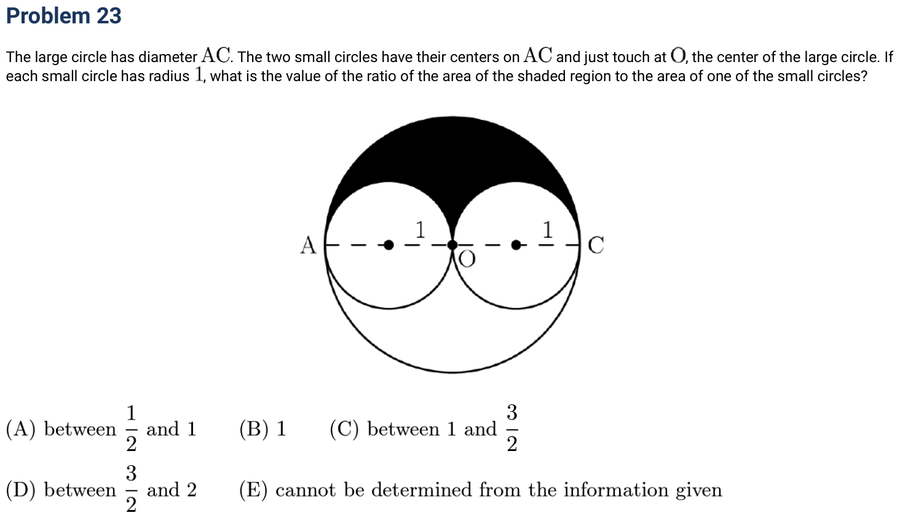
ajhsme-1986-23
Show hint (soft nudge)
Compare the upper half of the big circle to the upper halves of the two small circles.
Show hint (sharpest)
Big radius = 2, small radius = 1.
Show solution
  1. Big radius = 2 (since two small circles of radius 1 fit on AC). Shaded = ½(π · 2²) − 2 · ½(π · 1²) = 2π − π = π.
  2. Ratio to one small circle's area (π · 1² = π) is π ⁄ π = 1.
B 1.
Mark: · log in to save
Problem 24 · 1986 AJHSME Stretch
Counting & Probability fix-one-condition-rest

The 600 students at King Middle School are divided into three groups of equal size for lunch. Each group has lunch at a different time. A computer randomly assigns each student to one of three lunch groups. The probability that three friends, Al, Bob, and Carol, will be assigned to the same lunch group is approximately

Show hint (soft nudge)
Fix Al's group, then ask the chance Bob and Carol each land in the same one.
Show hint (sharpest)
Each independently lands in any group with chance ≈ 1⁄3.
Show solution
  1. Whatever group Al is in, Bob lands there with chance ≈ 1⁄3 and Carol independently with chance ≈ 1⁄3.
  2. Combined: 1⁄3 × 1⁄3 = 1⁄9.
B 1⁄9.
Mark: · log in to save
Problem 25 · 1986 AJHSME Stretch
Number Theory average-of-arithmetic-progression

Which of the following sets of whole numbers has the largest average?

Show hint (soft nudge)
For an arithmetic progression, the average is just (first + last)⁄2.
Show hint (sharpest)
Compare each set's first and last terms.
Show solution
  1. Averages: multiples of 2 → (2 + 100)⁄2 = 51; of 3 → (3 + 99)⁄2 = 51; of 4 → (4 + 100)⁄2 = 52; of 5 → (5 + 100)⁄2 = 52.5; of 6 → (6 + 96)⁄2 = 51.
  2. Largest is 52.5 — multiples of 5.
D multiples of 5 between 1 and 101.
Mark: · log in to save