AJHSME

1987 AJHSME

25 problems — read each, give it a real try, then peek at the hints.

Practice: Take as test →
Problem 1 · 1987 AJHSME Easy
Fractions, Decimals & Percents align-decimals

.4 + .02 + .006 =

Show hint
Line up the decimal points and add column by column.
Show solution
  1. Tenths 4, hundredths 2, thousandths 6.
  2. Sum = .426.
E .426.
Mark: · log in to save
Problem 2 · 1987 AJHSME Easy
Fractions, Decimals & Percents scale-to-power-of-ten

2 ⁄ 25 =

Show hint
Multiply numerator and denominator by 4 to make the denominator 100.
Show solution
  1. 2⁄25 = 8⁄100 = 0.08.
B .08.
Mark: · log in to save
Problem 3 · 1987 AJHSME Easy
Arithmetic & Operations pair-from-ends

2(81 + 83 + 85 + 87 + 89 + 91 + 93 + 95 + 97 + 99) =

Show hint (soft nudge)
Pair the smallest with the largest, next-smallest with next-largest, etc.
Show hint (sharpest)
Each pair sums to the same value.
Show solution
  1. 81 + 99 = 83 + 97 = ⋯ = 180. Five such pairs make 5 × 180 = 900.
  2. Double it: 2 × 900 = 1800.
E 1800.
Mark: · log in to save
Problem 4 · 1987 AJHSME Easy
Fractions, Decimals & Percents quarter-of-circle

Martians measure angles in clerts. There are 500 clerts in a full circle. How many clerts are there in a right angle?

Show hint
A right angle is a quarter of a full circle.
Show solution
  1. 500 ⁄ 4 = 125 clerts.
C 125.
Mark: · log in to save
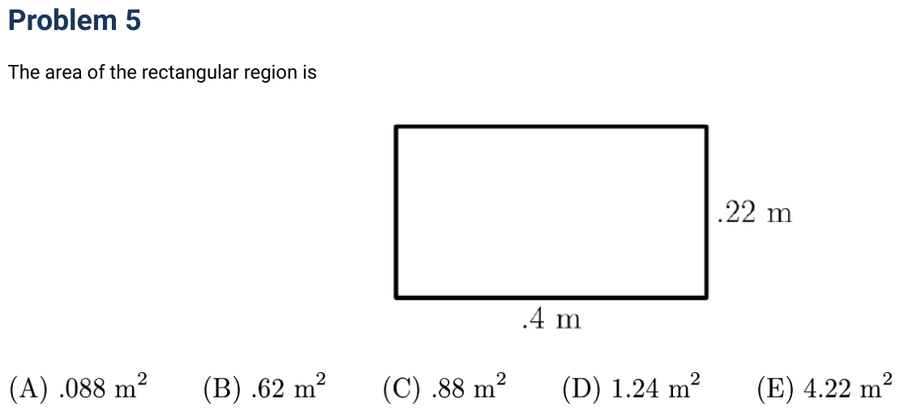
Problem 5 · 1987 AJHSME Easy
Geometry & Measurement rectangle-area-decimals
ajhsme-1987-05
Show hint
Area of a rectangle is length × width.
Show solution
  1. 0.4 × 0.22 = 0.088 m².
A .088 m².
Mark: · log in to save
Problem 6 · 1987 AJHSME Medium
Arithmetic & Operations sign-rules

The smallest product one could obtain by multiplying two numbers in the set {−7, −5, −1, 1, 3} is

Show hint (soft nudge)
A negative product needs one negative factor and one positive factor.
Show hint (sharpest)
Make the magnitudes as big as possible — pair the biggest positive with the biggest-magnitude negative.
Show solution
  1. For the most-negative product, pick the largest positive (3) and the most-negative number (−7).
  2. 3 × (−7) = −21.
B −21.
Mark: · log in to save
Problem 7 · 1987 AJHSME Medium
Geometry & Measurement count-by-sub-cube-class
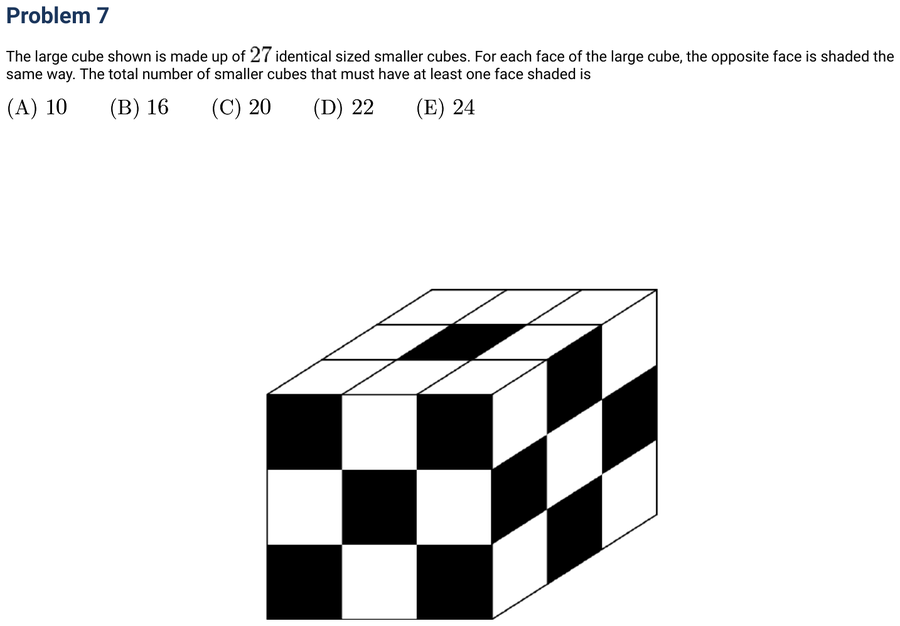
ajhsme-1987-07
Show hint (soft nudge)
Group the 27 small cubes by where they sit: 8 corners, 12 edges, 6 face-centers, 1 internal.
Show hint (sharpest)
On each face, only the very center square sits at a face-center sub-cube — and only those (plus the internal cube) escape being shaded.
Show solution
  1. Each face is shaded everywhere except its center square. So 8 corner sub-cubes and 12 edge sub-cubes each show at least one shaded square; only the 6 face-center sub-cubes and the 1 internal cube show none.
  2. 8 + 12 = 20 small cubes have at least one shaded face.
C 20.
Mark: · log in to save
Problem 8 · 1987 AJHSME Medium
Number Theory bound-the-sum
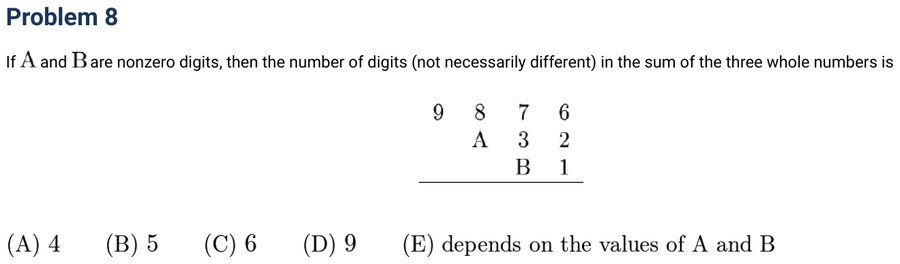
ajhsme-1987-08
Show hint (soft nudge)
Check the smallest and largest possible sums to see whether the digit count can change.
Show hint (sharpest)
Smallest: A = B = 1. Largest: A = B = 9.
Show solution
  1. Smallest: 9876 + 132 + 11 = 10019. Largest: 9876 + 932 + 91 = 10899.
  2. Both have 5 digits, so the sum always does.
B 5.
Mark: · log in to save
Problem 9 · 1987 AJHSME Medium
Number Theory lcm-from-prime-factors

When finding the sum 1⁄2 + 1⁄3 + 1⁄4 + 1⁄5 + 1⁄6 + 1⁄7, the least common denominator used is

Show hint (soft nudge)
Take the highest power of each prime in 2, 3, 4, 5, 6, 7.
Show hint (sharpest)
4 contributes 2², the rest contribute 3, 5, and 7 once.
Show solution
  1. Primes appearing: 2² (from 4), 3, 5, 7.
  2. LCM = 4 × 3 × 5 × 7 = 420.
C 420.
Mark: · log in to save
Problem 10 · 1987 AJHSME Medium
Arithmetic & Operations factor-the-common-term

4(299) + 3(299) + 2(299) + 298 =

Show hint (soft nudge)
Factor 299 from the first three terms.
Show hint (sharpest)
(4 + 3 + 2) × 299 = 9 × 299.
Show solution
  1. (4 + 3 + 2)(299) + 298 = 9 × 299 + 298 = 2691 + 298.
  2. = 2989.
B 2989.
Mark: · log in to save
Problem 11 · 1987 AJHSME Hard
Fractions, Decimals & Percents bound-the-fractional-part

The sum 2 1⁄7 + 3 1⁄2 + 5 1⁄19 is between

Show hint (soft nudge)
Add the whole parts first, then bound the fractions.
Show hint (sharpest)
1⁄7 + 1⁄2 + 1⁄19 — at most 3⁄2, at least 1⁄2.
Show solution
  1. Whole parts: 2 + 3 + 5 = 10. Fractions: 1⁄7 + 1⁄2 + 1⁄19 sits between 1⁄2 and 1 (clearly more than 1⁄2 since one term is already 1⁄2, but less than 1 since 1⁄7 + 1⁄19 < 1⁄2).
  2. Total between 10 + 1⁄2 = 10 1⁄2 and 10 + 1 = 11. Answer B.
B 10 1⁄2 and 11.
Mark: · log in to save
Problem 12 · 1987 AJHSME Hard
Geometry & Measurement fraction-of-rectangle
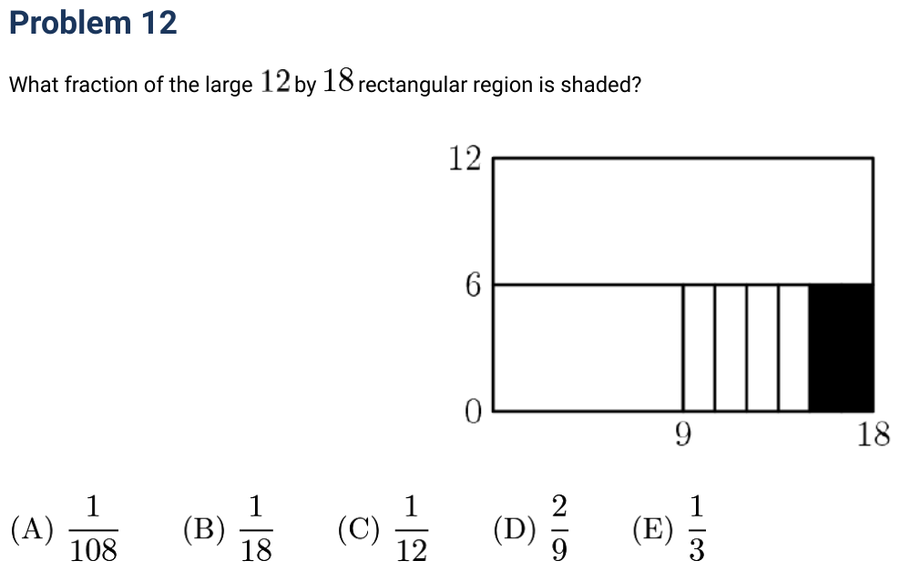
ajhsme-1987-12
Show hint (soft nudge)
Find the area of the shaded rectangle and divide by the area of the whole.
Show hint (sharpest)
Whole area = 12 × 18; the shaded region is 3 × 6.
Show solution
  1. Shaded rectangle is 3 wide × 6 tall = 18. Whole rectangle is 12 × 18 = 216.
  2. Fraction = 18 ⁄ 216 = 1⁄12.
C 1⁄12.
Mark: · log in to save
Problem 13 · 1987 AJHSME Hard
Fractions, Decimals & Percents compare-to-half

Which of the following fractions has the largest value?

Show hint (soft nudge)
Compare each fraction to 1⁄2 — only one exceeds it.
Show hint (sharpest)
a⁄b > 1⁄2 ⇔ 2a > b.
Show solution
  1. Doubling each numerator: 6 < 7, 8 < 9, 34 < 35, 200 < 201, but 302 > 301.
  2. Only 151⁄301 exceeds 1⁄2, so it's the largest.
E 151⁄301.
Mark: · log in to save
Problem 14 · 1987 AJHSME Hard
Ratios, Rates & Proportions unit-conversion

A computer can do 10,000 additions per second. How many additions can it do in one hour?

Show hint
1 hour = 3600 seconds.
Show solution
  1. 10,000 × 3600 = 36,000,000.
  2. = 36 million.
B 36 million.
Mark: · log in to save
Problem 15 · 1987 AJHSME Hard
Algebra & Patterns solve-linear-equation

The sale ad read: "Buy three tires at the regular price and get the fourth tire for three dollars." Sam paid 240 dollars for a set of four tires at the sale. What was the regular price of one tire?

Show hint
Subtract the $3 promo tire first, then split what's left across three tires.
Show solution
  1. Three full-price tires cost 240 − 3 = 237 dollars.
  2. Regular price = 237 ⁄ 3 = 79 dollars.
D 79 dollars.
Mark: · log in to save
Problem 16 · 1987 AJHSME Hard
Fractions, Decimals & Percents set-up-percent-equation

Joyce made 12 of her first 30 shots in the first three games of this basketball game, so her seasonal shooting average was 40%. In her next game, she took 10 shots and raised her seasonal shooting average to 50%. How many of these 10 shots did she make?

Show hint (soft nudge)
After the next game her total shots is 40 and average is 50%, so total made = 20.
Show hint (sharpest)
She'd already made 12 — how many more did she need?
Show solution
  1. After 40 shots at 50%, she's made 20. She had 12 before, so she made 20 − 12.
  2. = 8 shots this game.
E 8.
Mark: · log in to save
Problem 17 · 1987 AJHSME Hard
Logic & Word Problems negate-both-clues

Abby, Bret, Carl, and Dana are seated in a row of four seats numbered #1 to #4. Joe looks at them and says:

"Bret is next to Carl."
"Abby is between Bret and Carl."

However each one of Joe's statements is false. Bret is actually sitting in seat #3. Who is sitting in seat #2?

Show hint (soft nudge)
Both statements are false — turn each one into a 'not'.
Show hint (sharpest)
If Bret (#3) and Carl aren't adjacent, Carl must be in seat #1.
Show solution
  1. Bret is in #3, and "Bret next to Carl" is false, so Carl isn't in #2 or #4 — Carl is in #1. Then "Abby between Bret and Carl" being false rules Abby out of #2, the only spot strictly between them.
  2. So Abby is in #4 and Dana is in #2.
D Dana.
Mark: · log in to save
Problem 18 · 1987 AJHSME Hard
Fractions, Decimals & Percents compose-fractions

Half the people in a room left. One third of those remaining started to dance. There were then 12 people who were not dancing. The original number of people in the room was what?

Show hint (soft nudge)
After the leavers, half remain; of those, 2⁄3 are not dancing.
Show hint (sharpest)
(1⁄2) × (2⁄3) × N = 12.
Show solution
  1. Non-dancers are 1⁄2 × 2⁄3 = 1⁄3 of the original group.
  2. N ⁄ 3 = 12 → N = 36.
C 36.
Mark: · log in to save
Problem 19 · 1987 AJHSME Hard
Algebra & Patterns repeated-squaring growth
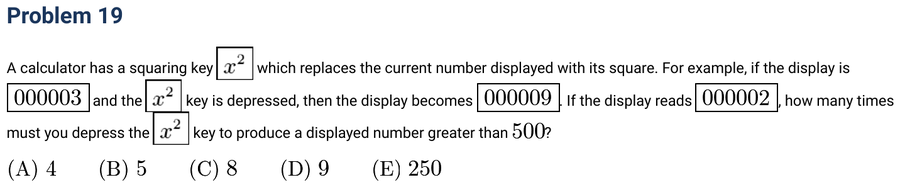
ajhsme-1987-19
Show hint
Repeated squaring goes 2 → 4 → 16 → 256 → 65536. Watch which crosses 500.
Show solution
  1. 2 → 4 → 16 → 256 → 65536. 256 isn't yet greater than 500, but 65536 is.
  2. So 4 presses are needed.
A 4.
Mark: · log in to save
Problem 20 · 1987 AJHSME Hard
Number Theory counterexample

"If a whole number n is not prime, then the whole number n − 2 is not prime." A value of n which shows this statement to be false is

Show hint (soft nudge)
Look for n that is itself not prime but n − 2 IS prime.
Show hint (sharpest)
Check each composite choice's n − 2.
Show solution
  1. Try n = 9: 9 is not prime, and 9 − 2 = 7 is prime.
  2. That falsifies the claim, so n = 9.
A 9.
Mark: · log in to save
Problem 21 · 1987 AJHSME Stretch
Fractions, Decimals & Percents operator-substitution

Suppose n* means 1⁄n, the reciprocal of n. For example, 5* = 1⁄5. How many of the following statements are true?

i) 3* + 6* = 9*
ii) 6* − 4* = 2*
iii) 2* · 6* = 12*
iv) 10* ÷ 2* = 5*
Show hint (soft nudge)
For 1⁄a + 1⁄b, the result is rarely 1⁄(a+b).
Show hint (sharpest)
For 1⁄a · 1⁄b = 1⁄(ab) and (1⁄a) ÷ (1⁄b) = b⁄a — both follow simple rules.
Show solution
  1. i) 1⁄3 + 1⁄6 = 1⁄2 ≠ 1⁄9 — false. ii) 1⁄6 − 1⁄4 = −1⁄12 ≠ 1⁄2 — false. iii) 1⁄2 · 1⁄6 = 1⁄12 — true. iv) (1⁄10) ÷ (1⁄2) = 1⁄5 — true.
  2. 2 statements are true.
C 2.
Mark: · log in to save
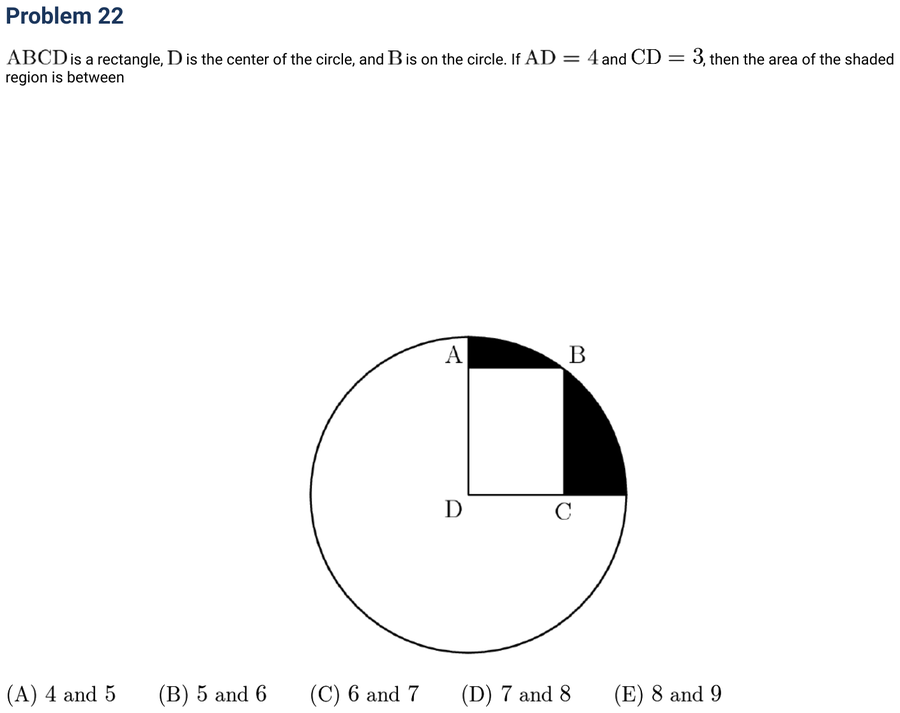
Problem 22 · 1987 AJHSME Stretch
Geometry & Measurement quarter-circle-minus-rectangle
ajhsme-1987-22
Show hint (soft nudge)
The diagonal DB is also the circle's radius — find it with the Pythagorean theorem.
Show hint (sharpest)
Shaded region = (quarter of the disk) − (rectangle in that quarter).
Show solution
  1. DB² = 4² + 3² = 25, so the radius is 5. The shaded region is the quarter-disk above and to the right of D with the rectangle ABCD removed.
  2. Area = (1⁄4)(π · 25) − 12 = 25π⁄4 − 12 ≈ 19.63 − 12 ≈ 7.63, which sits between 7 and 8.
D between 7 and 8.
Mark: · log in to save
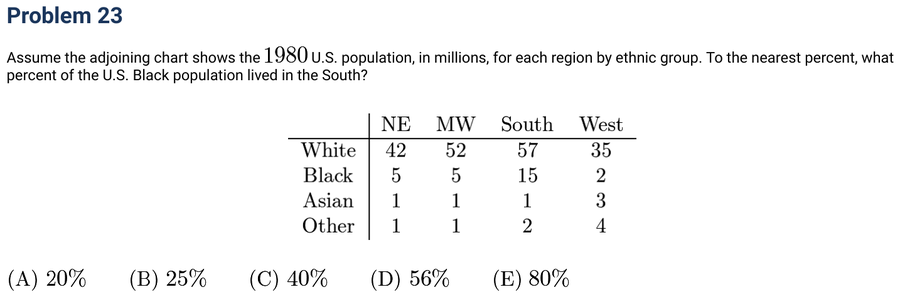
Problem 23 · 1987 AJHSME Stretch
Fractions, Decimals & Percents percent-of-row-total
ajhsme-1987-23
Show hint
Add the Black row, then take the South entry as a percent of that total.
Show solution
  1. Black population: 5 + 5 + 15 + 2 = 27 (millions). South share = 15 ⁄ 27 ≈ 0.556.
  2. Nearest percent: 56%.
D 56%.
Mark: · log in to save
Problem 24 · 1987 AJHSME Stretch
Algebra & Patterns score-constraint parity

A multiple choice examination consists of 20 questions. The scoring is +5 for each correct answer, −2 for each incorrect answer, and 0 for each unanswered question. John's score on the examination is 48. What is the maximum number of questions he could have answered correctly?

Show hint (soft nudge)
Let c = correct, w = wrong; 5c − 2w = 48 with c + w ≤ 20 and c, w ≥ 0 integers.
Show hint (sharpest)
5c must be even, so c must be even — that limits c to even values.
Show solution
  1. From 5c − 2w = 48, c must be even (so 5c is even); from c + w ≤ 20, c is at most about 12.6.
  2. The biggest even c that fits is c = 12 (w = 6, total 18).
D 12.
Mark: · log in to save
Problem 25 · 1987 AJHSME Stretch
Counting & Probability parity without-replacement

Ten balls numbered 1 to 10 are in a jar. Jack reaches into the jar and randomly removes one of the balls. Then Jill reaches into the jar and randomly removes a different ball. The probability that the sum of the two numbers on the balls removed is even is

Show hint (soft nudge)
The sum is even when both balls have the same parity.
Show hint (sharpest)
5 odd and 5 even balls; second draw is without replacement, so the denominator becomes 9.
Show solution
  1. P(both odd) = (5⁄10)(4⁄9) = 2⁄9. P(both even) = (5⁄10)(4⁄9) = 2⁄9.
  2. Total = 2⁄9 + 2⁄9 = 4⁄9.
A 4⁄9.
Mark: · log in to save