AJHSME · Test Mode

1988 AJHSME

Test mode — hints and solutions are locked. Pick an answer for each, then submit at the bottom to see your score.

← Exit test mode No hints or solutions until you submit.
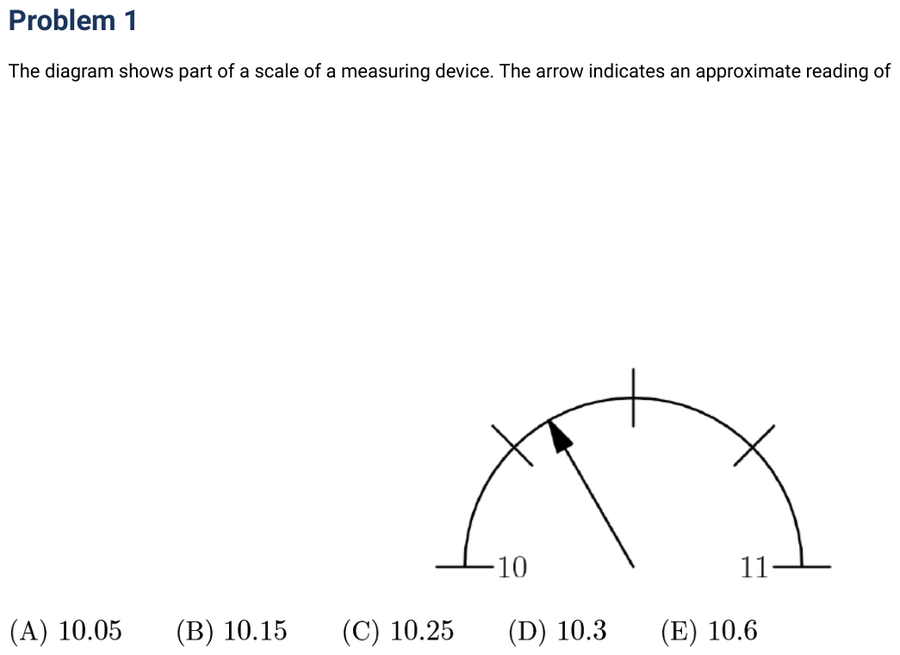
Problem 1 · 1988 AJHSME Easy
Fractions, Decimals & Percents scale-reading
ajhsme-1988-01
Show hint (soft nudge)
Between the 10 and 11 marks, the arrow points roughly a quarter of the way past 10.
Show hint (sharpest)
A quarter of the gap from 10 to 11 is 0.25.
Show solution
  1. The arrow sits about one-fourth of the way from 10 toward 11.
  2. That's 10 + 0.25 = 10.25.
C 10.25.
Mark: · log in to save
Problem 2 · 1988 AJHSME Easy
Fractions, Decimals & Percents pair-decimals

The product 8 × .25 × 2 × .125 =

Show hint (soft nudge)
Pair numbers whose product is a round number.
Show hint (sharpest)
8 · 0.125 = 1 and 2 · 0.25 = 0.5.
Show solution
  1. Rearrange: (8 × 0.125) × (2 × 0.25) = 1 × 0.5.
  2. Product = 1⁄2.
C 1⁄2.
Mark: · log in to save
Problem 3 · 1988 AJHSME Easy
Fractions, Decimals & Percents simplify-each-fraction

1⁄10 + 2⁄20 + 3⁄30 =

Show hint (soft nudge)
Each fraction simplifies to the same thing.
Show hint (sharpest)
1⁄10 = 2⁄20 = 3⁄30.
Show solution
  1. 2⁄20 = 1⁄10 and 3⁄30 = 1⁄10, so the sum is 1⁄10 + 1⁄10 + 1⁄10 = 3⁄10.
  2. 3⁄10 = 0.3.
D .3.
Mark: · log in to save
Problem 4 · 1988 AJHSME Medium
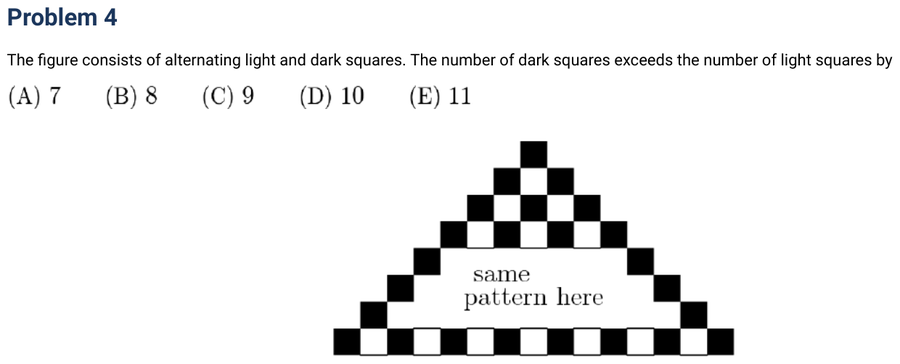
Counting & Probability count-by-row symmetry
ajhsme-1988-04
Show hint (soft nudge)
The figure is symmetric top to bottom — count one half and double, watching the shared middle row.
Show hint (sharpest)
In each row, count dark squares minus light squares; sum over all rows.
Show solution
  1. In each row, dark squares outnumber light squares by exactly one because the row starts and ends with dark.
  2. There are 11 rows in the diamond, so dark exceeds light by 11.
E 11.
Mark: · log in to save
Problem 5 · 1988 AJHSME Medium
Geometry & Measurement protractor-reading angle-subtraction
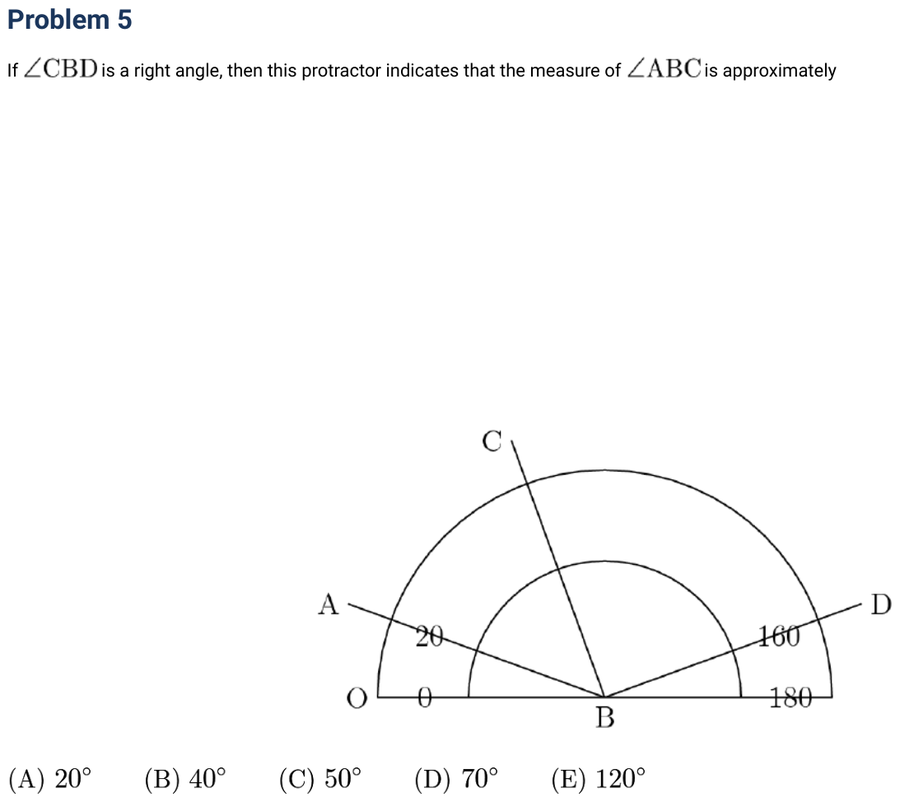
ajhsme-1988-05
Show hint (soft nudge)
The protractor reads A at 20° and D at 160°.
Show hint (sharpest)
If ∠CBD = 90°, then C reads at 160° − 90° = 70°.
Show solution
  1. D reads 160°; since ∠CBD = 90°, C reads 160° − 90° = 70°.
  2. ∠ABC = 70° − 20° = 50°.
C 50°.
Mark: · log in to save
Problem 6 · 1988 AJHSME Medium
Fractions, Decimals & Percents ratio-of-powers

(.2)³ ⁄ (.02)² =

Show hint (soft nudge)
Factor out (.2)² from the numerator first.
Show hint (sharpest)
(.2 ⁄ .02)² = 10².
Show solution
  1. (.2)³ ⁄ (.02)² = .2 × (.2⁄.02)² = .2 × 10² = .2 × 100.
  2. = 20.
E 20.
Mark: · log in to save
Problem 7 · 1988 AJHSME Medium
Arithmetic & Operations round-and-multiply

2.46 × 8.163 × (5.17 + 4.829) is closest to

Show hint (soft nudge)
Round each factor to a friendly number.
Show hint (sharpest)
2.46 ≈ 2.5, 8.163 ≈ 8, the sum ≈ 10.
Show solution
  1. 2.46 × 8.163 × (5.17 + 4.829) ≈ 2.5 × 8 × 10.
  2. = 200.
B 200.
Mark: · log in to save
Problem 8 · 1988 AJHSME Medium
Fractions, Decimals & Percents count-decimal-places

Betty used a calculator to find the product 0.075 × 2.56. She forgot to enter the decimal points. The calculator showed 19200. If Betty had entered the decimal points correctly, the answer would have been

Show hint (soft nudge)
Count the total number of digits after the decimal point in the two factors.
Show hint (sharpest)
Move the decimal point in 19200 that many places to the left.
Show solution
  1. 0.075 has 3 decimal places, 2.56 has 2 — total 5. Move the decimal in 19200 five places to the left.
  2. 19200 → 0.19200 = 0.192.
B .192.
Mark: · log in to save
Problem 9 · 1988 AJHSME Medium
Geometry & Measurement distance-on-grid isoceles-check
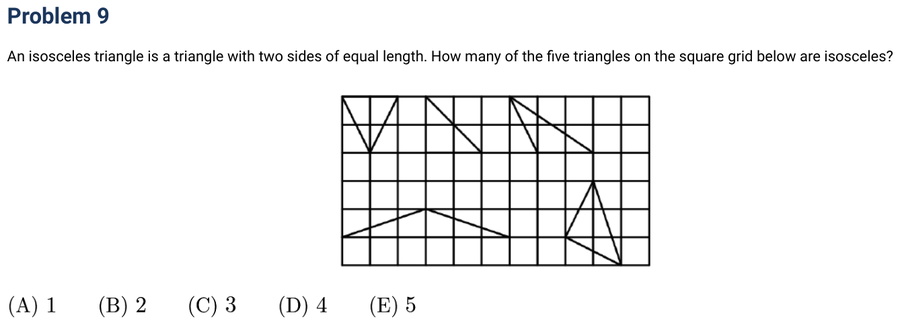
ajhsme-1988-09
Show hint (soft nudge)
For each triangle, check whether at least two side lengths match — count squares horizontally, vertically, and diagonally using a²+b².
Show hint (sharpest)
Only one of the five fails the test.
Show solution
  1. Compute the three side lengths of each triangle from the grid (use a² + b² for slanted sides).
  2. Four of the five have two matching sides; only one is scalene, so 4 are isosceles.
D 4.
Mark: · log in to save
Problem 10 · 1988 AJHSME Medium
Number Theory mod-7

Chris's birthday is on a Thursday this year. What day of the week will it be 60 days after her birthday?

Show hint (soft nudge)
Days of the week repeat every 7 days, so reduce 60 modulo 7.
Show hint (sharpest)
60 = 8·7 + 4.
Show solution
  1. 60 days = 8 full weeks plus 4 extra days.
  2. 4 days after Thursday → Friday, Saturday, Sunday, Monday.
A Monday.
Mark: · log in to save
Problem 11 · 1988 AJHSME Hard
Number Theory bound-by-perfect-squares

√164 is

Show hint (soft nudge)
Bound 164 between two consecutive perfect squares.
Show hint (sharpest)
12² = 144 and 13² = 169.
Show solution
  1. 12² = 144 < 164 < 169 = 13².
  2. So √164 lies between 12 and 13.
E between 12 and 13.
Mark: · log in to save
Problem 12 · 1988 AJHSME Hard
Fractions, Decimals & Percents cancel-powers-of-ten

Suppose the estimated 20 billion dollar cost to send a person to the planet Mars is shared equally by the 250 million people in the U.S. Then each person's share is

Show hint (soft nudge)
billion = 1000 × million, so 20 billion = 20,000 million.
Show hint (sharpest)
Divide 20,000 by 250.
Show solution
  1. 20 billion ⁄ 250 million = 20,000 million ⁄ 250 million = 20,000 ⁄ 250.
  2. = 80 dollars.
C 80 dollars.
Mark: · log in to save
Problem 13 · 1988 AJHSME Hard
Geometry & Measurement circumference approximate

If rose bushes are spaced about 1 foot apart, approximately how many bushes are needed to surround a circular patio whose radius is 12 feet?

Show hint (soft nudge)
The number of bushes ≈ the circumference (in feet).
Show hint (sharpest)
Circumference = 2π · 12.
Show solution
  1. Circumference = 2π · 12 = 24π ≈ 75.4 feet.
  2. With 1-foot spacing, about 75 bushes fit around.
D 75.
Mark: · log in to save
Problem 14 · 1988 AJHSME Hard
Number Theory factor-pairs max-sum

◇ and △ are whole numbers and ◇ × △ = 36. The largest possible value of ◇ + △ is

Show hint (soft nudge)
List all factor pairs of 36 and add each pair.
Show hint (sharpest)
Sums are biggest when the factors are most spread out.
Show solution
  1. Factor pairs of 36: (1,36), (2,18), (3,12), (4,9), (6,6). Their sums: 37, 20, 15, 13, 12.
  2. The largest is 1 + 36 = 37.
E 37.
Mark: · log in to save
Problem 15 · 1988 AJHSME Hard
Fractions, Decimals & Percents add-fractions-then-flip

The reciprocal of (1⁄2 + 1⁄3) is

Show hint (soft nudge)
Add the fractions first, then flip.
Show hint (sharpest)
1⁄2 + 1⁄3 = 5⁄6.
Show solution
  1. 1⁄2 + 1⁄3 = 3⁄6 + 2⁄6 = 5⁄6.
  2. Reciprocal of 5⁄6 is 6⁄5.
C 6⁄5.
Mark: · log in to save
Problem 16 · 1988 AJHSME Hard
Counting & Probability block-each-line
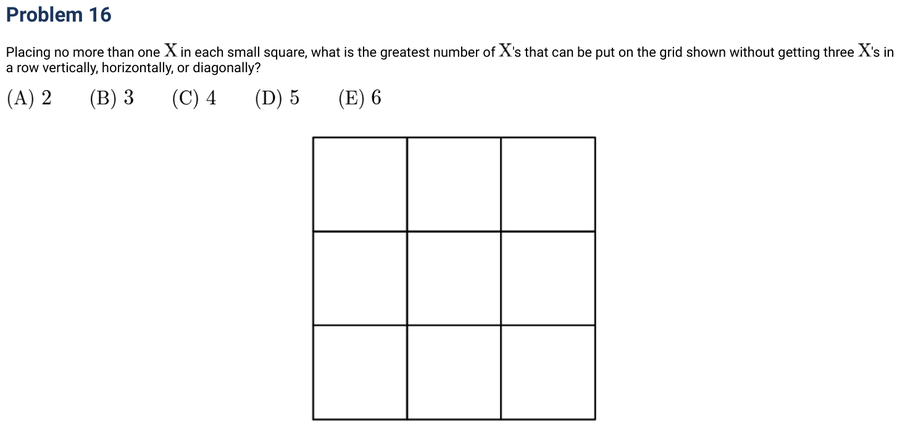
ajhsme-1988-16
Show hint (soft nudge)
There are 8 lines (3 rows, 3 columns, 2 diagonals); each must miss at least one square.
Show hint (sharpest)
Leaving the center plus two opposite corners empty kills every line.
Show solution
  1. Leave the center and two opposite corners empty (3 squares). The center kills the middle row, middle column, and both diagonals; the two opposite corners kill the remaining four edge lines.
  2. So 9 − 3 = 6 X's can be placed.
E 6.
Mark: · log in to save
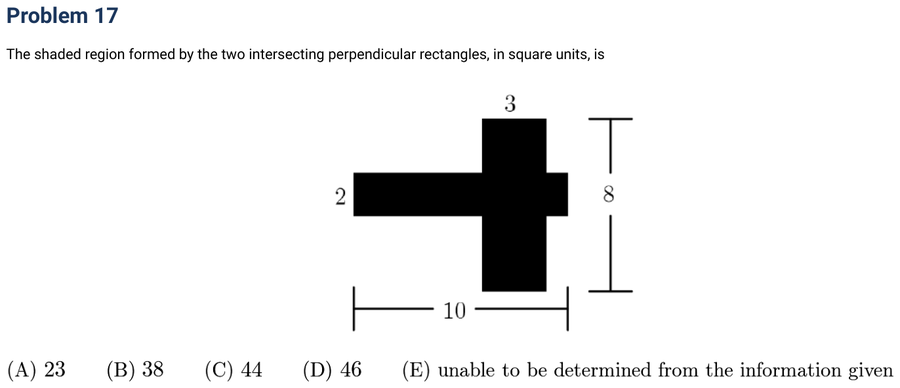
Problem 17 · 1988 AJHSME Hard
Geometry & Measurement inclusion-exclusion-area
ajhsme-1988-17
Show hint (soft nudge)
Add the two rectangles' areas, then subtract the overlap so it isn't counted twice.
Show hint (sharpest)
The overlap is a 3 × 2 rectangle.
Show solution
  1. Horizontal rectangle: 10 × 2 = 20. Vertical rectangle: 3 × 8 = 24. Overlap: 3 × 2 = 6.
  2. Shaded area = 20 + 24 − 6 = 38.
B 38.
Mark: · log in to save
Problem 18 · 1988 AJHSME Hard
Ratios, Rates & Proportions weighted-average

The average weight of 6 boys is 150 pounds and the average weight of 4 girls is 120 pounds. The average weight of the 10 children is

Show hint (soft nudge)
Average isn't just the average of the two averages — weight by group size.
Show hint (sharpest)
Total weight ÷ total count.
Show solution
  1. Total weight = 6 × 150 + 4 × 120 = 900 + 480 = 1380.
  2. Average = 1380 ⁄ 10 = 138 pounds.
C 138 pounds.
Mark: · log in to save
Problem 19 · 1988 AJHSME Hard
Algebra & Patterns arithmetic-sequence-nth-term

What is the 100th number in the arithmetic sequence: 1, 5, 9, 13, 17, 21, 25, …?

Show hint (soft nudge)
The common difference is 4; the 100th term sits 99 steps after the first.
Show hint (sharpest)
100th term = 1 + 99 × 4.
Show solution
  1. First term 1, common difference 4. The 100th term = 1 + 99 × 4 = 1 + 396.
  2. = 397.
A 397.
Mark: · log in to save
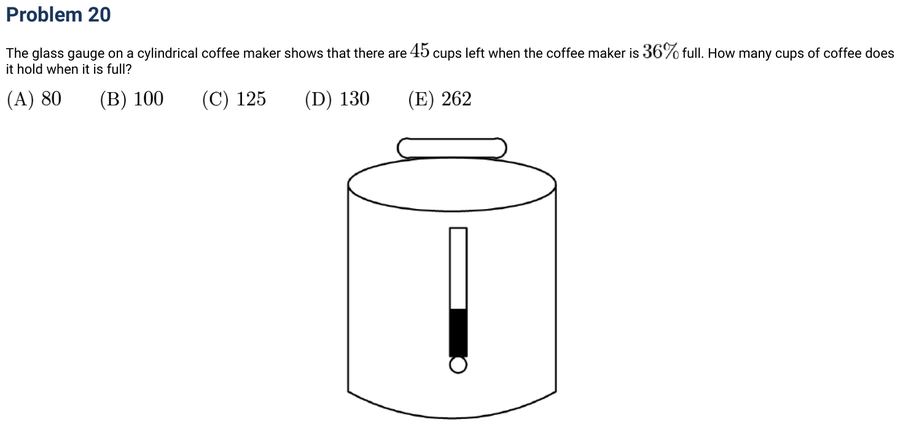
Problem 20 · 1988 AJHSME Hard
Fractions, Decimals & Percents percent-of-whole
ajhsme-1988-20
Show hint (soft nudge)
45 cups is 36% of the full capacity.
Show hint (sharpest)
Divide 45 by 0.36.
Show solution
  1. If 45 = 0.36 · Full, then Full = 45 ⁄ 0.36 = 4500 ⁄ 36.
  2. = 125 cups.
C 125.
Mark: · log in to save
Problem 21 · 1988 AJHSME Stretch
Algebra & Patterns case-on-where-n-falls

A fifth number, n, is added to the set {3, 6, 9, 10} to make the mean of the set of five numbers equal to its median. The number of possible values of n is

Show hint (soft nudge)
The median depends on where n falls in the sorted list; split into three cases.
Show hint (sharpest)
In each case, set mean = median and solve for n.
Show solution
  1. Mean = (28 + n)⁄5. Case n ≤ 6: median = 6 → n = 2. Case 6 ≤ n ≤ 9: median = n → 28 + n = 5n → n = 7. Case n ≥ 9: median = 9 → n = 17.
  2. Each value of n is consistent with its case, so the answers are 2, 7, 17 — 3 values.
C 3.
Mark: · log in to save
Problem 22 · 1988 AJHSME Stretch
Fractions, Decimals & Percents compound-percent

Tom's Hat Shoppe increased all original prices by 25%. Now the shoppe is having a sale where all prices are 20% off these increased prices. Which statement best describes the sale price of an item?

Show hint (soft nudge)
Apply each percent change as a multiplier and multiply them.
Show hint (sharpest)
1.25 × 0.80 — what does that equal?
Show solution
  1. +25% means ×1.25; −20% off means ×0.80. Combined: 1.25 × 0.80 = 1.00.
  2. So the sale price equals the original price.
E The sale price is the same as the original price.
Mark: · log in to save
Problem 23 · 1988 AJHSME Stretch
Ratios, Rates & Proportions profit-per-item

Maria buys computer disks at a price of 4 for $5 and sells them at a price of 3 for $5. How many computer disks must she sell in order to make a profit of $100?

Show hint (soft nudge)
Cost per disk = $5⁄4; sale price per disk = $5⁄3.
Show hint (sharpest)
Profit per disk = $5⁄3 − $5⁄4.
Show solution
  1. Profit per disk = 5⁄3 − 5⁄4 = 20⁄12 − 15⁄12 = 5⁄12 dollar.
  2. To make $100: 100 ÷ (5⁄12) = 100 × 12⁄5 = 240 disks.
D 240.
Mark: · log in to save
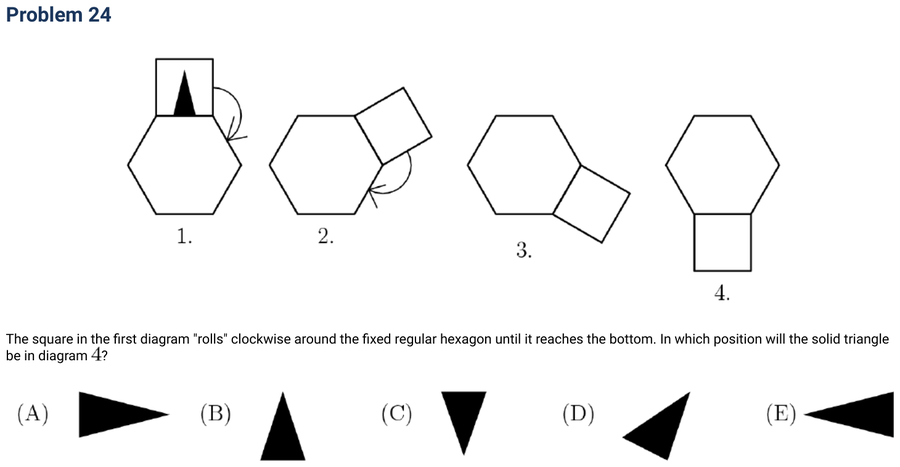
Problem 24 · 1988 AJHSME Stretch
Geometry & Measurement roll-around-polygon rotation
ajhsme-1988-24
Show hint (soft nudge)
When a square rolls around a hexagon's corner, it pivots through the hexagon's exterior angle.
Show hint (sharpest)
Total rotation from position 1 to position 4 = 3 × 60° = 180°.
Show solution
  1. Each pivot at a hexagon corner rotates the square by the exterior angle 60°. Three pivots take it from the top to the bottom, so the square has rotated 3 × 60° = 180° clockwise.
  2. Rotating the original triangle by 180° gives the orientation in choice A.
A A.
Mark: · log in to save
Problem 25 · 1988 AJHSME Stretch
Counting & Probability count-palindromes case-by-digit-count

A palindrome is a whole number that reads the same forwards and backwards. If one neglects the colon, certain times displayed on a digital watch are palindromes. Three examples are: 1:01, 4:44, and 12:21. How many times during a 12-hour period will be palindromes?

Show hint (soft nudge)
Split into 1-digit hours (1–9) and 2-digit hours (10–12) and count each.
Show hint (sharpest)
For h:mm to be a palindrome, the last digit of mm must equal h, and the middle digit can be 0–5.
Show solution
  1. 1-digit hours h:mm (h = 1–9): need mm's ones digit = h with mm's tens digit 0–5; that's 6 minutes per hour, so 9 × 6 = 54 palindromes.
  2. 2-digit hours hh:mm (10, 11, 12): only 10:01, 11:11, 12:21 work — 3 more. Total = 54 + 3 = 57.
A 57.
Mark: · log in to save