AJHSME · Test Mode

1990 AJHSME

Test mode — hints and solutions are locked. Pick an answer for each, then submit at the bottom to see your score.

← Exit test mode No hints or solutions until you submit.
Problem 1 · 1990 AJHSME Medium
Number Theory place-value minimize
ajhsme-1990-01
Show hint (soft nudge)
The hundreds digits matter most, so put the two smallest there.
Show hint (sharpest)
Then the next-smallest in the tens, and the largest in the units.
Show solution
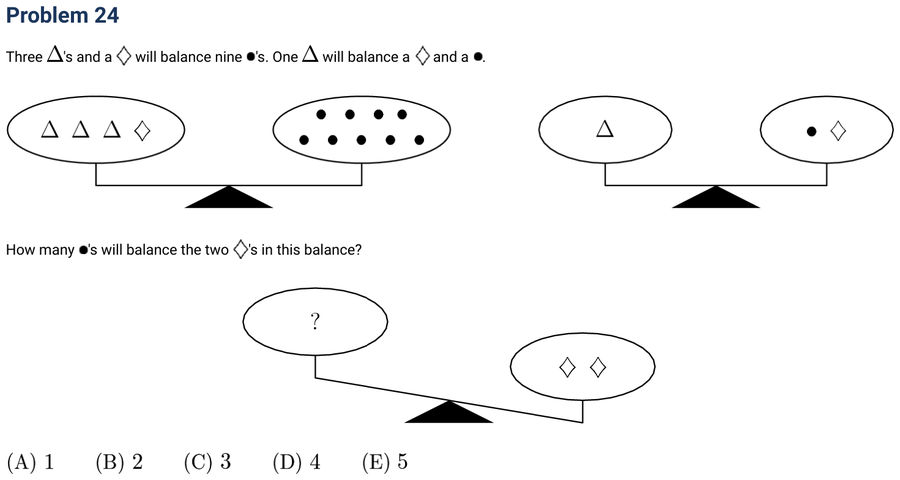
  1. Put 4 and 5 in the hundreds (900), 6 and 7 in the tens (130), and 8 and 9 in the units (17).
  2. The smallest sum is 900 + 130 + 17 = 1047.
C 1047.
Mark: · log in to save
Problem 2 · 1990 AJHSME Easy
Fractions, Decimals & Percents place-value

Which digit of .12345, when changed to 9, gives the largest number?

Show hint (soft nudge)
Changing a digit helps most where its place value is largest.
Show hint (sharpest)
The leftmost digit is the tenths place.
Show solution
  1. The 1 sits in the tenths place, the most valuable spot. Changing it to 9 makes .92345.
  2. That beats changing any digit further right, so the answer is the 1.
A the 1.
Mark: · log in to save
Problem 3 · 1990 AJHSME Hard
Geometry & Measurement area-fraction rearrangement
ajhsme-1990-03
Show hint (soft nudge)
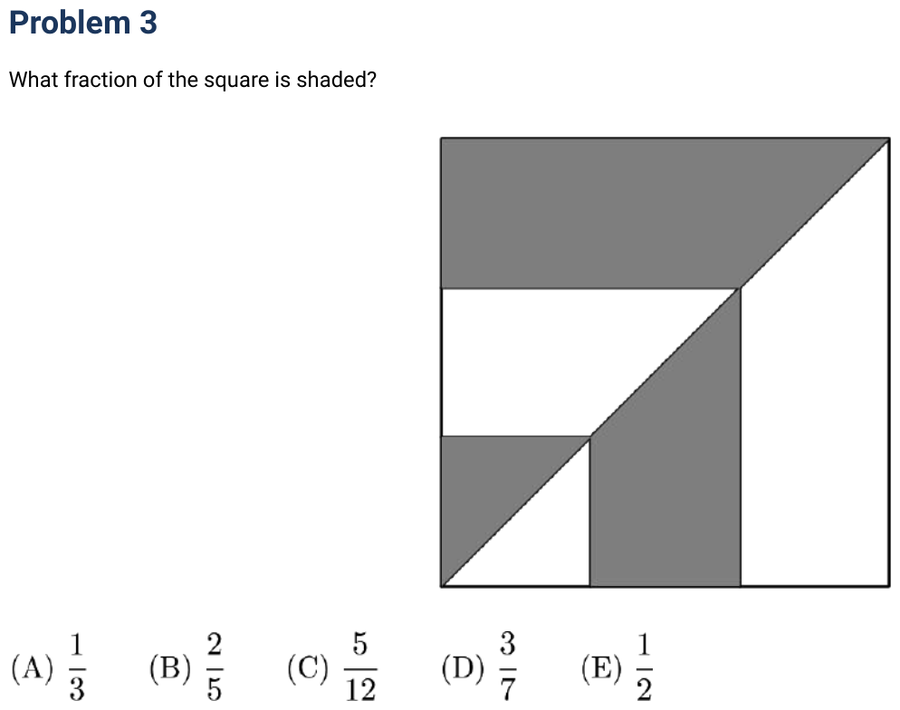
The square's diagonal splits it into two equal halves.
Show hint (sharpest)
Rearrange the shaded pieces — they fill exactly one of those halves.
Show solution
  1. The diagonal cuts the square into two equal triangles. The shaded shapes can be slid together to cover exactly one triangle's worth of area.
  2. So the shaded fraction is 1/2.
E 1/2.
Mark: · log in to save
Problem 4 · 1990 AJHSME Medium
Number Theory units-digit-of-squares

Which of the following could not be the units digit (one's digit) of the square of a whole number?

Show hint (soft nudge)
Square the digits 0 through 9 and look at the last digit.
Show hint (sharpest)
Some digits never show up as a final digit.
Show solution
  1. Squares end only in 0, 1, 4, 5, 6, or 9.
  2. 8 is not on that list, so a square can never end in 8.
E 8.
Mark: · log in to save
Problem 5 · 1990 AJHSME Medium
Fractions, Decimals & Percents estimation

Which of the following is closest to the product (.48017)(.48017)(.48017)?

Show hint (soft nudge)
Round .48017 to about 0.5 to estimate.
Show hint (sharpest)
Cube the rounded value.
Show solution
  1. .48017 ≈ 0.5, and 0.5³ = 0.125.
  2. That is closest to 0.110.
B 0.110.
Mark: · log in to save
Problem 6 · 1990 AJHSME Medium
Fractions, Decimals & Percents compare-operations
ajhsme-1990-06
Show hint (soft nudge)
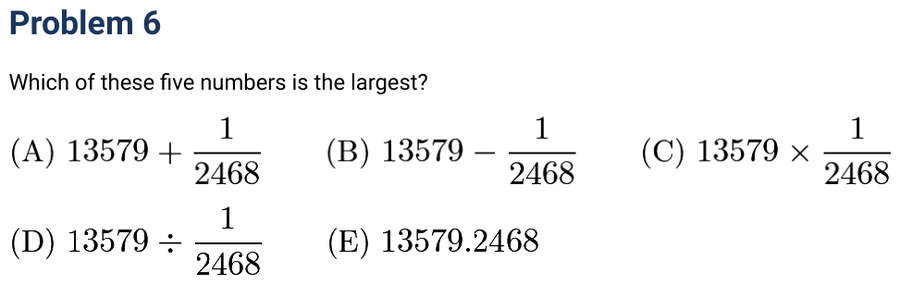
Adding, subtracting, or appending decimals barely changes 13579.
Show hint (sharpest)
Dividing by a tiny fraction like 1/2468 multiplies by 2468.
Show solution
  1. Choices A, B, C, E all stay close to 13579 (or smaller).
  2. But dividing by 1/2468 means multiplying by 2468, giving about 33 million — by far the largest. So 13579 ÷ (1/2468).
D 13579 ÷ (1/2468).
Mark: · log in to save
Problem 7 · 1990 AJHSME Medium
Arithmetic & Operations sign-product maximize

When three different numbers from the set {−3, −2, −1, 4, 5} are multiplied, the largest possible product is

Show hint (soft nudge)
A positive product needs an even number of negatives — here, two.
Show hint (sharpest)
Pair the two most-negative numbers with the largest positive.
Show solution
  1. Using (−3)(−2) = 6 and the largest positive 5 gives a positive product.
  2. 6 × 5 = 30, the largest possible.
C 30.
Mark: · log in to save
Problem 8 · 1990 AJHSME Medium
Fractions, Decimals & Percents discount-tax

A dress originally priced at 80 dollars was put on sale for 25% off. If 10% tax was added to the sale price, then the total selling price (in dollars) of the dress was

Show hint (soft nudge)
Take 25% off first, then add the tax on the reduced price.
Show hint (sharpest)
25% off $80 leaves $60.
Show solution
  1. 25% off $80 is $60.
  2. Adding 10% tax: $60 × 1.10 = $66.
D 66 dollars.
Mark: · log in to save
Problem 9 · 1990 AJHSME Hard
Fractions, Decimals & Percents count-in-range percent
ajhsme-1990-09
Show hint (soft nudge)
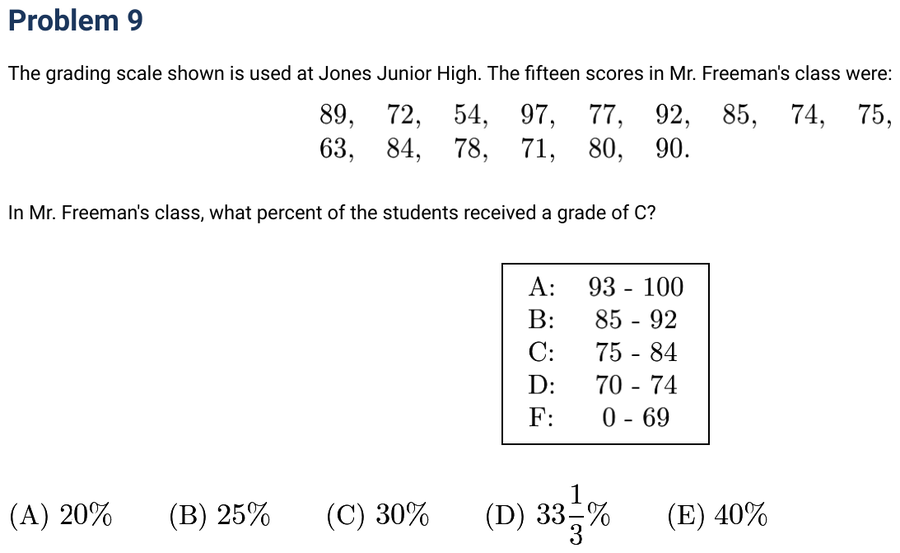
A C is a score from 75 to 84 — count how many of the 15 scores fall there.
Show hint (sharpest)
Then divide by 15.
Show solution
  1. Scores in 75–84 are 77, 75, 84, 78, 80 — that's 5 of the 15.
  2. 5/15 = 33⅓%.
D 33⅓%.
Mark: · log in to save
Problem 10 · 1990 AJHSME Hard
Logic & Word Problems calendar-arithmetic
ajhsme-1990-10
Show hint (soft nudge)
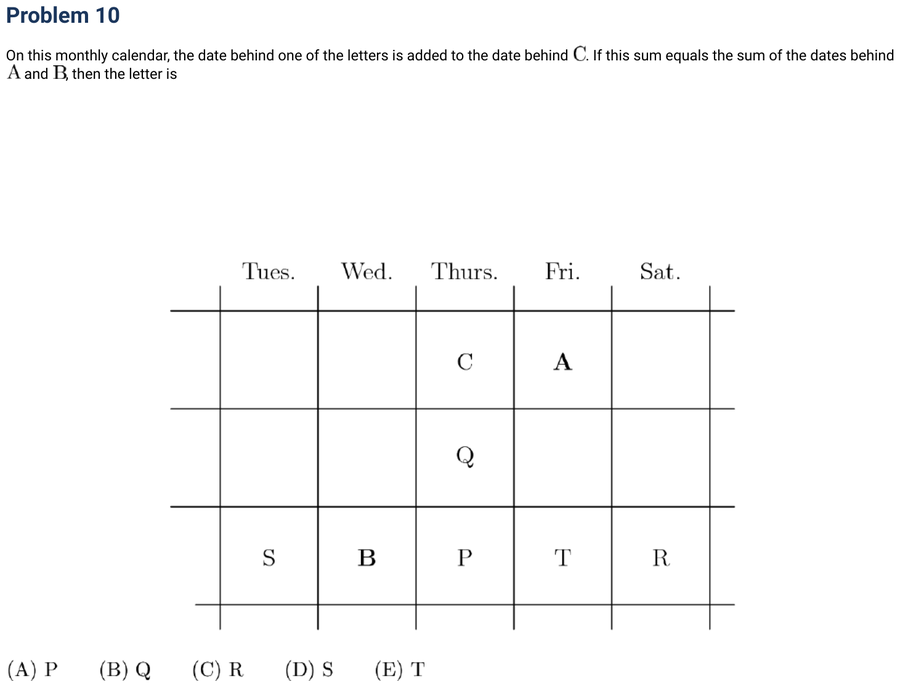
Dates one row apart on a calendar differ by 7; A is one day after C.
Show hint (sharpest)
Set up the equation (date) + C = A + B and solve for the letter.
Show solution
  1. Let C be its date. Then A = C + 1, B = C + 13, and P = C + 14 (two rows below C).
  2. Since A + B = 2C + 14 and P + C = 2C + 14, the matching letter is P.
A P.
Mark: · log in to save
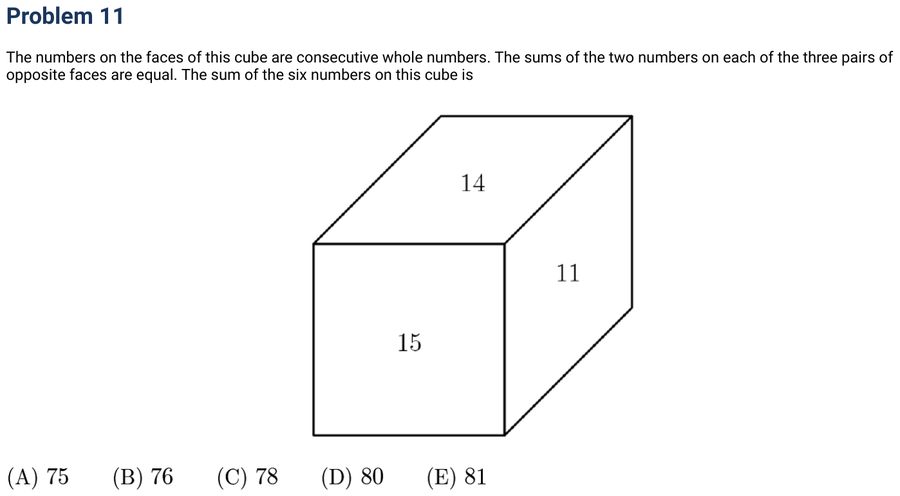
Problem 11 · 1990 AJHSME Stretch
Number Theory consecutive opposite-pairs
ajhsme-1990-11
Show hint (soft nudge)
The six faces are six consecutive numbers including the visible 11, 14, 15.
Show hint (sharpest)
The visible faces meet at a corner, so they can't be opposite each other — that pins which six numbers.
Show solution
  1. The visible 11, 14, 15 are mutually adjacent, so they aren't opposite pairs. The six consecutive numbers must be 11–16, pairing as 11+16, 12+15, 13+14 (each summing to 27).
  2. Their total is 11 + 12 + 13 + 14 + 15 + 16 = 81.
E 81.
Mark: · log in to save
Problem 12 · 1990 AJHSME Hard
Counting & Probability ordering-permutations

There are twenty-four 4-digit numbers that use each of the four digits 2, 4, 5, and 7 exactly once. Listed in numerical order from smallest to largest, the number in the 17th position in the list is

Show hint (soft nudge)
Each choice of leading digit fixes 3! = 6 numbers.
Show hint (sharpest)
Find which leading-digit block holds the 17th, then list within it.
Show solution
  1. Leading 2: positions 1–6, leading 4: 7–12, leading 5: 13–18. So the 17th is the 5th number starting with 5.
  2. Those are 5247, 5274, 5427, 5472, 5724 — the 5th is 5724.
B 5724.
Mark: · log in to save
Problem 13 · 1990 AJHSME Hard
Arithmetic & Operations round-up rate

One proposal for new postage rates for a letter was 30 cents for the first ounce and 22 cents for each additional ounce (or fraction of an ounce). The postage for a letter weighing 4.5 ounces was

Show hint (soft nudge)
After the first ounce, 3.5 ounces remain — each fraction counts as a whole charge.
Show hint (sharpest)
Round 3.5 up to 4 additional charges.
Show solution
  1. After the first ounce (30¢), 3.5 ounces remain, charged as 4 additional ounces.
  2. Total = 30 + 4 × 22 = 118¢ = $1.18.
C 1.18 dollars.
Mark: · log in to save
Problem 14 · 1990 AJHSME Medium
Counting & Probability probability

A bag contains only blue balls and green balls. There are 6 blue balls. If the probability of drawing a blue ball at random from this bag is 14, then the number of green balls in the bag is

Show hint (soft nudge)
If blue is 1/4 of the balls, the total is 4 times the blue count.
Show hint (sharpest)
Subtract the blue balls to get the green ones.
Show solution
  1. Blue = 1/4 of all, so the total is 4 × 6 = 24 balls.
  2. Green = 24 − 6 = 18.
B 18.
Mark: · log in to save
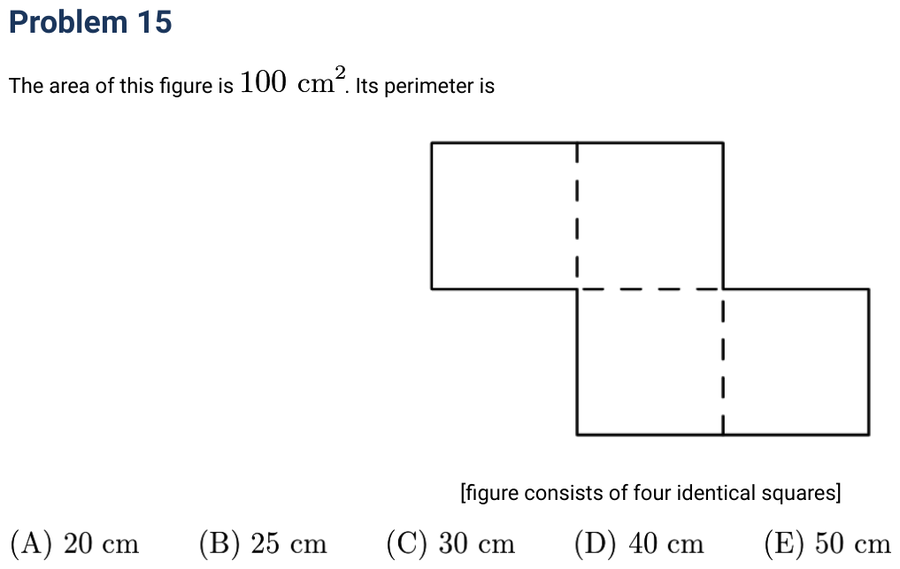
Problem 15 · 1990 AJHSME Hard
Geometry & Measurement perimeter tetromino
ajhsme-1990-15
Show hint (soft nudge)
Four equal squares with area 100 means each square has area 25 and side 5.
Show hint (sharpest)
Count the outside edges of the S-shaped figure — there are 10.
Show solution
  1. Each of the four squares has area 25, so side 5. The offset (S-shaped) figure has 10 unit-side edges on its boundary.
  2. Perimeter = 10 × 5 = 50 cm.
E 50 cm.
Mark: · log in to save
Problem 16 · 1990 AJHSME Hard
Algebra & Patterns pair-terms

1990 − 1980 + 1970 − 1960 + … − 20 + 10 =

Show hint (soft nudge)
Pair the terms: (1990 − 1980), (1970 − 1960), … each equals 10.
Show hint (sharpest)
Don't forget the leftover +10 at the end.
Show solution
  1. Pairs (1990 − 1980), (1970 − 1960), …, (30 − 20) each give 10, and there are 99 such pairs: 990.
  2. Adding the final +10 gives 990 + 10 = 1000.
D 1000.
Mark: · log in to save
Problem 17 · 1990 AJHSME Hard
Geometry & Measurement volume unit-conversion round-up

A straight concrete sidewalk is to be 3 feet wide, 60 feet long, and 3 inches thick. How many cubic yards of concrete must a contractor order for the sidewalk if concrete must be ordered in a whole number of cubic yards?

Show hint (soft nudge)
Convert 3 inches to feet (1/4 ft) and find the volume in cubic feet.
Show hint (sharpest)
There are 27 cubic feet in a cubic yard; round up.
Show solution
  1. Volume = 3 × 60 × ¼ = 45 cubic feet, and 45 ÷ 27 ≈ 1.67 cubic yards.
  2. Ordering a whole number rounds up to 2 cubic yards.
A 2.
Mark: · log in to save
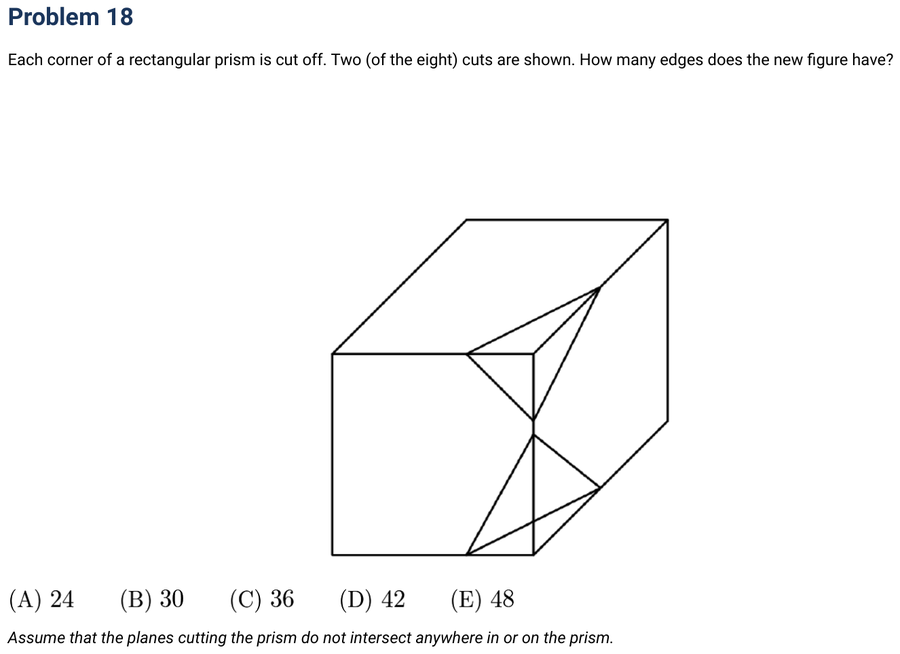
Problem 18 · 1990 AJHSME Stretch
Geometry & Measurement truncation edge-counting
ajhsme-1990-18
Show hint (soft nudge)
Each corner cut adds a new triangular face with 3 new edges.
Show hint (sharpest)
The original 12 edges of the prism survive (just shortened).
Show solution
  1. Cutting all 8 corners adds 8 triangular faces, each with 3 new edges: 8 × 3 = 24 new edges.
  2. Adding the 12 original edges gives 12 + 24 = 36.
C 36.
Mark: · log in to save
Problem 19 · 1990 AJHSME Hard
Counting & Probability spacing covering

There are 120 seats in a row. What is the fewest number of seats that must be occupied so the next person to be seated must sit next to someone?

Show hint (soft nudge)
You want every empty seat to be adjacent to an occupied one.
Show hint (sharpest)
Seating one person every three seats does this with the fewest people.
Show solution
  1. If you seat one person in every block of 3 seats (occupied, empty, empty), every empty seat touches an occupied one.
  2. That uses 120 ÷ 3 = 40 seats.
B 40.
Mark: · log in to save
Problem 20 · 1990 AJHSME Hard
Arithmetic & Operations mean-error

The annual incomes of 1,000 families range from 8200 dollars to 98,000 dollars. In error, the largest income was entered on the computer as 980,000 dollars. The difference between the mean of the incorrect data and the mean of the actual data is

Show hint (soft nudge)
Only one entry changed, so the totals differ by that one error.
Show hint (sharpest)
Divide the size of the error by the number of families.
Show solution
  1. The wrong entry overstates the total by 980,000 − 98,000 = 882,000.
  2. Over 1,000 families, the mean is off by 882,000 ÷ 1000 = $882.
A 882 dollars.
Mark: · log in to save
Problem 21 · 1990 AJHSME Stretch
Algebra & Patterns work-backward

A list of 8 numbers is formed by beginning with two given numbers. Each new number in the list is the product of the two previous numbers. Find the first number if the last three numbers are 16, 64, 1024.

Show hint (soft nudge)
Each term is the product of the two before it, so divide to step backward.
Show hint (sharpest)
From 16, 64, 1024 work back: the term before 16 is 64 ÷ 16, and so on.
Show solution
  1. Since 1024 = 16 · 64, the term before 16 is 64 ÷ 16 = 4, then 16 ÷ 4 = 4, then 4 ÷ 4 = 1, then 4 ÷ 1 = 4, and finally 1 ÷ 4 = 1/4.
  2. So the first number is 1/4.
B 1/4.
Mark: · log in to save
Problem 22 · 1990 AJHSME Stretch
Number Theory modular divisors

Several students are seated at a large circular table. They pass around a bag of 100 pieces of candy. Each person takes one piece and passes the bag to the next person. If Chris takes the first and the last piece of candy, then the number of students at the table could be

Show hint (soft nudge)
Chris takes pieces 1, n+1, 2n+1, … where n is the number of students.
Show hint (sharpest)
Taking the 100th piece too means 99 is a multiple of n.
Show solution
  1. Chris takes the 1st and every nth piece after, so for the 100th to be his, n must divide 100 − 1 = 99.
  2. Of the choices, only 11 divides 99, so there could be 11 students.
B 11.
Mark: · log in to save
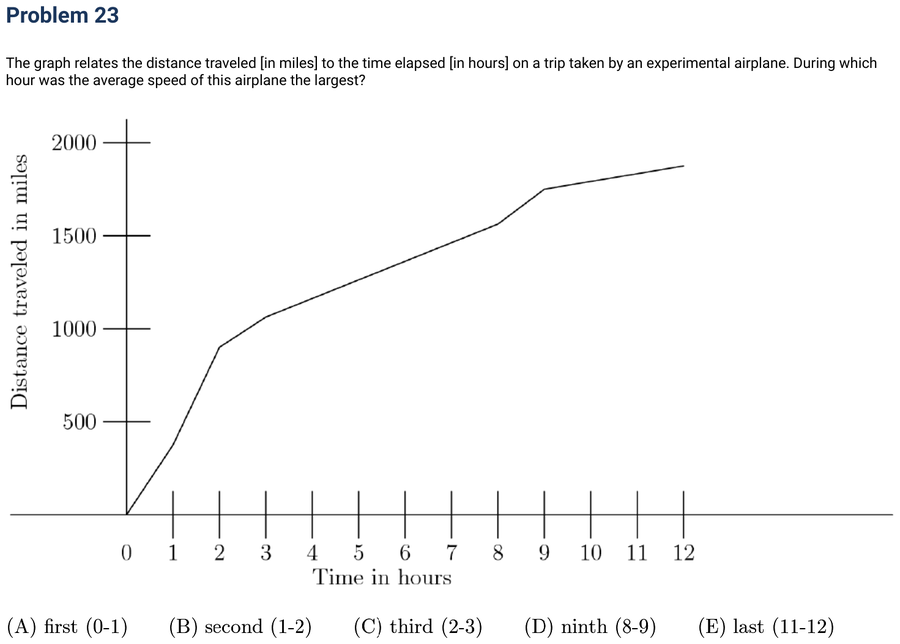
Problem 23 · 1990 AJHSME Hard
Ratios, Rates & Proportions read-graph slope
ajhsme-1990-23
Show hint (soft nudge)
Average speed in an hour is how much the distance rose that hour — the steepness.
Show hint (sharpest)
Find the steepest one-hour rise on the graph.
Show solution
  1. The distance jumps the most between hours 1 and 2 (about 500 miles), steeper than any other hour.
  2. So the largest average speed is during the second hour (1-2).
B The second hour (1-2).
Mark: · log in to save
Problem 24 · 1990 AJHSME Stretch
Algebra & Patterns substitution balance
ajhsme-1990-24
Show hint (soft nudge)
Write the two balances as equations: 3 triangles + 1 diamond = 9 circles, and 1 triangle = 1 diamond + 1 circle.
Show hint (sharpest)
Substitute to eliminate the triangles.
Show solution
  1. From 3T + D = 9C and T = D + C: 3(D + C) + D = 9C gives 4D = 6C, so 2D = 3C.
  2. Thus two diamonds balance 3 circles.
C 3.
Mark: · log in to save
Problem 25 · 1990 AJHSME Stretch
Counting & Probability counting-up-to-symmetry
ajhsme-1990-25
Show hint (soft nudge)
The nine cells come in three kinds: center, edges, and corners.
Show hint (sharpest)
Group the chosen pairs by the kinds of the two cells and their relative position.
Show solution
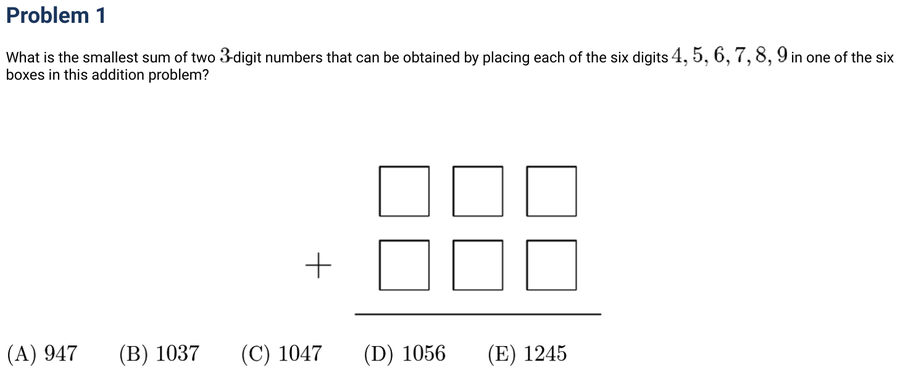
  1. Sort the two-cell choices by type: center+edge, center+corner, two adjacent edges, two opposite edges, two adjacent corners, two diagonal corners, corner+touching edge, corner+far edge.
  2. These give 8 patterns that can't be matched by any flip or turn, so the answer is 8.
C 8.
Mark: · log in to save