Problem 1 · 1991 AJHSME
Easy
Arithmetic & Operations
subtraction
1,000,000,000,000 − 777,777,777,777 =
(A) 222,222,222,222
(B) 222,222,222,223
(C) 233,333,333,333
(D) 322,222,222,223
(E) 333,333,333,333
Show hint (soft nudge)
Compare with 999,999,999,999 − 777,777,777,777, which is all 2's.
Show hint (sharpest)
Subtracting from one more than that adds 1.
Show solution
999,999,999,999 − 777,777,777,777 = 222,222,222,222. Our top number is 1 larger, so the answer is 222,222,222,222 + 1 = 222,222,222,223 .
B
222,222,222,223.
Mark:
easy
got-it
tough
follow-up
clear
· log in to save
Problem 2 · 1991 AJHSME
Easy
Arithmetic & Operations
order-of-operations
(A) 4
(B) 8
(C) 12
(D) 16
(E) 20
Show hint (soft nudge)
Work out the top and the bottom separately first.
Show hint (sharpest)
Then divide.
Show solution
Top: 16 + 8 = 24. Bottom: 4 − 2 = 2. 24 ÷ 2 = 12 .
C
12.
Mark:
easy
got-it
tough
follow-up
clear
· log in to save
Problem 3 · 1991 AJHSME
Easy
Arithmetic & Operations
powers-of-ten
Two hundred thousand times two hundred thousand equals
(A) four hundred thousand
(B) four million
(C) forty thousand
(D) four hundred million
(E) forty billion
Show hint (soft nudge)
Multiply 2 × 2 and count the zeros.
Show hint (sharpest)
200,000 has five zeros.
Show solution
(2 × 10⁵) × (2 × 10⁵) = 4 × 10¹⁰. 4 × 10¹⁰ = 40,000,000,000 = forty billion .
E
forty billion.
Mark:
easy
got-it
tough
follow-up
clear
· log in to save
Problem 4 · 1991 AJHSME
Medium
Algebra & Patterns
sum-near-round-number
If 991 + 993 + 995 + 997 + 999 = 5000 − N , then N =
(A) 5
(B) 10
(C) 15
(D) 20
(E) 25
Show hint (soft nudge)
Each term is a little under 1000; how much under?
Show hint (sharpest)
The five shortfalls add to N.
Show solution
The five numbers fall short of 1000 by 9, 7, 5, 3, 1, totaling 25, so the sum is 5000 − 25. Thus N = 25 .
E
25.
Mark:
easy
got-it
tough
follow-up
clear
· log in to save
Problem 5 · 1991 AJHSME
Medium
Geometry & Measurement
parity
tiling
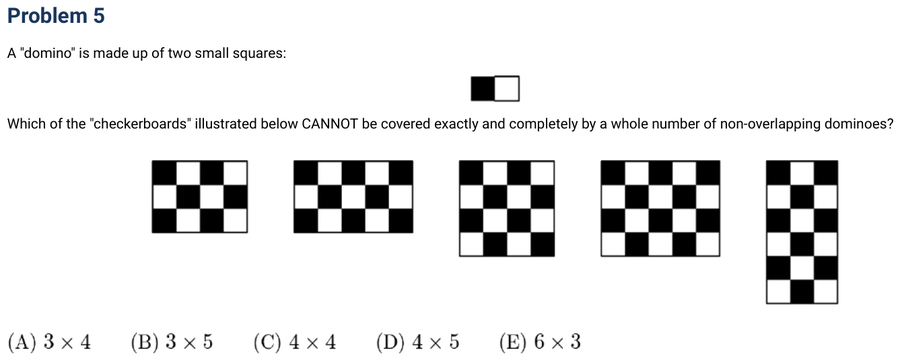
(A)
(B)
(C)
(D)
(E)
Show hint (soft nudge)
Each domino covers exactly 2 squares, so a board needs an even number of squares.
Show hint (sharpest)
Compute each board's area.
Show solution
The boards have 12, 15, 16, 20, and 18 squares. Only 3 × 5 = 15 is odd. An odd number of squares can't be split into dominoes, so 3 × 5 cannot be covered.
B
3 × 5.
Mark:
easy
got-it
tough
follow-up
clear
· log in to save
Problem 6 · 1991 AJHSME
Hard
Logic & Word Problems
array-search
(A)
(B)
(C)
(D)
(E)
Show hint (soft nudge)
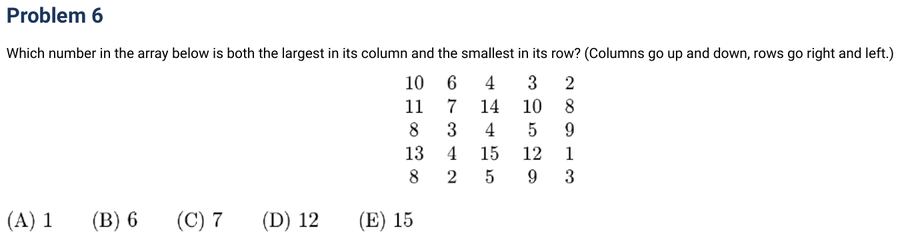
You want a number that is both the biggest in its column and the smallest in its row.
Show hint (sharpest)
Scan each column for its max, then check whether that entry is the min of its row.
Show solution
In the second column the largest entry is 7, and across its row (11, 7, 14, 10, 8) it is the smallest. So the number that is both is 7 .
C
7.
Mark:
easy
got-it
tough
follow-up
clear
· log in to save
Problem 7 · 1991 AJHSME
Hard
Arithmetic & Operations
estimation
factoring
(A)
(B)
(C)
(D)
(E)
Show hint (soft nudge)
The numerator has 487,000 as a common factor — pull it out.
Show hint (sharpest)
Then round each piece to a power of ten.
Show solution
The numerator is 487,000 × (12,027,300 + 9,621,001) ≈ (5 × 10⁵)(2 × 10⁷) = 10¹³. The denominator is about (2 × 10⁴)(0.05) = 10³, so the value ≈ 10¹³ ÷ 10³ = 10¹⁰ .
D
About 10,000,000,000.
Mark:
easy
got-it
tough
follow-up
clear
· log in to save
Problem 8 · 1991 AJHSME
Medium
Arithmetic & Operations
max-quotient
signs
What is the largest quotient that can be formed using two numbers chosen from the set {−24, −3, −2, 1, 2, 8}?
(A) −24
(B) −3
(C) 8
(D) 12
(E) 24
Show hint (soft nudge)
For a big positive quotient, divide a large-magnitude number by a small one.
Show hint (sharpest)
Two negatives divide to a positive.
Show solution
Dividing −24 by −2 gives a positive quotient of 12, the biggest possible. So the largest quotient is 12 .
D
12.
Mark:
easy
got-it
tough
follow-up
clear
· log in to save
Problem 9 · 1991 AJHSME
Hard
Number Theory
inclusion-exclusion
How many whole numbers from 1 through 46 are divisible by either 3 or 5 or both?
(A) 18
(B) 21
(C) 24
(D) 25
(E) 27
Show hint (soft nudge)
Count multiples of 3 and of 5 separately.
Show hint (sharpest)
Subtract the multiples of 15, which got counted twice.
Show solution
Multiples of 3: ⌊46/3⌋ = 15; of 5: ⌊46/5⌋ = 9; of 15: ⌊46/15⌋ = 3. So 15 + 9 − 3 = 21 .
B
21.
Mark:
easy
got-it
tough
follow-up
clear
· log in to save
Problem 10 · 1991 AJHSME
Medium
Geometry & Measurement
base-height
(A)
(B)
(C)
(D)
(E)
Show hint (soft nudge)
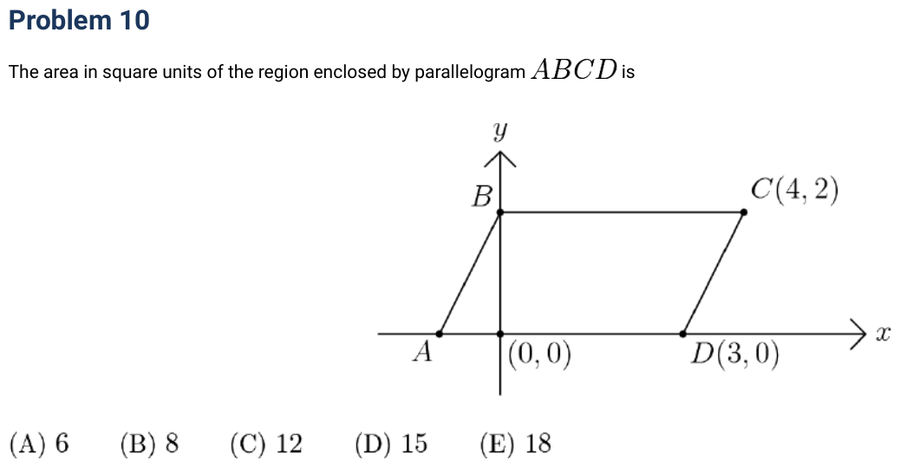
Use the horizontal side BC as the base.
Show hint (sharpest)
The height is the vertical gap between the top and bottom sides.
Show solution
The top side BC runs from (0,2) to (4,2), a base of 4, and the parallelogram's height (top row at y=2 down to the bottom at y=0) is 2. Area = 4 × 2 = 8 .
B
8.
Mark:
easy
got-it
tough
follow-up
clear
· log in to save
Problem 11 · 1991 AJHSME
Medium
Counting & Probability
count-pairs
There are several sets of three different numbers whose sum is 15 which can be chosen from {1, 2, 3, 4, 5, 6, 7, 8, 9}. How many of these sets contain a 5?
(A) 3
(B) 4
(C) 5
(D) 6
(E) 7
Show hint (soft nudge)
If 5 is in the set, the other two numbers must add to 10.
Show hint (sharpest)
Count distinct pairs (not using 5) that sum to 10.
Show solution
The other two numbers must sum to 15 − 5 = 10, both different and not 5. Those pairs are (1,9), (2,8), (3,7), (4,6) — 4 sets.
B
4.
Mark:
easy
got-it
tough
follow-up
clear
· log in to save
Problem 12 · 1991 AJHSME
Medium
Arithmetic & Operations
average
If 2 + 3 + 4 3 1990 + 1991 + 1992 N N =
(A) 3
(B) 6
(C) 1990
(D) 1991
(E) 1992
Show hint (soft nudge)
The left side is the average of 2, 3, 4, which is 3.
Show hint (sharpest)
For the right side to equal 3, N must be the count that makes its average 3 — i.e. the sum divided by 3.
Show solution
The left side equals 3. The right side is 5973/N, so 5973/N = 3 gives N = 5973 ÷ 3. That is N = 1991 (the middle of 1990, 1991, 1992).
D
1991.
Mark:
easy
got-it
tough
follow-up
clear
· log in to save
Problem 13 · 1991 AJHSME
Hard
Number Theory
trailing-zeros
factor-2-and-5
How many zeros are at the end of the product 25 × 25 × 25 × 25 × 25 × 25 × 25 × 8 × 8 × 8?
(A) 3
(B) 6
(C) 9
(D) 10
(E) 12
Show hint (soft nudge)
Each trailing zero comes from a pair of factors 2 and 5.
Show hint (sharpest)
Count the total 2's and 5's; the smaller count wins.
Show solution
The product is 25⁷ · 8³ = 5¹⁴ · 2⁹, giving fourteen 5's and nine 2's. Trailing zeros = the smaller count = 9 .
C
9.
Mark:
easy
got-it
tough
follow-up
clear
· log in to save
Problem 14 · 1991 AJHSME
Stretch
Counting & Probability
worst-case
parity
Several students are competing in a series of three races. A student earns 5 points for winning a race, 3 points for finishing second, and 1 point for finishing third. There are no ties. What is the smallest number of points a student must earn in the three races to be guaranteed of earning more points than any other student?
(A) 9
(B) 10
(C) 11
(D) 13
(E) 15
Show hint (soft nudge)
Each race awards 5, 3, 1 — all odd — so a 3-race total is always odd.
Show hint (sharpest)
Find the lowest odd total that no rival can match.
Show solution
Race totals are sums of three odd numbers, hence always odd. With 13 points (say 5 + 5 + 3), the best a rival can scrape together from the leftovers is 5 + 3 + 3 = 11. Any total of 11 could be tied, so the guaranteed-winning minimum is 13 .
D
13.
Mark:
easy
got-it
tough
follow-up
clear
· log in to save
Problem 15 · 1991 AJHSME
Hard
Geometry & Measurement
surface-area
invariance
(A)
(B)
(C)
(D)
(E)
Show hint (soft nudge)
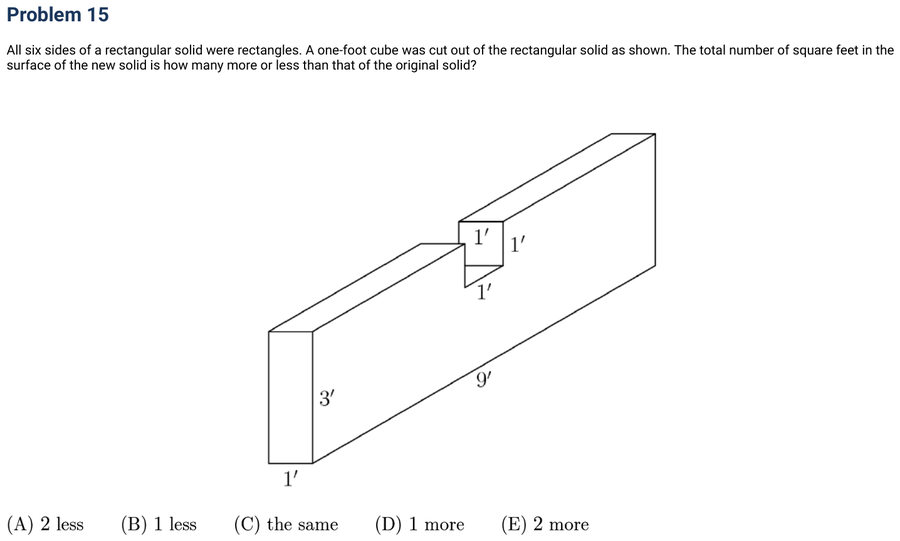
Count the faces of the cut-out cube that were on the surface, and the new faces it uncovers.
Show hint (sharpest)
Removing a corner cube trades the same number of squares away as it reveals.
Show solution
Cutting the unit cube out of the corner removes three exposed unit squares but uncovers three new ones inside the notch. The two amounts cancel, so the surface area stays the same .
C
the same.
Mark:
easy
got-it
tough
follow-up
clear
· log in to save
Problem 16 · 1991 AJHSME
Stretch
Geometry & Measurement
folding
spatial
(A)
(B)
(C)
(D)
(E)
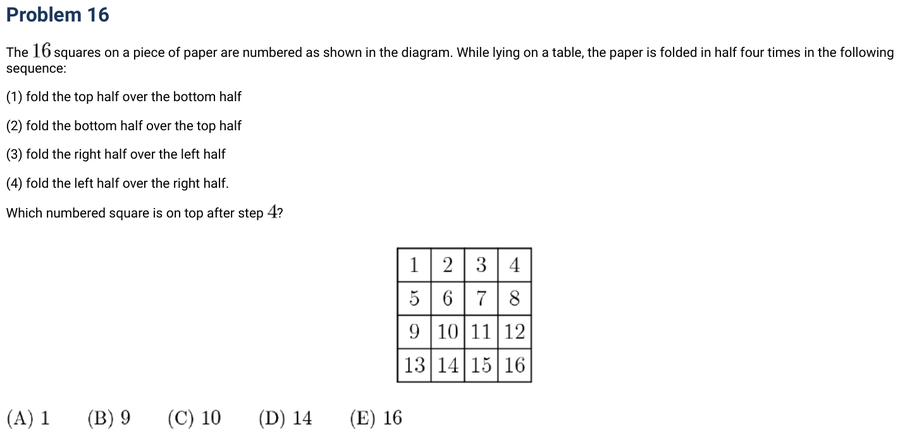
Show hint (soft nudge)
Track one square's position through each of the four folds.
Show hint (sharpest)
Each fold maps the grid onto half its size; see which number ends up on top.
Show solution
Folding top-over-bottom, then bottom-over-top, then right-over-left, then left-over-right collapses the 4 × 4 grid to a single stack. Carefully tracking which square lands on top, it is the square numbered 9 .
B
9.
Mark:
easy
got-it
tough
follow-up
clear
· log in to save
Problem 17 · 1991 AJHSME
Stretch
Counting & Probability
max-independent
sum
An auditorium with 20 rows of seats has 10 seats in the first row. Each successive row has one more seat than the previous row. If students taking an exam are permitted to sit in any row, but not next to another student in that row, then the maximum number of students that can be seated for an exam is
(A) 150
(B) 180
(C) 200
(D) 400
(E) 460
Show hint (soft nudge)
In a row of n seats, the most students with gaps between them is ⌈n/2⌉.
Show hint (sharpest)
Add ⌈n/2⌉ for n = 10, 11, …, 29.
Show solution
Rows hold 10 through 29 seats; each fits ⌈n/2⌉ students: 5, 6, 6, 7, 7, …, 15. Adding these row-maxima gives 200 .
C
200.
Mark:
easy
got-it
tough
follow-up
clear
· log in to save
Problem 18 · 1991 AJHSME
Hard
Fractions, Decimals & Percents
pictograph
percent
(A)
(B)
(C)
(D)
(E)
Show hint (soft nudge)
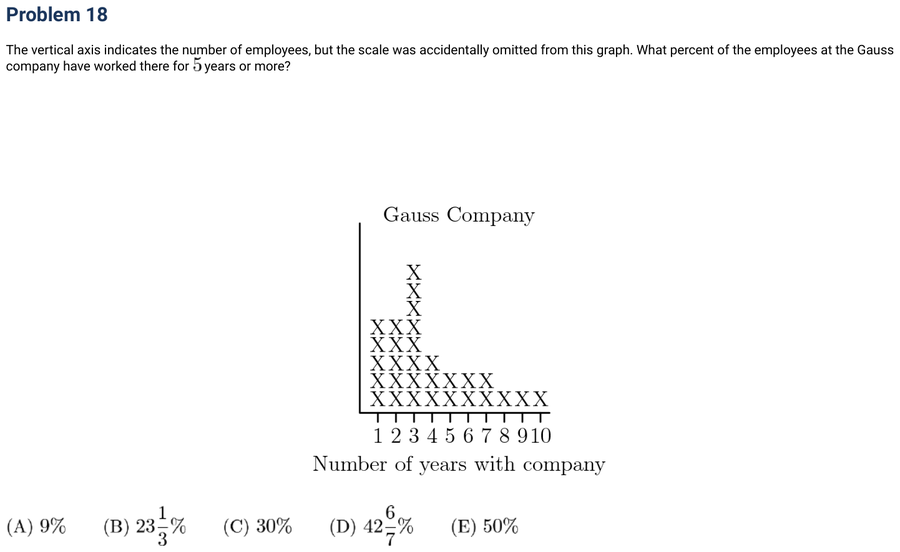
Even with no scale, each X stands for the same number of employees, so count X's.
Show hint (sharpest)
Add the X's for 5 years or more and divide by the total number of X's.
Show solution
Each X represents the same number of employees, so the percent is just (X's for 5+ years) ÷ (total X's). Counting the columns, that fraction comes out to 30% .
C
30%.
Mark:
easy
got-it
tough
follow-up
clear
· log in to save
Problem 19 · 1991 AJHSME
Hard
Algebra & Patterns
minimize-rest
The average (arithmetic mean) of 10 different positive whole numbers is 10. The largest possible value of any of these numbers is
(A) 10
(B) 50
(C) 55
(D) 90
(E) 91
Show hint (soft nudge)
The ten numbers add to 10 × 10 = 100.
Show hint (sharpest)
To make one as big as possible, make the other nine as small as possible (and different).
Show solution
The numbers total 100. The nine smallest different positive numbers are 1, 2, …, 9, summing to 45. So the largest can be 100 − 45 = 55 .
C
55.
Mark:
easy
got-it
tough
follow-up
clear
· log in to save
Problem 20 · 1991 AJHSME
Stretch
Number Theory
cryptarithm
place-value
(A)
(B)
(C)
(D)
(E)
Show hint (soft nudge)
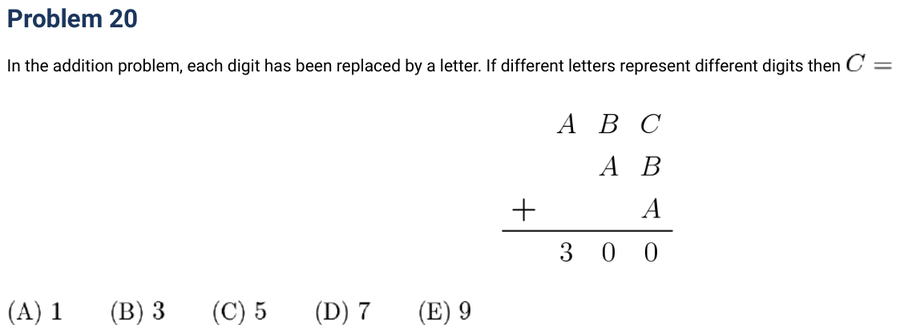
Add the column-place values: ABC + AB + A = 111·A + 11·B + C.
Show hint (sharpest)
Set that equal to 300 and find digits A, B, C.
Show solution
111A + 11B + C = 300. Taking A = 2 gives 11B + C = 78, so B = 7 and C = 1 (271 + 27 + 2 = 300). All digits differ, so C = 1 .
A
1.
Mark:
easy
got-it
tough
follow-up
clear
· log in to save
Problem 21 · 1991 AJHSME
Medium
Algebra & Patterns
linear-rate
For every 3° rise in temperature, the volume of a certain gas expands by 4 cubic centimeters. If the volume of the gas is 24 cubic centimeters when the temperature is 32°, what was the volume in cubic centimeters when the temperature was 20°?
(A) 8
(B) 12
(C) 15
(D) 16
(E) 40
Show hint (soft nudge)
From 32° down to 20° is a 12° drop — how many 3° steps is that?
Show hint (sharpest)
Each step removes 4 cm³.
Show solution
A 12° drop is four 3° steps, each shrinking the gas by 4 cm³, for 16 cm³ less. So the volume was 24 − 16 = 8 cm³.
A
8.
Mark:
easy
got-it
tough
follow-up
clear
· log in to save
Problem 22 · 1991 AJHSME
Hard
Counting & Probability
complementary
parity
(A)
(B)
(C)
(D)
(E)
Show hint (soft nudge)
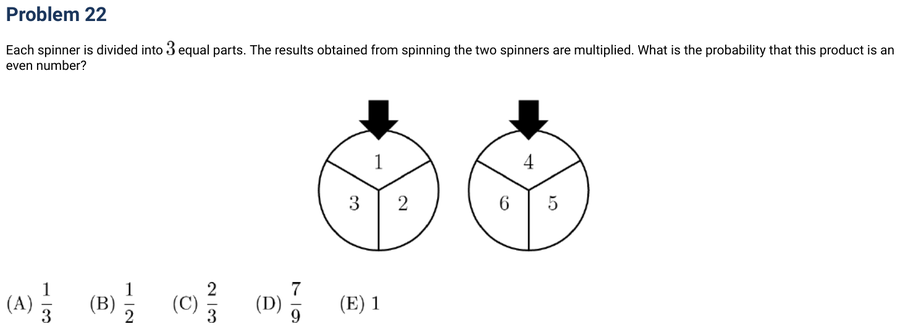
A product is even unless BOTH spins are odd.
Show hint (sharpest)
Find each spinner's chance of landing odd, then multiply for 'both odd'.
Show solution
Spinner 1 is odd (1 or 3) with probability 2/3; spinner 2 is odd (5) with probability 1/3. Both odd: 2/3 · 1/3 = 2/9, so an even product has probability 1 − 2/9 = 7/9 .
D
7/9.
Mark:
easy
got-it
tough
follow-up
clear
· log in to save
Problem 23 · 1991 AJHSME
Stretch
Counting & Probability
inclusion-exclusion
venn
The Pythagoras High School band has 100 female and 80 male members. The orchestra has 80 female and 100 male members. There are 60 females who are in both band and orchestra. Altogether there are 230 students who are in either band or orchestra or both. The number of males in the band who are NOT in the orchestra is
(A) 10
(B) 20
(C) 30
(D) 50
(E) 70
Show hint (soft nudge)
First find how many distinct females there are, then subtract to get the distinct males.
Show hint (sharpest)
Use inclusion-exclusion on the males to find those in both groups.
Show solution
Distinct females = 100 + 80 − 60 = 120, so distinct males = 230 − 120 = 110. Then males in both = 80 + 100 − 110 = 70. Males in band but not orchestra = 80 − 70 = 10 .
A
10.
Mark:
easy
got-it
tough
follow-up
clear
· log in to save
Problem 24 · 1991 AJHSME
Stretch
Geometry & Measurement
volume-decomposition
A cube of edge 3 cm is cut into N smaller cubes, not all the same size. If the edge of each smaller cube is a whole number of centimeters, then N =
(A) 4
(B) 8
(C) 12
(D) 16
(E) 20
Show hint (soft nudge)
The total volume is 27, and pieces must be 1×1×1 or 2×2×2.
Show hint (sharpest)
Only one 2-cube fits in a 3-cube; the rest are unit cubes.
Show solution
One 2 × 2 × 2 cube uses 8 of the 27 cubic cm, leaving 19 unit cubes (two 2-cubes won't fit in an edge of 3). That's 1 + 19 = 20 cubes, and they aren't all the same size.
E
20.
Mark:
easy
got-it
tough
follow-up
clear
· log in to save
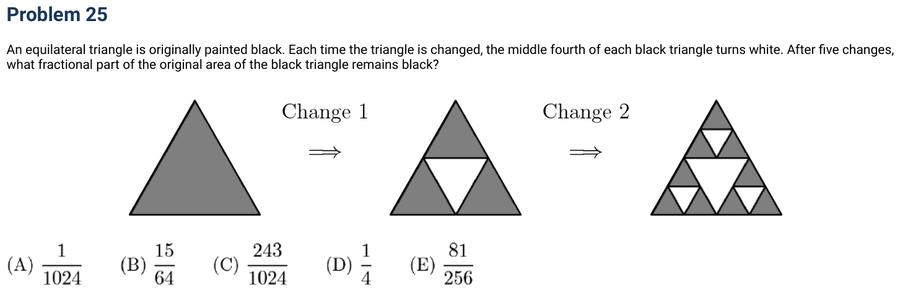
Problem 25 · 1991 AJHSME
Stretch
Geometry & Measurement
geometric-fraction
(A)
(B)
(C)
(D)
(E)
Show hint (soft nudge)
Each change turns the middle fourth of every black triangle white.
Show hint (sharpest)
So each change keeps 3/4 of the black area; apply that five times.
Show solution
Turning the middle fourth white leaves 3/4 of each black triangle black, so after 5 changes the black fraction is (3/4)⁵. (3/4)⁵ = 243/1024.
C
243/1024.
Mark:
easy
got-it
tough
follow-up
clear
· log in to save