Problem 1 · 1992 AJHSME
Medium
Arithmetic & Operations
pair-terms
(A)
(B)
(C)
(D)
(E)
Show hint (soft nudge)
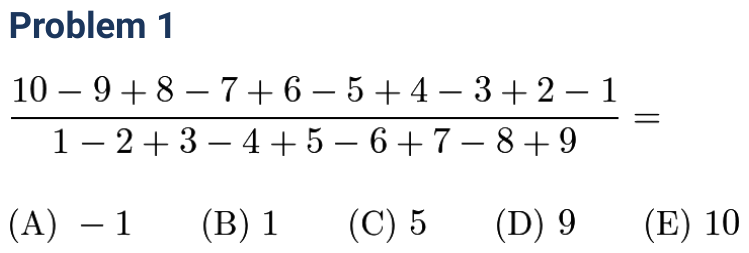
Pair consecutive terms in the top, and in the bottom, to add them up quickly.
Show hint (sharpest)
Both the numerator and the denominator come out to 5.
Show solution
Top: (10−9)+(8−7)+(6−5)+(4−3)+(2−1) = 5. Bottom: (1−2)+(3−4)+(5−6)+(7−8)+9 = −4+9 = 5. So the value is 5/5 = 1 .
B
1.
Mark:
easy
got-it
tough
follow-up
clear
· log in to save
Problem 2 · 1992 AJHSME
Easy
Fractions, Decimals & Percents
compare-fractions
(A)
(B)
(C)
(D)
(E)
Show hint (soft nudge)
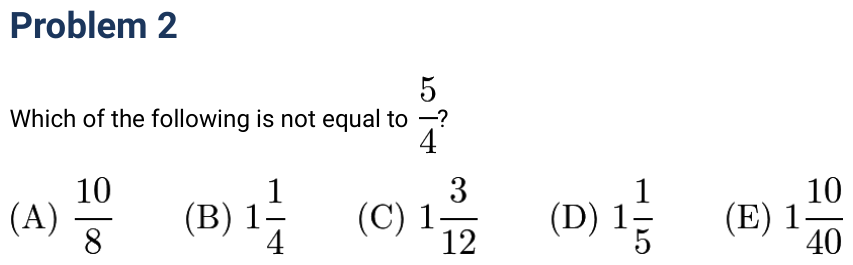
5/4 = 1.25 — convert each choice and compare.
Show hint (sharpest)
A mixed number like 1 1/5 equals 1.2.
Show solution
5/4 = 1.25. The choices 10/8, 1¼, 1 3/12, and 1 10/40 all equal 1.25. But 1 1/5 = 1.2, so 1 1/5 is the one that's not equal.
D
1 1/5.
Mark:
easy
got-it
tough
follow-up
clear
· log in to save
Problem 3 · 1992 AJHSME
Easy
Arithmetic & Operations
max-min
What is the largest difference that can be formed by subtracting two numbers chosen from the set {−16, −4, 0, 2, 4, 12}?
(A) 10
(B) 12
(C) 16
(D) 28
(E) 48
Show hint (soft nudge)
A difference is largest when you subtract the smallest number from the largest.
Show hint (sharpest)
Subtracting a negative adds.
Show solution
The biggest difference is 12 − (−16). That equals 12 + 16 = 28 .
D
28.
Mark:
easy
got-it
tough
follow-up
clear
· log in to save
Problem 4 · 1992 AJHSME
Medium
Fractions, Decimals & Percents
percent
During the softball season, Judy had 35 hits. Among her hits were 1 home run, 1 triple, and 5 doubles. The rest of her hits were singles. What percent of her hits were singles?
(A) 28%
(B) 35%
(C) 70%
(D) 75%
(E) 80%
Show hint (soft nudge)
Count the non-single hits first and subtract.
Show hint (sharpest)
Then write the singles as a fraction of 35.
Show solution
Non-singles: 1 + 1 + 5 = 7, so singles = 35 − 7 = 28. 28/35 = 80% .
E
80%.
Mark:
easy
got-it
tough
follow-up
clear
· log in to save
Problem 5 · 1992 AJHSME
Medium
Geometry & Measurement
area-subtraction
(A)
(B)
(C)
(D)
(E)
Show hint (soft nudge)
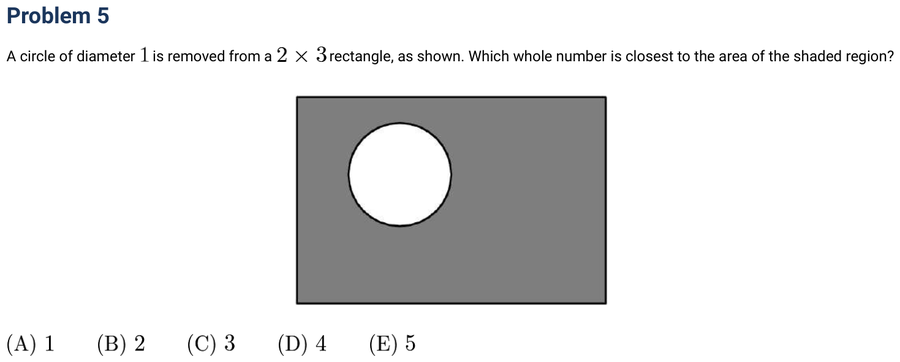
Find the rectangle's area, then subtract the circle's.
Show hint (sharpest)
The circle has diameter 1, so radius 1/2.
Show solution
The rectangle is 2 × 3 = 6, and the circle has area π(1/2)² ≈ 0.79. 6 − 0.79 ≈ 5.2, closest to 5 .
E
5.
Mark:
easy
got-it
tough
follow-up
clear
· log in to save
Problem 6 · 1992 AJHSME
Medium
Algebra & Patterns
custom-operation
(A)
(B)
(C)
(D)
(E)
Show hint (soft nudge)
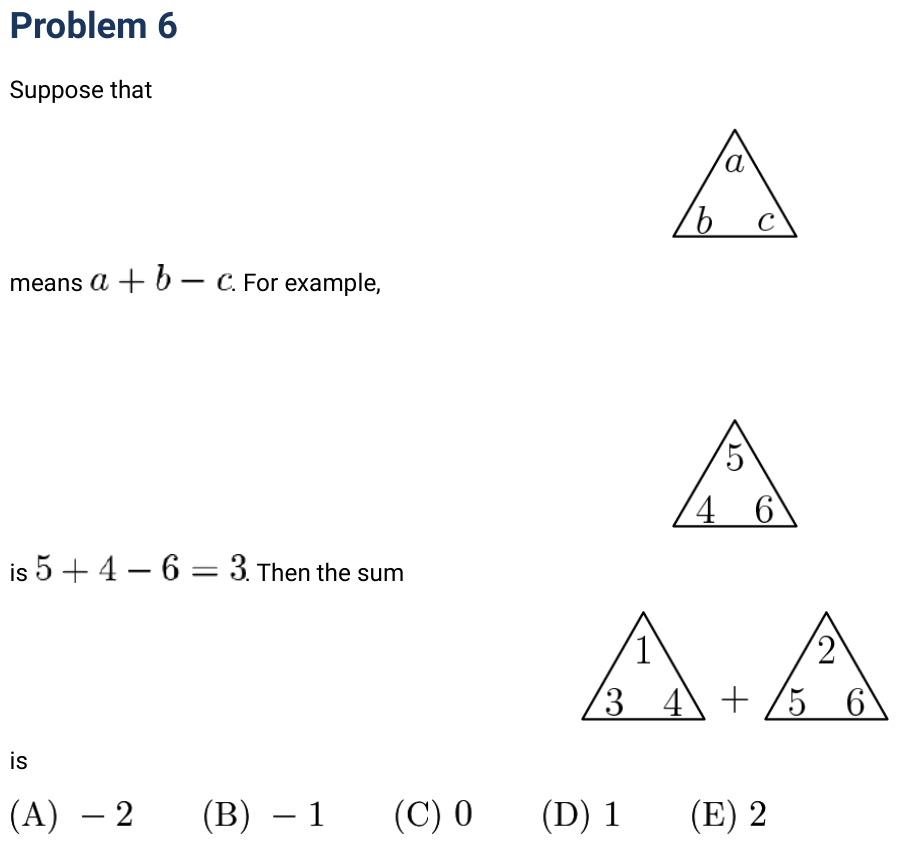
Each triangle means top + bottom-left − bottom-right.
Show hint (sharpest)
Evaluate both triangles, then add.
Show solution
First triangle: 1 + 3 − 4 = 0. Second triangle: 2 + 5 − 6 = 1. Their sum is 0 + 1 = 1 .
D
1.
Mark:
easy
got-it
tough
follow-up
clear
· log in to save
Problem 7 · 1992 AJHSME
Hard
Counting & Probability
digit-sum
parity
The digit-sum of 998 is 9 + 9 + 8 = 26. How many 3-digit whole numbers, whose digit-sum is 26, are even?
(A) 1
(B) 2
(C) 3
(D) 4
(E) 5
Show hint (soft nudge)
A digit-sum of 26 is just 1 below the maximum 27, so the digits are nearly all 9s.
Show hint (sharpest)
An even number needs an even units digit.
Show solution
Digit-sum 26 means the digits are 9, 9, 8 in some order: 998, 989, 899. Only 998 is even, so the answer is 1 .
A
1.
Mark:
easy
got-it
tough
follow-up
clear
· log in to save
Problem 8 · 1992 AJHSME
Medium
Algebra & Patterns
cost-revenue-profit
A store owner bought 1500 pencils at $0.10 each. If he sells them for $0.25 each, how many of them must he sell to make a profit of exactly $100.00?
(A) 400
(B) 667
(C) 1000
(D) 1500
(E) 1900
Show hint (soft nudge)
First find his total cost, then the revenue needed for a $100 profit.
Show hint (sharpest)
Divide that revenue by the $0.25 selling price.
Show solution
Cost is 1500 × $0.10 = $150, so he needs $150 + $100 = $250 in sales. At $0.25 each, that's $250 ÷ $0.25 = 1000 pencils.
C
1000.
Mark:
easy
got-it
tough
follow-up
clear
· log in to save
Problem 9 · 1992 AJHSME
Hard
Fractions, Decimals & Percents
read-graph
ratio
(A)
(B)
(C)
(D)
(E)
Show hint (soft nudge)
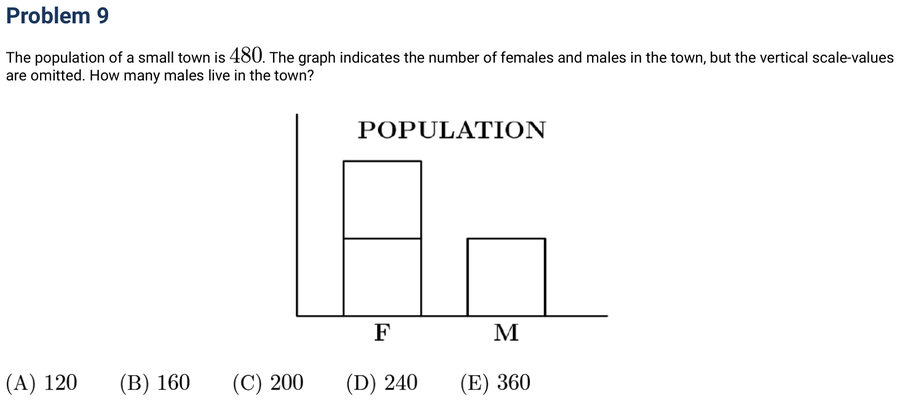
The line across the F bar shows it is twice as tall as the M bar.
Show hint (sharpest)
So females and males split the 480 in a 2 : 1 ratio.
Show solution
The female bar is twice the male bar, so the town is 2 parts female to 1 part male — 3 parts total. Each part is 480 ÷ 3 = 160, so there are 160 males.
B
160.
Mark:
easy
got-it
tough
follow-up
clear
· log in to save
Problem 10 · 1992 AJHSME
Hard
Geometry & Measurement
count-congruent-pieces
(A)
(B)
(C)
(D)
(E)
Show hint (soft nudge)
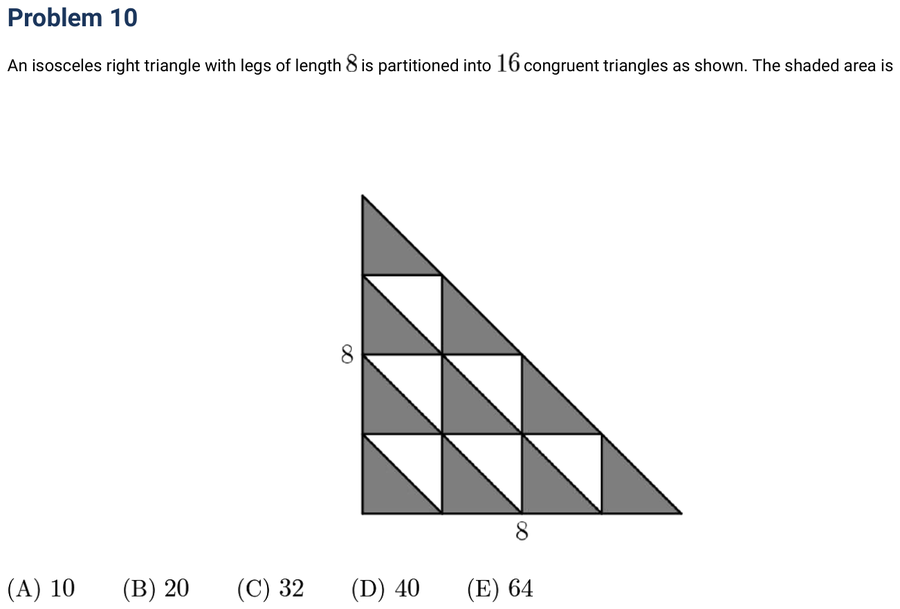
First find the area of one of the 16 small triangles.
Show hint (sharpest)
Then count how many small triangles are shaded.
Show solution
The big triangle has area ½ · 8 · 8 = 32, so each of the 16 congruent pieces is 2. Ten of them are shaded, giving 10 × 2 = 20 .
B
20.
Mark:
easy
got-it
tough
follow-up
clear
· log in to save
Problem 11 · 1992 AJHSME
Medium
Fractions, Decimals & Percents
read-graph
percent
(A)
(B)
(C)
(D)
(E)
Show hint (soft nudge)
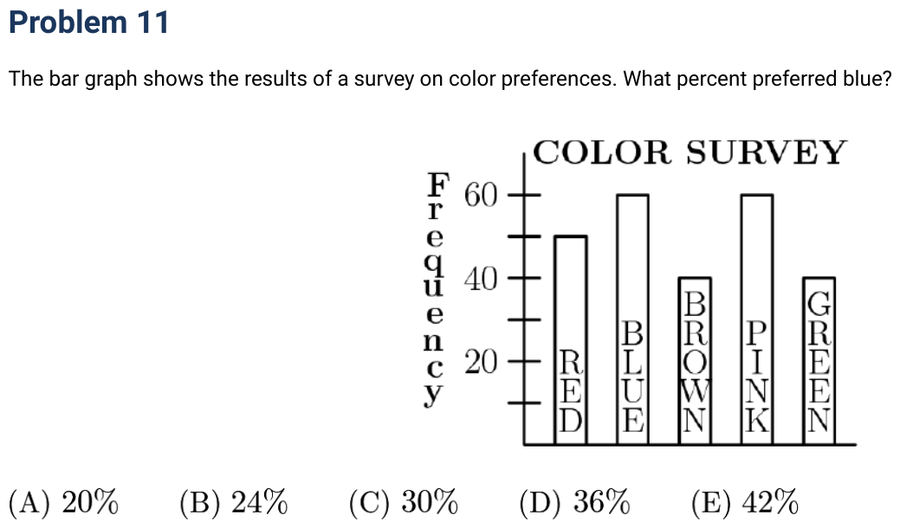
Read every bar's frequency and add for the total.
Show hint (sharpest)
Blue's frequency over the total gives the percent.
Show solution
The frequencies are 50, 60, 40, 60, 40, summing to 250. Blue is 60, so 60/250 = 24% .
B
24%.
Mark:
easy
got-it
tough
follow-up
clear
· log in to save
Problem 12 · 1992 AJHSME
Medium
Ratios, Rates & Proportions
total-divided
The five tires of a car (four road tires and a full-sized spare) were rotated so that each tire was used the same number of miles during the first 30,000 miles the car traveled. For how many miles was each tire used?
(A) 6000
(B) 7500
(C) 24,000
(D) 30,000
(E) 37,500
Show hint (soft nudge)
Only 4 tires are on the road at any moment, so count total tire-miles.
Show hint (sharpest)
Share those tire-miles equally among all 5 tires.
Show solution
Four tires are used over 30,000 miles, for 4 × 30,000 = 120,000 tire-miles. Split among 5 tires: 120,000 ÷ 5 = 24,000 miles each.
C
24,000 miles.
Mark:
easy
got-it
tough
follow-up
clear
· log in to save
Problem 13 · 1992 AJHSME
Hard
Arithmetic & Operations
mean-median-mode
Five test scores have a mean of 90, a median of 91, and a mode of 94. The sum of the two lowest test scores is
(A) 170
(B) 171
(C) 176
(D) 177
(E) not determined by the information given
Show hint (soft nudge)
The five scores total 5 × 90; the median is the 3rd score.
Show hint (sharpest)
The mode 94 must be the two highest scores.
Show solution
The scores total 450. The median is 91 (the 3rd), and the mode 94 (twice) must be the 4th and 5th: so the top three are 91, 94, 94 = 279. The two lowest sum to 450 − 279 = 171 .
B
171.
Mark:
easy
got-it
tough
follow-up
clear
· log in to save
Problem 14 · 1992 AJHSME
Medium
Fractions, Decimals & Percents
fraction-of
When four gallons are added to a tank that is one-third full, the tank is then one-half full. The capacity of the tank in gallons is
(A) 8
(B) 12
(C) 20
(D) 24
(E) 48
Show hint (soft nudge)
The 4 gallons raised the level from 1/3 to 1/2 — what fraction is that?
Show hint (sharpest)
Then scale up to the full tank.
Show solution
1/2 − 1/3 = 1/6 of the tank equals 4 gallons. So the full tank is 6 × 4 = 24 gallons.
D
24.
Mark:
easy
got-it
tough
follow-up
clear
· log in to save
Problem 15 · 1992 AJHSME
Hard
Number Theory
periodic-sequence
mod
What is the 1992nd letter in the sequence ABCDEDCBAABCDEDCBAABCDEDCBA… ?
(A) A
(B) B
(C) C
(D) D
(E) E
Show hint (soft nudge)
The block ABCDEDCBA repeats; count its length.
Show hint (sharpest)
Find 1992 modulo that length.
Show solution
The block ABCDEDCBA has 9 letters and repeats. 1992 = 9·221 + 3, so the 1992nd letter is the 3rd of the block: C .
C
C.
Mark:
easy
got-it
tough
follow-up
clear
· log in to save
Problem 16 · 1992 AJHSME
Hard
Geometry & Measurement
volume-cylinder
(A)
(B)
(C)
(D)
(E)
Show hint (soft nudge)
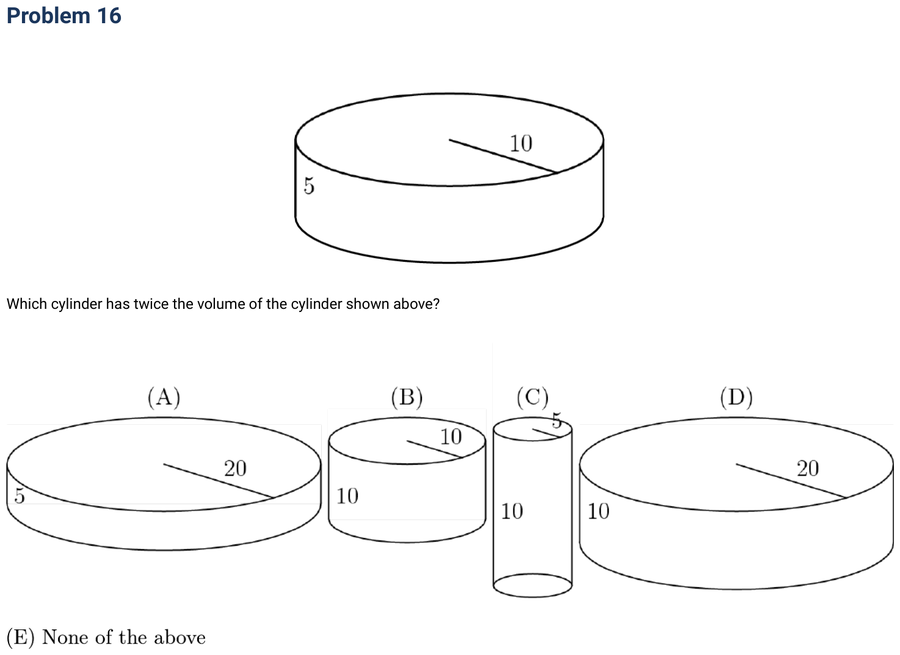
Volume of a cylinder is π · radius² · height.
Show hint (sharpest)
Doubling can come from doubling the height (radius squared matters most).
Show solution
The original has radius 10, height 5: volume π·100·5 = 500π. Twice that is 1000π. Cylinder B (radius 10, height 10) gives π·100·10 = 1000π — exactly double. So B .
B
Cylinder B.
Mark:
easy
got-it
tough
follow-up
clear
· log in to save
Problem 17 · 1992 AJHSME
Hard
Geometry & Measurement
triangle-inequality
The sides of a triangle have lengths 6.5, 10, and s , where s is a whole number. What is the smallest possible value of s ?
(A) 3
(B) 4
(C) 5
(D) 6
(E) 7
Show hint (soft nudge)
The third side must be longer than the difference of the other two.
Show hint (sharpest)
10 − 6.5 = 3.5, and s is a whole number.
Show solution
For a triangle, s must exceed 10 − 6.5 = 3.5. The smallest whole number greater than 3.5 is 4 .
B
4.
Mark:
easy
got-it
tough
follow-up
clear
· log in to save
Problem 18 · 1992 AJHSME
Medium
Ratios, Rates & Proportions
average-speed
On a trip, a car traveled 80 miles in an hour and a half, then was stopped in traffic for 30 minutes, then traveled 100 miles during the next 2 hours. What was the car's average speed in miles per hour for the 4-hour trip?
(A) 45
(B) 50
(C) 60
(D) 75
(E) 90
Show hint (soft nudge)
Average speed is total distance divided by total time — include the stop.
Show hint (sharpest)
Add 80 + 100 miles over 1.5 + 0.5 + 2 hours.
Show solution
Total distance is 80 + 100 = 180 miles over 1.5 + 0.5 + 2 = 4 hours. Average speed = 180 ÷ 4 = 45 mph.
A
45.
Mark:
easy
got-it
tough
follow-up
clear
· log in to save
Problem 19 · 1992 AJHSME
Hard
Algebra & Patterns
extremal
The distance between the 5th and 26th exits on an interstate highway is 118 miles. If any two exits are at least 5 miles apart, then what is the largest number of miles there can be between two consecutive exits that are between the 5th and 26th exits?
(A) 8
(B) 13
(C) 18
(D) 47
(E) 98
Show hint (soft nudge)
There are 21 gaps between the 5th and 26th exits.
Show hint (sharpest)
To stretch one gap as far as possible, make all the others as small as allowed (5 miles).
Show solution
There are 26 − 5 = 21 gaps. Making 20 of them the minimum 5 miles uses 100 miles. The last gap can be 118 − 100 = 18 miles.
C
18 miles.
Mark:
easy
got-it
tough
follow-up
clear
· log in to save
Problem 20 · 1992 AJHSME
Hard
Geometry & Measurement
net-folding
(A)
(B)
(C)
(D)
(E)
Show hint (soft nudge)
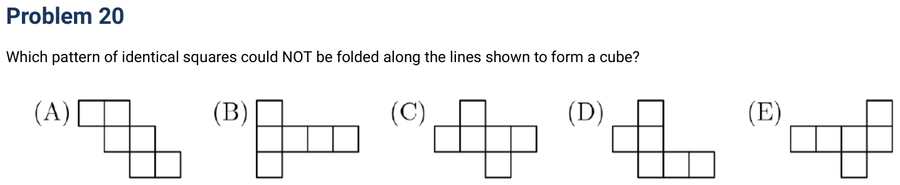
A cube net needs all six squares to fold without two landing on the same face.
Show hint (sharpest)
Mentally fold each; the bad one forces two squares onto the same face.
Show solution
Four of the patterns fold neatly into a cube, each square becoming a different face. Pattern D forces two squares onto the same face (leaving another open), so it cannot form a cube.
D
Pattern D.
Mark:
easy
got-it
tough
follow-up
clear
· log in to save
Problem 21 · 1992 AJHSME
Hard
Fractions, Decimals & Percents
read-graph
percent-comparison
(A)
(B)
(C)
(D)
(E)
Show hint (soft nudge)
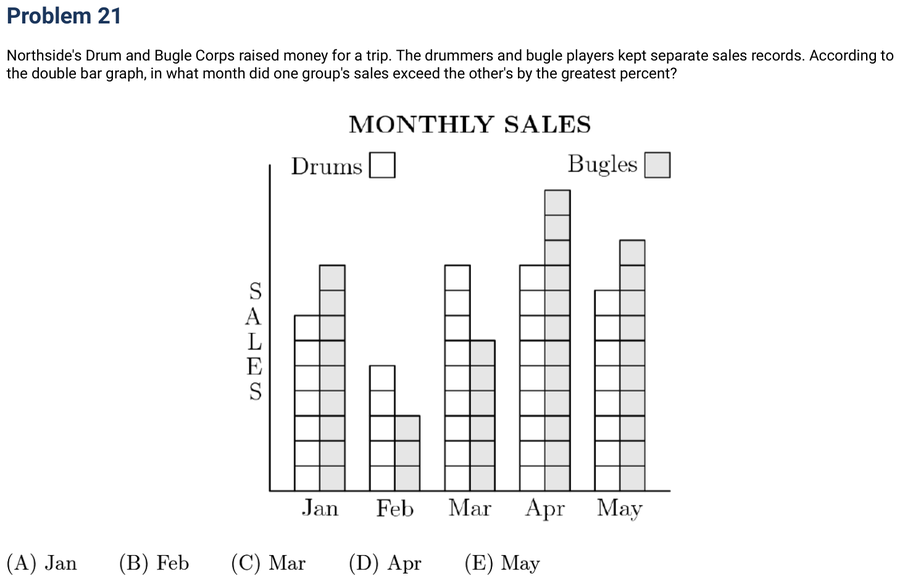
Greatest percent, not greatest amount — a small bar makes a small lead look big.
Show hint (sharpest)
Check the month with the lowest sales, where one bar is a large fraction above the other.
Show solution
In February the bars are smallest, so the one-unit lead of drums over bugles is a 50% difference. No other month's bars give that large a percentage gap, so the answer is February .
B
February.
Mark:
easy
got-it
tough
follow-up
clear
· log in to save
Problem 22 · 1992 AJHSME
Stretch
Geometry & Measurement
perimeter-change
parity
(A)
(B)
(C)
(D)
(E)
Show hint (soft nudge)
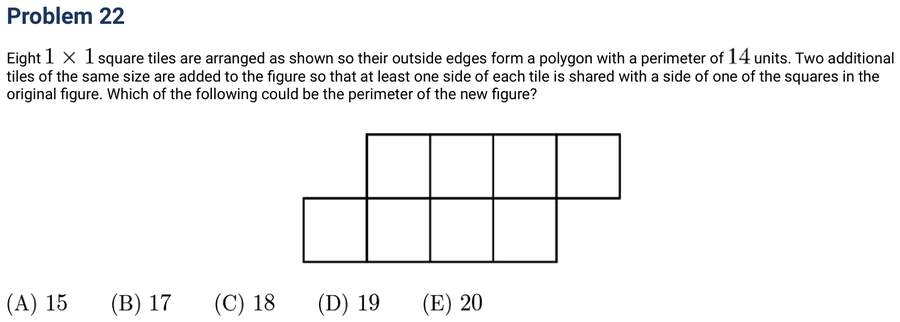
Adding a tile that shares exactly one edge raises the perimeter by 2; sharing more raises it less.
Show hint (sharpest)
Two tiles can add at most 2 + 2 = 4.
Show solution
Each new tile, sharing at least one edge, changes the perimeter by an even amount, at most +2. Starting at 14, two tiles add at most 4, so the largest reachable (even) perimeter is 18 .
C
18.
Mark:
easy
got-it
tough
follow-up
clear
· log in to save
Problem 23 · 1992 AJHSME
Stretch
Counting & Probability
casework
If two dice are tossed, the probability that the product of the numbers showing on the tops of the dice is greater than 10 is
(A) 3 7
(B) 17 36
(C) 1 2
(D) 5 8
(E) 11 12
Show hint (soft nudge)
Case on the larger die value and count how many partners push the product over 10.
Show hint (sharpest)
There are 36 equally likely ordered outcomes.
Show solution
Counting products over 10: a 2 works with 6 (1 way), a 3 with 4–6 (3), a 4 with 3–6 (4), a 5 with 3–6 (4), a 6 with 2–6 (5). That's 1 + 3 + 4 + 4 + 5 = 17 of 36, a probability of 17/36 .
B
17/36.
Mark:
easy
got-it
tough
follow-up
clear
· log in to save
Problem 24 · 1992 AJHSME
Stretch
Geometry & Measurement
area-subtraction
(A)
(B)
(C)
(D)
(E)
Show hint (soft nudge)
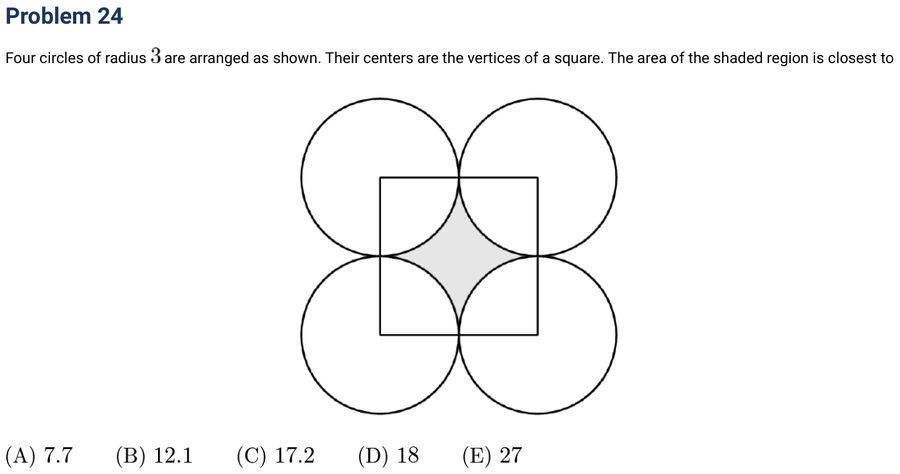
The shaded region is the square minus the four quarter-circle corners.
Show hint (sharpest)
Four quarter-circles make one whole circle.
Show solution
The centers form a square of side 2·3 = 6 (area 36), and the four quarter-circles total one circle of area π·3² ≈ 28.3. So the shaded area is 36 − 28.3 ≈ 7.7 .
A
7.7.
Mark:
easy
got-it
tough
follow-up
clear
· log in to save
Problem 25 · 1992 AJHSME
Stretch
Fractions, Decimals & Percents
telescoping-product
One half of the water is poured out of a full container. Then one third of the remainder is poured out. Continue the process: one fourth of the remainder for the third pouring, one fifth of the remainder for the fourth pouring, and so on. After how many pourings does exactly one tenth of the original water remain?
(A) 6
(B) 7
(C) 8
(D) 9
(E) 10
Show hint (soft nudge)
After each pouring, multiply by what's left: 1/2, then 2/3, then 3/4, …
Show hint (sharpest)
These products telescope to a simple fraction.
Show solution
After k pourings the remaining fraction is ½ · ⅔ · ¾ · … · k/(k+1), which telescopes to 1/(k+1). Setting 1/(k+1) = 1/10 gives k = 9 .
D
9.
Mark:
easy
got-it
tough
follow-up
clear
· log in to save