AJHSME

1995 AJHSME

25 problems — read each, give it a real try, then peek at the hints.

Practice: Take as test →
Problem 1 · 1995 AJHSME Easy
Fractions, Decimals & Percents mental-math

Walter has exactly one penny, one nickel, one dime, and one quarter in his pocket. What percent of one dollar is in his pocket?

Show hint (soft nudge)
Add the coin values in cents.
Show hint (sharpest)
Cents out of 100 is already a percent of a dollar.
Show solution
  1. 1 + 5 + 10 + 25 = 41 cents.
  2. That is 41% of a dollar.
D 41%.
Mark: · log in to save
Problem 2 · 1995 AJHSME Easy
Algebra & Patterns work-through-relations

Jose is 4 years younger than Zack. Zack is 3 years older than Inez. Inez is 15 years old. How old is Jose?

Show hint (soft nudge)
Start from Inez and work outward.
Show hint (sharpest)
Zack is 3 more than Inez; Jose is 4 less than Zack.
Show solution
  1. Zack is 15 + 3 = 18.
  2. Jose is 18 − 4 = 14.
C 14.
Mark: · log in to save
Problem 3 · 1995 AJHSME Medium
Fractions, Decimals & Percents fraction-operations

Which of the following operations has the same effect on a number as multiplying by 34 and then dividing by 35?

Show hint (soft nudge)
Dividing by 3/5 is the same as multiplying by 5/3.
Show hint (sharpest)
Combine the two multipliers into one.
Show solution
  1. Multiplying by 3/4 then dividing by 3/5 is × 3/4 × 5/3.
  2. That simplifies to × 5/4, i.e. multiplying by 5/4.
E multiplying by 5/4.
Mark: · log in to save
Problem 4 · 1995 AJHSME Medium
Arithmetic & Operations two-step-process

A teacher tells the class: "Think of a number, add 1 to it, and double the result. Give the answer to your partner. Partner, subtract 1 from the number you are given and double the result to get your answer." Ben thinks of 6 and gives his answer to Sue. What should Sue's answer be?

Show hint (soft nudge)
Compute Ben's answer first, then feed it into Sue's steps.
Show hint (sharpest)
Each person does: (something ± 1) then double.
Show solution
  1. Ben: (6 + 1) × 2 = 14, which he gives to Sue.
  2. Sue: (14 − 1) × 2 = 26.
C 26.
Mark: · log in to save
Problem 5 · 1995 AJHSME Medium
Fractions, Decimals & Percents estimate-fractions

Find the smallest whole number that is larger than the sum 212 + 313 + 414 + 515.

Show hint (soft nudge)
Add the whole parts first, then the fractions.
Show hint (sharpest)
The four fractions add to a bit more than 1.
Show solution
  1. The whole parts add to 2 + 3 + 4 + 5 = 14, and ½ + ⅓ + ¼ + ⅕ ≈ 1.28.
  2. The sum is about 15.28, so the smallest whole number larger than it is 16.
C 16.
Mark: · log in to save
Problem 6 · 1995 AJHSME Medium
Geometry & Measurement perimeter-side
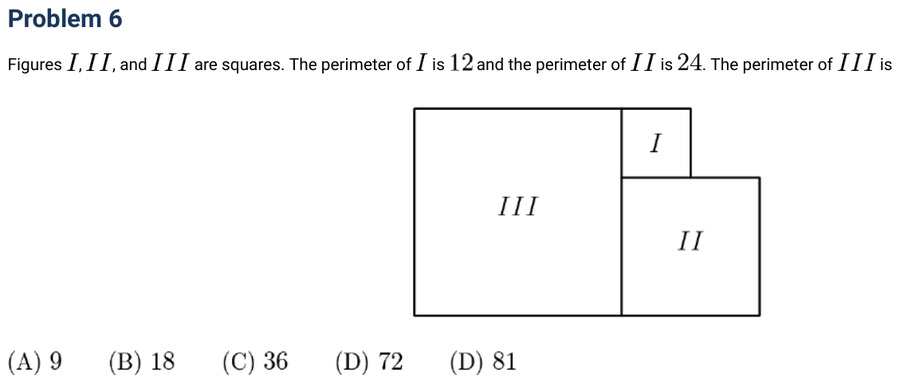
ajhsme-1995-06
Show hint (soft nudge)
Find the side of each small square from its perimeter (÷ 4).
Show hint (sharpest)
The big square's side is the sum of the two smaller sides.
Show solution
  1. Square I has side 12 ÷ 4 = 3 and square II has side 24 ÷ 4 = 6.
  2. Square III's side equals 3 + 6 = 9, so its perimeter is 4 × 9 = 36.
C 36.
Mark: · log in to save
Problem 7 · 1995 AJHSME Medium
Fractions, Decimals & Percents complement-fraction

At Clover View Junior High, half of the students go home on the school bus, one fourth go home by automobile, and one tenth go home on their bicycles. The rest walk home. What fractional part of the students walk home?

Show hint (soft nudge)
Add the three known fractions over a common denominator (20).
Show hint (sharpest)
Subtract that from 1.
Show solution
  1. Bus, car, bike = 1/2 + 1/4 + 1/10 = 10/20 + 5/20 + 2/20 = 17/20.
  2. So the walkers are 1 − 17/20 = 3/20.
B 3/20.
Mark: · log in to save
Problem 8 · 1995 AJHSME Medium
Ratios, Rates & Proportions proportion

An American traveling in Italy wishes to exchange American dollars for Italian lire. If 3000 lire = $1.60, how much lire will the traveler receive for $1.00?

Show hint (soft nudge)
Find how many lire equal one dollar.
Show hint (sharpest)
Divide 3000 by 1.60.
Show solution
  1. $1.60 buys 3000 lire, so $1.00 buys 3000 ÷ 1.60.
  2. That is 1875 lire.
D 1875 lire.
Mark: · log in to save
Problem 9 · 1995 AJHSME Hard
Geometry & Measurement tangent-circles
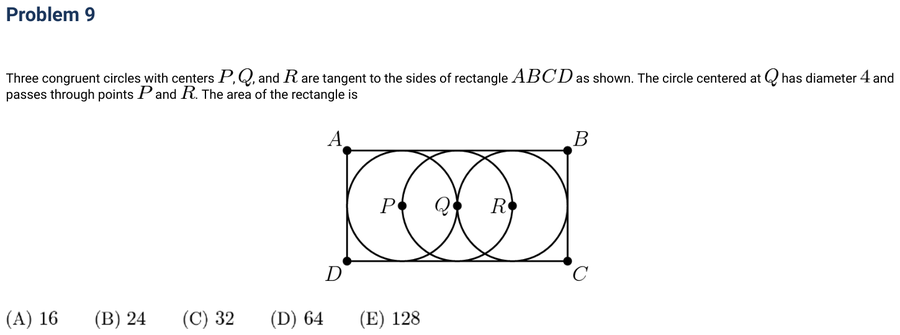
ajhsme-1995-09
Show hint (soft nudge)
Each circle has diameter 4, so the rectangle's height equals one diameter.
Show hint (sharpest)
Since circle Q passes through P and R, the centers are spaced one radius apart.
Show solution
  1. Each circle has radius 2, so the rectangle is 4 tall. Circle Q passing through P and R means PQ = QR = 2, so PR = 4.
  2. Adding a radius on each end, the width is 2 + 4 + 2 = 8, giving area 8 × 4 = 32.
C 32.
Mark: · log in to save
Problem 10 · 1995 AJHSME Hard
Fractions, Decimals & Percents percent-of-total

A jacket and a shirt originally sold for 80 dollars and 40 dollars, respectively. During a sale Chris bought the 80-dollar jacket at a 40% discount and the 40-dollar shirt at a 55% discount. The total amount saved was what percent of the total of the original prices?

Show hint (soft nudge)
Find the dollars saved on each item.
Show hint (sharpest)
Compare the total saved to the total original price of $120.
Show solution
  1. Savings: 40% of $80 = $32, and 55% of $40 = $22, for $54 saved.
  2. Out of $120 original, that's 54/120 = 45%.
A 45%.
Mark: · log in to save
Problem 11 · 1995 AJHSME Hard
Ratios, Rates & Proportions relative-speed perimeter
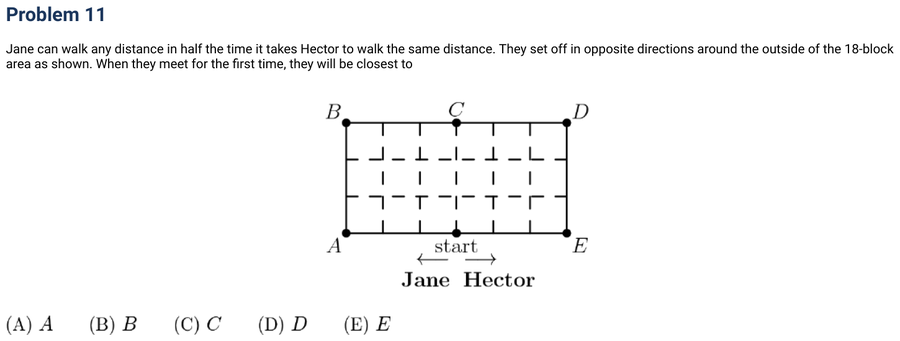
ajhsme-1995-11
Show hint (soft nudge)
Jane is twice as fast, so she covers twice the distance Hector does.
Show hint (sharpest)
Together they cover the whole 18-block perimeter, so Hector covers one-third of it.
Show solution
  1. Going opposite ways, together they cover the full 18-block loop. Jane (twice as fast) covers 12 blocks and Hector covers 6.
  2. Hector's 6 blocks from the start (right, then up the side) land him exactly at corner D.
D Point D.
Mark: · log in to save
Problem 12 · 1995 AJHSME Hard
Number Theory factor-pairs

A lucky year is one in which at least one date, written as month/day/year, has the property that the month times the day equals the last two digits of the year. For example, 1956 is lucky because 7/8/56 has 7 × 8 = 56. Which of the following is NOT a lucky year?

Show hint (soft nudge)
For each year, try to write its last two digits as month × day with a valid month (1–12) and day.
Show hint (sharpest)
94 has very few factor pairs.
Show solution
  1. 90 = 9 × 10, 91 = 7 × 13, 92 = 4 × 23, 93 = 3 × 31 — all have a month from 1–12 with a real day.
  2. But 94 = 2 × 47 only (besides 1 × 94), and no month 1–12 pairs with a valid day, so 1994 is not lucky.
E 1994.
Mark: · log in to save
Problem 13 · 1995 AJHSME Stretch
Geometry & Measurement angle-chase
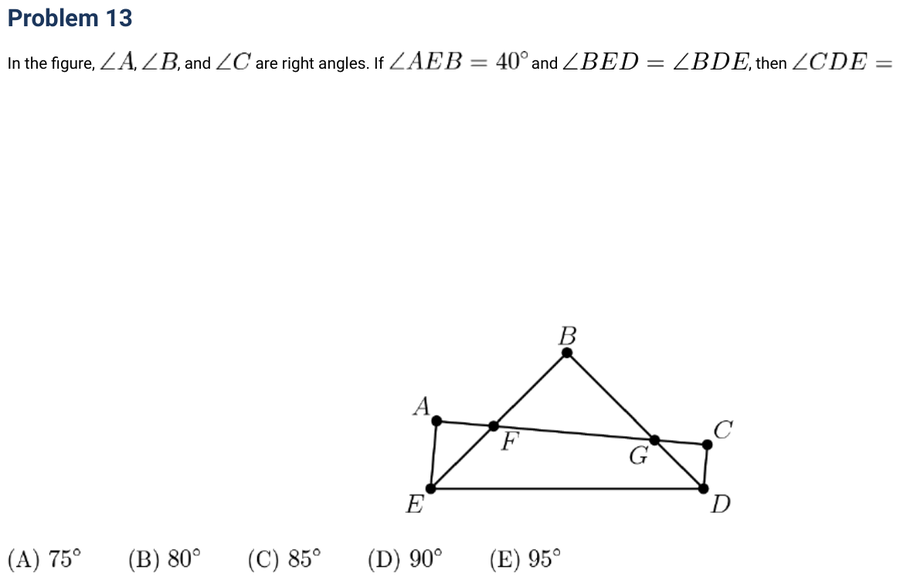
ajhsme-1995-13
Show hint (soft nudge)
Because EA is perpendicular to ED, ∠BED = 90° − ∠AEB.
Show hint (sharpest)
Triangle BED is isosceles, then the right angle at C finishes the chase.
Show solution
  1. Since EA ⊥ ED, ∠BED = 90° − 40° = 50°, and the isosceles triangle BED gives ∠BDE = 50°.
  2. Carrying the chase through the right angle at C gives ∠CDE = 95°.
E 95°.
Mark: · log in to save
Problem 14 · 1995 AJHSME Medium
Fractions, Decimals & Percents percent-target

A team won 40 of its first 50 games. How many of the remaining 40 games must this team win so that it will have won exactly 70% of its games for the season?

Show hint (soft nudge)
The season has 50 + 40 = 90 games; find 70% of that.
Show hint (sharpest)
Subtract the 40 wins already in hand.
Show solution
  1. 70% of the 90 games is 63 wins needed for the season.
  2. Already having 40, the team must win 63 − 40 = 23 more.
B 23.
Mark: · log in to save
Problem 15 · 1995 AJHSME Hard
Number Theory repeating-decimal cyclicity

What is the 100th digit to the right of the decimal point in the decimal form of 4/37?

Show hint (soft nudge)
Write 4/37 as a repeating decimal and find the repeating block.
Show hint (sharpest)
The block has length 3, so reduce 100 by 3.
Show solution
  1. 4/37 = 0.108108… , repeating the block 108 of length 3.
  2. Since 100 = 3·33 + 1, the 100th digit is the 1st of the block: 1.
B 1.
Mark: · log in to save
Problem 16 · 1995 AJHSME Hard
Ratios, Rates & Proportions unit-rate

Students from three middle schools worked on a summer project. Seven students from Allen school worked for 3 days, four students from Balboa school worked for 5 days, and five students from Carver school worked for 9 days. The total amount paid for the students' work was $774. Assuming each student received the same amount for a day's work, how much did the students from Balboa school earn altogether?

Show hint (soft nudge)
Count total student-days across all schools.
Show hint (sharpest)
Find the pay per student-day, then multiply by Balboa's student-days.
Show solution
  1. Student-days: Allen 7·3 = 21, Balboa 4·5 = 20, Carver 5·9 = 45, totaling 86.
  2. Each student-day pays $774 ÷ 86 = $9, so Balboa earned 20 × $9 = $180.
C 180.00 dollars.
Mark: · log in to save
Problem 17 · 1995 AJHSME Hard
Fractions, Decimals & Percents weighted-percent
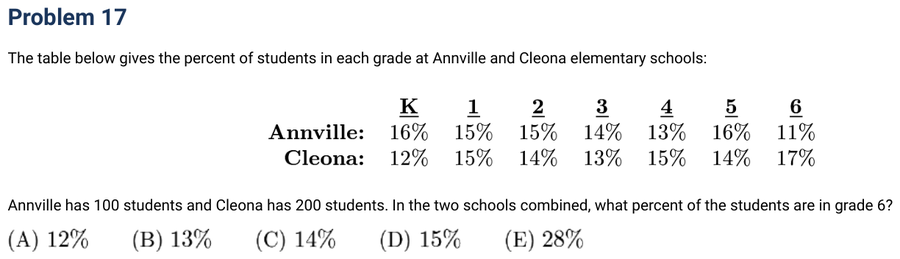
ajhsme-1995-17
Show hint (soft nudge)
Convert grade-6 percents to actual counts at each school.
Show hint (sharpest)
Add them and divide by the 300 total students.
Show solution
  1. Grade 6: Annville 11% of 100 = 11, Cleona 17% of 200 = 34, totaling 45.
  2. Out of 300 students, that is 45/300 = 15%.
D 15%.
Mark: · log in to save
Problem 18 · 1995 AJHSME Hard
Geometry & Measurement area-fraction
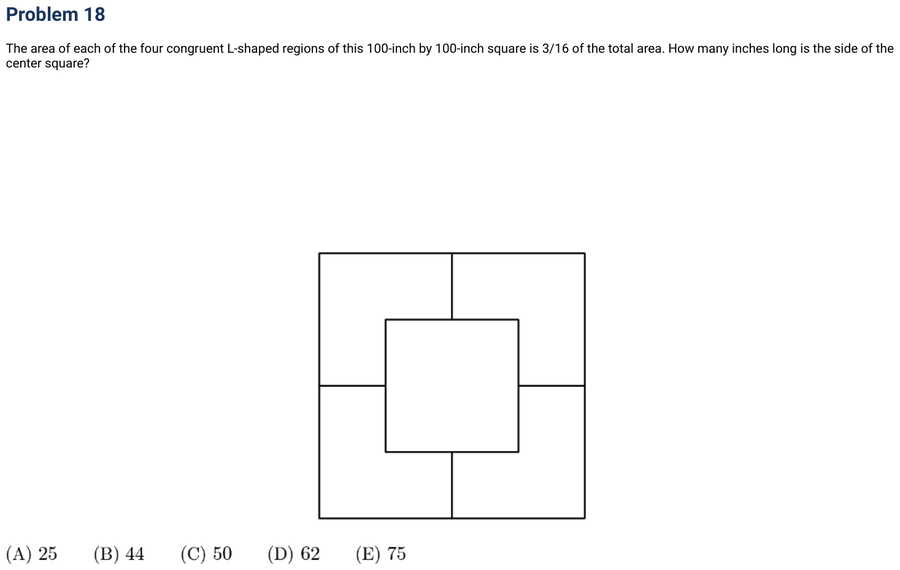
ajhsme-1995-18
Show hint (soft nudge)
The four L-shapes together cover 4 × 3/16 = 3/4 of the square.
Show hint (sharpest)
What's left is the center square.
Show solution
  1. The four L-regions cover 4 · 3/16 = 3/4 of the area, leaving 1/4 for the center square.
  2. That is 1/4 of 100 × 100 = 2500 square inches, so the side is √2500 = 50 inches.
C 50.
Mark: · log in to save
Problem 19 · 1995 AJHSME Hard
Arithmetic & Operations median read-graph
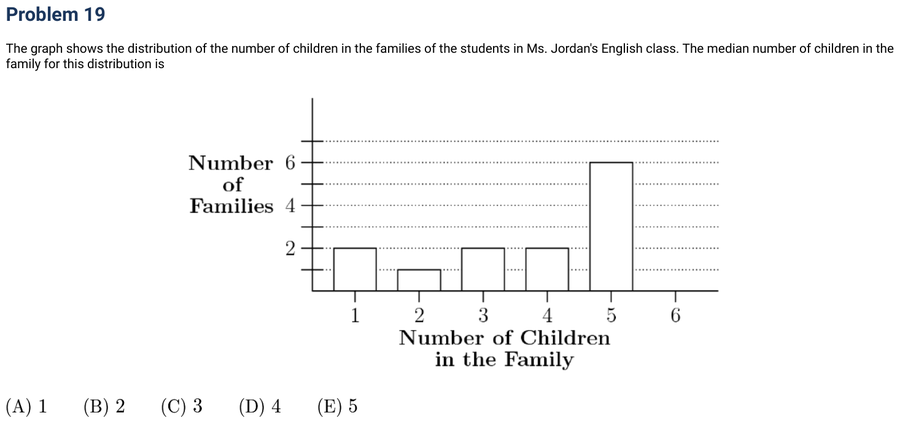
ajhsme-1995-19
Show hint (soft nudge)
Add up the bar heights to get the total number of families.
Show hint (sharpest)
The median is the middle value once all families are lined up in order.
Show solution
  1. The bars give 2, 1, 2, 2, 6 families for 1, 2, 3, 4, 5 children — 13 families total.
  2. The 7th value (the middle of 13) falls in the '4 children' group, so the median is 4.
D 4.
Mark: · log in to save
Problem 20 · 1995 AJHSME Hard
Counting & Probability symmetry complementary

Diana and Apollo each roll a standard die, obtaining a number at random from 1 to 6. What is the probability that Diana's number is larger than Apollo's number?

Show hint (soft nudge)
By symmetry, 'Diana larger' and 'Apollo larger' are equally likely.
Show hint (sharpest)
Subtract the ties first, then split the rest in half.
Show solution
  1. Of the 36 outcomes, 6 are ties, leaving 30 where one is larger.
  2. By symmetry half of those favor Diana: 15/36 = 5/12.
B 5/12.
Mark: · log in to save
Problem 21 · 1995 AJHSME Hard
Geometry & Measurement spatial-reasoning

A plastic snap-together cube has a protruding snap on one side and receptacle holes on the other five sides. What is the smallest number of these cubes that can be snapped together so that only receptacle holes are showing?

Show hint (soft nudge)
Every cube's single snap must be plugged into another cube's hole.
Show hint (sharpest)
Arrange the cubes so each snap points into the next one.
Show solution
  1. Each cube has one snap that must be hidden inside a neighbor's hole.
  2. Four cubes in a square ring, each snap pointing into the next, hide all four snaps, leaving only holes outside — and fewer than four can't absorb every snap. So 4.
B 4.
Mark: · log in to save
Problem 22 · 1995 AJHSME Hard
Number Theory factoring

The number 6545 can be written as a product of a pair of positive two-digit numbers. What is the sum of this pair of numbers?

Show hint (soft nudge)
Factor 6545 into primes first.
Show hint (sharpest)
Group the prime factors into two two-digit numbers.
Show solution
  1. 6545 = 5 · 7 · 11 · 17. Grouping as (5·17)(7·11) = 85 × 77 gives two two-digit numbers.
  2. Their sum is 85 + 77 = 162.
A 162.
Mark: · log in to save
Problem 23 · 1995 AJHSME Hard
Counting & Probability multiplication-principle

How many four-digit whole numbers are there such that the leftmost digit is odd, the second digit is even, and all four digits are different?

Show hint (soft nudge)
Count the choices for each digit position in turn.
Show hint (sharpest)
After fixing an odd first and even second digit, the last two just need to be different from those already used.
Show solution
  1. First digit (odd): 5 ways; second (even): 5 ways — these never clash since odd ≠ even.
  2. Third digit: 8 remaining, fourth: 7 remaining, so 5 × 5 × 8 × 7 = 1400.
B 1400.
Mark: · log in to save
Problem 24 · 1995 AJHSME Hard
Geometry & Measurement area-two-ways pythagorean
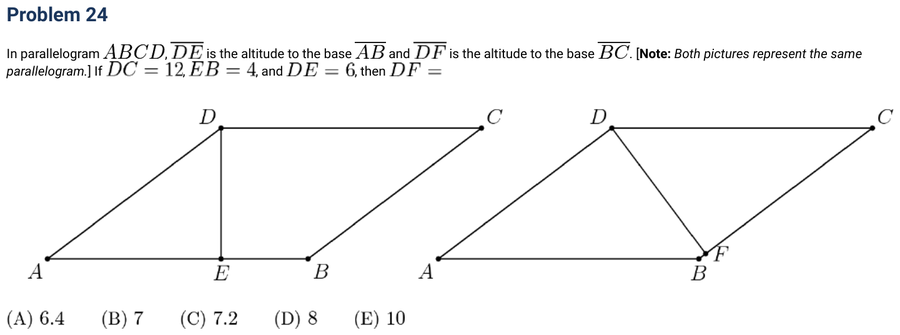
ajhsme-1995-24
Show hint (soft nudge)
The parallelogram's area can be measured two ways: base AB times DE, or base BC times DF.
Show hint (sharpest)
Use the right triangle at E to find side BC = AD.
Show solution
  1. AB = DC = 12 and DE = 6, so the area is 12 × 6 = 72. From right triangle ADE, AE = 12 − 4 = 8, so AD = √(8² + 6²) = 10 = BC.
  2. Then area = BC × DF gives 10 · DF = 72, so DF = 7.2.
C 7.2.
Mark: · log in to save
Problem 25 · 1995 AJHSME Stretch
Ratios, Rates & Proportions relative-motion interval-overlap

Buses from Dallas to Houston leave every hour on the hour. Buses from Houston to Dallas leave every hour on the half hour. The trip from one city to the other takes 5 hours. Assuming the buses travel on the same highway, how many Dallas-bound buses does a Houston-bound bus pass on the highway (not in the station)?

Show hint (soft nudge)
A Houston-bound bus is on the road for a 5-hour window; it passes any oncoming bus whose own road-window overlaps.
Show hint (sharpest)
Count the Dallas departure times whose 5-hour trips overlap that window on the highway.
Show solution
  1. Say the bus leaves Houston at 12:30 and reaches Dallas at 17:30. It meets every Dallas-bound bus already on the road or that sets out before it arrives.
  2. Those are the Dallas buses leaving from 8:00 through 17:00 — 10 of them — all passed on the highway.
D 10.
Mark: · log in to save