AJHSME

1996 AJHSME

25 problems — read each, give it a real try, then peek at the hints.

Practice: Take as test →
Problem 1 · 1996 AJHSME Easy
Number Theory divisor-counting

How many positive factors of 36 are also multiples of 4?

Show hint (soft nudge)
A factor of 36 that is a multiple of 4 is 4 times a factor of 36 ÷ 4 = 9.
Show hint (sharpest)
List the factors of 9.
Show solution
  1. Such a number is 4 × (a factor of 9), and 9 has factors 1, 3, 9.
  2. That gives 4, 12, 36 — 3 numbers.
B 3.
Mark: · log in to save
Problem 2 · 1996 AJHSME Easy
Arithmetic & Operations order-of-operations

Jose, Thuy, and Kareem each start with the number 10. Jose subtracts 1 from 10, doubles his answer, and then adds 2. Thuy doubles 10, subtracts 1 from her answer, and then adds 2. Kareem subtracts 1 from 10, adds 2 to his number, and then doubles the result. Who gets the largest final answer?

Show hint (soft nudge)
Just follow each person's three steps in order.
Show hint (sharpest)
Doubling last makes the biggest difference.
Show solution
  1. Jose: (10 − 1)·2 + 2 = 20. Thuy: 10·2 − 1 + 2 = 21. Kareem: (10 − 1 + 2)·2 = 22.
  2. The largest is Kareem's 22.
C Kareem.
Mark: · log in to save
Problem 3 · 1996 AJHSME Easy
Arithmetic & Operations pattern

The 64 whole numbers from 1 through 64 are written, one per square, on a checkerboard (an 8 by 8 array). The first 8 numbers go in order across the first row, the next 8 across the second row, and so on. After all 64 numbers are written, the sum of the numbers in the four corners will be

Show hint (soft nudge)
The top row is 1–8 and the bottom row is 57–64.
Show hint (sharpest)
The corners are the first and last entry of those two rows.
Show solution
  1. The corners are 1 and 8 (top row) and 57 and 64 (bottom row).
  2. Their sum is 1 + 8 + 57 + 64 = 130.
A 130.
Mark: · log in to save
Problem 4 · 1996 AJHSME Medium
Fractions, Decimals & Percents factor-common

What is the value of 2 + 4 + 6 + … + 343 + 6 + 9 + … + 51 ?

Show hint (soft nudge)
Both top and bottom are the same list 1 + 2 + … + 17, just scaled.
Show hint (sharpest)
The top is 2 times it; the bottom is 3 times it.
Show solution
  1. Top = 2(1 + 2 + … + 17) and bottom = 3(1 + 2 + … + 17).
  2. The shared sum cancels, leaving 2/3.
B 2/3.
Mark: · log in to save
Problem 5 · 1996 AJHSME Medium
Number Theory sign-analysis
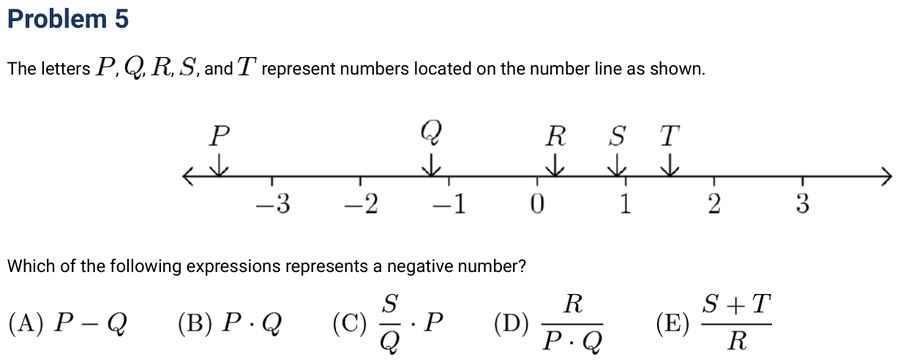
ajhsme-1996-05
Show hint (soft nudge)
Read each letter's sign and rough size from the number line.
Show hint (sharpest)
A difference is negative when you subtract a larger number from a smaller one.
Show solution
  1. From the line, P ≈ −2.7 and Q ≈ −1, while R, S, T are positive.
  2. P − Q ≈ −2.7 − (−1) = −1.7 is negative; the other four expressions all come out positive.
  3. So P − Q is the negative one.
A P − Q.
Mark: · log in to save
Problem 6 · 1996 AJHSME Medium
Algebra & Patterns minimize

What is the smallest result that can be obtained from the following process? Choose three different numbers from the set {3, 5, 7, 11, 13, 17}, add two of them, then multiply their sum by the third number.

Show hint (soft nudge)
To make a product small, multiply by the smallest number.
Show hint (sharpest)
Then add the two next-smallest numbers.
Show solution
  1. Use 3 as the multiplier and add the next two smallest, 5 and 7: (5 + 7) × 3 = 36.
  2. Any other choice (such as (3 + 7) × 5 = 50) is larger, so the smallest is 36.
C 36.
Mark: · log in to save
Problem 7 · 1996 AJHSME Medium
Number Theory powers exponential

Brent has goldfish that quadruple (become four times as many) every month, and Gretel has goldfish that double every month. If Brent has 4 goldfish at the same time that Gretel has 128 goldfish, in how many months from that time will they have the same number of goldfish?

Show hint (soft nudge)
Write both counts as powers of 2 and match the exponents.
Show hint (sharpest)
Brent: 4 · 4^m; Gretel: 128 · 2^m.
Show solution
  1. After m months Brent has 4 · 4^m = 2^(2m+2) and Gretel has 128 · 2^m = 2^(m+7).
  2. Setting 2m + 2 = m + 7 gives m = 5.
B 5 months.
Mark: · log in to save
Problem 8 · 1996 AJHSME Medium
Number Theory number-line extremal

Points A and B are 10 units apart. Points B and C are 4 units apart. Points C and D are 3 units apart. If A and D are as close as possible, then the number of units between them is

Show hint (soft nudge)
Walk from A: out 10, then come back as much as possible.
Show hint (sharpest)
The best you can backtrack is 4 + 3 = 7.
Show solution
  1. Place B 10 from A, then step C back 4 and D back another 3: A is at 0, D ends at 10 − 4 − 3 = 3.
  2. You can't reach 0 (10 ≠ 4 + 3), so the closest is 3 units.
B 3 units.
Mark: · log in to save
Problem 9 · 1996 AJHSME Medium
Algebra & Patterns reciprocal

If 5 times a number is 2, then 100 times the reciprocal of the number is

Show hint (soft nudge)
First find the number, then flip it.
Show hint (sharpest)
5 × number = 2 means the number is 2/5.
Show solution
  1. The number is 2/5, so its reciprocal is 5/2.
  2. 100 × (5/2) = 250.
D 250.
Mark: · log in to save
Problem 10 · 1996 AJHSME Medium
Fractions, Decimals & Percents fraction-of

When Walter drove up to the gasoline pump, his tank was 1/8 full. He bought 7.5 gallons, after which the tank was 5/8 full. How many gallons does the tank hold when it is full?

Show hint (soft nudge)
The 7.5 gallons raised the level from 1/8 to 5/8 — what fraction of the tank is that?
Show hint (sharpest)
Then scale up to a full tank.
Show solution
  1. Going from 1/8 to 5/8 is 4/8 = half the tank, filled by 7.5 gallons.
  2. So a full tank holds 2 × 7.5 = 15 gallons.
D 15 gallons.
Mark: · log in to save
Problem 11 · 1996 AJHSME Medium
Algebra & Patterns compare-magnitudes

Let x be the number 0.00…01, where there are 1996 zeros after the decimal point before the 1. Which of the following expressions represents the largest number?

Show hint (soft nudge)
x is an extremely tiny positive number.
Show hint (sharpest)
Dividing by something tiny makes the result enormous.
Show solution
  1. Since x is a tiny positive number, 3 + x, 3 − x, and 3·x are all near 3 (or near 0), and x/3 is tiny.
  2. But 3/x divides by something tiny, giving a gigantic number, so 3/x is largest.
D 3/x.
Mark: · log in to save
Problem 12 · 1996 AJHSME Medium
Arithmetic & Operations average-sum

What number should be removed from the list 1, 2, 3, 4, 5, 6, 7, 8, 9, 10, 11 so that the average of the remaining numbers is 6.1?

Show hint (soft nudge)
Find the total of all 11 numbers, then the total the 10 remaining must have.
Show hint (sharpest)
The difference is the removed number.
Show solution
  1. The eleven numbers total 66; the remaining ten must total 6.1 × 10 = 61.
  2. So the removed number is 66 − 61 = 5.
B 5.
Mark: · log in to save
Problem 13 · 1996 AJHSME Medium
Fractions, Decimals & Percents repeated-percent

In the fall of 1996, 800 students took part in an annual school clean-up day. The organizers expect that in each of 1997, 1998, and 1999, participation will increase by 50% over the previous year. The number of participants expected in the fall of 1999 is

Show hint (soft nudge)
A 50% increase multiplies by 1.5 each year.
Show hint (sharpest)
Apply that three times to reach 1999.
Show solution
  1. Three yearly increases multiply by 1.5 three times: 800 × (3/2)³ = 800 × 27/8.
  2. That is 100 × 27 = 2700.
E 2700.
Mark: · log in to save
Problem 14 · 1996 AJHSME Hard
Logic & Word Problems casework constraint
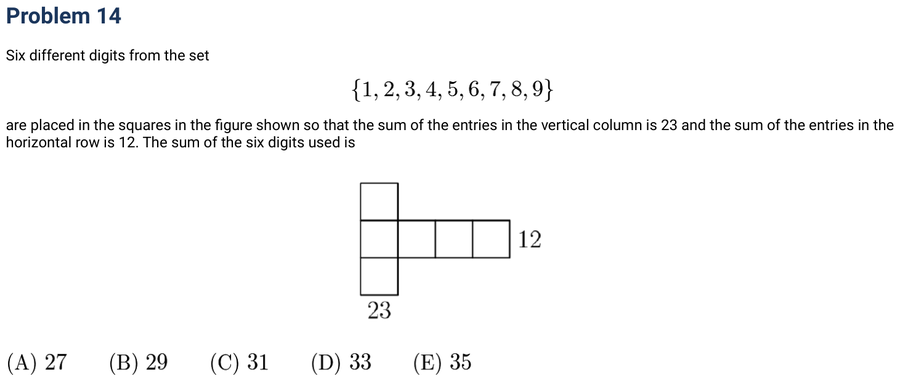
ajhsme-1996-14
Show hint (soft nudge)
The two lines cross at one shared square, which is counted in both sums.
Show hint (sharpest)
Sum of all six digits = 23 + 12 − (shared square), so pin down the shared digit.
Show solution
  1. The column (sum 23) needs three large distinct digits — only 6, 8, 9 work — and the shared digit is one of these.
  2. The row (sum 12) then needs three more digits adding to 12 − shared; this is possible only when the shared digit is 6 (with 1, 2, 3).
  3. So the six digits sum to 23 + 12 − 6 = 29.
B 29.
Mark: · log in to save
Problem 15 · 1996 AJHSME Hard
Number Theory units-digit modular-arithmetic

The remainder when the product 1492 · 1776 · 1812 · 1996 is divided by 5 is

Show hint (soft nudge)
Only the units digit of each factor matters for the remainder mod 5.
Show hint (sharpest)
Multiply the units digits and look at that product's units digit.
Show solution
  1. The units digits are 2, 6, 2, 6, and 2 · 6 · 2 · 6 = 144 ends in 4.
  2. A number ending in 4 leaves remainder 4 when divided by 5.
E 4.
Mark: · log in to save
Problem 16 · 1996 AJHSME Hard
Algebra & Patterns grouping telescoping

1 − 2 − 3 + 4 + 5 − 6 − 7 + 8 + 9 − 10 − 11 + … + 1992 + 1993 − 1994 − 1995 + 1996 =

Show hint (soft nudge)
The signs repeat in a 4-term pattern: +, −, −, +.
Show hint (sharpest)
Group the terms in blocks of four and see what each block adds to.
Show solution
  1. Each block of four, like 1 − 2 − 3 + 4, adds to 0.
  2. Since 1996 is a multiple of 4, the whole sum splits into 499 such blocks, giving 0.
C 0.
Mark: · log in to save
Problem 17 · 1996 AJHSME Hard
Geometry & Measurement coordinate-area
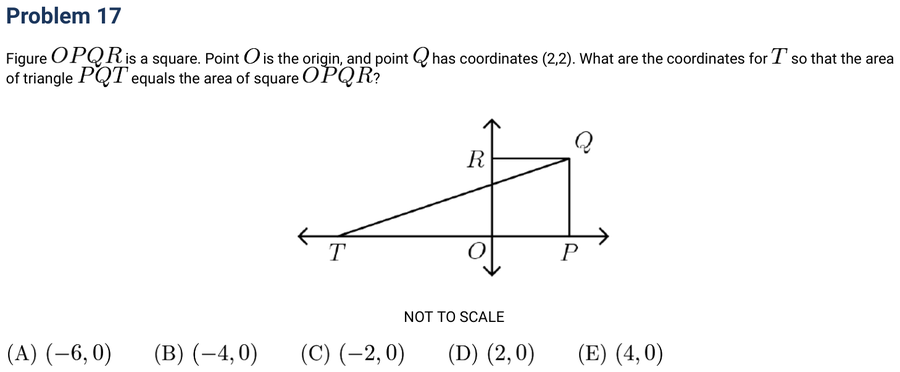
ajhsme-1996-17
Show hint (soft nudge)
The square OPQR has area 2 × 2 = 4, so triangle PQT must also have area 4.
Show hint (sharpest)
Using PQ (length 2) as the base, the horizontal distance from T to the line x = 2 is the height.
Show solution
  1. The square has area 4. Triangle PQT has base PQ = 2 (vertical), so its area is ½ · 2 · (distance from T to the line x = 2) = that distance.
  2. Setting the distance to 4 and placing T on the left of the origin gives T at x = 2 − 4 = −2, so T = (−2, 0).
C (−2, 0).
Mark: · log in to save
Problem 18 · 1996 AJHSME Medium
Fractions, Decimals & Percents successive-percent

Ana's monthly salary was $2000 in May. In June she received a 20% raise. In July she received a 20% pay cut. After the two changes in June and July, Ana's monthly salary was

Show hint (soft nudge)
A 20% raise then a 20% cut do NOT cancel out.
Show hint (sharpest)
Multiply by 1.2, then by 0.8.
Show solution
  1. After the raise: 2000 × 1.2 = 2400. After the cut: 2400 × 0.8 = 1920.
  2. So her salary is $1920.
A 1920 dollars.
Mark: · log in to save
Problem 19 · 1996 AJHSME Hard
Fractions, Decimals & Percents weighted-percent
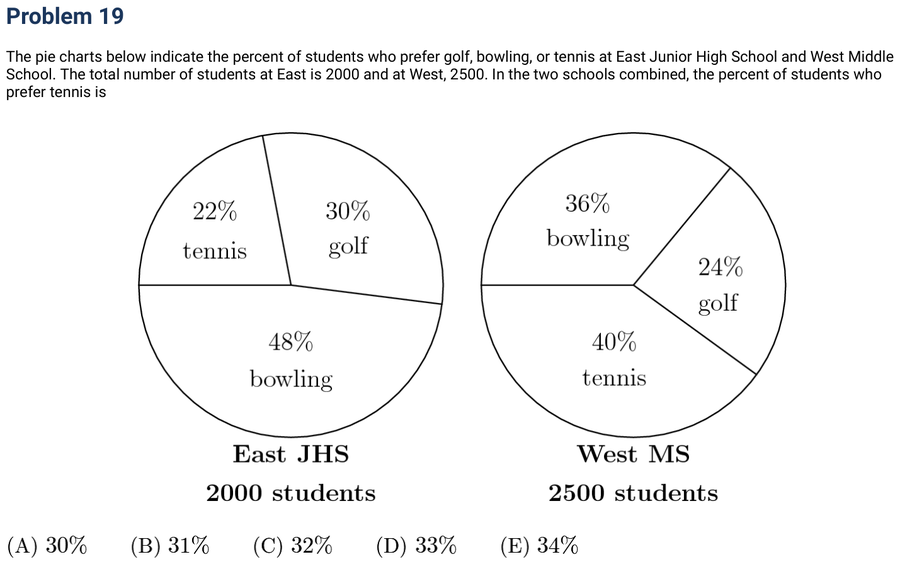
ajhsme-1996-19
Show hint (soft nudge)
Find the actual number of tennis fans at each school, not the percents.
Show hint (sharpest)
Combine and divide by the total of all students.
Show solution
  1. Tennis fans: East 22% of 2000 = 440, West 40% of 2500 = 1000, totaling 1440.
  2. Out of 2000 + 2500 = 4500 students, that's 1440/4500 = 32%.
C 32%.
Mark: · log in to save
Problem 20 · 1996 AJHSME Hard
Algebra & Patterns find-the-cycle

A special key on a calculator replaces the displayed number x with 1 ÷ (1 − x). (For example, from 2 it gives 1 ÷ (1 − 2) = −1.) If the calculator shows 5 and the key is pressed 100 times in a row, the calculator will display

Show hint (soft nudge)
Press the key a few times and watch for a repeating cycle.
Show hint (sharpest)
Once you know the cycle length, reduce 100 by it.
Show solution
  1. Starting at 5: 5 → −0.25 → 0.8 → 5, a cycle of length 3.
  2. Since 100 = 3·33 + 1, after 100 presses the display matches one press: −0.25.
A −0.25.
Mark: · log in to save
Problem 21 · 1996 AJHSME Hard
Counting & Probability parity combinations

How many subsets containing three different numbers can be selected from the set {89, 95, 99, 132, 166, 173} so that the sum of the three numbers is even?

Show hint (soft nudge)
Only the parity (odd/even) of each number matters: there are 4 odds and 2 evens.
Show hint (sharpest)
A sum of three is even only when an even count of them are odd — here that means exactly 2 odds and 1 even.
Show solution
  1. The set has 4 odd numbers (89, 95, 99, 173) and 2 even (132, 166). Three numbers sum to even only with 2 odds and 1 even (zero odds would need 3 evens, impossible).
  2. That's C(4,2) · C(2,1) = 6 · 2 = 12 subsets.
D 12.
Mark: · log in to save
Problem 22 · 1996 AJHSME Hard
Geometry & Measurement shoelace lattice
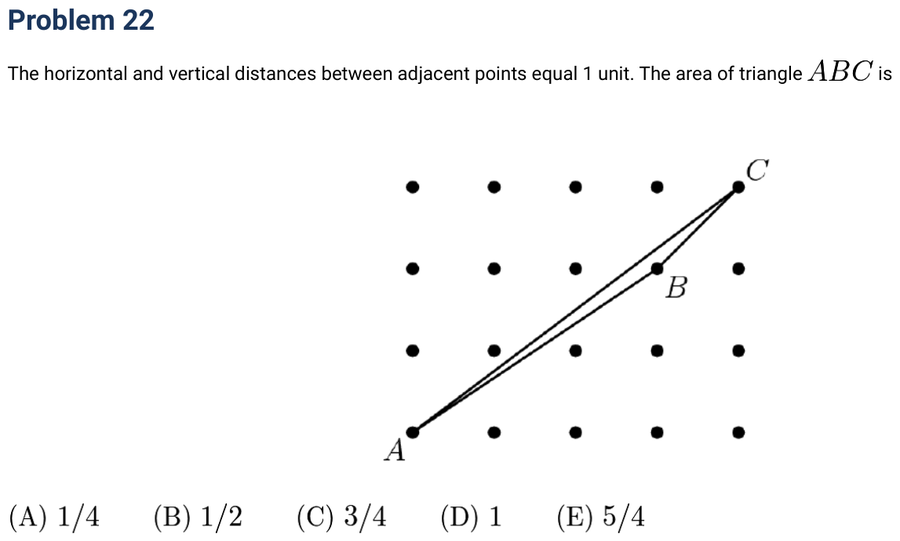
ajhsme-1996-22
Show hint (soft nudge)
A, B, and C are almost in a line, so the triangle is very thin.
Show hint (sharpest)
Read their lattice coordinates and use the area formula.
Show solution
  1. Reading the grid, A = (0,0), B = (3,2), C = (4,3).
  2. The area is ½|0(2−3) + 3(3−0) + 4(0−2)| = ½|9 − 8| = 1/2.
B 1/2.
Mark: · log in to save
Problem 23 · 1996 AJHSME Hard
Algebra & Patterns system-equations

The manager of a company planned to give a $50 bonus to each employee from the company fund, but the fund was $5 short of what was needed. Instead the manager gave each employee a $45 bonus and kept the remaining $95 in the fund. How much money was in the company fund before any bonuses were paid?

Show hint (soft nudge)
Let n be the number of employees and write the fund two ways.
Show hint (sharpest)
Fund = 50n − 5 (just short of $50 each) and fund = 45n + 95 (after the $45 bonuses).
Show solution
  1. The fund is 50n − 5 (5 short of $50 each) and also 45n + 95 (gave $45 each, kept $95).
  2. Setting them equal: 50n − 5 = 45n + 95 gives n = 20, so the fund was 45·20 + 95 = $995.
E 995 dollars.
Mark: · log in to save
Problem 24 · 1996 AJHSME Hard
Geometry & Measurement angle-bisector triangle-sum

The measure of angle ABC is 50°. AD bisects angle BAC, and DC bisects angle BCA. The measure of angle ADC is

Show hint (soft nudge)
The two remaining angles of triangle ABC add to 180° − 50° = 130°.
Show hint (sharpest)
In triangle ADC you use half of each of those angles.
Show solution
  1. In triangle ABC, ∠BAC + ∠BCA = 180° − 50° = 130°. The bisectors give ∠DAC + ∠DCA = half of that = 65°.
  2. So ∠ADC = 180° − 65° = 115°.
C 115°.
Mark: · log in to save
Problem 25 · 1996 AJHSME Stretch
Geometry & Measurement geometric-probability

A point is chosen at random from within a circular region. What is the probability that the point is closer to the center of the region than it is to the boundary of the region?

Show hint (soft nudge)
A point at distance r from the center is r from the center and R − r from the boundary.
Show hint (sharpest)
Closer to the center means r < R − r, i.e. r < R/2.
Show solution
  1. Being closer to the center than the boundary means r < R − r, so r < R/2 — the point lies in the inner circle of radius R/2.
  2. Its area is a fraction (R/2)² / R² = 1/4 of the whole.
A 1/4.
Mark: · log in to save