AJHSME · Test Mode

1997 AJHSME

Test mode — hints and solutions are locked. Pick an answer for each, then submit at the bottom to see your score.

← Exit test mode No hints or solutions until you submit.
Problem 1 · 1997 AJHSME Easy
Fractions, Decimals & Percents place-value
ajhsme-1997-01
Show hint (soft nudge)
Each fraction is one digit further into the decimal places.
Show hint (sharpest)
Write them as decimals and line them up.
Show solution
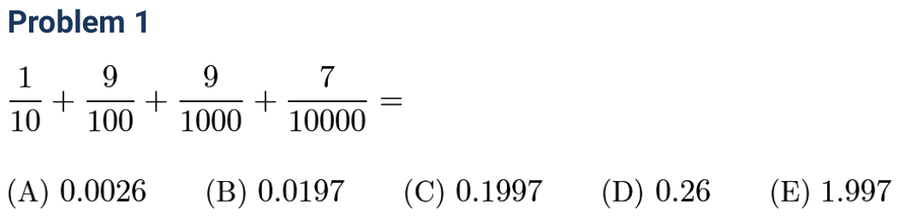
  1. The terms are 0.1, 0.09, 0.009, and 0.0007.
  2. Adding them stacks the digits: 0.1997.
C 0.1997.
Mark: · log in to save
Problem 2 · 1997 AJHSME Easy
Algebra & Patterns optimization

Ahn chooses a two-digit integer, subtracts it from 200, and doubles the result. What is the largest number Ahn can get?

Show hint (soft nudge)
To make the result big, subtract as little as possible from 200.
Show hint (sharpest)
The smallest two-digit number is 10.
Show solution
  1. Subtracting the smallest two-digit number, 10, leaves the most: 200 − 10 = 190.
  2. Doubling gives 2 × 190 = 380.
D 380.
Mark: · log in to save
Problem 3 · 1997 AJHSME Easy
Fractions, Decimals & Percents compare-decimals

Which of the following numbers is the largest?

Show hint (soft nudge)
Line the decimals up and compare them place by place.
Show hint (sharpest)
0.97, 0.979, and 0.9709 stay tied until the thousandths digit.
Show solution
  1. All have 9 tenths; A, B, C also have 7 hundredths (D and E have 0), so only those three can be largest.
  2. In the thousandths place 0.979 has a 9 while 0.97 and 0.9709 have 0, so 0.979 is largest.
B 0.979.
Mark: · log in to save
Problem 4 · 1997 AJHSME Medium
Ratios, Rates & Proportions unit-rate range-check

Julie is preparing a speech. It must last between one-half hour and three-quarters of an hour, and her ideal rate is 150 words per minute. If she speaks at that rate, which of the following word counts is an appropriate length?

Show hint (soft nudge)
Turn each time limit into a word count at 150 words per minute.
Show hint (sharpest)
The answer must fall between those two counts.
Show solution
  1. At 150 words per minute, 30 minutes is 4500 words and 45 minutes is 6750 words.
  2. The only choice between 4500 and 6750 is 5650.
E 5650 words.
Mark: · log in to save
Problem 5 · 1997 AJHSME Medium
Number Theory digit-sum listing

There are many two-digit multiples of 7, but only two of them have a digit sum of 10. The sum of these two multiples of 7 is

Show hint (soft nudge)
List the two-digit multiples of 7 and check each digit sum.
Show hint (sharpest)
Find the two whose digits add to 10.
Show solution
  1. Among 14, 21, 28, …, 98, the ones with digit sum 10 are 28 and 91.
  2. Their sum is 28 + 91 = 119.
A 119.
Mark: · log in to save
Problem 6 · 1997 AJHSME Medium
Fractions, Decimals & Percents place-value

In the number 74982.1035, the value of the place occupied by the digit 9 is how many times as great as the value of the place occupied by the digit 3?

Show hint (soft nudge)
Each place is 10 times the place to its right.
Show hint (sharpest)
Count how many places separate the 9 from the 3.
Show solution
  1. The 9 sits 5 places to the left of the 3 (hundreds versus thousandths).
  2. Each step left multiplies the place value by 10, so it is 10⁵ = 100,000 times as great.
C 100,000.
Mark: · log in to save
Problem 7 · 1997 AJHSME Medium
Geometry & Measurement inscribed-figure

The area of the smallest square that will contain a circle of radius 4 is

Show hint (soft nudge)
The circle fits snugly with its diameter equal to the square's side.
Show hint (sharpest)
Side = diameter = 2 × radius.
Show solution
  1. The square's side equals the circle's diameter, 2 × 4 = 8.
  2. So its area is 8² = 64.
D 64.
Mark: · log in to save
Problem 8 · 1997 AJHSME Medium
Arithmetic & Operations total-minus-parts

Walter catches the school bus at 7:30 a.m., has 6 classes that last 50 minutes each, has 30 minutes for lunch, and has 2 hours of additional time at school. He takes the bus home and arrives at 4:00 p.m. How many minutes has he spent on the bus?

Show hint (soft nudge)
Find the whole stretch from 7:30 a.m. to 4:00 p.m. in minutes.
Show hint (sharpest)
Subtract all the time accounted for at school.
Show solution
  1. From 7:30 a.m. to 4:00 p.m. is 8.5 hours = 510 minutes; school uses 6·50 + 30 + 2·60 = 450 minutes.
  2. The bus rides take the rest: 510 − 450 = 60 minutes.
B 60 minutes.
Mark: · log in to save
Problem 9 · 1997 AJHSME Medium
Counting & Probability counting-arrangements

Three students, with different names, line up single file. What is the probability that they are in alphabetical order from front to back?

Show hint (soft nudge)
Count all the ways three people can line up.
Show hint (sharpest)
Only one of those orders is alphabetical.
Show solution
  1. Three people can line up in 3 × 2 × 1 = 6 ways.
  2. Exactly one is alphabetical, so the probability is 1/6.
C 1/6.
Mark: · log in to save
Problem 10 · 1997 AJHSME Medium
Geometry & Measurement grid-counting
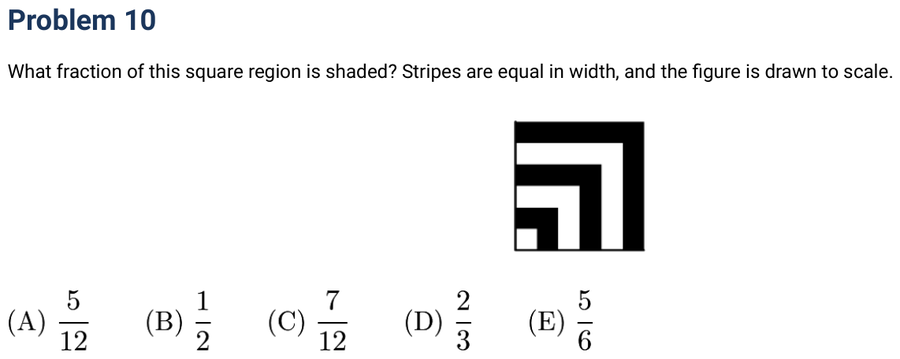
ajhsme-1997-10
Show hint (soft nudge)
Lay a 6 × 6 grid over the square and count the shaded cells.
Show hint (sharpest)
The black L-stripes hold 3, 7, and 11 cells.
Show solution
  1. On a 6 × 6 grid the square has 36 cells, and the black stripes cover 3 + 7 + 11 = 21.
  2. So the shaded fraction is 21/36 = 7/12.
C 7/12.
Mark: · log in to save
Problem 11 · 1997 AJHSME Hard
Number Theory count-divisors
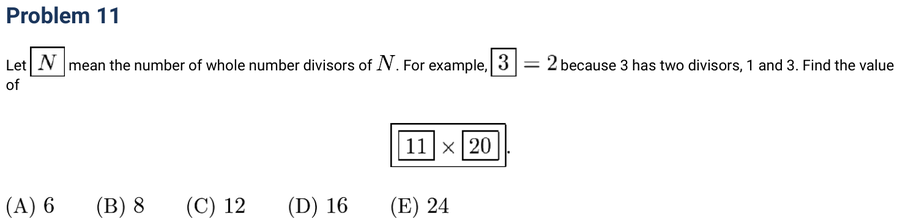
ajhsme-1997-11
Show hint (soft nudge)
The divisor count comes from the prime factorization: add 1 to each exponent and multiply.
Show hint (sharpest)
Work the brackets from the inside out.
Show solution
  1. ⟨11⟩ = 2 (11 is prime) and ⟨20⟩ = (2+1)(1+1) = 6, so the inner value is 2 × 6 = 12.
  2. Then ⟨12⟩ = (2+1)(1+1) = 6.
A 6.
Mark: · log in to save
Problem 12 · 1997 AJHSME Medium
Geometry & Measurement angle-chase
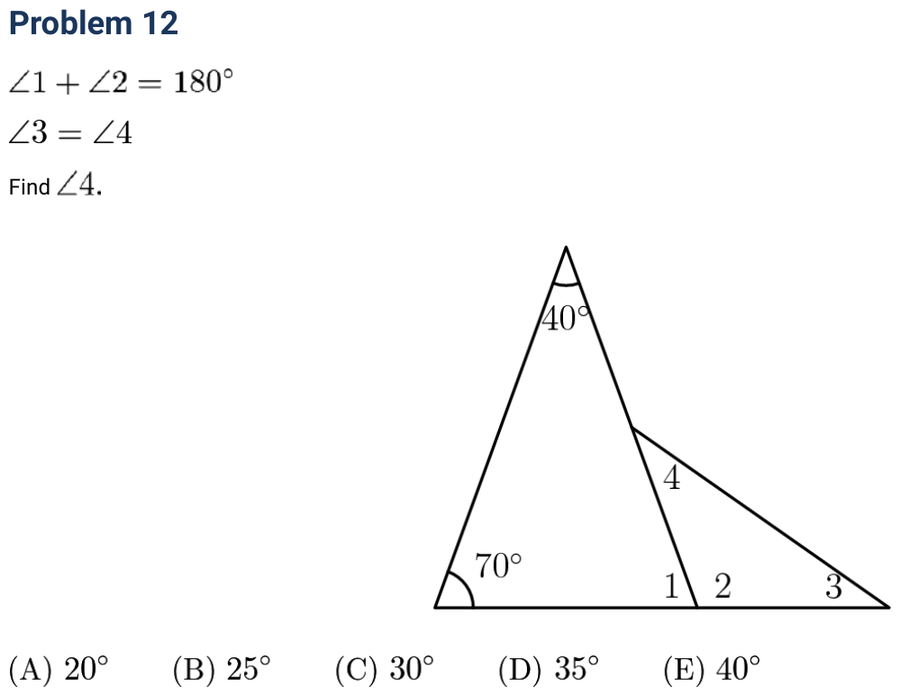
ajhsme-1997-12
Show hint (soft nudge)
Find ∠1 from the left triangle, where 70° and 40° are given.
Show hint (sharpest)
∠2 is its supplement, and the right triangle splits the remaining angle equally between ∠3 and ∠4.
Show solution
  1. In the left triangle, ∠1 = 180° − 70° − 40° = 70°, so ∠2 = 180° − 70° = 110°.
  2. In the right triangle ∠3 + ∠4 = 180° − 110° = 70°, and since ∠3 = ∠4, each is 35°.
D 35°.
Mark: · log in to save
Problem 13 · 1997 AJHSME Hard
Fractions, Decimals & Percents weighted-average

Three bags of jelly beans contain 26, 28, and 30 beans. The fractions of yellow beans in the bags are 50%, 25%, and 20%, respectively. All three bags are poured into one bowl. Which of the following is closest to the percent of yellow beans in the bowl?

Show hint (soft nudge)
Count the yellow beans in each bag, then total them.
Show hint (sharpest)
Divide the yellow total by the grand total of beans.
Show solution
  1. Yellow beans: 13 + 7 + 6 = 26, out of 26 + 28 + 30 = 84 beans.
  2. 26/84 ≈ 30.9%, closest to 31%.
A About 31%.
Mark: · log in to save
Problem 14 · 1997 AJHSME Hard
Arithmetic & Operations mean-median-mode

A set of five positive integers has mean 5, median 5, and 8 as its only mode. What is the difference between the largest and smallest integers in the set?

Show hint (soft nudge)
The five numbers sum to 5 × 5 = 25, and the mode 8 means two of them are 8.
Show hint (sharpest)
The median 5 is the middle value; the two smallest must be distinct and add to what's left.
Show solution
  1. The numbers total 25; two 8s (the only mode) account for 16, and the median forces the middle value 5, leaving 4 for the two smallest.
  2. Distinct positive integers adding to 4 are 1 and 3, giving {1, 3, 5, 8, 8} and a difference of 8 − 1 = 7.
D 7.
Mark: · log in to save
Problem 15 · 1997 AJHSME Hard
Geometry & Measurement pythagorean area-ratio
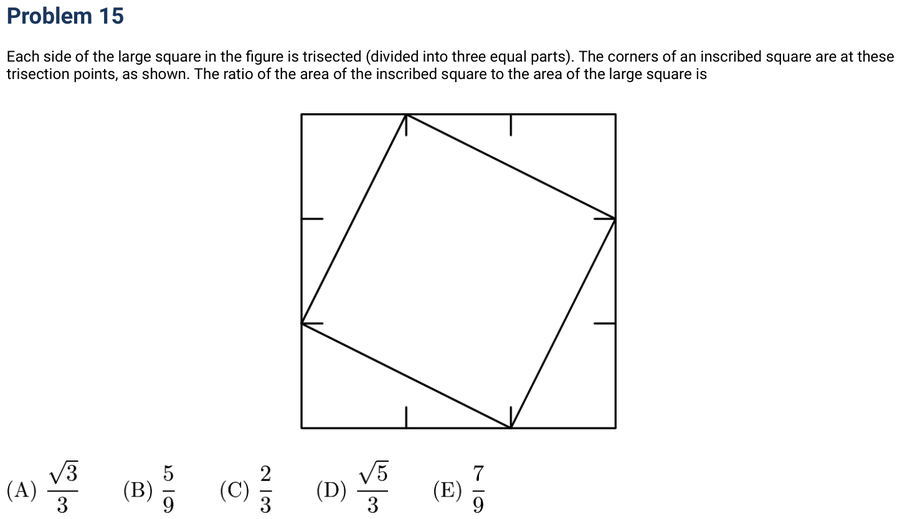
ajhsme-1997-15
Show hint (soft nudge)
Let the big square's side be 3 units; the inner side spans 2 units one way and 1 the other.
Show hint (sharpest)
Use the Pythagorean theorem for the inner side, then compare areas.
Show solution
  1. With the big square's side 3, each inner side is the hypotenuse of a 2-by-1 right triangle: √(2² + 1²) = √5.
  2. So the area ratio is (√5)² / 3² = 5/9.
B 5/9.
Mark: · log in to save
Problem 16 · 1997 AJHSME Hard
Fractions, Decimals & Percents successive-percent

Penni buys $100 of stock in each of three companies: AA, BB, and CC. After one year AA is up 20%, BB is down 25%, and CC is unchanged. In the second year AA drops 20% from its new value, BB rises 25% from its new value, and CC is unchanged. If A, B, C are the final values, which ordering is correct?

Show hint (soft nudge)
Track each $100 through both years.
Show hint (sharpest)
A 20% rise followed by a 20% fall does not return to the start.
Show solution
  1. AA: 100 → 120 → 96. BB: 100 → 75 → 93.75. CC stays 100.
  2. So 93.75 < 96 < 100, i.e. B < A < C.
E B < A < C.
Mark: · log in to save
Problem 17 · 1997 AJHSME Hard
Geometry & Measurement careful-counting
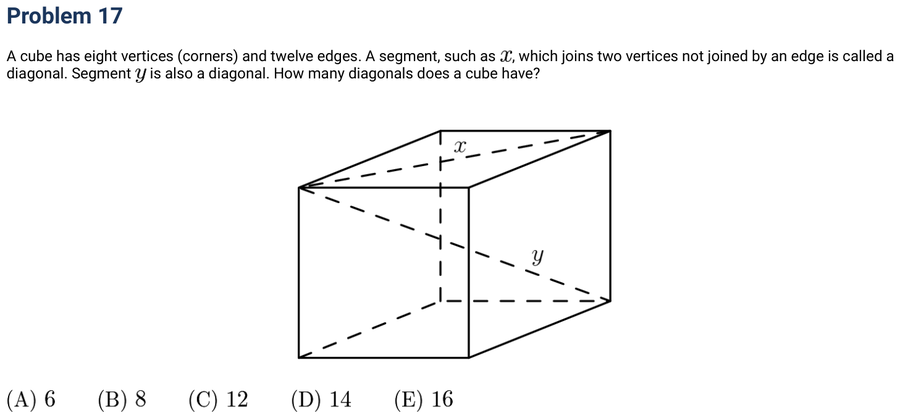
ajhsme-1997-17
Show hint (soft nudge)
Count the diagonals lying on the six faces, then the ones cutting through the interior.
Show hint (sharpest)
Each face has 2 diagonals; there are 4 long space diagonals.
Show solution
  1. The six faces each have 2 diagonals: 6 × 2 = 12 face diagonals.
  2. Add the 4 space diagonals through the cube's interior: 12 + 4 = 16.
E 16.
Mark: · log in to save
Problem 18 · 1997 AJHSME Hard
Fractions, Decimals & Percents percent-decrease

Last week small boxes of facial tissue were priced at 4 boxes for $5. This week they are on sale at 5 boxes for $4. The percent decrease in the price per box during the sale was closest to

Show hint (soft nudge)
Find the price of one box before and during the sale.
Show hint (sharpest)
Percent decrease compares the drop to the original price.
Show solution
  1. A box cost $5 ÷ 4 = $1.25 before and $4 ÷ 5 = $0.80 on sale.
  2. The decrease is $0.45 ÷ $1.25 = 36%, closest to 35%.
B About 35%.
Mark: · log in to save
Problem 19 · 1997 AJHSME Hard
Algebra & Patterns telescoping
ajhsme-1997-19
Show hint (soft nudge)
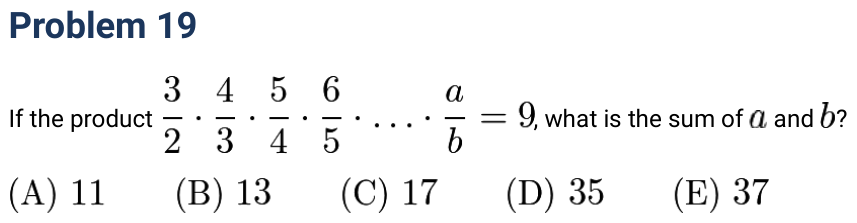
Each numerator cancels the denominator of the next fraction.
Show hint (sharpest)
After all the cancellation only a/2 survives, and b is one less than a.
Show solution
  1. Everything cancels except a/2, so a/2 = 9 gives a = 18, and b = 17.
  2. Their sum is 18 + 17 = 35.
D 35.
Mark: · log in to save
Problem 20 · 1997 AJHSME Stretch
Counting & Probability casework

A pair of 8-sided dice have sides numbered 1 through 8, each equally likely. What is the probability that the product of the two numbers facing up exceeds 36?

Show hint (soft nudge)
A big product needs big rolls — case on each high value of one die.
Show hint (sharpest)
Count the ordered pairs whose product is more than 36 out of all 64.
Show solution
  1. Going through the high rolls: a 5 needs an 8 (1 way), a 6 needs 7–8 (2), a 7 needs 6–8 (3), and an 8 needs 5–8 (4).
  2. That's 1 + 2 + 3 + 4 = 10 ordered pairs out of 64, a probability of 10/64 = 5/32.
A 5/32.
Mark: · log in to save
Problem 21 · 1997 AJHSME Stretch
Geometry & Measurement surface-area invariance
ajhsme-1997-21
Show hint (soft nudge)
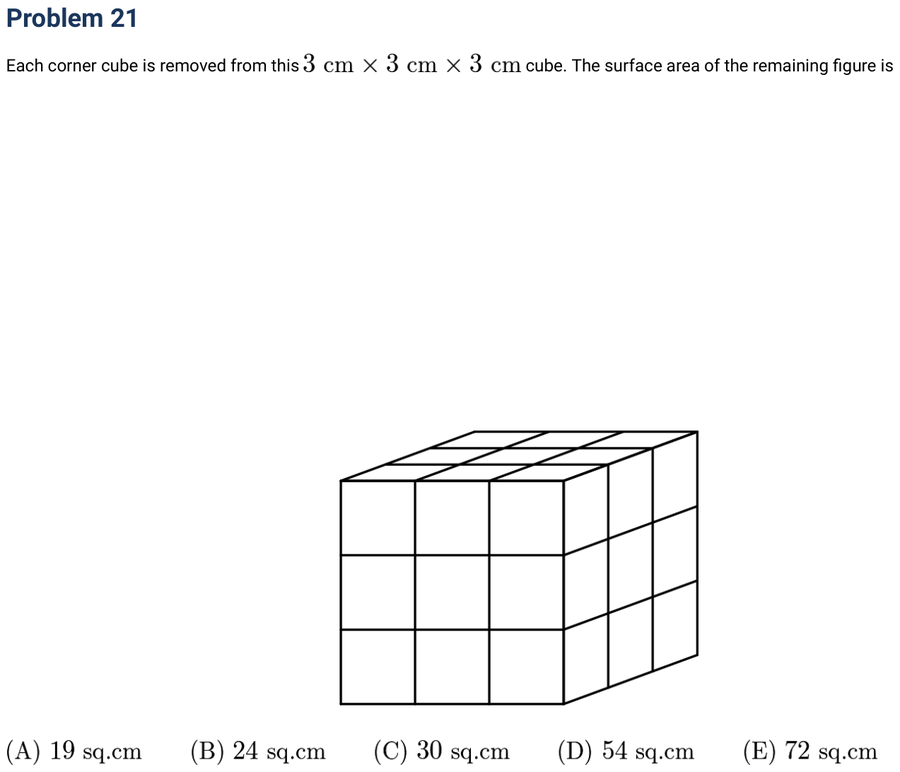
When you carve out a corner cube, count the faces you lose and the faces you newly expose.
Show hint (sharpest)
Each corner removal trades 3 squares away for 3 squares back.
Show solution
  1. Cutting out a corner cube removes 3 unit faces but uncovers 3 new ones, so the surface area doesn't change.
  2. It stays equal to the original cube's: 6 × 3² = 54 sq cm.
D 54 sq cm.
Mark: · log in to save
Problem 22 · 1997 AJHSME Stretch
Geometry & Measurement volume-scaling

A two-inch cube (2 × 2 × 2) of silver weighs 3 pounds and is worth $200. How much is a three-inch cube of silver worth?

Show hint (soft nudge)
Value follows volume, not side length.
Show hint (sharpest)
Compare the volumes: 3³ versus 2³.
Show solution
  1. The 2-inch cube is 8 unit cubes worth $200, so each unit cube is worth $25.
  2. A 3-inch cube is 27 unit cubes, worth 27 × $25 = $675.
E $675.
Mark: · log in to save
Problem 23 · 1997 AJHSME Stretch
Number Theory bounding casework

Some positive integers have both properties: (I) the sum of the squares of their digits is 50, and (II) each digit is larger than the one to its left. The product of the digits of the largest such integer is

Show hint (soft nudge)
The digits strictly increase, so they're distinct; squaring shows there can be at most four of them.
Show hint (sharpest)
To make the number large, push the leading digits up while keeping the square-sum at 50.
Show solution
  1. Five increasing digits would have squares summing to at least 1+4+9+16+25 = 55 > 50, so at most four digits.
  2. The digits 1, 2, 3, 6 give 1 + 4 + 9 + 36 = 50 and form the largest such number, 1236.
  3. Its digit product is 1 × 2 × 3 × 6 = 36.
C 36.
Mark: · log in to save
Problem 24 · 1997 AJHSME Stretch
Geometry & Measurement area-decomposition
ajhsme-1997-24
Show hint (soft nudge)
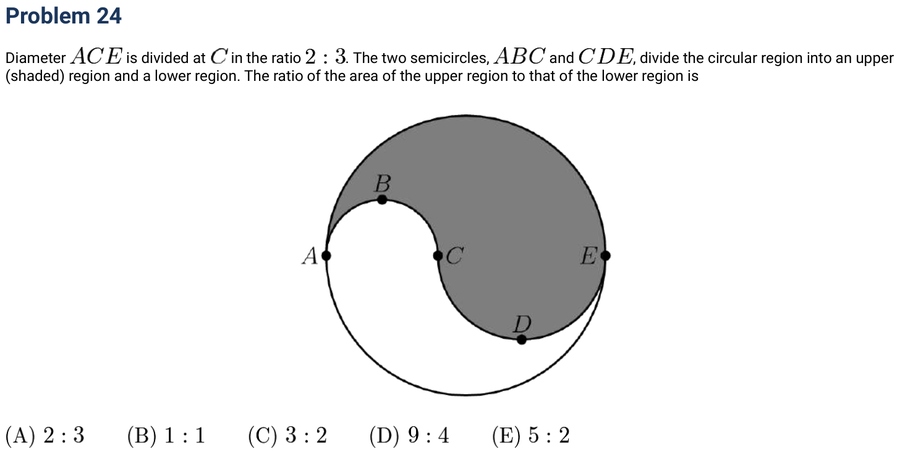
Set the diameter to 10, so AC = 4 and CE = 6, and the big radius is 5.
Show hint (sharpest)
Build the upper region from the big half-disk by removing one small semicircle and adding the other.
Show solution
  1. Let AE = 10, so AC = 4 and CE = 6; the three radii are 5, 2, 3 and their half-areas are 12.5π, 2π, 4.5π.
  2. The upper region is the big half-disk minus semicircle ABC plus semicircle CDE: 12.5π − 2π + 4.5π = 15π, leaving 10π below.
  3. The ratio is 15π : 10π = 3 : 2.
C 3 : 2.
Mark: · log in to save
Problem 25 · 1997 AJHSME Stretch
Number Theory units-digit cyclicity

All the even numbers from 2 to 98 inclusive, except those ending in 0, are multiplied together. What is the units digit of the product?

Show hint (soft nudge)
Only units digits matter; each block of ten contributes the units 2, 4, 6, 8.
Show hint (sharpest)
2 × 4 × 6 × 8 ends in 4, and there are ten blocks — find the units digit of 4¹⁰.
Show solution
  1. Each block of ten (like 2, 4, 6, 8) multiplies to a units digit of 4, and there are 10 such blocks, so we need the units digit of 4¹⁰.
  2. 4² ends in 6, and any power of 6 ends in 6, so 4¹⁰ = (4²)⁵ ends in 6.
D 6.
Mark: · log in to save