AJHSME · Test Mode

1998 AJHSME

Test mode — hints and solutions are locked. Pick an answer for each, then submit at the bottom to see your score.

← Exit test mode No hints or solutions until you submit.
Problem 1 · 1998 AJHSME Easy
Algebra & Patterns substitution

For x = 7, which of the following is the smallest?

Show hint (soft nudge)
Plug in x = 7 and compare the five values.
Show hint (sharpest)
The smallest fraction has the largest bottom and a small top.
Show solution
  1. With x = 7 the choices are 6/7, 6/8, 6/6, 7/6, 8/6.
  2. The smallest is 6/8 = 0.75, which is 6/(x+1).
B 6/(x+1).
Mark: · log in to save
Problem 2 · 1998 AJHSME Easy
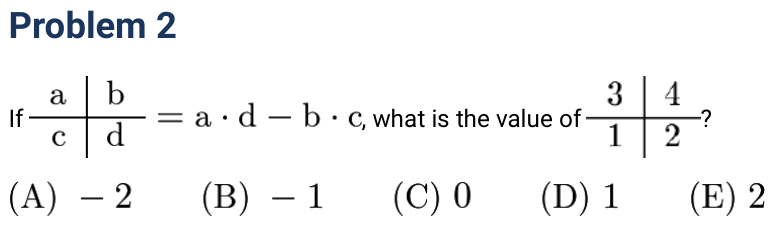
Algebra & Patterns custom-operation
ajhsme-1998-02
Show hint (soft nudge)
Apply the given rule: top-left × bottom-right minus top-right × bottom-left.
Show hint (sharpest)
Just plug in 3, 4, 1, 2.
Show solution
  1. The rule gives a·d − b·c = 3·2 − 4·1.
  2. That is 6 − 4 = 2.
E 2.
Mark: · log in to save
Problem 3 · 1998 AJHSME Easy
Fractions, Decimals & Percents fraction-arithmetic
ajhsme-1998-03
Show hint (soft nudge)
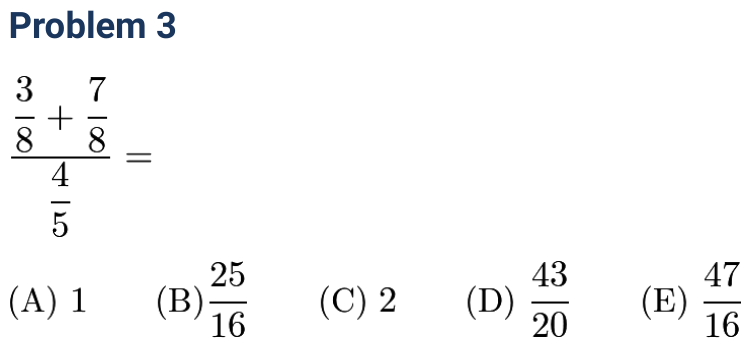
Add the top fractions first, then divide by the bottom one.
Show hint (sharpest)
Dividing by 4/5 is the same as multiplying by 5/4.
Show solution
  1. The top is 3/8 + 7/8 = 10/8 = 5/4, and dividing by 4/5 multiplies by 5/4.
  2. So (5/4)(5/4) = 25/16.
B 25/16.
Mark: · log in to save
Problem 4 · 1998 AJHSME Easy
Geometry & Measurement careful-counting
ajhsme-1998-04
Show hint (soft nudge)
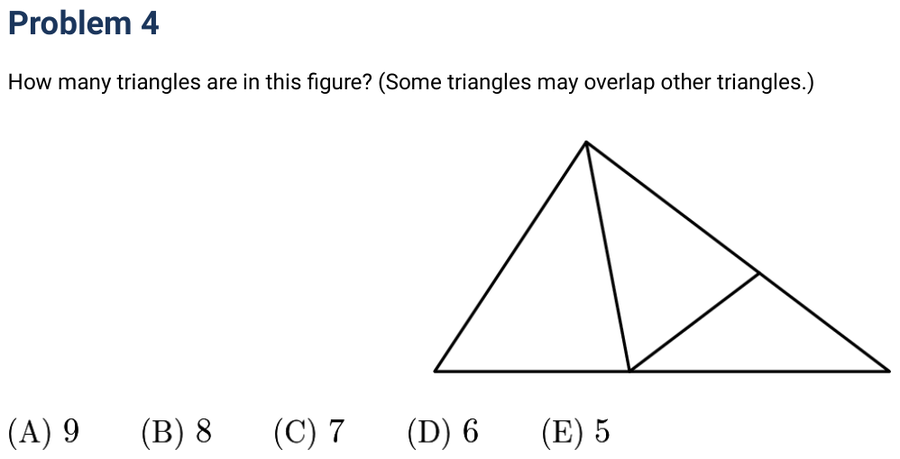
Count the smallest triangles first, then any larger ones built from pieces.
Show hint (sharpest)
Remember the whole outline is itself a triangle.
Show solution
  1. There are 3 small triangles; the two right-hand ones also join into 1 larger triangle; and the whole figure forms 1 more.
  2. That's 3 + 1 + 1 = 5 triangles.
E 5 triangles.
Mark: · log in to save
Problem 5 · 1998 AJHSME Medium
Fractions, Decimals & Percents compare-decimals
ajhsme-1998-05
Show hint (soft nudge)
They all agree through 9.1234 — compare the digits that come after.
Show hint (sharpest)
A repeating 4 keeps adding 4s, beating a number that simply stops.
Show solution
  1. All five begin 9.1234. The next digit is 4 for both A and B, but smaller for C, D, and E.
  2. A stops at 9.12344 while B continues 9.123444…, so B is the largest.
B 9.1234̄ (B).
Mark: · log in to save
Problem 6 · 1998 AJHSME Medium
Geometry & Measurement rearrangement
ajhsme-1998-06
Show hint (soft nudge)
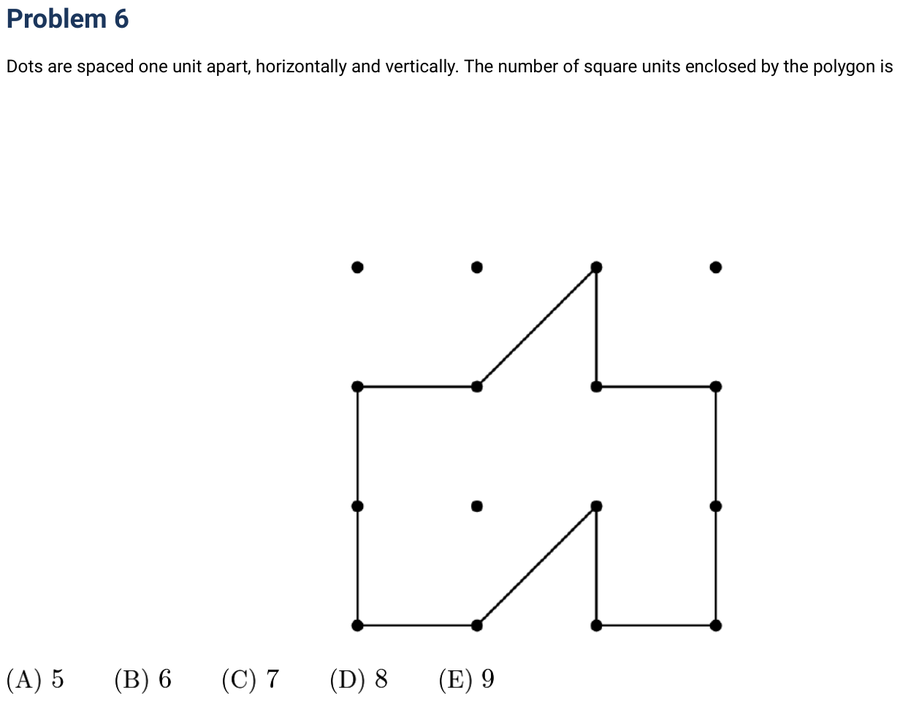
The slanted edges just move area from one spot to another.
Show hint (sharpest)
Compare the shape to a simple 2 × 3 rectangle.
Show solution
  1. The two slanted edges shift equal triangular pieces from the bottom to the top, so the enclosed area equals a plain 2 × 3 block.
  2. That area is 2 × 3 = 6 square units.
B 6 square units.
Mark: · log in to save
Problem 7 · 1998 AJHSME Medium
Arithmetic & Operations regrouping

100 × 19.98 × 1.998 × 1000 =

Show hint (soft nudge)
Pair the factors so each pair makes the same round number.
Show hint (sharpest)
100 × 19.98 and 1.998 × 1000 are both 1998.
Show solution
  1. Group as (100 × 19.98) × (1.998 × 1000) = 1998 × 1998.
  2. That is (1998)².
D (1998)².
Mark: · log in to save
Problem 8 · 1998 AJHSME Easy
Ratios, Rates & Proportions rate

A child's wading pool contains 200 gallons of water. If water evaporates at the rate of 0.5 gallons per day and no other water is added or removed, how many gallons of water will be in the pool after 30 days?

Show hint (soft nudge)
Find the total amount lost over the 30 days first.
Show hint (sharpest)
Subtract that from the starting 200 gallons.
Show solution
  1. In 30 days the pool loses 0.5 × 30 = 15 gallons.
  2. So 200 − 15 = 185 gallons remain.
C 185 gallons.
Mark: · log in to save
Problem 9 · 1998 AJHSME Medium
Fractions, Decimals & Percents successive-discount

For a sale, a store owner reduces the price of a $10 scarf by 20%. Later the price is lowered again, this time by one-half of the reduced price. The price is now

Show hint (soft nudge)
Take 20% off the $10 first.
Show hint (sharpest)
The next markdown removes half of that new price.
Show solution
  1. A 20% cut leaves $10 × 0.8 = $8.
  2. Cutting that in half gives $8 ÷ 2 = $4.00.
C $4.00.
Mark: · log in to save
Problem 10 · 1998 AJHSME Hard
Number Theory casework

Each of the letters W, X, Y, and Z represents a different integer in the set {1, 2, 3, 4}, but not necessarily in that order. If WXYZ = 1, then the sum of W and Y is

Show hint (soft nudge)
For the difference to be exactly the whole number 1, each fraction should itself be a whole number.
Show hint (sharpest)
Try making one fraction 3/1 and the other 4/2.
Show solution
  1. To get a difference of exactly 1, both fractions should be integers: 3/1 = 3 and 4/2 = 2 work, since 3 − 2 = 1.
  2. Then W = 3 and Y = 4, so W + Y = 7.
E 7.
Mark: · log in to save
Problem 11 · 1998 AJHSME Medium
Logic & Word Problems careful-counting

Harry has 3 sisters and 5 brothers. His sister Harriet has S sisters and B brothers. What is the product of S and B?

Show hint (soft nudge)
First count the girls and boys in the whole family.
Show hint (sharpest)
Harriet doesn't count herself among her own sisters.
Show solution
  1. Harry (a boy) has 3 sisters and 5 brothers, so the family has 3 girls and 6 boys.
  2. Harriet, a girl, then has 2 sisters and 6 brothers, so S × B = 2 × 6 = 12.
C 12.
Mark: · log in to save
Problem 12 · 1998 AJHSME Medium
Algebra & Patterns simplify-term

What is the value of 2(1 − 12) + 3(1 − 13) + 4(1 − 14) + … + 10(1 − 110)?

Show hint (soft nudge)
Simplify a single term: k(1 − 1/k) is just k − 1.
Show hint (sharpest)
Then you're adding 1 + 2 + … + 9.
Show solution
  1. Each term k(1 − 1/k) equals k − 1, so the sum is 1 + 2 + 3 + … + 9.
  2. That total is 45.
A 45.
Mark: · log in to save
Problem 13 · 1998 AJHSME Hard
Geometry & Measurement area-ratio symmetry
ajhsme-1998-13
Show hint (soft nudge)
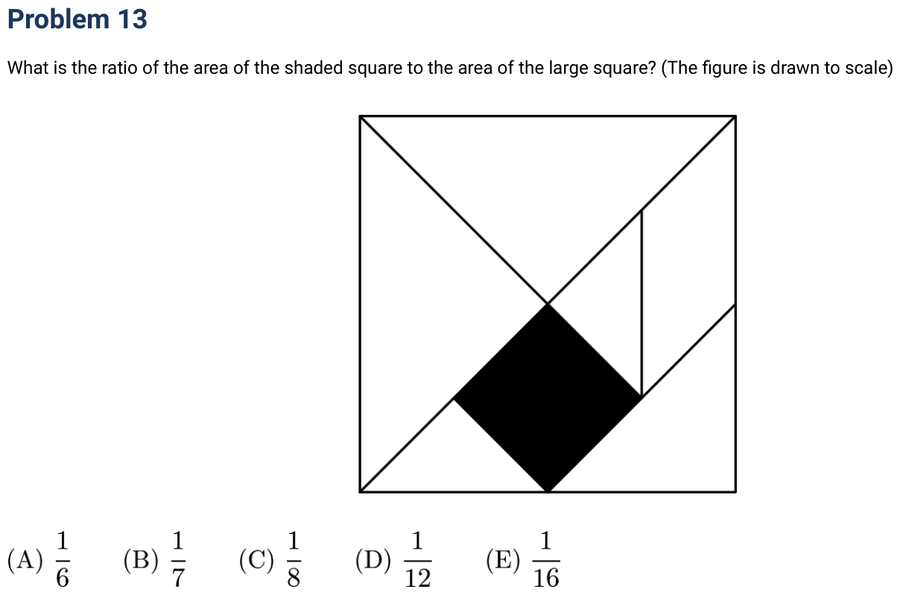
The diagonals and lines cut the big square into matching triangular pieces.
Show hint (sharpest)
The shaded square is half of one quarter of the whole.
Show solution
  1. The drawn lines split the big square into equal pieces; the shaded square fills half of one of the four quarters.
  2. So its area is ½ × ¼ = 1/8 of the large square.
C 1/8.
Mark: · log in to save
Problem 14 · 1998 AJHSME Medium
Fractions, Decimals & Percents percent-overlap

At Annville Junior High School, 30% of the students in the Math Club are in the Science Club, and 80% of the students in the Science Club are in the Math Club. There are 15 students in the Science Club. How many students are in the Math Club?

Show hint (soft nudge)
Find how many students are in both clubs, using the Science Club side.
Show hint (sharpest)
That same number is 30% of the Math Club.
Show solution
  1. Both clubs share 80% of 15 = 12 students.
  2. Those 12 make up 30% of the Math Club, so the Math Club has 12 ÷ 0.3 = 40 students.
E 40 students.
Mark: · log in to save
Problem 15 · 1998 AJHSME Medium
Ratios, Rates & Proportions exponential-growth estimation

Nisos Isles. In 1998 the islands have 200 people, and the population triples every 25 years. Estimate the population in the year 2050.

Show hint (soft nudge)
From 1998 to about 2050 spans two 25-year tripling periods.
Show hint (sharpest)
Triple once, then triple again.
Show solution
  1. By 2048 (two 25-year periods) the population triples twice: 200 × 3 × 3 = 1800.
  2. That is closest to 2000.
D About 2000.
Mark: · log in to save
Problem 16 · 1998 AJHSME Medium
Ratios, Rates & Proportions exponential-growth estimation

Nisos Isles. In 1998 the islands have 200 people, and the population triples every 25 years. Estimate the year in which the population will be about 6000.

Show hint (soft nudge)
6000 is about 30 times the starting 200.
Show hint (sharpest)
Each tripling multiplies by 3 — how many triples reach about 30×?
Show solution
  1. 6000 ÷ 200 = 30, and three triplings give ×27 ≈ 30.
  2. Three 25-year periods is 75 years after 1998, about 2075.
B About 2075.
Mark: · log in to save
Problem 17 · 1998 AJHSME Hard
Ratios, Rates & Proportions exponential-growth estimation

Nisos Isles. In 1998 the islands have 200 people, and the population triples every 25 years. The total area is 24,900 square miles, and the Queen requires at least 1.5 square miles per person. In about how many years from 1998 will the population reach the maximum the islands can support?

Show hint (soft nudge)
First find the largest population the land allows: area ÷ 1.5.
Show hint (sharpest)
Compare that to 200 and count how many triplings it takes.
Show solution
  1. The land supports 24,900 ÷ 1.5 = 16,600 people, about 83 times today's 200.
  2. Since 3⁴ = 81 ≈ 83, that's four triplings, or 4 × 25 = 100 years.
C About 100 years.
Mark: · log in to save
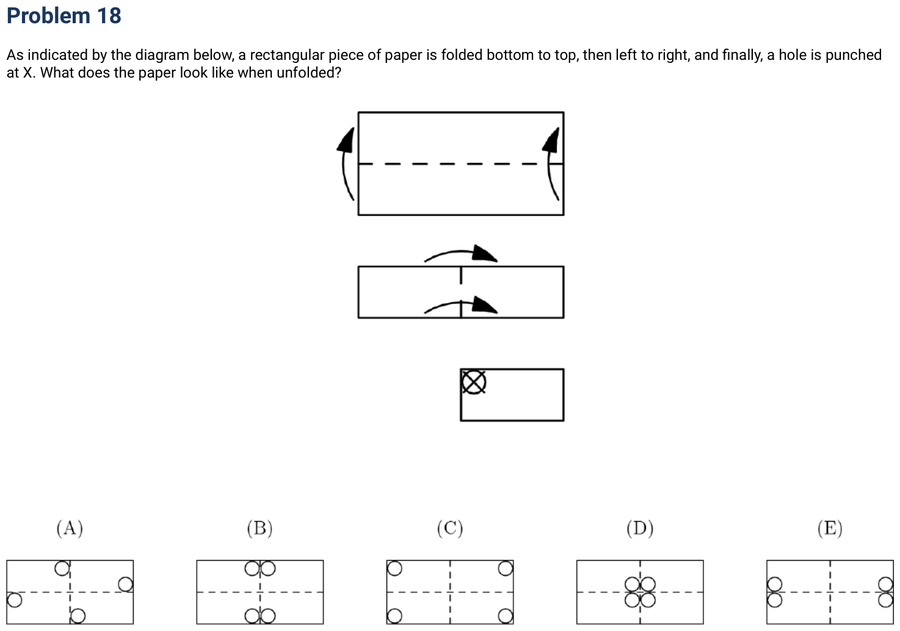
Problem 18 · 1998 AJHSME Hard
Geometry & Measurement symmetry spatial-reasoning
ajhsme-1998-18
Show hint (soft nudge)
Each fold doubles the holes by reflecting across its crease.
Show hint (sharpest)
Unfold one step at a time, mirroring the punched hole each time.
Show solution
  1. Undoing the left-to-right fold mirrors the hole across the vertical crease, and undoing the bottom-to-top fold mirrors both across the horizontal crease.
  2. That produces the four-hole pattern of choice B.
B Choice B.
Mark: · log in to save
Problem 19 · 1998 AJHSME Hard
Counting & Probability enumerate-cases

Tamika selects two different numbers at random from the set {8, 9, 10} and adds them. Carlos takes two different numbers at random from the set {3, 5, 6} and multiplies them. What is the probability that Tamika's result is greater than Carlos' result?

Show hint (soft nudge)
List Tamika's possible sums and Carlos's possible products.
Show hint (sharpest)
Compare each of the 3 × 3 equally likely pairings.
Show solution
  1. Tamika's sums are 17, 18, 19; Carlos's products are 15, 18, 30 — each value equally likely.
  2. Tamika beats 15 all 3 times, beats 18 once (with 19), and never beats 30: that's 3 + 1 + 0 = 4 of 9 cases.
  3. So the probability is 4/9.
A 4/9.
Mark: · log in to save
Problem 20 · 1998 AJHSME Hard
Geometry & Measurement folding area-to-side

Let PQRS be a square piece of paper. P is folded onto R, and then Q is folded onto S. The area of the resulting figure is 9 square inches. Find the perimeter of square PQRS.

Show hint (soft nudge)
Each fold halves the area.
Show hint (sharpest)
After two folds the figure is one-fourth of the square's area.
Show solution
  1. Folding P onto R halves the square, and folding Q onto S halves it again, leaving one-fourth of the area: s²/4 = 9, so s² = 36 and s = 6.
  2. The perimeter is 4 × 6 = 24 inches.
D 24 inches.
Mark: · log in to save
Problem 21 · 1998 AJHSME Hard
Geometry & Measurement complementary-counting

A 4 × 4 × 4 cubical box contains 64 identical small cubes that exactly fill the box. How many of these small cubes touch a side or the bottom of the box?

Show hint (soft nudge)
Count the cubes that touch nothing — not the four walls, not the bottom — and subtract.
Show hint (sharpest)
Those untouched cubes form a small block held away from every wall and the floor.
Show solution
  1. A cube avoids all four walls and the bottom only if it lies in the inner 2 × 2 columns and above the bottom layer: 2 × 2 × 3 = 12 cubes.
  2. So 64 − 12 = 52 cubes touch a side or the bottom.
B 52 cubes.
Mark: · log in to save
Problem 22 · 1998 AJHSME Stretch
Algebra & Patterns find-the-cycle

Terri builds a sequence of positive integers by these rules: if the integer is less than 10, multiply it by 9; if it is even and greater than 9, divide it by 2; if it is odd and greater than 9, subtract 5. Find the 98th term of the sequence that begins 98, 49, … .

Show hint (soft nudge)
Generate terms until they start repeating.
Show hint (sharpest)
Once you spot the repeating block, use its length to jump ahead to the 98th term.
Show solution
  1. The sequence runs 98, 49, 44, 22, 11, 6, 54, 27, 22, 11, … — from the 4th term on it cycles 22, 11, 6, 54, 27 with length 5.
  2. From the 4th term, (98 − 4) = 94 steps and 94 ÷ 5 leaves remainder 4, landing on the 5th entry of the cycle: 27.
D 27.
Mark: · log in to save
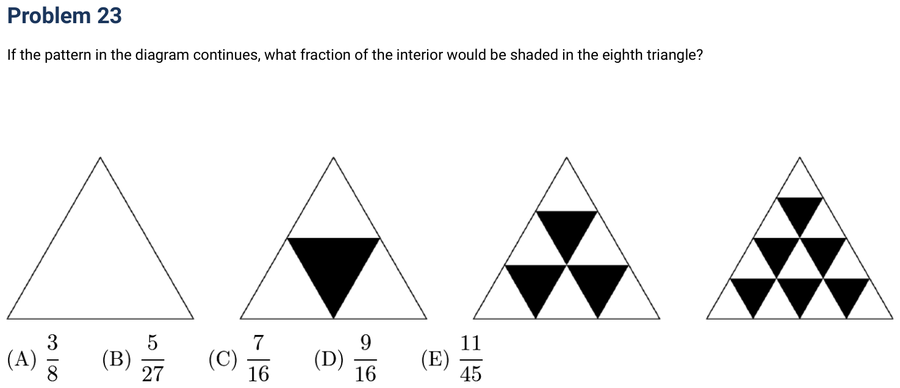
Problem 23 · 1998 AJHSME Stretch
Algebra & Patterns find-the-pattern
ajhsme-1998-23
Show hint (soft nudge)
Count shaded vs. total small triangles in the first few figures, then find the rule.
Show hint (sharpest)
The ratio simplifies to (n − 1)/(2n) for the nth triangle.
Show solution
  1. The nth triangle splits into n² small triangles, of which (n² − n)/2 are shaded — a ratio of (n − 1)/(2n).
  2. For the 8th triangle that is 7/16.
C 7/16.
Mark: · log in to save
Problem 24 · 1998 AJHSME Stretch
Number Theory triangular-numbers mod-arithmetic

A board of 8 columns has squares numbered left to right, top to bottom (row one is 1–8, row two is 9–16, and so on). A student shades square 1, then skips one and shades square 3, skips two and shades square 6, skips three and shades square 10, and continues this way until every column has at least one shaded square. What is the number of the shaded square that first achieves this?

Show hint (soft nudge)
The shaded squares are the triangular numbers 1, 3, 6, 10, 15, … .
Show hint (sharpest)
A square's column is set by its value mod 8 — you need all 8 remainders to appear.
Show solution
  1. The shaded squares are triangular numbers, and a square's column depends on its value mod 8.
  2. Every remainder shows up early except 0; the first triangular number divisible by 8 is 120, so the last column fills at square 120.
E 120.
Mark: · log in to save
Problem 25 · 1998 AJHSME Stretch
Algebra & Patterns work-backward invariant

Three generous friends redistribute their money as follows: Amy gives Jan and Toy enough to double each of their amounts; then Jan gives Amy and Toy enough to double theirs; finally Toy gives Amy and Jan enough to double theirs. Toy had $36 at the beginning and $36 at the end. What is the total amount the three friends have?

Show hint (soft nudge)
The total never changes — you only need to find it at one moment.
Show hint (sharpest)
Toy's money doubles in the first two rounds, so track it up to just before his own turn.
Show solution
  1. Toy's $36 doubles in each of the first two rounds: 36 → 72 → 144 just before his turn.
  2. He ends with $36, so he gave away 144 − 36 = 108, which exactly doubled Amy and Jan — meaning they held $108 then.
  3. The total, unchanged throughout, is 144 + 108 = $252.
D $252.
Mark: · log in to save