AMC 8 · Test Mode

1999 AMC 8

Test mode — hints and solutions are locked. Pick an answer for each, then submit at the bottom to see your score.

← Exit test mode No hints or solutions until you submit.
Problem 1 · 1999 AMC 8 Easy
Arithmetic & Operations work-backward

(6 ? 3) + 4 − (2 − 1) = 5. To make this statement true, the question mark between the 6 and the 3 should be replaced by

Show hint (soft nudge)
Simplify the part you can: 4 − (2 − 1) is just 3.
Show hint (sharpest)
That leaves 6 ? 3 = 2 — which operation gives 2?
Show solution
  1. The tail simplifies: 4 − (2 − 1) = 3.
  2. So 6 ? 3 must equal 5 − 3 = 2, and only 6 ÷ 3 = 2 works.
  3. The missing sign is ÷.
A ÷ (division).
Mark: · log in to save
Problem 2 · 1999 AMC 8 Easy
Geometry & Measurement angle-measure

What is the degree measure of the smaller angle formed by the hands of a clock at 10 o'clock?

Show hint (soft nudge)
Each number on the clock face is 30° from the next.
Show hint (sharpest)
Count how many gaps separate the 10 and the 12.
Show solution
  1. At 10 o'clock the hands point to 10 and 12 — two hour-marks apart.
  2. Each hour-mark spans 360° ÷ 12 = 30°, so the angle is 2 × 30° = 60°.
C 60°.
Mark: · log in to save
Problem 3 · 1999 AMC 8 Easy
Fractions, Decimals & Percents mental-math

Which triplet of numbers has a sum NOT equal to 1?

Show hint (soft nudge)
Add each triplet, but watch for one that obviously collapses.
Show hint (sharpest)
In choice D the 1.1 and 1.0 sum to exactly 2.1 — which the −2.1 wipes out.
Show solution
  1. Choices A, B, C, and E each total 1 (for instance ½ + ⅓ + ⅙ = 1).
  2. Choice D gives 1.1 − 2.1 + 1.0 = 0, not 1.
  3. So the odd one out is (1.1, −2.1, 1.0).
D (1.1, −2.1, 1.0).
Mark: · log in to save
Problem 4 · 1999 AMC 8 Easy
Ratios, Rates & Proportions graph-reading
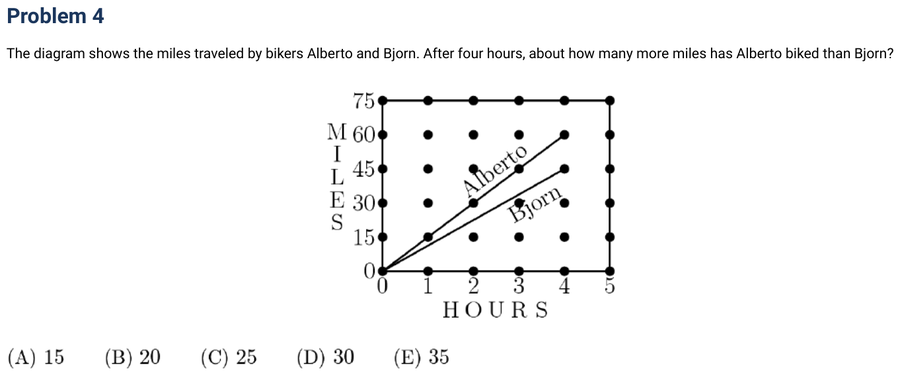
amc8-1999-04
Show hint (soft nudge)
Read each rider's distance straight off the graph at the 4-hour mark.
Show hint (sharpest)
Then just subtract.
Show solution
  1. At 4 hours the graph shows Alberto at about 60 miles and Bjorn at about 45 miles.
  2. Alberto is ahead by 60 − 45 = 15 miles.
A About 15 miles.
Mark: · log in to save
Problem 5 · 1999 AMC 8 Medium
Geometry & Measurement perimeter-area

A rectangular garden 50 feet long and 10 feet wide is enclosed by a fence. To make the garden larger, while using the same fence, its shape is changed to a square. By how many square feet does this enlarge the garden?

Show hint (soft nudge)
The fence length stays the same, so find the square's side from that perimeter.
Show hint (sharpest)
Then compare the two areas.
Show solution
  1. The fence is 2(50 + 10) = 120 ft, so the square has side 120 ÷ 4 = 30 ft and area 30² = 900.
  2. The original area was 50 × 10 = 500, so the gain is 900 − 500 = 400 square feet.
D 400 square feet.
Mark: · log in to save
Problem 6 · 1999 AMC 8 Easy
Logic & Word Problems ordering

Bo, Coe, Flo, Jo, and Moe have different amounts of money. Neither Jo nor Bo has as much money as Flo. Both Bo and Coe have more than Moe. Jo has more than Moe, but less than Bo. Who has the least amount of money?

Show hint (soft nudge)
You don't need the full ranking — just find who everyone beats.
Show hint (sharpest)
Every clue that names Moe places someone above him.
Show solution
  1. Bo, Coe, and Jo are each said to have more than Moe, and Flo has more than Bo, so Flo beats Moe too.
  2. Everyone has more than Moe, so Moe has the least.
E Moe.
Mark: · log in to save
Problem 7 · 1999 AMC 8 Medium
Fractions, Decimals & Percents fraction-of

The third exit on a highway is located at milepost 40 and the tenth exit is at milepost 160. There is a service center on the highway located three-fourths of the way from the third exit to the tenth exit. At what milepost would you expect to find this service center?

Show hint (soft nudge)
The two exits are 160 − 40 = 120 mileposts apart.
Show hint (sharpest)
Go three-fourths of that distance past milepost 40.
Show solution
  1. From milepost 40 to 160 is 120 miles, and three-fourths of 120 is 90.
  2. So the center sits at 40 + 90 = 130.
E Milepost 130.
Mark: · log in to save
Problem 8 · 1999 AMC 8 Medium
Geometry & Measurement spatial-reasoning net-folding
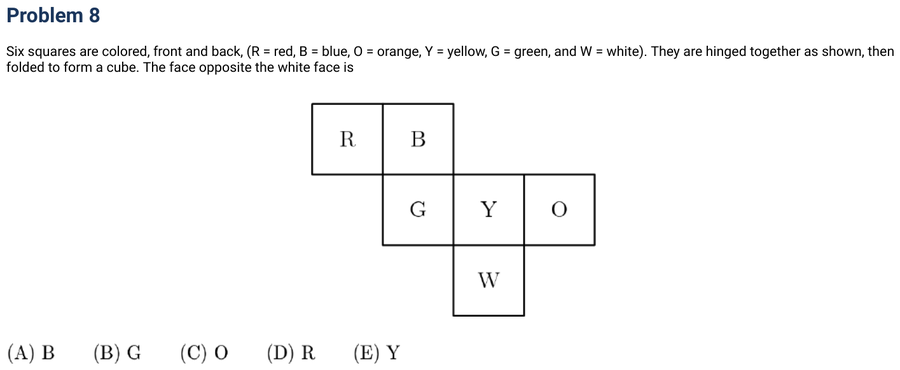
amc8-1999-08
Show hint (soft nudge)
Find a straight strip of three squares in the net that includes the white face.
Show hint (sharpest)
The two ends of a straight three-square strip fold onto opposite faces.
Show solution
  1. White, green, and blue lie in a straight vertical strip of three squares.
  2. Folding a straight strip of three wraps its ends onto opposite faces, so white ends up across from blue.
A Blue.
Mark: · log in to save
Problem 9 · 1999 AMC 8 Medium
Counting & Probability inclusion-exclusion
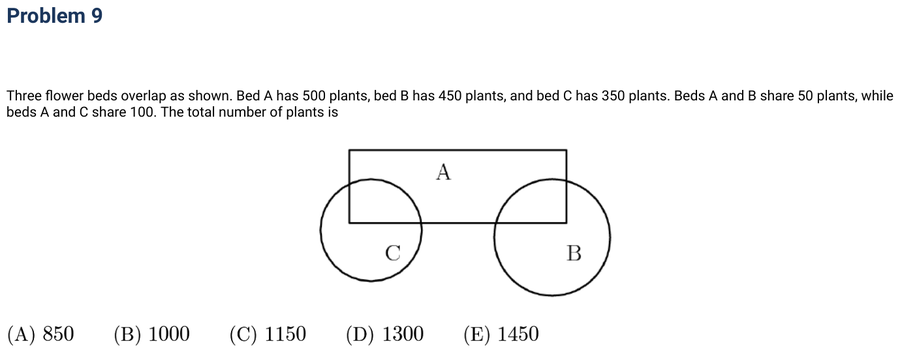
amc8-1999-09
Show hint (soft nudge)
Add the three bed counts, then fix the double-counting.
Show hint (sharpest)
Each shared plant got counted twice, so subtract the overlaps once.
Show solution
  1. Adding the beds gives 500 + 450 + 350 = 1300, but the 50 + 100 = 150 shared plants were each counted twice.
  2. Subtract the overlap once: 1300 − 150 = 1150 plants.
C 1150 plants.
Mark: · log in to save
Problem 10 · 1999 AMC 8 Medium
Counting & Probability probability

A complete cycle of a traffic light takes 60 seconds. During each cycle the light is green for 25 seconds, yellow for 5 seconds, and red for 30 seconds. At a randomly chosen time, what is the probability that the light will NOT be green?

Show hint (soft nudge)
"Not green" just means yellow or red.
Show hint (sharpest)
Compare that time to the full 60-second cycle.
Show solution
  1. Not green means yellow or red: 5 + 30 = 35 seconds out of 60.
  2. So the probability is 35/60 = 7/12.
E 7/12.
Mark: · log in to save
Problem 11 · 1999 AMC 8 Medium
Logic & Word Problems counted-twice optimization
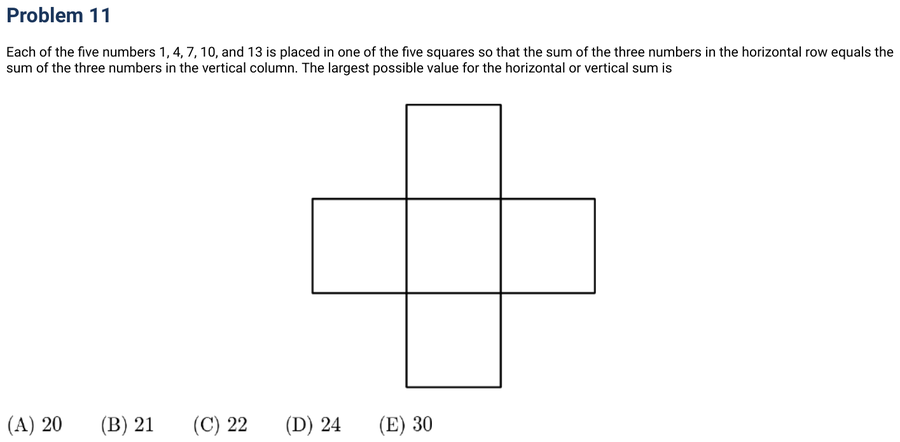
amc8-1999-11
Show hint (soft nudge)
The horizontal and vertical lines share the middle square — it counts in both sums.
Show hint (sharpest)
So put the largest number in the center to make the totals as big as possible.
Show solution
  1. The two line-sums together use all five numbers once, plus the center one extra time: 35 + center.
  2. Putting 13 in the center gives 35 + 13 = 48, and each line is half of that: 48 ÷ 2 = 24.
D 24.
Mark: · log in to save
Problem 12 · 1999 AMC 8 Medium
Fractions, Decimals & Percents ratio-to-percent

The ratio of the number of games won to the number of games lost (no ties) by the Middle School Middies is 114. To the nearest whole percent, what percent of its games did the team lose?

Show hint (soft nudge)
Turn the ratio into parts: 11 won and 4 lost make 15 games in all.
Show hint (sharpest)
The lost fraction is 4 out of 15.
Show solution
  1. Treat the ratio as 11 wins and 4 losses, so 15 games total.
  2. Losses are 4/15 ≈ 26.7%, which rounds to 27%.
B 27%.
Mark: · log in to save
Problem 13 · 1999 AMC 8 Medium
Arithmetic & Operations averages totals

The average age of the 40 members of a computer science camp is 17 years. There are 20 girls, 15 boys, and 5 adults. If the average age of the girls is 15 and the average age of the boys is 16, what is the average age of the adults?

Show hint (soft nudge)
Work with total ages, not averages: everyone's ages add to 40 × 17.
Show hint (sharpest)
Subtract the girls' and boys' totals to leave the adults' total.
Show solution
  1. All 40 ages total 40 × 17 = 680. Girls total 20 × 15 = 300 and boys total 15 × 16 = 240.
  2. Adults total 680 − 300 − 240 = 140, so their average is 140 ÷ 5 = 28.
C 28 years.
Mark: · log in to save
Problem 14 · 1999 AMC 8 Medium
Geometry & Measurement pythagorean symmetry
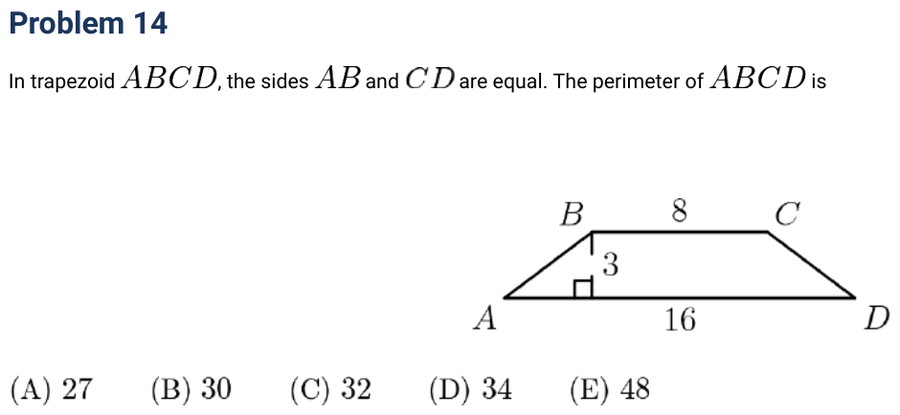
amc8-1999-14
Show hint (soft nudge)
Drop verticals from B and C to split the long base into the middle 8 and two equal end pieces.
Show hint (sharpest)
Each slant side is then the hypotenuse of a 3–4 right triangle.
Show solution
  1. The two equal ends of the bottom are each (16 − 8) ÷ 2 = 4, and the height is 3, so each slant side is √(4² + 3²) = 5.
  2. The perimeter is 16 + 8 + 5 + 5 = 34.
D 34.
Mark: · log in to save
Problem 15 · 1999 AMC 8 Hard
Counting & Probability multiplication-principle optimization

Bicycle license plates in Flatville each contain three letters. The first is chosen from the set {C, H, L, P, R}, the second from {A, I, O}, and the third from {D, M, N, T}. When Flatville needed more license plates, they added two new letters. The new letters may both be added to one set, or one letter may be added to one set and one to another. What is the largest possible number of additional license plates that can be made by adding two letters?

Show hint (soft nudge)
The number of plates is the product of the three set sizes — right now 5 × 3 × 4 = 60.
Show hint (sharpest)
Growing the smallest factors multiplies the count the most; try a couple of placements.
Show solution
  1. Now there are 5 × 3 × 4 = 60 plates; two new letters change one or two of the factors.
  2. The best is to enlarge the small factors: 5 × 5 × 4 (both into the size-3 set) or 5 × 4 × 5 each give 100 plates.
  3. That's 100 − 60 = 40 additional plates.
D 40 more plates.
Mark: · log in to save
Problem 16 · 1999 AMC 8 Medium
Fractions, Decimals & Percents percent-of

Tori's mathematics test had 75 problems: 10 arithmetic, 30 algebra, and 35 geometry problems. Although she answered 70% of the arithmetic, 40% of the algebra, and 60% of the geometry problems correctly, she did not pass the test because she got less than 60% of the problems right. How many more problems would she have needed to answer correctly to earn a 60% passing grade?

Show hint (soft nudge)
Count how many she actually got right in each subject.
Show hint (sharpest)
Compare that total to 60% of all 75 problems.
Show solution
  1. She got 7 of the arithmetic, 12 of the algebra, and 21 of the geometry right: 7 + 12 + 21 = 40 correct.
  2. A 60% grade needs 0.6 × 75 = 45 correct, so she was short by 5.
B 5 more.
Mark: · log in to save
Problem 17 · 1999 AMC 8 Medium
Arithmetic & Operations round-up unit-conversion

Cookies for a Crowd. At a school, 108 students eat an average of 2 cookies apiece. The recipe makes a pan of 15 cookies and uses 2 eggs per pan, and only full recipes are made. Walter buys eggs by the half-dozen. How many half-dozens should he buy to make enough cookies?

Show hint (soft nudge)
First find how many full pans of 15 cookies cover all the cookies needed.
Show hint (sharpest)
Then count the eggs and split them into half-dozens (6 each).
Show solution
  1. The students eat 108 × 2 = 216 cookies, needing 216 ÷ 15 = 14.4 → 15 full pans.
  2. That's 15 × 2 = 30 eggs, or 30 ÷ 6 = 5 half-dozens.
C 5 half-dozens.
Mark: · log in to save
Problem 18 · 1999 AMC 8 Medium
Fractions, Decimals & Percents percent-decrease round-up

Cookies for a Crowd. The recipe makes a pan of 15 cookies, and only full recipes are made. Normally 108 students each eat 2 cookies, but a concert cuts attendance by 25%. How many recipes should Walter and Gretel make for the smaller party?

Show hint (soft nudge)
A 25% drop leaves three-fourths of the 108 students.
Show hint (sharpest)
Find their cookies, then round up to whole pans of 15.
Show solution
  1. Three-fourths of 108 is 81 students, eating 81 × 2 = 162 cookies.
  2. That needs 162 ÷ 15 = 10.8 → 11 full recipes.
E 11 recipes.
Mark: · log in to save
Problem 19 · 1999 AMC 8 Medium
Arithmetic & Operations round-up unit-conversion

Cookies for a Crowd. The recipe makes a pan of 15 cookies using 3 tablespoons of butter, and only full recipes are made. Walter and Gretel must supply 216 cookies. There are 8 tablespoons in a stick of butter. How many sticks of butter are needed?

Show hint (soft nudge)
Find the number of full pans for 216 cookies, then the butter they use.
Show hint (sharpest)
Convert tablespoons to sticks (8 per stick), rounding up.
Show solution
  1. 216 cookies need 216 ÷ 15 = 14.4 → 15 pans, using 15 × 3 = 45 tablespoons of butter.
  2. At 8 tablespoons per stick, that's 45 ÷ 8 = 5.6 → 6 sticks.
B 6 sticks.
Mark: · log in to save
Problem 20 · 1999 AMC 8 Hard
Geometry & Measurement spatial-reasoning
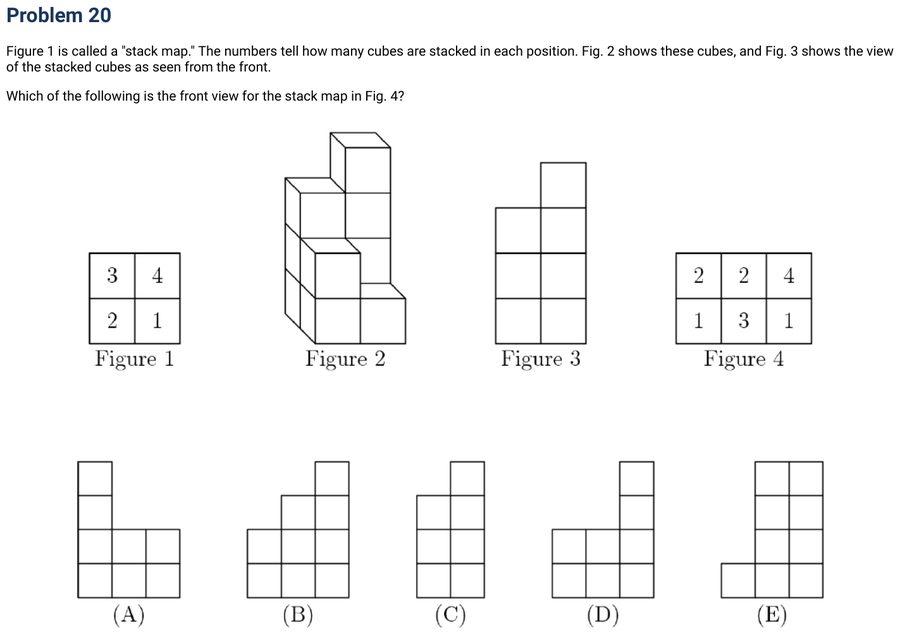
amc8-1999-20
Show hint (soft nudge)
From the front, each column appears as tall as its tallest stack.
Show hint (sharpest)
Take the larger of the two numbers in each column of the map.
Show solution
  1. Looking from the front, a column is as tall as its highest stack: max(2,1) = 2, max(2,3) = 3, max(4,1) = 4.
  2. So the columns rise 2, 3, 4 from left to right, which matches figure B.
B Figure B.
Mark: · log in to save
Problem 21 · 1999 AMC 8 Stretch
Geometry & Measurement angle-chase
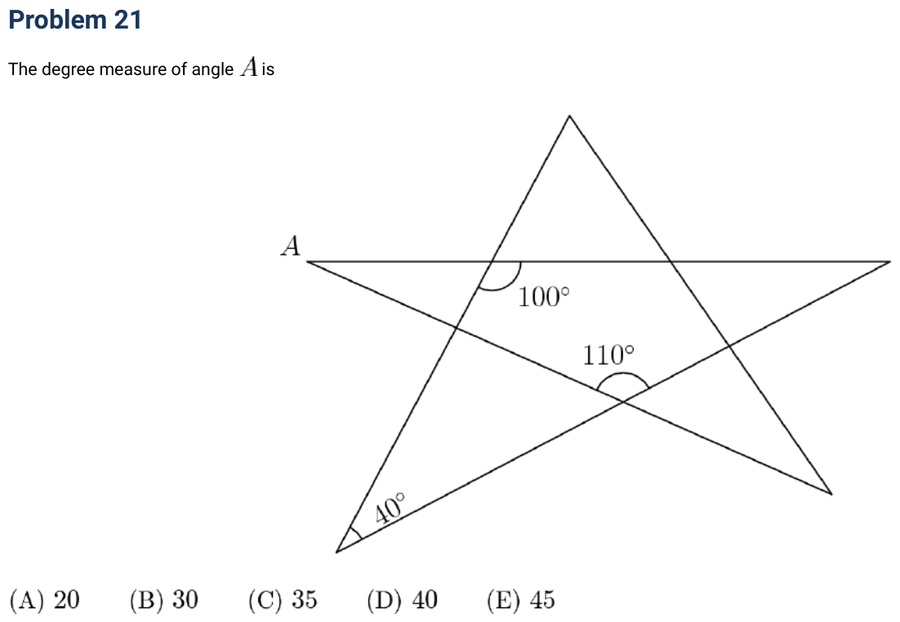
amc8-1999-21
Show hint (soft nudge)
Each marked angle has a supplement along its line — start by finding those.
Show hint (sharpest)
Chase through the small triangles, using vertical angles where lines cross, until you reach A.
Show solution
  1. The 100° and 110° marks have supplements 80° and 70° along their lines.
  2. In the triangle holding the 40° tip and that 70°, the third angle is 180° − 70° − 40° = 70°, and its vertical angle at the crossing near A is also 70°.
  3. A's triangle then gives ∠A = 180° − 80° − 70° = 30°.
B 30°.
Mark: · log in to save
Problem 22 · 1999 AMC 8 Stretch
Ratios, Rates & Proportions substitution unit-rate

In a far-off land three fish can be traded for two loaves of bread, and a loaf of bread can be traded for four bags of rice. How many bags of rice is one fish worth?

Show hint (soft nudge)
Convert bread into rice first, so everything is measured in rice.
Show hint (sharpest)
Then 3 fish equals that many bags — divide by 3.
Show solution
  1. Since 1 loaf = 4 bags of rice, 2 loaves = 8 bags, and 3 fish trade for those 2 loaves.
  2. So 3 fish = 8 bags, making one fish 8 ÷ 3 = 2⅔ bags of rice.
D 2⅔ bags.
Mark: · log in to save
Problem 23 · 1999 AMC 8 Stretch
Geometry & Measurement area-to-length pythagorean
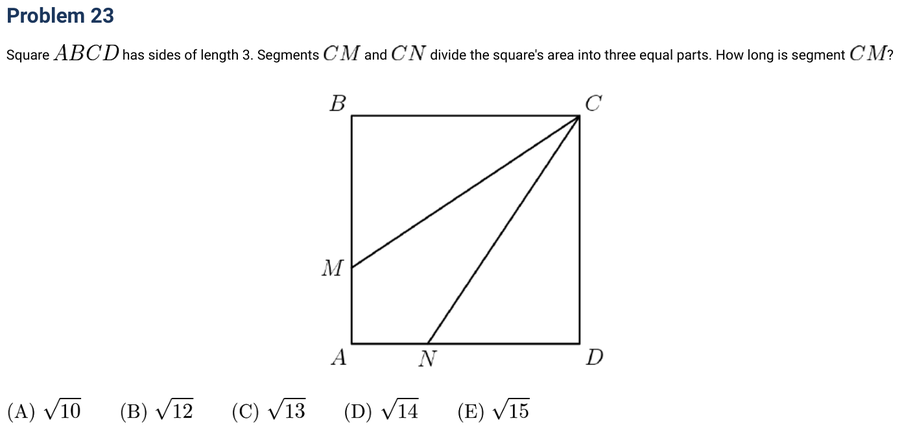
amc8-1999-23
Show hint (soft nudge)
Each of the three equal regions has area 9 ÷ 3 = 3.
Show hint (sharpest)
Use the area of the corner triangle BMC to find BM, then Pythagoras for CM.
Show solution
  1. The square's area is 9, so each region is 3. Triangle BMC has area ½ · 3 · BM = 3, giving BM = 2.
  2. Then CM = √(BM² + BC²) = √(4 + 9) = √13.
C √13.
Mark: · log in to save
Problem 24 · 1999 AMC 8 Stretch
Number Theory units-digit cyclicity

When 19992000 is divided by 5, the remainder is

Show hint (soft nudge)
Only the units digit of 1999 matters for the units digit of the power.
Show hint (sharpest)
Powers of 9 end in 9, 1, 9, 1, … — and an even exponent lands on 1.
Show solution
  1. Powers of a number ending in 9 cycle 9, 1, 9, 1, …; since 2000 is even, 1999²⁰⁰⁰ ends in 1.
  2. A number ending in 1 leaves remainder 1 when divided by 5.
D 1.
Mark: · log in to save
Problem 25 · 1999 AMC 8 Stretch
Geometry & Measurement geometric-series self-similarity
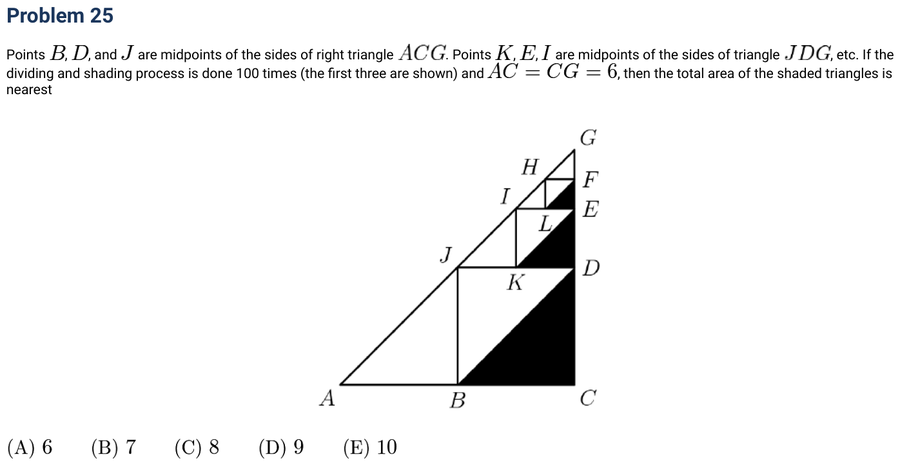
amc8-1999-25
Show hint (soft nudge)
Each shaded triangle has one-fourth the area of the previous one.
Show hint (sharpest)
Sum the geometric series — 100 terms is essentially the whole infinite sum.
Show solution
  1. The shaded triangles have areas 9/2, 9/8, 9/32, …, each one-fourth of the one before.
  2. The infinite sum is (9/2) ÷ (1 − ¼) = (9/2) ÷ (3/4) = 6, and 100 triangles is indistinguishable from that.
  3. So the total shaded area is nearest 6.
A About 6.
Mark: · log in to save