AMC 8 · Test Mode

2000 AMC 8

Test mode — hints and solutions are locked. Pick an answer for each, then submit at the bottom to see your score.

← Exit test mode No hints or solutions until you submit.
Problem 1 · 2000 AMC 8 Easy
Arithmetic & Operations ages

Aunt Anna is 42 years old. Caitlin is 5 years younger than Brianna, and Brianna is half as old as Aunt Anna. How old is Caitlin?

Show hint
Find Brianna's age first, then step down to Caitlin.
Show solution
  1. Brianna is half of 42, which is 21.
  2. Caitlin is 5 younger: 21 − 5 = 16.
B 16.
Mark: · log in to save
Problem 2 · 2000 AMC 8 Easy
Arithmetic & Operations number-systems

Which of these numbers is less than its reciprocal?

Show hint (soft nudge)
Rule out the easy ones: 0 has no reciprocal, and ±1 equal their own.
Show hint (sharpest)
Check −2 against its reciprocal, −½.
Show solution
  1. 0 has no reciprocal; 1 and −1 are their own reciprocals; and 2 > ½.
  2. Only −2 is below its reciprocal, since −2 < −½. Answer −2.
A −2.
Mark: · log in to save
Problem 3 · 2000 AMC 8 Easy
Arithmetic & Operations careful-counting estimate-and-pick

How many whole numbers lie in the interval between 53 and 2π?

Show hint (soft nudge)
Find the smallest whole number above 5/3 and the largest below 2π.
Show hint (sharpest)
5/3 ≈ 1.67 and 2π ≈ 6.28.
Show solution
  1. 5/3 ≈ 1.67 and 2π ≈ 6.28, so the whole numbers strictly between them are 2, 3, 4, 5, 6.
  2. That is 5 whole numbers.
D 5.
Mark: · log in to save
Problem 4 · 2000 AMC 8 Easy
Fractions, Decimals & Percents graph-interpretation percent-multiplier
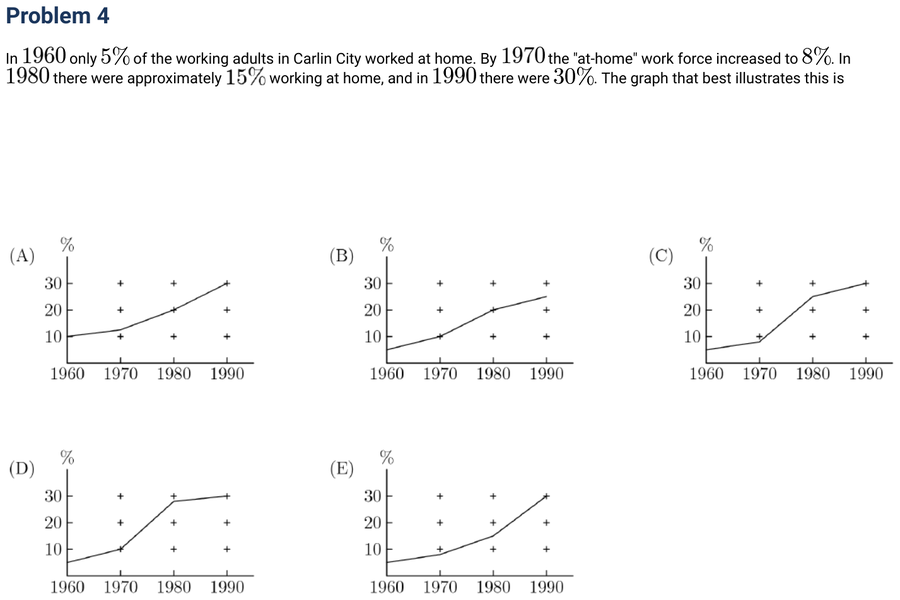
amc8-2000-04
Show hint (soft nudge)
Plot the four data points (5, 8, 15, 30) and see which curve hits them all.
Show hint (sharpest)
The jumps grow each decade, so the rise should steepen.
Show solution
  1. The at-home percentages 5, 8, 15, 30 rise by larger amounts each decade.
  2. Only graph E passes through all four points with that steepening climb.
E Graph E.
Mark: · log in to save
Problem 5 · 2000 AMC 8 Easy
Logic & Word Problems work-backward careful-counting

Each principal of Lincoln High School serves exactly one 3-year term. What is the maximum number of principals this school could have during an 8-year period?

Show hint (soft nudge)
Line the terms up so a changeover happens as early and as late in the 8 years as possible.
Show hint (sharpest)
Start mid-term and end mid-term to squeeze in extra principals.
Show solution
  1. Let year 1 be the last year of one principal's term. Two full 3-year terms then fill years 2–7.
  2. A fourth principal starts in year 8, for 4 principals.
C 4.
Mark: · log in to save
Problem 6 · 2000 AMC 8 Medium
Geometry & Measurement area-decomposition
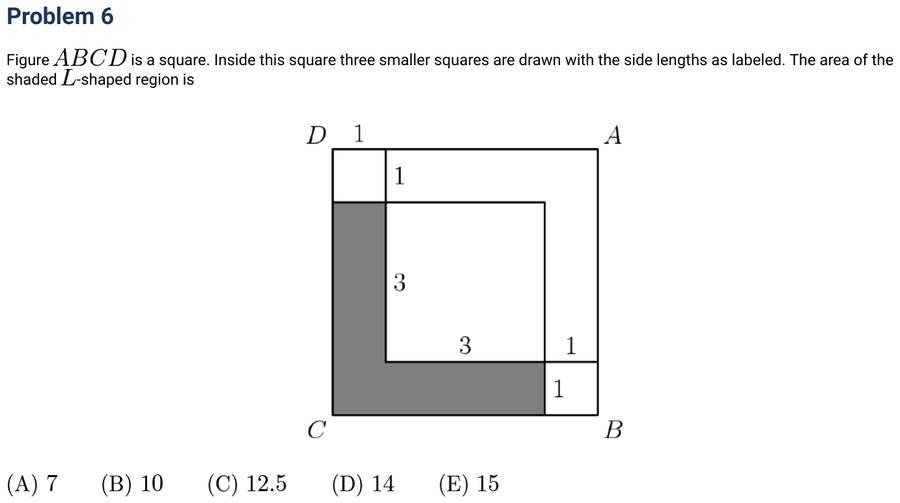
amc8-2000-06
Show hint (soft nudge)
The shaded L is the big square minus the white pieces inside it.
Show hint (sharpest)
The big square is 5×5; the white pieces are two unit squares and a 4×4 square.
Show solution
  1. The outer square has side 5 (area 25); the white regions are two 1×1 squares and one 4×4 square.
  2. Shaded L = 25 − 1 − 1 − 16 = 7.
A 7.
Mark: · log in to save
Problem 7 · 2000 AMC 8 Medium
Arithmetic & Operations number-systems careful-counting

What is the minimum possible product of three different numbers of the set {−8, −6, −4, 0, 3, 5, 7}?

Show hint (soft nudge)
A product of three numbers is negative when you use one negative or all three negatives.
Show hint (sharpest)
Compare the two extreme options against each other.
Show solution
  1. For the most negative product, try one negative with the two largest positives, or all three negatives.
  2. (−8)(5)(7) = −280 beats (−8)(−6)(−4) = −192, so the minimum is −280.
B −280.
Mark: · log in to save
Problem 8 · 2000 AMC 8 Medium
Arithmetic & Operations complementary-counting
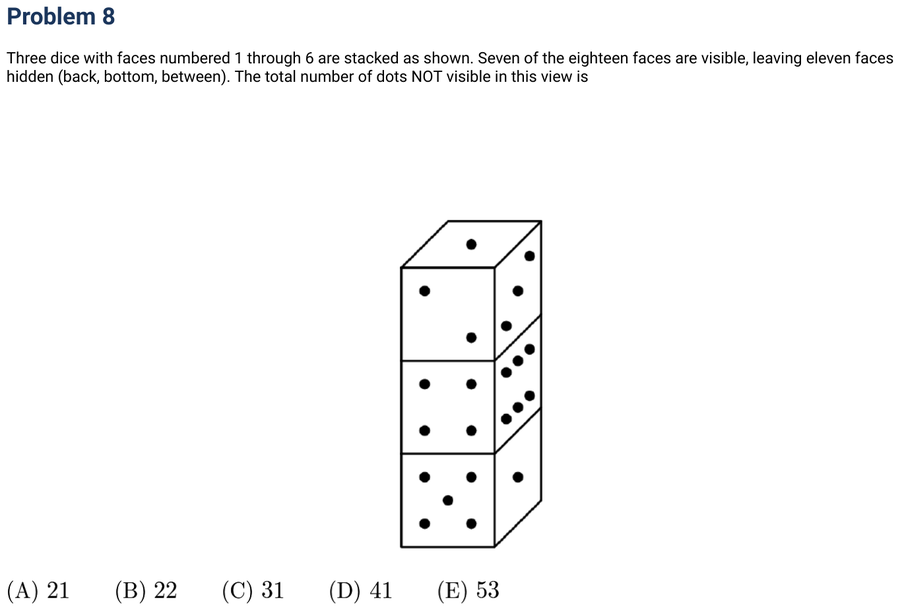
amc8-2000-08
Show hint (soft nudge)
The six faces of one die always total 1+2+3+4+5+6 = 21.
Show hint (sharpest)
Subtract the visible dots from the total of all three dice.
Show solution
  1. All three dice together have 3 × 21 = 63 dots.
  2. The seven visible faces show 1 + 1 + 2 + 3 + 4 + 5 + 6 = 22, so the hidden dots total 63 − 22 = 41.
D 41.
Mark: · log in to save
Problem 9 · 2000 AMC 8 Medium
Number Theory powers careful-counting
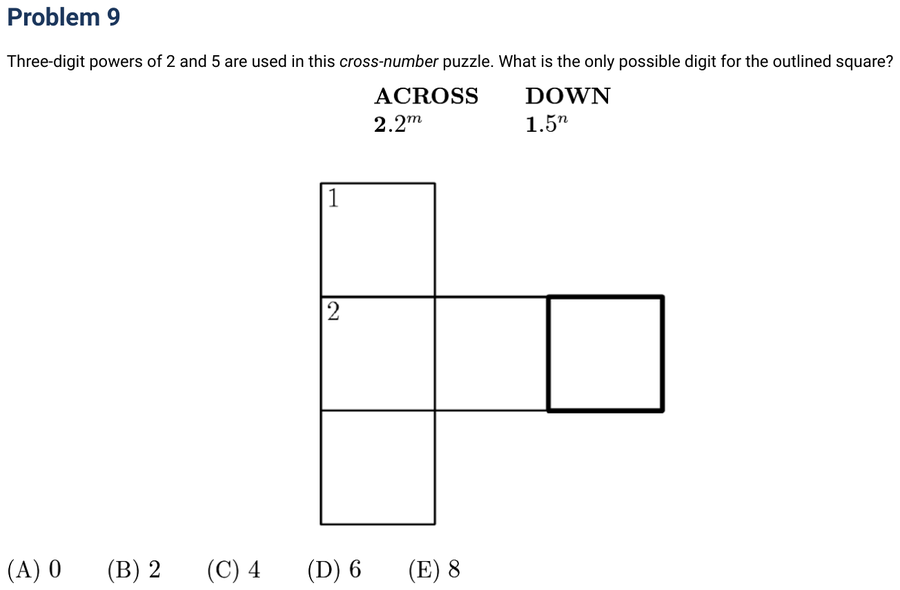
amc8-2000-09
Show hint (soft nudge)
List all the three-digit powers of 5, and of 2.
Show hint (sharpest)
The shared crossing digit forces which power of 2 fits.
Show solution
  1. Three-digit powers of 5 are only 125 and 625; three-digit powers of 2 are 128, 256, and 512.
  2. The crossing forces the power of 2 to be 256, so the outlined square holds its units digit, 6.
D 6.
Mark: · log in to save
Problem 10 · 2000 AMC 8 Medium
Fractions, Decimals & Percents percent-multiplier

Ara and Shea were once the same height. Since then Shea has grown 20% while Ara has grown half as many inches as Shea. Shea is now 60 inches tall. How tall, in inches, is Ara now?

Show hint (soft nudge)
Find the common starting height from Shea's 20% growth.
Show hint (sharpest)
Ara grew half as many inches as Shea — match inches, not percents.
Show solution
  1. Shea grew 20% to reach 60, so the start was 60 ÷ 1.2 = 50 inches, meaning Shea grew 10 inches.
  2. Ara grew half that, 5 inches, ending at 50 + 5 = 55 inches.
E 55 inches.
Mark: · log in to save
Problem 11 · 2000 AMC 8 Medium
Number Theory divisibility casework

The number 64 has the property that it is divisible by its units digit. How many whole numbers between 10 and 50 have this property?

Show hint (soft nudge)
Group the numbers by their units digit and test divisibility.
Show hint (sharpest)
Units digit 1, 2, or 5 always works; 0 never does (no division by 0).
Show solution
  1. Units digit 1, 2, and 5 each give 4 working numbers (12 total). Then 33 (digit 3), 24 and 44 (digit 4), 36 (digit 6), and 48 (digit 8) work; digits 0, 7, 9 give none.
  2. Total = 12 + 1 + 2 + 1 + 1 = 17.
C 17.
Mark: · log in to save
Problem 12 · 2000 AMC 8 Medium
Arithmetic & Operations careful-counting
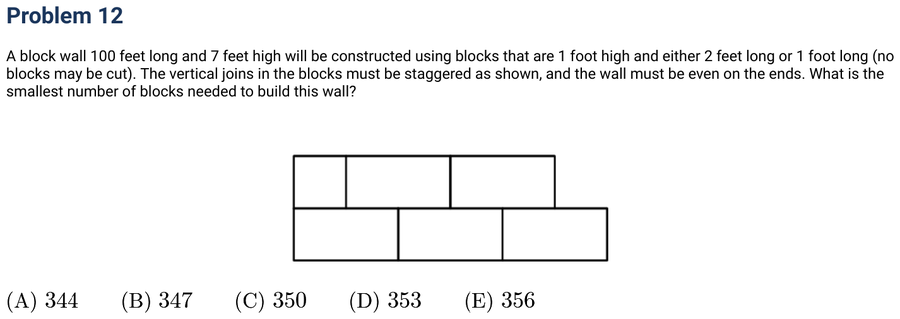
amc8-2000-12
Show hint (soft nudge)
Each row is 100 ft long — find the cheapest way to fill one row.
Show hint (sharpest)
Staggering the joints forces the alternate rows to use a 1-ft block at each end.
Show solution
  1. A row of all 2-ft blocks needs 100 ÷ 2 = 50 blocks. To stagger the joints, the in-between rows use 49 two-ft blocks plus a 1-ft block on each end = 51 blocks.
  2. Four rows of 50 and three rows of 51: 200 + 153 = 353 blocks.
D 353 blocks.
Mark: · log in to save
Problem 13 · 2000 AMC 8 Hard
Geometry & Measurement angle-chasing
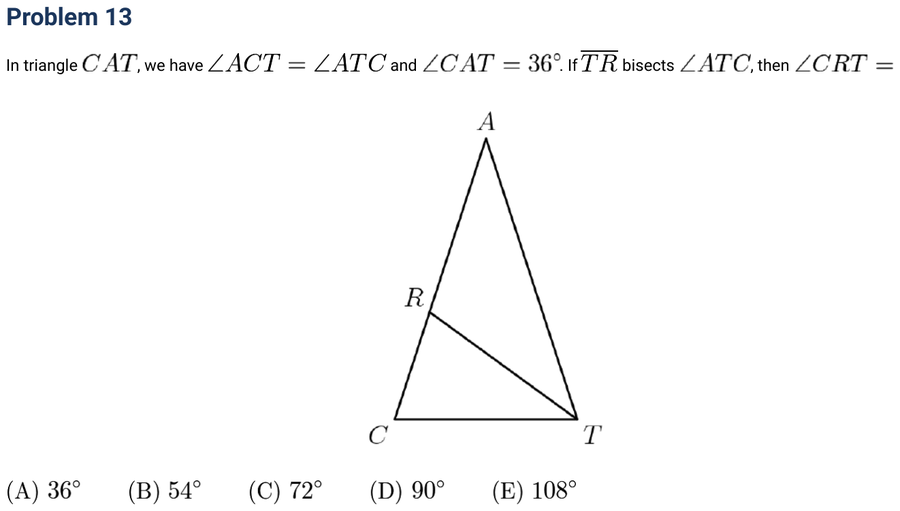
amc8-2000-13
Show hint (soft nudge)
First find the equal base angles of isosceles triangle CAT.
Show hint (sharpest)
Then use the bisected angle inside triangle CRT.
Show solution
  1. In triangle CAT, ∠ACT = ∠ATC, and with ∠CAT = 36° they fill 180°, so each base angle is (180 − 36)/2 = 72°.
  2. TR bisects ∠ATC, so ∠RTC = 36°. In triangle CRT, ∠CRT = 180 − 72 − 36 = 72°.
C 72°.
Mark: · log in to save
Problem 14 · 2000 AMC 8 Hard
Number Theory last-digit mod-10

What is the units digit of 1919 + 9999?

Show hint (soft nudge)
Only the units digit of the base matters, and powers of 9 cycle 9, 1, 9, 1, …
Show hint (sharpest)
9 raised to an odd power ends in 9.
Show solution
  1. Powers of 9 end in 9 for odd exponents and 1 for even ones. Both 19 and 99 end in 9, and both exponents are odd, so each power ends in 9.
  2. 9 + 9 = 18, so the units digit is 8.
D 8.
Mark: · log in to save
Problem 15 · 2000 AMC 8 Hard
Geometry & Measurement perimeter
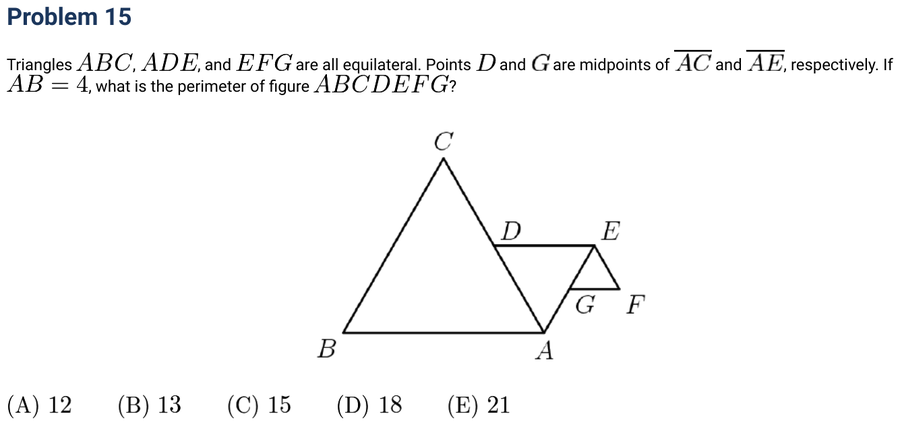
amc8-2000-15
Show hint (soft nudge)
Each triangle is half the size of the one before: sides 4, 2, 1.
Show hint (sharpest)
Add only the outer edges of the combined outline.
Show solution
  1. The three equilateral triangles have sides 4, 2, and 1 (each midpoint halves the side).
  2. Tracing the outline ABCDEFG, the outer edges are 4, 4, 2, 2, 1, 1, 1, which sum to 15.
C 15.
Mark: · log in to save
Problem 16 · 2000 AMC 8 Hard
Geometry & Measurement perimeter area

In order for Mateen to walk a kilometer (1000 m) in his rectangular backyard, he must walk the length 25 times or walk its perimeter 10 times. What is the area of Mateen's backyard in square meters?

Show hint (soft nudge)
The '25 times' clue gives the length; the '10 times' clue gives the perimeter.
Show hint (sharpest)
Then perimeter = 2(length + width) gives the width.
Show solution
  1. Length = 1000 ÷ 25 = 40 m; perimeter = 1000 ÷ 10 = 100 m.
  2. From 100 = 2(40 + W) we get W = 10, so area = 40 × 10 = 400 m².
C 400 square meters.
Mark: · log in to save
Problem 17 · 2000 AMC 8 Hard
Algebra & Patterns custom-operation

The operation ★ is defined for all nonzero numbers by ab = a2b. Determine [(1 ★ 2) ★ 3] − [1 ★ (2 ★ 3)].

Show hint (soft nudge)
Compute each bracket separately, innermost operation first.
Show hint (sharpest)
The operation isn't associative, so the two brackets won't match.
Show solution
  1. 1 ★ 2 = 1²/2 = ½, then (½) ★ 3 = (½)²/3 = 1/12.
  2. 2 ★ 3 = 2²/3 = 4/3, then 1 ★ (4/3) = 1²/(4/3) = 3/4.
  3. Difference = 1/12 − 3/4 = 1/12 − 9/12 = −2/3.
A −2/3.
Mark: · log in to save
Problem 18 · 2000 AMC 8 Hard
Geometry & Measurement area-decomposition perimeter
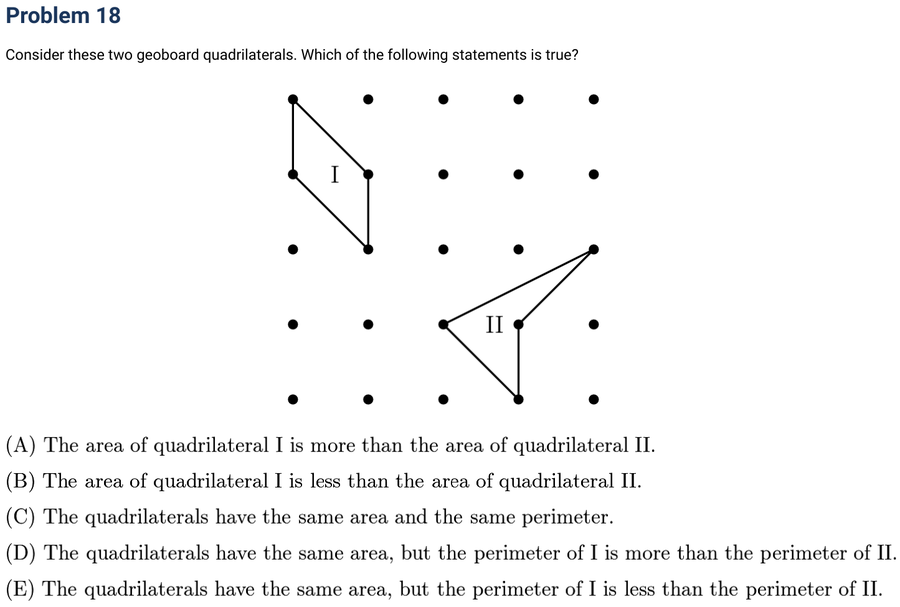
amc8-2000-18
Show hint (soft nudge)
Work out both areas first — they come out equal.
Show hint (sharpest)
Then compare the slanted sides to see which perimeter is larger.
Show solution
  1. Both shapes have area 1 (I is a 1×1 parallelogram; II is two triangles of area ½).
  2. They share two equal slant sides, but I's other two sides are unit length while II has a longer slant, so II's perimeter is bigger — meaning I's is less (choice E).
E Same area, but quadrilateral I has the smaller perimeter.
Mark: · log in to save
Problem 19 · 2000 AMC 8 Hard
Geometry & Measurement area-decomposition rearrangement
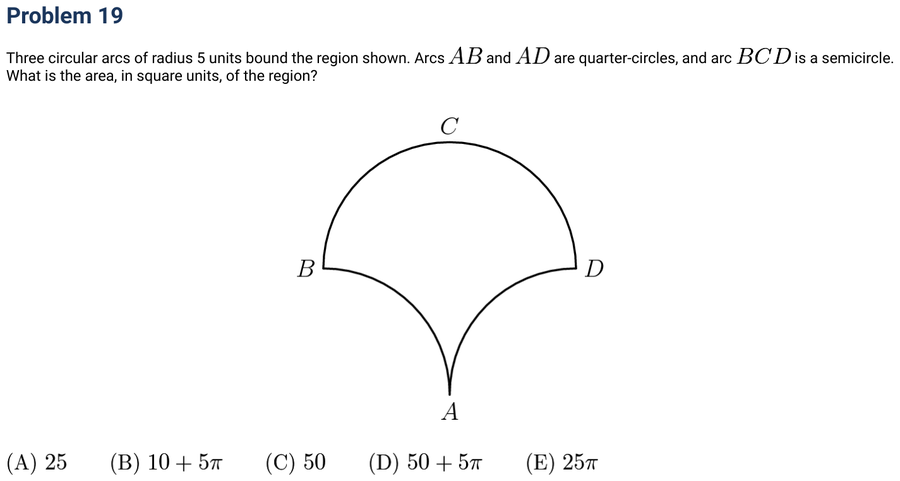
amc8-2000-19
Show hint (soft nudge)
The two quarter-circles removed exactly match the semicircular bump added.
Show hint (sharpest)
So the region's area equals a plain rectangle.
Show solution
  1. The quarter-circle pieces cut away exactly balance the semicircular bump added, so the area equals that of the surrounding rectangle.
  2. That rectangle is 10 by 5, so the area is 50 square units.
C 50 square units.
Mark: · log in to save
Problem 20 · 2000 AMC 8 Stretch
Logic & Word Problems casework careful-counting

You have nine coins: a collection of pennies, nickels, dimes, and quarters having a total value of $1.02, with at least one coin of each type. How many dimes must you have?

Show hint (soft nudge)
Start with one of each coin (41¢) and work out what the other 5 coins make.
Show hint (sharpest)
The leftover must end in a 1, which pins the number of pennies.
Show solution
  1. One of each coin uses 1 + 5 + 10 + 25 = 41¢, leaving 61¢ in 5 more coins. To end in a 1, exactly one more is a penny, leaving 60¢ in 4 coins.
  2. Those 4 must include quarters (4 dimes reach only 40¢); two quarters leave 10¢ = two nickels.
  3. No extra dimes are needed, so there is just the original 1 dime.
A 1 dime.
Mark: · log in to save
Problem 21 · 2000 AMC 8 Stretch
Counting & Probability casework

Keiko tosses one penny and Ephraim tosses two pennies. The probability that Ephraim gets the same number of heads that Keiko gets is

Show hint (soft nudge)
Keiko can only land on 0 or 1 head, so those are the only two cases you have to match.
Show hint (sharpest)
Find Ephraim's chance of 0 heads and of 1 head, then pair each with Keiko's.
Show solution
  1. Keiko gets 1 head or 0 heads, each with probability ½. Ephraim's two tosses give 1 head with probability ½ (HT or TH) and 0 heads with probability ¼ (TT).
  2. Both at 1 head: ½ · ½ = ¼. Both at 0 heads: ½ · ¼ = ⅛.
  3. Add the two matching cases: ¼ + ⅛ = .
B 3/8.
Mark: · log in to save
Problem 22 · 2000 AMC 8 Stretch
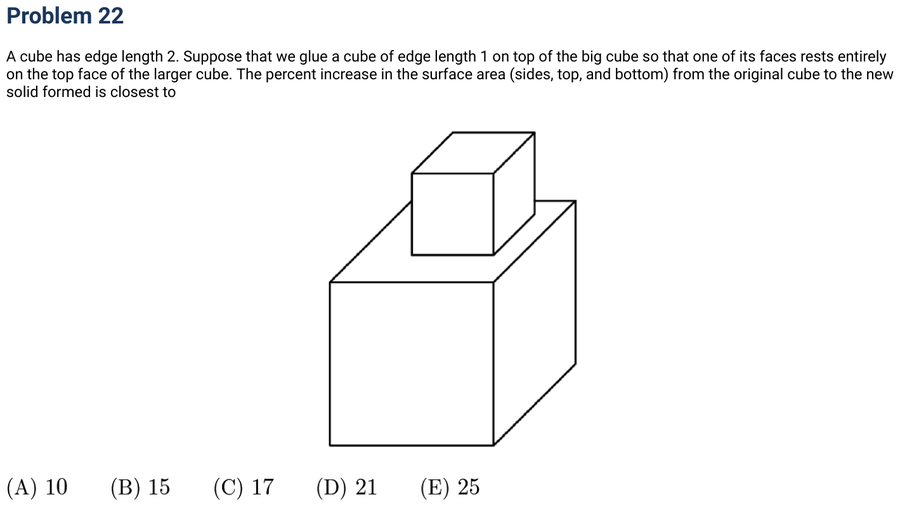
Geometry & Measurement surface-area
amc8-2000-22
Show hint (soft nudge)
The little cube hides part of the big top, but its own top covers exactly that hidden patch — so what area is genuinely new?
Show hint (sharpest)
Only the four side walls of the small cube add surface; the top is a wash.
Show solution
  1. The original cube's surface area is 6 · 2² = 24.
  2. The small cube hides a 1 × 1 patch of the big top, but its own top sits directly above that patch, so the upward-facing area is unchanged. Only its 4 side walls are new, adding 4.
  3. The increase is 4 / 24 = ⅙ ≈ 16.7%, closest to 17%.
C About 17%.
Mark: · log in to save
Problem 23 · 2000 AMC 8 Stretch
Arithmetic & Operations averages

There is a list of seven numbers. The average of the first four numbers is 5, and the average of the last four numbers is 8. If the average of all seven numbers is 647, then the number common to both sets of four numbers is

Show hint (soft nudge)
Add the two group-sums together — every number is counted once, except the shared one, counted twice.
Show hint (sharpest)
So (sum of the two fours) minus (sum of all seven) leaves exactly the common number.
Show solution
  1. The first four total 4 · 5 = 20 and the last four total 4 · 8 = 32. Adding gives 52, which counts every number once except the shared middle one, counted twice.
  2. All seven total 7 · 6⁴⁄₇ = 46, counting each number once.
  3. Subtracting strips one copy of everything, leaving the doubled number: 52 − 46 = 6.
B 6.
Mark: · log in to save
Problem 24 · 2000 AMC 8 Stretch
Geometry & Measurement angle-chase exterior-angle
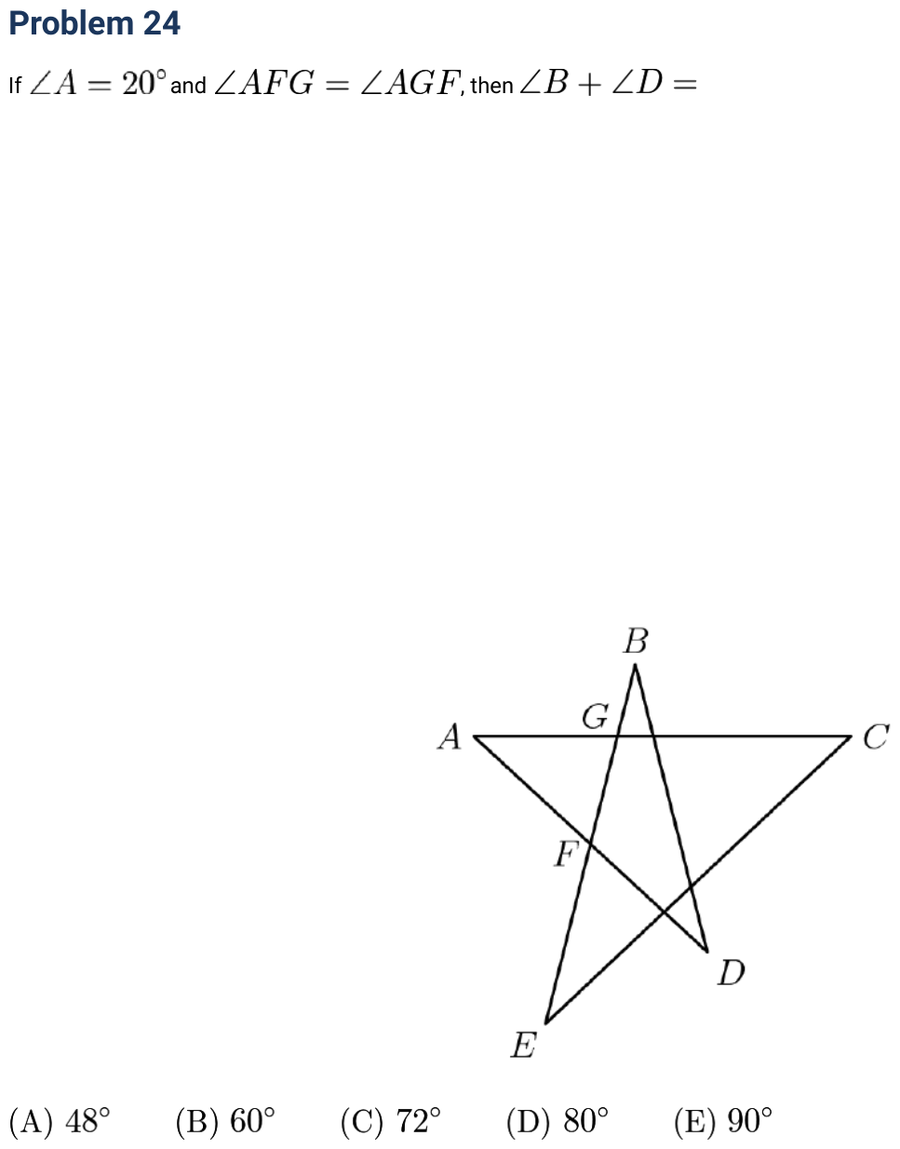
amc8-2000-24
Show hint (soft nudge)
Triangle AFG is isosceles with apex angle A — that pins both of its base angles.
Show hint (sharpest)
The base angle at F is the exterior angle of triangle BFD, so it already equals ∠B + ∠D.
Show solution
  1. In triangle AFG the apex ∠A = 20° and the two base angles are equal, so each is (180° − 20°) / 2 = 80°.
  2. Lines AD and BE cross at F, so ∠AFG is the exterior angle of triangle BFD at F. An exterior angle equals the sum of the two remote angles, which here are exactly ∠B and ∠D.
  3. Therefore ∠B + ∠D = 80°.
D 80°.
Another way: supplement, then angle sum (as MAA presents it)
  1. From the isosceles triangle, ∠AFG = 80°, so the angle inside triangle BFD at F is its supplement, 180° − 80° = 100°.
  2. The angles of triangle BFD sum to 180°, so ∠B + ∠D = 180° − 100° = 80°.
Mark: · log in to save
Problem 25 · 2000 AMC 8 Stretch
Geometry & Measurement area-decomposition

The area of rectangle ABCD is 72. If point A and the midpoints of sides BC and CD are joined to form a triangle, the area of that triangle is

ABCD
Show hint (soft nudge)
Slice the triangle out by removing the three right triangles in the corners — each is a clean fraction of the whole rectangle.
Show hint (sharpest)
Two corners take a quarter each and the third takes an eighth; whatever's left is the answer.
Show solution
  1. The triangle is what remains after cutting off the three corner right triangles. Measured against the whole rectangle, the ones at corners B and D are ¼ each (a full side and a half-side as legs), and the one at corner C is ⅛ (two half-sides).
  2. Together the corners take ¼ + ¼ + ⅛ = ⅝ of the rectangle, leaving ⅜.
  3. So the triangle is ⅜ · 72 = 27.
B 27.
Mark: · log in to save