Casey's shop class is making a golf trophy. He has to paint 300 dimples on a golf ball. If it takes him 2 seconds to paint one dimple, how many minutes will he need to do his job?
Show hint
Find the total seconds first, then convert to minutes.
On a dark and stormy night Snoopy suddenly saw a flash of lightning. Ten seconds later he heard the sound of thunder. The speed of sound is 1088 feet per second and one mile is 5280 feet. Estimate, to the nearest half-mile, how far Snoopy was from the flash of lightning.
Show hint (soft nudge)
Distance = speed × time gives the feet; then compare with a mile.
Show hint (sharpest)
Two miles is about 10,560 feet.
Show solution
In 10 seconds the sound travels 10 × 1088 = 10,880 feet.
Since 2 miles is 2 × 5280 = 10,560 feet, the distance is closest to 2 miles.
Six trees are equally spaced along one side of a straight road. The distance from the first tree to the fourth is 60 feet. What is the distance in feet between the first and last trees?
Show hint (soft nudge)
Count the gaps between trees, not the trees themselves.
To promote her school's annual Kite Olympics, Genevieve makes a small kite and a large kite for a bulletin board display. The kites look like the one in the diagram. For her small kite Genevieve draws the kite on a one-inch grid (shown below). For the large kite she triples both the height and width of the entire grid.
What is the number of square inches in the area of the small kite?
Show hint (soft nudge)
A kite's area is half the product of its two diagonals.
Show hint (sharpest)
Read the diagonal lengths straight off the grid.
Show solution
On the grid the kite's diagonals measure 6 and 7 inches.
To promote her school's annual Kite Olympics, Genevieve makes a small kite and a large kite for a bulletin board display. The kites look like the one in the diagram. For her small kite Genevieve draws the kite on a one-inch grid (shown below). For the large kite she triples both the height and width of the entire grid.
Genevieve puts bracing on her large kite in the form of a cross connecting opposite corners of the kite. How many inches of bracing material does she need?
Show hint (soft nudge)
The cross of bracing is just the kite's two diagonals.
Show hint (sharpest)
Tripling the grid triples each diagonal's length.
Show solution
The small kite's diagonals are 6 and 7 units; tripling the grid makes them 18 and 21 inches.
To promote her school's annual Kite Olympics, Genevieve makes a small kite and a large kite for a bulletin board display. The kites look like the one in the diagram. For her small kite Genevieve draws the kite on a one-inch grid (shown below). For the large kite she triples both the height and width of the entire grid.
The large kite is covered with gold foil. The foil is cut from a rectangular piece that just covers the entire grid. How many square inches of waste material are cut off from the four corners?
Show hint (soft nudge)
The kite fills exactly half of the rectangle that surrounds it.
Show hint (sharpest)
So the waste is the other half — equal to the large kite's area.
Show solution
The large grid is (3×6) by (3×7) = 18 × 21 = 378 square inches.
The kite covers exactly half, so the four corners cut away are the other half: 378 ÷ 2 = 189 square inches.
Of the 36 students in Richelle's class, 12 prefer chocolate pie, 8 prefer apple, and 6 prefer blueberry. Half of the remaining students prefer cherry pie and half prefer lemon. For Richelle's pie graph showing this data, how many degrees should she use for cherry pie?
Show hint (soft nudge)
Find how many students like cherry pie first.
Show hint (sharpest)
Each student is worth 360° ÷ 36 = 10° of the circle.
Show solution
Remaining students: 36 − 12 − 8 − 6 = 10, and half prefer cherry, so 5 students.
Each student is 360° ÷ 36 = 10°, so cherry pie gets 5 × 10° = 50°.
Tyler has entered a buffet line in which he chooses one kind of meat, two different vegetables, and one dessert. If the order of food items is not important, how many different meals might he choose?
Homer began peeling a pile of 44 potatoes at the rate of 3 potatoes per minute. Four minutes later Christen joined him and peeled at the rate of 5 potatoes per minute. When they finished, how many potatoes had Christen peeled?
Show hint (soft nudge)
First find how many potatoes are left when Christen starts.
Show hint (sharpest)
Then they peel together at a combined rate — find how long that takes.
Show solution
In the first 4 minutes Homer peels 3 × 4 = 12, leaving 44 − 12 = 32 potatoes.
Together they peel 3 + 5 = 8 per minute, so the rest takes 32 ÷ 8 = 4 minutes.
In those 4 minutes Christen peels 5 × 4 = 20 potatoes.
A square piece of paper, 4 inches on a side, is folded in half vertically. Both layers are then cut in half parallel to the fold. Three new rectangles are formed, a large one and two small ones. What is the ratio of the perimeter of one of the small rectangles to the perimeter of the large rectangle?
Show hint (soft nudge)
Track the dimensions: folding the 4×4 square makes a 4×2 rectangle.
Show hint (sharpest)
After the cut, the large rectangle is 4×2 and each small one is 4×1.
Show solution
Folding the 4×4 square in half gives a 4×2 shape; cutting parallel to the fold yields one large 4×2 rectangle and two small 4×1 rectangles.
For the game show Who Wants To Be a Millionaire?, the dollar values of each question are shown in the following table (where K = 1000). Between which two questions is the percent increase of the value the smallest?
Question values (K = 1000)
Question
1
2
3
4
5
6
7
8
Value
100
200
300
500
1K
2K
4K
8K
Question
9
10
11
12
13
14
15
Value
16K
32K
64K
125K
250K
500K
1000K
Show hint (soft nudge)
Most steps simply double the value — that's a 100% increase, so ignore them.
Show hint (sharpest)
Only 2→3, 3→4, and 11→12 are not doublings; compare those.
Show solution
Almost every step doubles (a 100% jump), so the smallest increase is among the non-doublings: 2→3, 3→4, and 11→12.
2→3 is 200→300 = +50%; 3→4 is 300→500 ≈ +67%; 11→12 is 64K→125K ≈ +95%.
Kaleana shows her test score to Quay, Marty, and Shana, but the others keep theirs hidden. Quay thinks, "At least two of us have the same score." Marty thinks, "I didn't get the lowest score." Shana thinks, "I didn't get the highest score." List the scores from lowest to highest for Marty (M), Quay (Q), and Shana (S).
Show hint (soft nudge)
Quay can only see Kaleana's score — what must be true for him to be sure two scores match?
Show hint (sharpest)
That fixes Quay = Kaleana; then read Marty's and Shana's thoughts relative to Kaleana.
Show solution
Quay only knows Kaleana's score, so to be certain two match he must equal her: Q = K.
Marty isn't lowest, so M > K; Shana isn't highest, so S < K. Replacing K with Q gives S < Q < M.
The mean of a set of five different positive integers is 15. The median is 18. The maximum possible value of the largest of these five integers is
Show hint (soft nudge)
Mean 15 means the five numbers add to 75.
Show hint (sharpest)
To push one number as high as possible, make the other four as small as the rules allow.
Show solution
Five numbers averaging 15 sum to 5 × 15 = 75.
The median (3rd value) is 18, so the two below it are the smallest distinct positives 1 and 2, and the 4th value is the smallest integer above 18, namely 19.
On a twenty-question test, each correct answer is worth 5 points, each unanswered question is worth 1 point, and each incorrect answer is worth 0 points. Which of the following scores is NOT possible?
Show hint (soft nudge)
Start from the top: what's the maximum score, and the next one just below it?
Show hint (sharpest)
There's a gap right under the maximum that no score can land in.
Show solution
All 20 correct scores 20 × 5 = 100. The next-best is 19 correct plus 1 unanswered: 95 + 1 = 96.
So 97, 98, 99 are unreachable — 97 is the impossible score (90, 91, 92, 95 are all attainable).
Points R, S, and T are vertices of an equilateral triangle, and points X, Y, and Z are midpoints of its sides. How many noncongruent triangles can be drawn using any three of these six points as vertices?
Show hint (soft nudge)
Many of the small triangles are just rotations or reflections of one another — count distinct shapes, not positions.
Show hint (sharpest)
By symmetry, every triangle you can form matches one found in half of the figure.
Show solution
Choosing 3 of the 6 points gives many triangles, but rotations and reflections make most of them congruent, so only distinct shapes count.
There are exactly four shapes: the big equilateral RST; a small equilateral like XYZ; a 30-60-90 right triangle like R-T-Z (two corners and a midpoint); and an obtuse isosceles like R-X-Z (a corner and two midpoints).
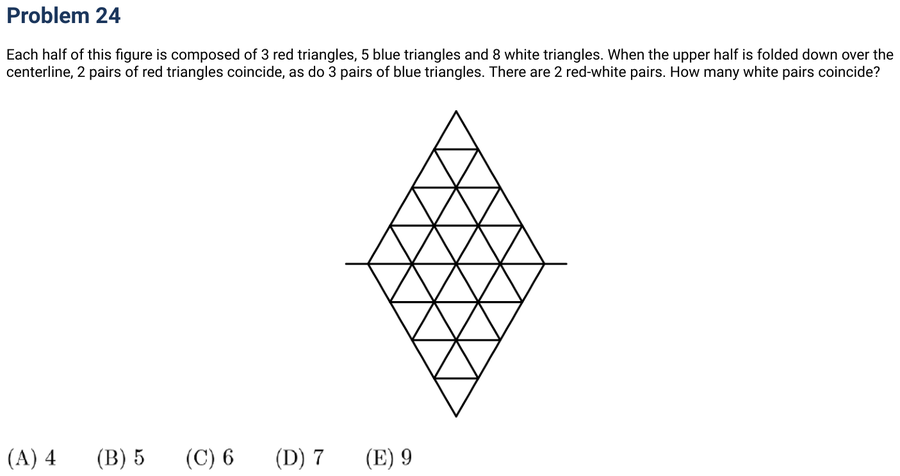
Track what's left on each half after the red and blue pairs are used up.
Show hint (sharpest)
Each half starts with 3 red, 5 blue, 8 white; subtract the coinciding pairs and the red-white pairs.
Show solution
Each half has 3 red, 5 blue, 8 white. The 2 red pairs use 2 reds per half (1 red left); the 3 blue pairs use 3 blues per half (2 blue left).
The 2 red-white pairs use that last red and 1 white per half, and the 2 leftover blues must pair with whites (no more blue-blue allowed), using 2 more whites.
That leaves 8 − 1 − 2 = 5 whites per half, which coincide as 5 white pairs.
There are 24 four-digit whole numbers that use each of the four digits 2, 4, 5, and 7 exactly once. Only one of these four-digit numbers is a multiple of another one. Which of the following is it?
Show hint (soft nudge)
The multiple still uses the digits 2, 4, 5, 7, so it stays between 2457 and 7542.
Show hint (sharpest)
That keeps the factor tiny: 2457 × 4 is already too big, so test multiplying by 3.
Show solution
Any such multiple uses the same four digits, so it lies between 2457 and 7542; since 2457 × 4 ≈ 9828 overshoots, the factor can only be 2 or 3.
No doubling of a number in the set lands back in the set, but 2475 × 3 = 7425, which uses exactly 2, 4, 5, 7.