AMC 8 · Test Mode

2003 AMC 8

Test mode — hints and solutions are locked. Pick an answer for each, then submit at the bottom to see your score.

← Exit test mode No hints or solutions until you submit.
Problem 1 · 2003 AMC 8 Easy
Geometry & Measurement spatial-reasoning

Jamie counted the number of edges of a cube, Jimmy counted the corners, and Judy counted the faces. They then added the three numbers. What was the resulting sum?

Show hint
A cube has 12 edges, 8 corners, and 6 faces — recall each, then add.
Show solution
  1. Edges: 12. Corners: 8. Faces: 6.
  2. 12 + 8 + 6 = 26.
E 26.
Mark: · log in to save
Problem 2 · 2003 AMC 8 Easy
Number Theory primes

Which of the following numbers has the smallest prime factor?

Show hint
No prime is smaller than 2 — which of these has 2 as a factor?
Show solution
  1. A prime factor can't be smaller than 2, and only even numbers have 2 as a factor.
  2. 58 is the only even choice, so its smallest prime factor is 2 — smaller than any odd number could manage. Answer 58.
C 58 (its smallest prime factor is 2).
Mark: · log in to save
Problem 3 · 2003 AMC 8 Easy
Fractions, Decimals & Percents proportion

A burger at Ricky C's weighs 120 grams, of which 30 grams are filler. What percent of the burger is not filler?

Show hint
Find the non-filler weight first, then compare it to the whole.
Show solution
  1. Non-filler: 120 − 30 = 90 grams.
  2. 90/120 = 3/4 = 75%.
D 75%.
Mark: · log in to save
Problem 4 · 2003 AMC 8 Easy
Algebra & Patterns substitution

A group of children riding on bicycles and tricycles rode past Billy Bob's house. Billy Bob counted 7 children and 19 wheels. How many tricycles were there?

Show hint
Imagine all 7 children on bicycles first, then see how many extra wheels you still need.
Show solution
  1. If all 7 rode bicycles, that's 7 × 2 = 14 wheels.
  2. There are 19 − 14 = 5 extra wheels, and each tricycle adds exactly one extra wheel, so there are 5 tricycles.
C 5 tricycles.
Another way: solve the system
  1. With b bicycles and t tricycles: b + t = 7 and 2b + 3t = 19.
  2. Subtract twice the first from the second: t = 19 − 14 = 5.
Mark: · log in to save
Problem 5 · 2003 AMC 8 Easy
Fractions, Decimals & Percents percent-multiplier proportion

If 20% of a number is 12, what is 30% of the same number?

Show hint
You don't need the number itself — how does 30% compare to 20%?
Show solution
  1. 30% is 1.5 times 20%.
  2. So 30% of the number is 1.5 × 12 = 18.
B 18.
Another way: find the whole first
  1. 20% of the number is 12, so the number is 12 ÷ 0.2 = 60.
  2. 30% of 60 = 0.3 × 60 = 18.
Mark: · log in to save
Problem 6 · 2003 AMC 8 Medium
Geometry & Measurement pythagorean-triple square-area area
amc8-2003-06
Show hint (soft nudge)
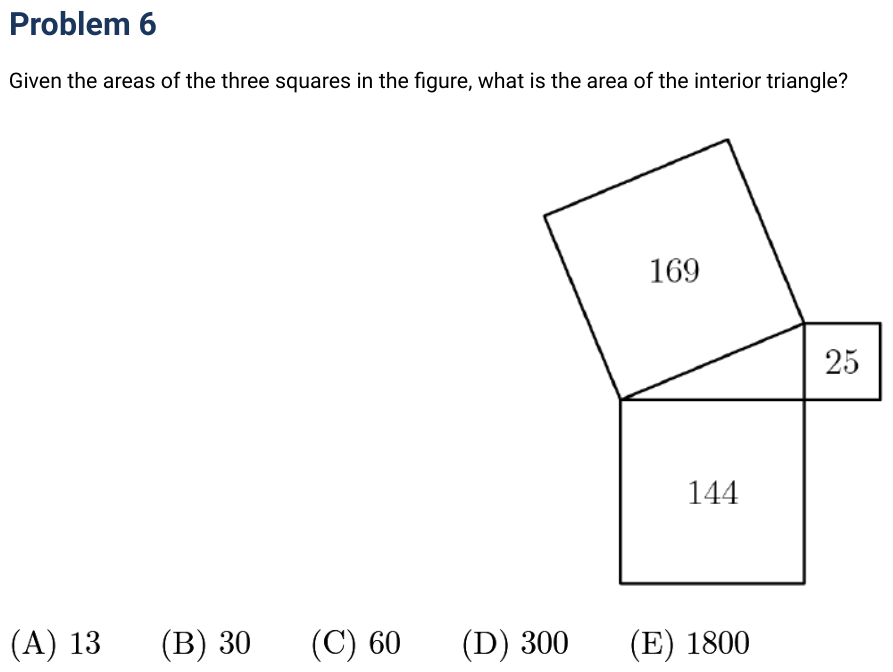
Each square's area gives you a side length of the triangle — take square roots.
Show hint (sharpest)
5, 12, 13 form a right triangle, so two of those sides are the legs.
Show solution
  1. The squares have areas 169, 144, and 25, so the triangle's sides are 13, 12, and 5.
  2. Since 5² + 12² = 13², the triangle is right-angled with legs 5 and 12.
  3. Area = ½ × 5 × 12 = 30.
B 30.
Mark: · log in to save
Problem 7 · 2003 AMC 8 Medium
Arithmetic & Operations total-then-divide

Blake and Jenny each took four 100-point tests. Blake averaged 78 on the four tests. Compared with Blake, Jenny scored 10 points higher on the first test, 10 points lower on the second, and 20 points higher on each of the third and fourth. By how much does Jenny's average exceed Blake's on these four tests?

Show hint
You never need Blake's actual average — just track how far ahead or behind Jenny is on each test.
Show solution
  1. Jenny's differences from Blake are +10, −10, +20, +20, which total +40.
  2. Her average is ahead by 40 ÷ 4 = 10 points.
A 10 points.
Mark: · log in to save
Problem 8 · 2003 AMC 8 Medium
Geometry & Measurement area

Art, Roger, Paul, and Trisha bake cookies that are all the same thickness, in the shapes shown below (dimensions in inches). Each friend uses the same amount of dough, and Art's batch makes exactly 12 cookies.

Who makes the fewest cookies from one batch of dough?

Show hint (soft nudge)
With the same dough, whoever has the biggest cookie makes the fewest of them.
Show hint (sharpest)
Find each cookie's area; the largest area wins.
Show solution
  1. Everyone uses equal dough, so the person with the largest cookie makes the fewest.
  2. Areas (square inches): Art ½(3 + 5)(3) = 12, Roger 2 × 4 = 8, Paul 3 × 2 = 6, Trisha ½(3)(4) = 6.
  3. Art's cookie is the biggest, so Art makes the fewest.
A Art.
Mark: · log in to save
Problem 9 · 2003 AMC 8 Medium
Ratios, Rates & Proportions proportion ratio

Art, Roger, Paul, and Trisha bake cookies that are all the same thickness, in the shapes shown below (dimensions in inches). Each friend uses the same amount of dough, and Art's batch makes exactly 12 cookies.

Art's cookies sell for 60 cents each. To bring in the same total from one batch, how much should one of Roger's cookies cost, in cents?

Show hint (soft nudge)
Same total money from one batch means each cookie's price scales with its size.
Show hint (sharpest)
Compare Roger's cookie area to Art's, then scale 60 cents by that ratio.
Show solution
  1. For a fixed batch and a fixed total price, each cookie's price is proportional to its area.
  2. Roger's cookie is 8 in² and Art's is 12 in², a ratio of 8/12 = 2/3.
  3. So Roger should charge 60 × 2/3 = 40 cents.
C 40 cents.
Another way: count the cookies
  1. Art: 12 cookies at 60¢ = 720¢ per batch, using 12 × 12 = 144 in² of dough.
  2. Roger's 8 in² cookies: 144 ÷ 8 = 18 per batch.
  3. 720 ÷ 18 = 40 cents each.
Mark: · log in to save
Problem 10 · 2003 AMC 8 Medium
Arithmetic & Operations division proportion

Art, Roger, Paul, and Trisha bake cookies that are all the same thickness, in the shapes shown below (dimensions in inches). Each friend uses the same amount of dough, and Art's batch makes exactly 12 cookies.

How many cookies will be in one batch of Trisha's cookies?

Show hint
A batch is the dough that makes 12 of Art's cookies. How does Trisha's cookie size compare to Art's?
Show solution
  1. A batch is the dough for 12 of Art's 12 in² cookies, i.e. 144 in².
  2. Trisha's cookies are ½(3)(4) = 6 in², exactly half of Art's, so she makes twice as many: 24.
E 24 cookies.
Mark: · log in to save
Problem 11 · 2003 AMC 8 Medium
Fractions, Decimals & Percents percent-multiplier

Business is a little slow at Lou's Fine Shoes, so Lou decides to have a sale. On Friday, Lou increases all of Thursday's prices by 10%. Over the weekend, Lou advertises the sale: "Ten percent off the listed price. Sale starts Monday." How much does a pair of shoes cost on Monday that cost $40 on Thursday?

Show hint (soft nudge)
A 10% increase followed by a 10% decrease is not a wash — the cut is taken off a bigger number.
Show hint (sharpest)
Multiply the two factors: ×1.1 then ×0.9.
Show solution
  1. Friday: 40 × 1.1 = 44. Monday: 44 × 0.9 = 39.60.
  2. Equivalently 40 × 1.1 × 0.9 = 40 × 0.99 = 39.60 — a hair under the original.
B $39.60.
Mark: · log in to save
Problem 12 · 2003 AMC 8 Medium
Counting & Probability divisibility casework

When a fair six-sided die is tossed on a table top, the bottom face cannot be seen. What is the probability that the product of the numbers on the five faces that can be seen is divisible by 6?

Show hint (soft nudge)
6 = 2 × 3, so you just need a 2 and a 3 both showing somewhere.
Show hint (sharpest)
Only one face is hidden — check the worst case, where it's the 6.
Show solution
  1. 6 = 2 × 3, so the product is divisible by 6 as long as a 2 and a 3 both appear among the visible faces.
  2. Only one face is hidden. If it isn't the 6, then the 6 is visible. If it is the 6, then 2 and 3 are both still visible.
  3. Either way the product is divisible by 6, so the probability is 1.
E 1 (it always happens).
Mark: · log in to save
Problem 13 · 2003 AMC 8 Hard
Geometry & Measurement spatial-reasoning
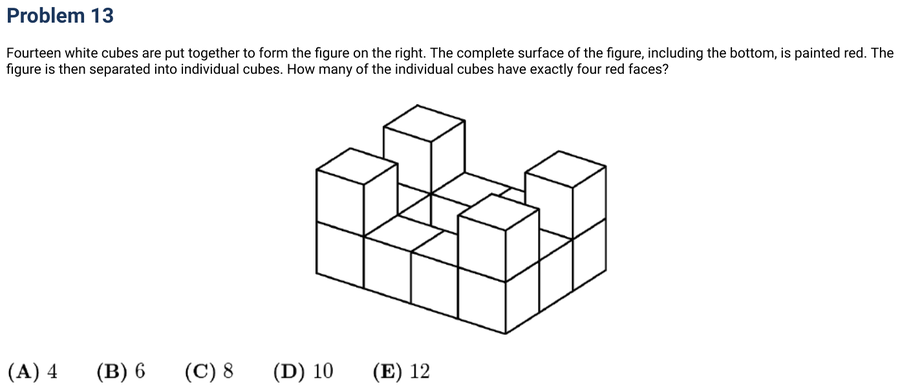
amc8-2003-13
Show hint (soft nudge)
Each cube gets one painted face for every side that is exposed, so you want the cubes with exactly four exposed sides.
Show hint (sharpest)
Sort the 14 cubes: the ones perched on top are too exposed, the bottom corners not exposed enough.
Show solution
  1. A cube ends up with exactly four painted faces when exactly four of its sides are exposed.
  2. The 4 cubes sitting on top each have 5 exposed faces; the 4 corner cubes of the bottom layer each have only 3.
  3. That leaves 14 − 4 − 4 = 6 cubes with exactly four painted faces.
B 6 cubes.
Mark: · log in to save
Problem 14 · 2003 AMC 8 Hard
Logic & Word Problems place-value casework

In this addition problem, each letter stands for a different digit.

    T W O
  + T W O
  -------
  F O U R

If T = 7 and the letter O represents an even number, what is the only possible value for W?

Show hint (soft nudge)
Two 3-digit numbers add to a 4-digit number, so F must be 1.
Show hint (sharpest)
Look at the hundreds column with T = 7: it forces O to be 4 or 5, and "O is even" picks one.
Show solution
  1. Two 3-digit numbers sum to the 4-digit number FOUR, so the leading carry makes F = 1.
  2. Hundreds column: 7 + 7 = 14 (plus any carry from the tens) makes the hundreds digit O equal to 4 or 5; since O is even, O = 4, and nothing carried out of the tens.
  3. Units: 4 + 4 = 8 gives R = 8 with no carry, so the tens column is simply W + W = U, again with no carry.
  4. So 2W = U must stay below 10 and avoid the digits already used (7, 1, 4, 8): W = 3 gives U = 6, the only option. W = 3.
D W = 3.
Mark: · log in to save
Problem 15 · 2003 AMC 8 Hard
Geometry & Measurement spatial-reasoning
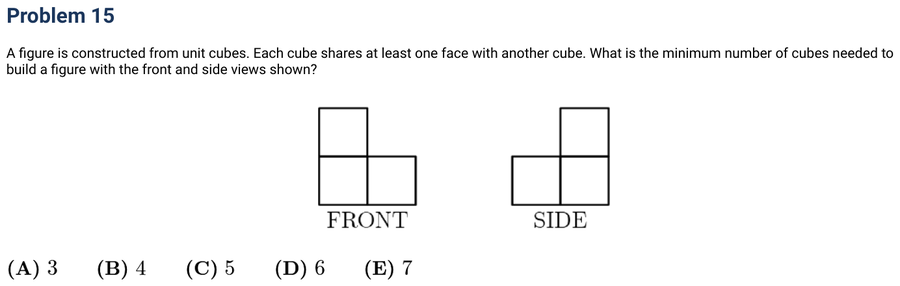
amc8-2003-15
Show hint (soft nudge)
Build the front view first with as few cubes as possible, then add only what the side view forces.
Show hint (sharpest)
The side view shows the figure has depth, so something must sit behind the front row.
Show solution
  1. The front view (an L of 3 squares) needs at least 3 cubes.
  2. The side view shows the shape has depth, so at least one more cube must sit behind — one extra cube is enough to make both views correct.
  3. Minimum: 4 cubes.
B 4 cubes.
Mark: · log in to save
Problem 16 · 2003 AMC 8 Hard
Counting & Probability careful-counting

Ali, Bonnie, Carlo, and Dianna are going to drive together to a nearby theme park. The car they are using has four seats: one driver's seat, one front passenger seat, and two back passenger seats. Bonnie and Carlo are the only ones who know how to drive the car. How many possible seating arrangements are there?

Show hint (soft nudge)
Fill the most restricted seat first — only two people can take the driver's seat.
Show hint (sharpest)
Once the driver is chosen, the other three sit anywhere.
Show solution
  1. Only Bonnie or Carlo can drive: 2 choices for the driver's seat.
  2. The other 3 people fill the remaining 3 seats in 3! = 6 ways.
  3. 2 × 6 = 12 arrangements.
D 12 arrangements.
Mark: · log in to save
Problem 17 · 2003 AMC 8 Hard
Logic & Word Problems casework

The six children listed below are from two families of three siblings each. Each child has blue or brown eyes and black or blond hair. Children from the same family have at least one of these characteristics in common. Which two children are Jim's siblings?

ChildEye ColorHair Color
BenjaminBlueBlack
JimBrownBlond
NadeenBrownBlack
AustinBlueBlond
TevynBlueBlack
SueBlueBlond
Show hint (soft nudge)
Write down Jim's two traits, then see who could even be in his family.
Show hint (sharpest)
Three of the other children share one trait among themselves — that locks in both families.
Show solution
  1. Jim has brown eyes and blond hair, so a sibling must share one of those: only Nadeen (brown eyes), Austin (blond), or Sue (blond) qualify.
  2. But Benjamin, Nadeen, and Tevyn all have black hair, so those three already form a valid family.
  3. That forces Jim's family to be Jim, Austin, and Sue (all blond) — his siblings are Austin and Sue.
E Austin and Sue.
Mark: · log in to save
Problem 18 · 2003 AMC 8 Hard
Logic & Word Problems careful-counting
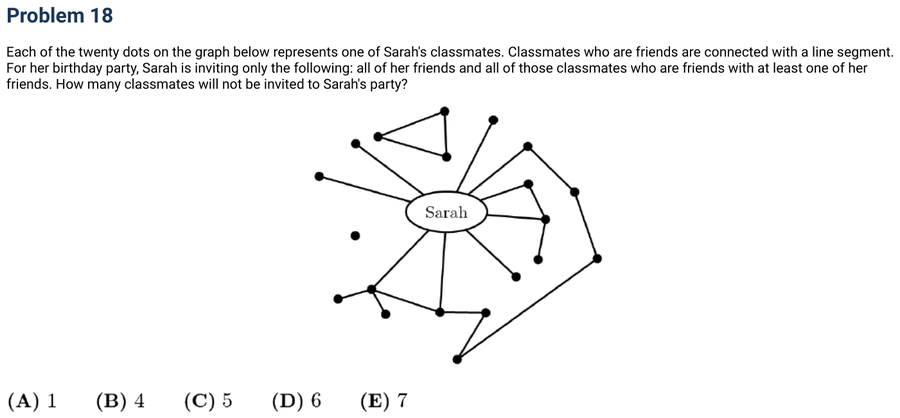
amc8-2003-18
Show hint (soft nudge)
Sarah invites everyone within two links of her: herself, her friends, and her friends' friends.
Show hint (sharpest)
Find the classmates who are three or more links away (or not connected to her at all).
Show solution
  1. Sarah's guests are everyone at most two line-segments away — her friends, and their friends.
  2. Reading the graph: 4 classmates aren't connected to Sarah at all, and 2 more sit three links away.
  3. Those 4 + 2 = 6 classmates are not invited.
D 6 classmates.
Mark: · log in to save
Problem 19 · 2003 AMC 8 Hard
Number Theory divisibility factorization

How many integers between 1000 and 2000 have all three of the numbers 15, 20, and 25 as factors?

Show hint (soft nudge)
A number divisible by all three is divisible by their least common multiple.
Show hint (sharpest)
LCM(15, 20, 25) = 300 — now count its multiples in range.
Show solution
  1. Being divisible by 15, 20, and 25 is the same as being divisible by their LCM.
  2. LCM(15, 20, 25) = 300.
  3. Multiples of 300 between 1000 and 2000: 1200, 1500, 1800 — that's 3.
C 3 integers.
Mark: · log in to save
Problem 20 · 2003 AMC 8 Stretch
Geometry & Measurement proportion

What is the measure of the acute angle formed by the hands of the clock at 4:20 PM?

Show hint (soft nudge)
At 20 minutes past, the minute hand points exactly at a number — which one?
Show hint (sharpest)
The hour hand has crept a fraction of the way from 4 toward 5.
Show solution
  1. At :20, the minute hand points exactly at the 4.
  2. The hour hand is 20/60 = 1/3 of the way from 4 to 5, and each number-to-number gap is 30°, so it sits 30° ÷ 3 = 10° past the 4.
  3. The two hands are 10° apart.
D 10°.
Mark: · log in to save
Problem 21 · 2003 AMC 8 Stretch
Geometry & Measurement pythagorean-triple area-decomposition
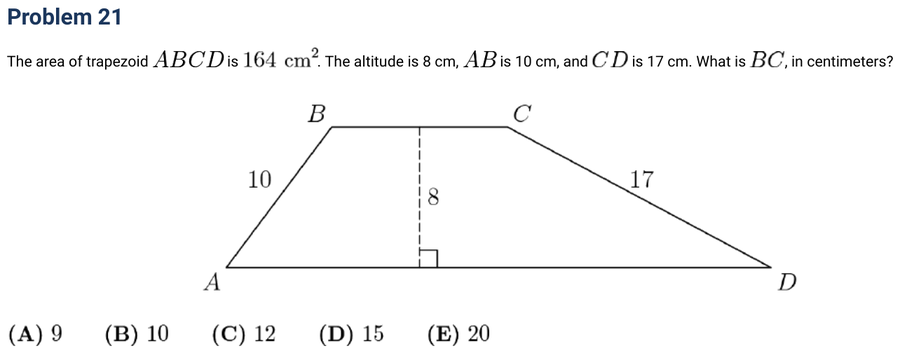
amc8-2003-21
Show hint (soft nudge)
Drop perpendiculars from the short side down to the long side — the two slanted legs become familiar right triangles.
Show hint (sharpest)
The 10-8 and 17-8 legs hint at the 6-8-10 and 8-15-17 triples; that tells you how much the bottom overhangs the top.
Show solution
  1. Drop perpendiculars from B and C to the long side AD. The legs give right triangles: AB = 10 with height 8 leaves a base of 6 (a 6-8-10 triangle), and CD = 17 with height 8 leaves 15 (an 8-15-17 triangle).
  2. So AD = BC + 6 + 15 = BC + 21.
  3. Area: ½(BC + AD)(8) = 164, so BC + AD = 41.
  4. Then BC + (BC + 21) = 41, giving 2·BC = 20, so BC = 10.
B BC = 10 cm.
Mark: · log in to save
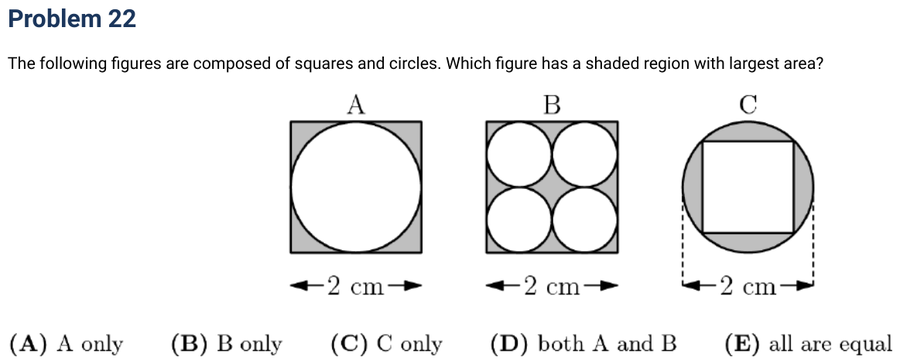
Problem 22 · 2003 AMC 8 Stretch
Geometry & Measurement area area-decomposition
amc8-2003-22
Show hint (soft nudge)
Find each shaded area in terms of π — A and B turn out identical, so really compare them against C.
Show hint (sharpest)
In C the square is inscribed in the circle, so its diagonal is the circle's diameter.
Show solution
  1. A: a 2×2 square minus its inscribed circle (radius 1) = 4 − π ≈ 0.86.
  2. B: a 2×2 square minus four circles of radius ½ = 4 − 4(π/4) = 4 − π ≈ 0.86 — the same as A.
  3. C: the square is inscribed in the circle, so its diagonal is the diameter 2, giving area 2; shaded = circle − square = π − 2 ≈ 1.14.
  4. C's shaded region is the largest, so the answer is C only.
C C only.
Mark: · log in to save
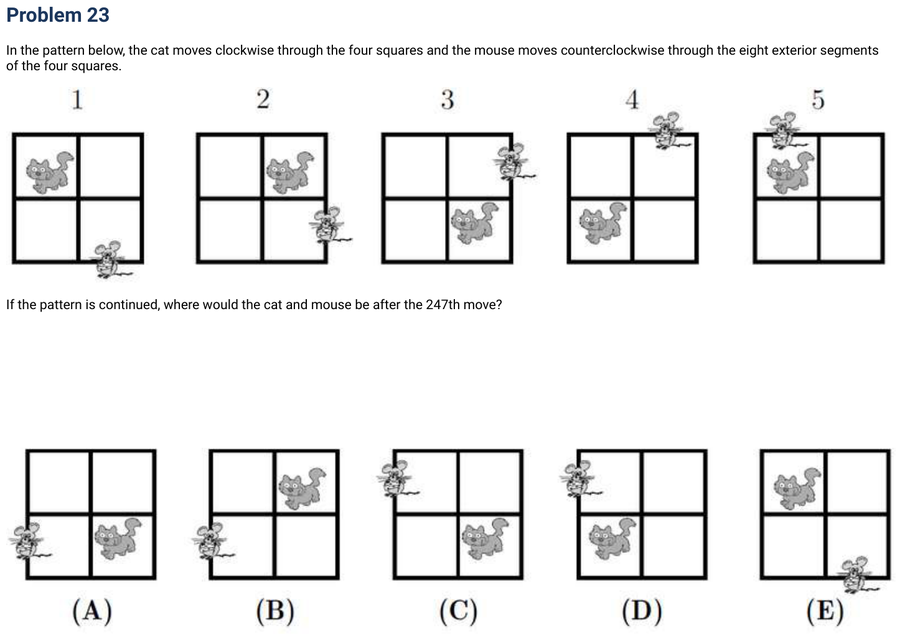
Problem 23 · 2003 AMC 8 Stretch
Algebra & Patterns
amc8-2003-23
Show hint (soft nudge)
The cat and mouse move independently — handle each one's cycle on its own.
Show hint (sharpest)
The cat repeats every 4 moves and the mouse every 8; use the remainders of 247.
Show solution
  1. The cat's position repeats every 4 moves and the mouse's every 8, so only the remainder of 247 matters for each.
  2. 247 = 4·61 + 3, so the cat is where it is after 3 moves: the bottom-right square.
  3. 247 = 8·30 + 7, so the mouse is where it is after 7 moves: the bottom-left segment.
  4. The picture matching both is A.
A the cat in the bottom-right square, the mouse on the bottom-left segment.
Mark: · log in to save
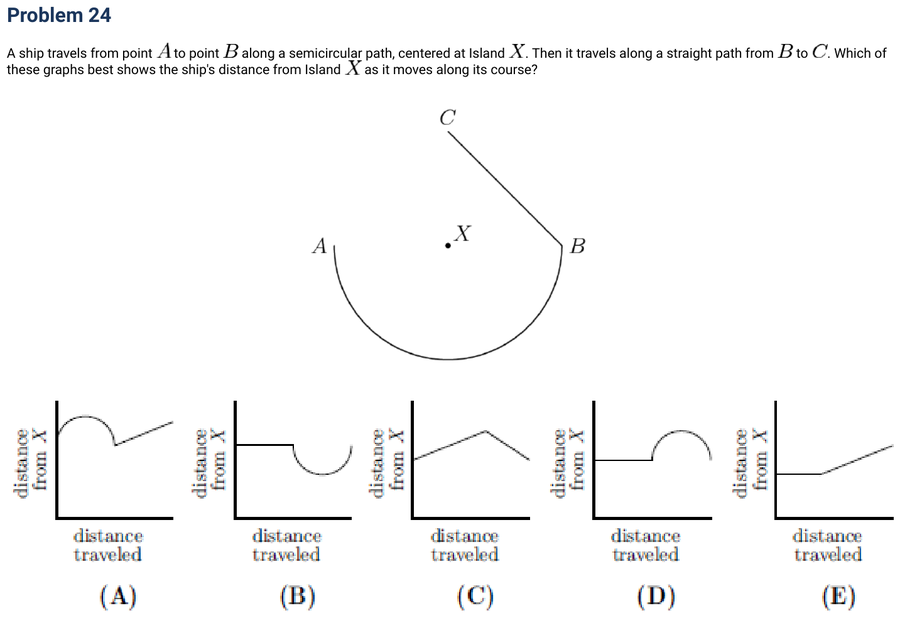
Problem 24 · 2003 AMC 8 Stretch
Geometry & Measurement spatial-reasoning
amc8-2003-24
Show hint (soft nudge)
Distance from the center of a circle doesn't change while you travel along that circle.
Show hint (sharpest)
On the straight stretch, the ship first nears X, then moves away again.
Show solution
  1. From A to B the ship moves along the semicircle centered at X, so its distance from X stays constant (one radius) — a flat line.
  2. From B to C it travels straight: the distance to X shrinks until it passes the point closest to X, then grows again — a dip down and back up.
  3. Flat, then a dip: that's graph B.
B the constant-then-dip graph.
Mark: · log in to save
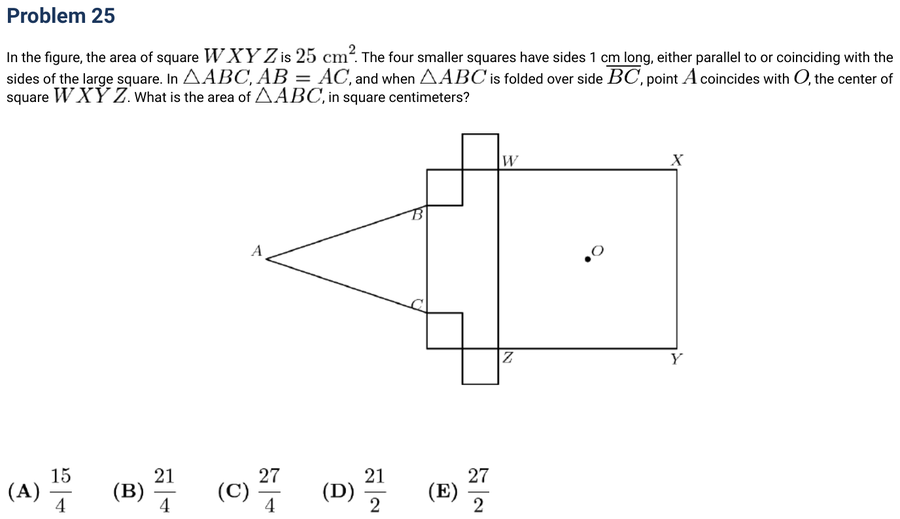
Problem 25 · 2003 AMC 8 Stretch
Geometry & Measurement folding area square-area
amc8-2003-25
Show hint (soft nudge)
The big square has area 25, so its side is 5 — find its center O.
Show hint (more)
Folding A onto O over BC means A and O are mirror images, so A is exactly as far from BC as O is.
Show hint (sharpest)
Get the base BC and that height, then take half their product.
Show solution
  1. Square WXYZ has area 25, so its side is 5 and its center O is 5/2 from side WZ.
  2. The base BC sits 2 cm outside WZ (two unit squares), so BC is 5 − 2 = 3 cm long, and O is 2 + 5/2 = 9/2 cm from BC.
  3. Folding A onto O across BC makes A the mirror image of O, so A is also 9/2 cm from BC — that's the triangle's height.
  4. Area = ½ × 3 × 9/2 = 27/4 cm².
C 27/4 square centimeters.
Mark: · log in to save