When Cheenu was a boy he could run 15 miles in 3 hours and 30 minutes. As an old man he can now walk 10 miles in 4 hours. How many minutes longer does it take for him to travel a mile now compared to when he was a boy?
Show hint (soft nudge)
Convert each to minutes-per-mile, then subtract.
Show hint (sharpest)
Boy: 210 min / 15 mi = 14 min/mi. Old: 240 min / 10 mi = 24 min/mi.
Show solution
Boy: 3 h 30 min = 210 minutes for 15 miles ⇒ 14 min/mile.
Old: 4 h = 240 minutes for 10 miles ⇒ 24 min/mile.
Determine how many two-digit numbers satisfy the following property: when the number is added to the number obtained by reversing its digits, the sum is 132.
Show hint (soft nudge)
Two-digit + reversed = (10a + b) + (10b + a) = 11(a + b). So a + b = 12.
Show hint (sharpest)
Count digit pairs (a, b) with a + b = 12, a ∈ {1, …, 9}, b ∈ {0, …, 9}.
Show solution
(10a + b) + (10b + a) = 11(a + b) = 132 ⇒ a + b = 12.
Valid pairs with a from 1–9 and b from 0–9: (3,9), (4,8), (5,7), (6,6), (7,5), (8,4), (9,3).
Jefferson Middle School has the same number of boys and girls. 34 of the girls and 23 of the boys went on a field trip. What fraction of the students on the field trip were girls?
Show hint
Common denominator: 3/4 = 9/12 and 2/3 = 8/12. So per 12 girls there are 9 on the trip; per 12 boys, 8.
Show solution
Same group sizes ⇒ girls : boys = 1 : 1. Their trip fractions: 3/4 vs 2/3 → 9/12 vs 8/12.
Karl's car uses a gallon of gas every 35 miles, and his gas tank holds 14 gallons when it is full. One day, Karl started with a full tank of gas, drove 350 miles, bought 8 gallons of gas, and continued driving to his destination. When he arrived, his gas tank was half full. How many miles did Karl drive that day?
Show hint
Track gallons. Start 14, drive 350 = use 10, left 4. Buy 8 → 12. End half full = 7. So extra used = 5 gallons = 175 miles.
Show solution
Start: 14 gal. After 350 mi: used 350/35 = 10 gal, leaving 4.
Bought 8 gal → 12 gal in tank. Arrived half full (7 gal), so used 12 − 7 = 5 more gallons = 5 × 35 = 175 miles.
Annie and Bonnie are running laps around a 400-meter oval track. They started together, but Annie has pulled ahead because she runs 25% faster than Bonnie. How many laps will Annie have run when she first passes Bonnie?
Show hint (soft nudge)
25% faster means speed ratio 5 : 4. Annie gains a quarter-lap on Bonnie per Bonnie-lap.
Show hint (sharpest)
To gain a full lap, Bonnie completes 4 laps; in that time Annie completes 5.
Show solution
Speed ratio Annie : Bonnie = 5 : 4. So for every lap Bonnie runs, Annie runs 5/4 laps — a gain of 1/4 lap per Bonnie-lap.
To gain a full lap (and pass Bonnie), Bonnie must run 4 laps. In that time, Annie runs 5 laps.
An ATM password at Fred's Bank is composed of four digits from 0 to 9, with repeated digits allowable. If no password may begin with the sequence 9, 1, 1, then how many passwords are possible?
Show hint
Total - bad. Total = 104. Bad: first three digits forced to 9, 1, 1; last digit anything (10 options).
Show solution
Total passwords: 104 = 10,000.
Bad passwords (starting 9, 1, 1): the last digit can be any of 10 → 10 bad passwords.
In an All-Area track meet, 216 sprinters enter a 100-meter dash competition. The track has 6 lanes, so only 6 sprinters can compete at a time. At the end of each race, the five non-winners are eliminated, and the winner will compete again in a later race. How many races are needed to determine the champion sprinter?
Show hint
Don't count races by tracking winners. Count eliminations: each race eliminates exactly 5 sprinters.
Show solution
To leave one champion, 215 sprinters must be eliminated.
Each race eliminates 5, so number of races = 215 / 5 = 43.
The least common multiple of a and b is 12, and the least common multiple of b and c is 15. What is the least possible value of the least common multiple of a and c?
Show hint (soft nudge)
b divides both lcms — so b divides gcd(12, 15) = 3. Try b = 3.
Show hint (sharpest)
Then minimize a and c: smallest a giving lcm(a, 3) = 12 is 4, and smallest c giving lcm(c, 3) = 15 is 5.
Show solution
b must divide both 12 and 15, so b | gcd(12, 15) = 3.
Take b = 3. Then smallest a with lcm(a, 3) = 12 is a = 4. Smallest c with lcm(c, 3) = 15 is c = 5.
A top hat contains 3 red chips and 2 green chips. Chips are drawn randomly, one at a time without replacement, until all 3 of the reds are drawn or until both green chips are drawn. What is the probability that the 3 reds are drawn?
Show hint
Imagine all 5 chips drawn in random order. The 3 reds get drawn first iff the LAST chip in the order is green — not the second-green.
Show solution
Imagine shuffling all 5 chips and drawing them all. The drawing stops as soon as you have all 3 reds OR both greens.
All 3 reds come out before both greens ⇔ the last chip in the shuffle is green.
By symmetry, the last chip is one of the 5 uniformly — probability it's green is 2/5 (2 green chips of 5).
Two congruent circles centered at points A and B each pass through the other circle's center. The line containing both A and B is extended to intersect the circles at points C and D. The circles intersect at two points, one of which is E. What is the degree measure of ∠CED?
Show hint (soft nudge)
▵AEB is equilateral (all sides are radii). So ∠AEB = 60°.
Show hint (sharpest)
CA and BD are diameters of their circles, so the inscribed angles ∠CEA and ∠BED are 90° each.
Show solution
AE = EB = AB (all radii of congruent circles passing through each other's center) ⇒ ▵AEB equilateral, so ∠AEB = 60°.
CA is a diameter of the first circle, so the inscribed angle ∠CEA = 90°. Similarly ∠BED = 90°.
The digits 1, 2, 3, 4, and 5 are each used once to write a five-digit number PQRST. The three-digit number PQR is divisible by 4, the three-digit number QRS is divisible by 5, and the three-digit number RST is divisible by 3. What is P?
Show hint (soft nudge)
QRS div by 5 means S ends in 0 or 5; the only digit available is 5. So S = 5.
Show hint (sharpest)
PQR div by 4 means QR is divisible by 4. With S = 5 used, QR is a 2-digit from {1, 2, 3, 4}. Options: 12, 24, 32.
Show solution
S = 5 (the only digit from {1,2,3,4,5} that makes QRS end in 0 or 5).
QR must be a 2-digit number from {1, 2, 3, 4} divisible by 4: {12, 24, 32}.
Test each. QR = 12: leftover {3, 4} for P, T. RST = 25T, digit sum 7 + T; T ∈ {3, 4} gives 10 or 11, neither div by 3.
QR = 24: leftover {1, 3}. RST = 45T, digit sum 9 + T; T = 3 gives 12 (div 3) ✓. So Q = 2, R = 4, T = 3, P = 1. Number: 12435.
QR = 32: leftover {1, 4}. RST = 25T sum 7 + T; T ∈ {1, 4} gives 8 or 11, neither div by 3.
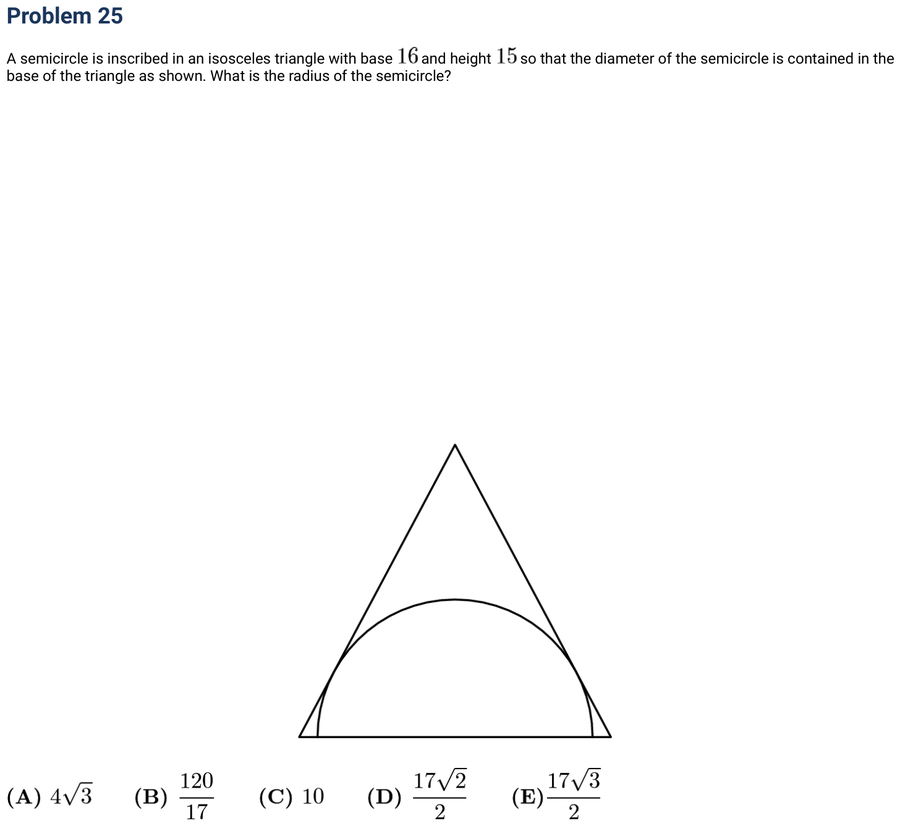
The slant side of the triangle is tangent to the semicircle, so its distance from the semicircle's center equals the radius.
Show hint (sharpest)
Slant length: half-base 8 + height 15 → an 8-15-17 right triangle. The slant line is 17 long; use the distance-from-point formula.
Show solution
The center of the semicircle is the midpoint of the base. By symmetry, both slant sides are tangent to the semicircle, so the perpendicular distance from the center to a slant side equals the radius.