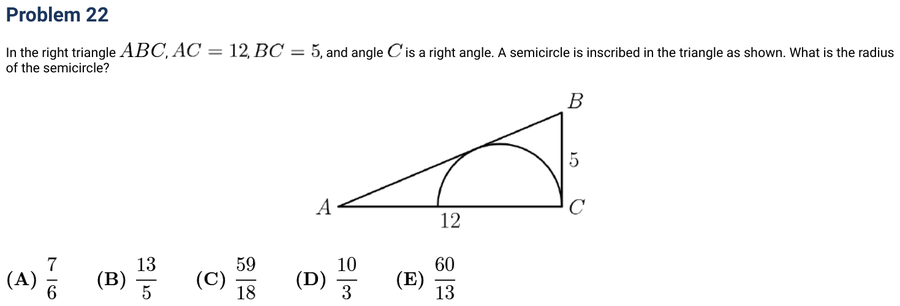
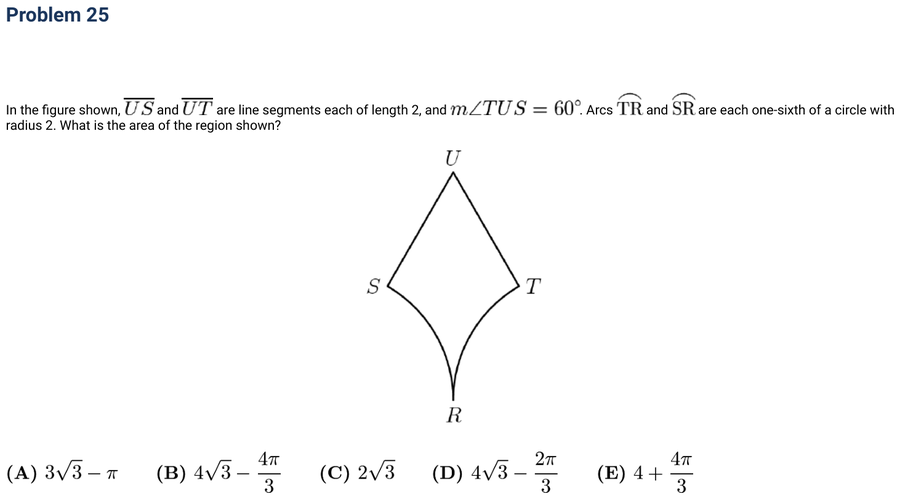
Let Z be a 6-digit positive integer, such as 247247, whose first three digits are the same as its last three digits taken in the same order. Which of the following numbers must also be a factor of Z?
Show hint
Write Z = abcabc as a multiple of abc. The multiplier factors into nice primes.
Show solution
Z = abcabc = abc · 1001.
1001 = 7 · 11 · 13. So 11 is always a factor of Z.
Malcolm wants to visit Isabella after school today and knows the street where she lives but doesn't know her house number. She tells him, "My house number has two digits, and exactly three of the following four statements about it are true."
It is prime.
It is even.
It is divisible by 7.
One of its digits is 9.
This information allows Malcolm to determine Isabella's house number. What is its units digit?
Show hint (soft nudge)
Which two statements can't both be true together?
Show hint (sharpest)
A 2-digit number can't be both even and prime (the only even prime is 2). So either (1) or (2) is false — and since 3 of 4 are true, the false one must be (1) "prime".
Show solution
(1) prime and (2) even can't both be true for a 2-digit number (the only even prime is 2). So the false statement is (1), making (2), (3), (4) all true: the number is even, div by 7, and has a 9 as a digit.
Even + divisible by 7 ⇒ divisible by 14. Two-digit multiples of 14: 14, 28, 42, 56, 70, 84, 98. Only 98 has a 9 digit.
All of Marcy's marbles are blue, red, green, or yellow. One third of her marbles are blue, one fourth of them are red, and six of them are green. What is the smallest number of yellow marbles that Marcy could have?
Show hint (soft nudge)
The total must be divisible by both 3 and 4 — so by 12. Try 12 first; if it fails, try 24.
Show hint (sharpest)
12 total: 4 blue + 3 red + 6 green = 13 > 12. Doesn't work. Try 24.
Show solution
Total must be a multiple of 12 (so that 1/3 and 1/4 are integers).
Try 12: blue = 4, red = 3, green = 6 ⇒ total already 13 > 12. Doesn't fit.
Try 24: blue = 8, red = 6, green = 6 ⇒ yellow = 24 − 8 − 6 − 6 = 4.
A box contains five cards, numbered 1, 2, 3, 4, and 5. Three cards are selected randomly without replacement from the box. What is the probability that 4 is the largest value selected?
Show hint
For 4 to be the largest, the draw must include 4 and the other two come from {1, 2, 3}.
Show solution
Total ways to choose 3 of 5 cards: C(5, 3) = 10.
Favorable: pick 4, then pick the other 2 from {1, 2, 3}: C(3, 2) = 3 ways.
A square-shaped floor is covered with congruent square tiles. If the total number of tiles that lie on the two diagonals is 37, how many tiles cover the floor?
Show hint
Both diagonals share the center tile (the floor must be an odd-by-odd square). So diagonal tiles = 2n − 1.
Show solution
If the floor is n × n, the two diagonals share the center tile, so they cover 2n − 1 tiles.
The smallest positive integer greater than 1 that leaves a remainder of 1 when divided by 4, 5, and 6 lies between which of the following pairs of numbers?
Show hint
Same remainder mod 4, 5, AND 6 means n − 1 is divisible by all three. So n − 1 = lcm(4, 5, 6).
Show solution
n − 1 is divisible by 4, 5, and 6, so by lcm(4, 5, 6) = 60.
Smallest n > 1: n = 61, which lies between 60 and 79.
Peter, Emma, and Kyler played chess with each other. Peter won 4 games and lost 2 games. Emma won 3 games and lost 3 games. If Kyler lost 3 games, how many games did he win?
Show hint
Every game has one winner and one loser, so total wins across all players = total losses.
Chloe and Zoe are both students in Ms. Demeanor's math class. Last night they each solved half of the problems in their homework assignment alone and then solved the other half together. Chloe had correct answers to only 80% of the problems she solved alone, but overall 88% of her answers were correct. Zoe had correct answers to 90% of the problems she solved alone. What was Zoe's overall percentage of correct answers?
Show hint (soft nudge)
Pretend there are 100 problems — 50 alone, 50 together. The "together" half is the same for both girls. Find that.
Show hint (sharpest)
Chloe: 80% of 50 = 40 alone; 88% total = 88 correct; so together = 48 of 50.
Starting with some gold coins and some empty treasure chests, I tried to put 9 gold coins in each treasure chest, but that left 2 treasure chests empty. So instead I put 6 gold coins in each treasure chest, but then I had 3 gold coins left over. How many gold coins did I have?
Show hint
Set up two equations for the same gold-coin count: g = 9(n − 2) and g = 6n + 3.
Show solution
Let n = chests, g = coins. Nine-per-chest leaves 2 empty: g = 9(n − 2). Six-per-chest with 3 left over: g = 6n + 3.
For any positive integer M, the notation M! denotes the product of the integers 1 through M. What is the largest integer n for which 5n is a factor of the sum
98! + 99! + 100! ?
Show hint (soft nudge)
Factor out 98! from all three terms. The leftover is a clean number.
Show hint (sharpest)
98! + 99! + 100! = 98!(1 + 99 + 99·100) = 98! · 10,000. Count factors of 5 in each piece.
Each day for four days, Linda traveled for one hour at a speed that resulted in her traveling one mile in an integer number of minutes. Each day after the first, her speed decreased so that the number of minutes to travel one mile increased by 5 minutes over the preceding day. Each of the four days, her distance traveled was also an integer number of miles. What was the total number of miles for the four trips?
Show hint (soft nudge)
Each day's min-per-mile must divide 60 (so that 60 min yields an integer mile count). Find four divisors of 60 in arithmetic progression with common difference 5.
Show hint (sharpest)
Divisors of 60: 1, 2, 3, 4, 5, 6, 10, 12, 15, 20, 30, 60. The only arithmetic-progression-5 of length 4 is 5, 10, 15, 20.
Show solution
60 minutes total per day; for integer miles, the min-per-mile divides 60.
Four divisors of 60 forming an AP with common difference 5: 5, 10, 15, 20.
Miles each day: 60/5 + 60/10 + 60/15 + 60/20 = 12 + 6 + 4 + 3 = 25.
Mrs. Sanders has three grandchildren, who call her regularly. One calls her every three days, one calls her every four days, and one calls her every five days. All three called her on December 31, 2016. On how many days during the next year did she not receive a phone call from any of her grandchildren?
Show hint (soft nudge)
The pattern repeats every lcm(3, 4, 5) = 60 days. Count call-days in 60, then scale to 365 (with the leftover 5 days handled).
Show hint (sharpest)
Inclusion–exclusion in a 60-day block: 20 + 15 + 12 − 5 − 4 − 3 + 1 = 36 call days. So 60 − 36 = 24 no-call days.
Show solution
lcm(3, 4, 5) = 60, so the call pattern repeats every 60 days. In one 60-day block: