Luka is making lemonade to sell at a school fundraiser. His recipe requires 4 times as much water as sugar and twice as much sugar as lemon juice. He uses 3 cups of lemon juice. How many cups of water does he need?
Show hint (soft nudge)
Don't solve for sugar first — chain the two scalings into one trip from lemon juice to water.
Show hint (sharpest)
Water is 4 × sugar, sugar is 2 × lemon. So water is 4 × 2 = 8 times the lemon juice.
Show solution
Water is 4 × sugar, and sugar is 2 × lemon juice, so water is 4 × 2 = 8 times the lemon juice.
With 3 cups of lemon juice, water = 8 × 3 = 24 cups.
E
24 cups.
Another way: step by step: lemon → sugar → water (MAA)
Four friends do yardwork for their neighbors over the weekend, earning $15, $20, $25, and $40, respectively. They decide to split their earnings equally among themselves. In total how much will the friend who earned $40 give to the others?
Show hint (soft nudge)
Find the fair share first — what does each friend end up with?
Show hint (sharpest)
The $40 friend gives away whatever they have above the fair share.
Carrie has a rectangular garden that measures 6 feet by 8 feet. She plants the entire garden with strawberry plants. Carrie is able to plant 4 strawberry plants per square foot, and she harvests an average of 10 strawberries per plant. How many strawberries can she expect to harvest?
Show hint
Walk it through in units: square feet → plants → strawberries. Just multiply each step.
Three fourths of a pitcher is filled with pineapple juice. The pitcher is emptied by pouring an equal amount of juice into each of 5 cups. What percent of the total capacity of the pitcher did each cup receive?
Show hint (soft nudge)
Split 34 into 5 equal shares — what fraction of the whole pitcher is each share?
Show hint (sharpest)
Each cup gets 34 ÷ 5 = 320 of the pitcher. Now turn that into a percent.
Aaron, Darren, Karen, Maren, and Sharon rode on a small train that has five cars that seat one person each. Maren sat in the last car. Aaron sat directly behind Sharon. Darren sat in one of the cars in front of Aaron. At least one person sat between Karen and Darren. Who sat in the middle car?
Show hint (soft nudge)
Place the fixed constraints first: Maren is in car 5; Sharon→Aaron is a glued-together pair; Darren is somewhere ahead of Aaron.
Show hint (sharpest)
Try Sharon−Aaron in cars 2−3, then 3−4. The 2−3 case fails (no room for Darren ahead of Aaron with Karen ge 2 apart); 3−4 forces Darren in 1, Karen in 4 — wait that's Aaron. Recheck.
Show solution
Maren is in car 5. Place the Sharon−Aaron pair (S in car k, A in k+1) and have Darren somewhere strictly less than k+1.
S, A in cars 1, 2: Darren must be ahead of car 2 — only car 1, taken. Fail.
S, A in cars 2, 3: Darren must be in car 1. Karen in car 4. But Karen (4) and Darren (1) have cars 2, 3 (Sharon, Aaron) between them — 2 people between — satisfies "at least one" constraint. Configuration: Darren, Sharon, Aaron, Karen, Maren. Middle car = Aaron.
S, A in cars 3, 4: Darren must be in car 1 or 2. Karen fills the other, and they'd be in cars 1 and 2 with no one between — fails the spacing rule.
Only the middle case works: Aaron sits in the middle car.
How many integers between 2020 and 2400 have four distinct digits arranged in increasing order? (For example, 2347 is one integer.)
Show hint (soft nudge)
Pin down the leading digits first. The thousands digit is forced; the hundreds digit has only one valid value.
Show hint (sharpest)
First digit = 2. For the digits to be increasing and the number ≤ 2400, the second digit must be 3 (since it must exceed 2 and be ≤ 3). Then the last two digits are any two distinct digits from {4,5,6,7,8,9}.
Show solution
Digits must be increasing, so they're strictly ascending. First digit = 2 (number is between 2020 and 2400). Second digit must be > 2 and ≤ 3 (else the number exceeds 2400): second digit = 3.
Last two digits: any 2 distinct values from {4, 5, 6, 7, 8, 9}, arranged in increasing order. That's C(6, 2) = 15.
Ricardo has 2020 coins, some of which are pennies (1-cent coins) and the rest of which are nickels (5-cent coins). He has at least one penny and at least one nickel. What is the difference in cents between the greatest possible and least possible amounts of money that Ricardo can have?
Show hint (soft nudge)
Trade pennies for nickels: each swap adds 4 cents. So the total is a linear function of the nickel count n.
Show hint (sharpest)
Total = p + 5n = (p+n) + 4n = 2020 + 4n. With 1 ≤ n ≤ 2019, difference is 4 × (2019 − 1).
Show solution
Total cents = p + 5n = (p + n) + 4n = 2020 + 4n.
Constraints: p ≥ 1 and n ≥ 1 with p + n = 2020 ⇒ n ∈ [1, 2019].
Maximum vs minimum total: 4(2019) − 4(1) = 4 × 2018 = 8072.
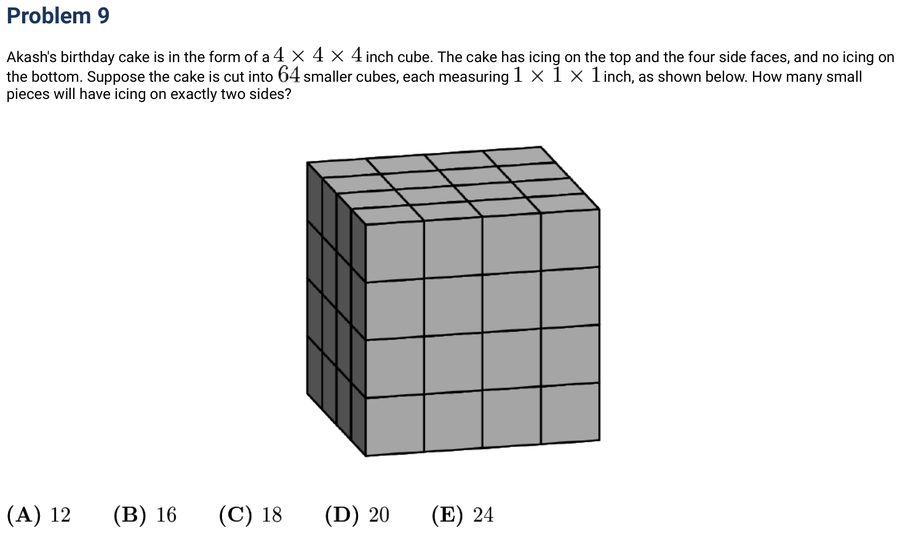
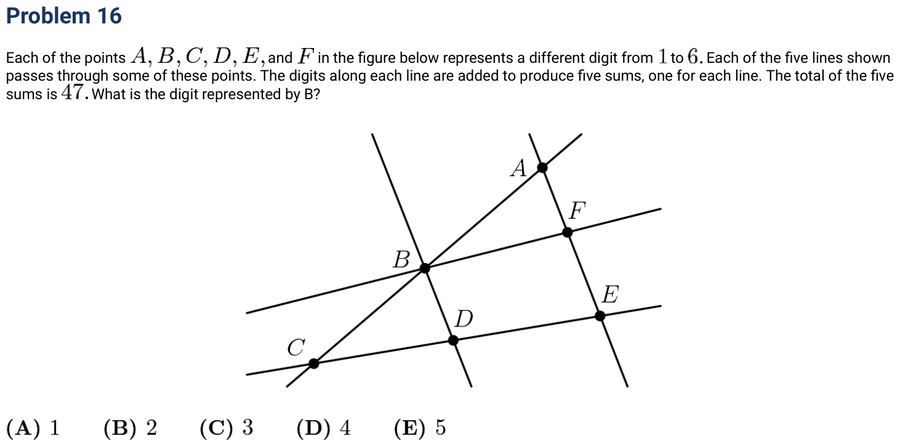
Icing is on the top and the 4 sides; the bottom has none. Count where exactly two of these meet on a small cube.
Show hint (sharpest)
Top-edge cubes (not corners): top + one side = 2 sides. Bottom-corner vertical edges: side + side = 2 sides. Add them up.
Show solution
Top non-corner edge cubes (k=4, exactly one of i,j at the boundary): touch top + one side → 2 iced sides. There are 4 top edges × 2 non-corner cubes per edge = 8.
Vertical-edge cubes (both i and j at a side boundary, but k < 4): touch 2 side faces, and bottom has no icing → 2 iced sides. 4 vertical edges × 3 cubes per edge = 12.
Zara has a collection of 4 marbles: an Aggie, a Bumblebee, a Steelie, and a Tiger. She wants to display them in a row on a shelf, but does not want to put the Steelie and the Tiger next to one another. In how many ways can she do this?
Show hint (soft nudge)
Count all arrangements, then subtract the bad ones (Steelie next to Tiger).
Show hint (sharpest)
Total: 4! = 24. Steelie-Tiger adjacent: glue them as a block → 3! = 6 arrangements, × 2 internal orders = 12.
Show solution
Total arrangements of 4 marbles: 4! = 24.
Bad arrangements (Steelie and Tiger adjacent): treat ST as a single block → 3! = 6 arrangements; the block can be ST or TS → × 2 = 12.
For a positive integer n, the factorial notation n! represents the product of the integers from n to 1. For example: 6! = 6 × 5 × 4 × 3 × 2 × 1. What value of N satisfies the following equation?
5! × 9! = 12 × N!
Show hint (soft nudge)
Compute 5! — can you factor 12 out of it neatly?
Show hint (sharpest)
5! = 120 = 12 × 10. So the equation becomes 12 × 10 × 9! = 12 × N!.
Jamal has a drawer containing 6 green socks, 18 purple socks, and 12 orange socks. After adding more purple socks, Jamal noticed that there is now a 60% chance that a sock randomly selected from the drawer is purple. How many purple socks did Jamal add?
Show hint (soft nudge)
If s purple socks are added, what fraction of the new drawer is purple? Set that equal to 0.6.
Show hint (sharpest)
(18 + s) / (36 + s) = 0.6.
Show solution
Original drawer: 6 + 18 + 12 = 36 socks. After adding s purple: 18 + s purple out of 36 + s total.
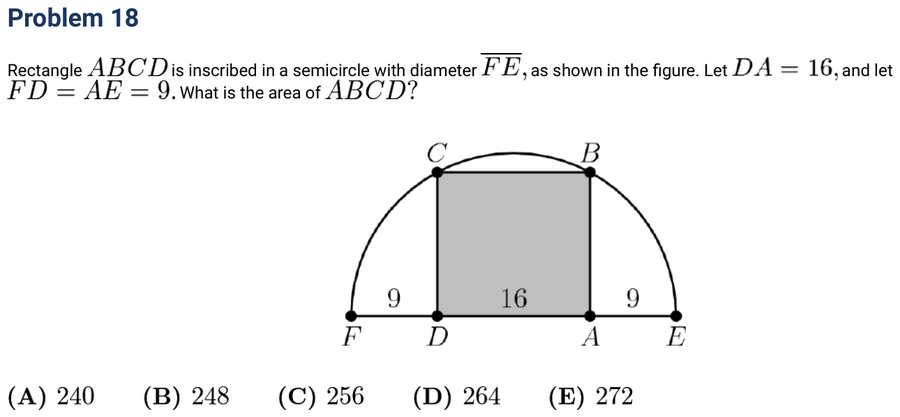
Use the center O of FE. Then OD is easy to compute, and OC equals the radius.
Show hint (sharpest)
FE = 9 + 16 + 9 = 34, so radius 17. The rectangle's center sits at O, so OD = DA/2 = 8. Triangle ODC is right with hypotenuse OC = 17. Pythagoras gives DC.
Show solution
Diameter FE = 9 + 16 + 9 = 34, radius 17. Let O be the center.
ABCD is symmetric about the perpendicular through O, so OD = AD/2 = 8. C is on the semicircle, so OC = 17.
A number is called flippy if its digits alternate between two distinct digits. For example, 2020 and 37373 are flippy, but 3883 and 123123 are not. How many five-digit flippy numbers are divisible by 15?
Show hint (soft nudge)
Divisible by 15 = divisible by 5 AND by 3. The last digit must be 0 or 5; since the number is 5 digits, the first digit can't be 0.
Show hint (sharpest)
Five-digit flippy: pattern ababa. a ≠ 0 and ends in a, so a = 5. Digit sum = 15 + 2b ⇒ b ∈ {0, 3, 6, 9}.
Show solution
5-digit flippy: ababa with a ≠ b and a ≠ 0.
Div by 5 ⇒ last digit (= a) is 0 or 5. Since a ≠ 0, a = 5.
Number is 5b5b5. Div by 3 ⇒ digit sum 15 + 2b div by 3 ⇒ b div by 3, so b ∈ {0, 3, 6, 9} (and all are ≠ 5).
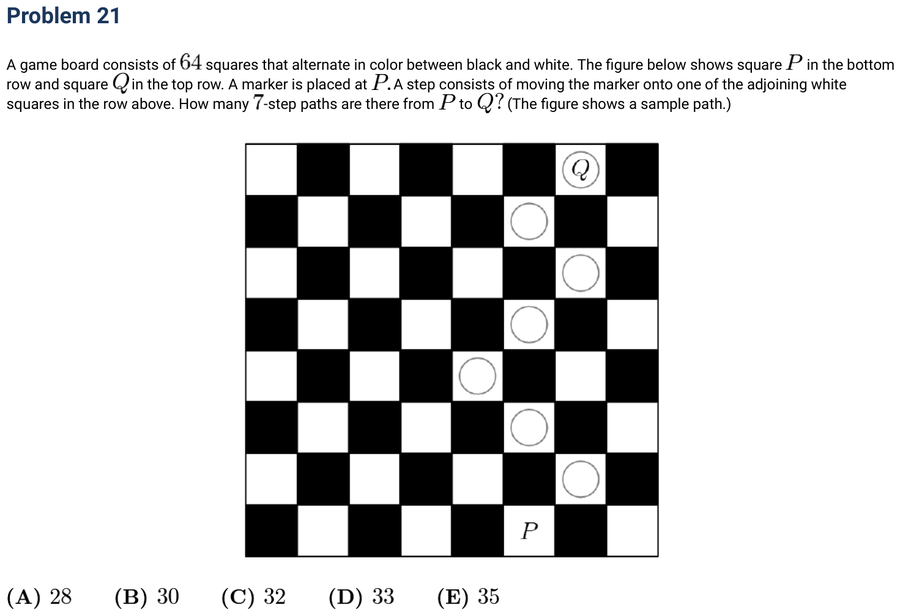
Each move goes up one row and shifts left or right one square. Build up Pascal-style: ways-to-reach a square = sum of ways to reach the two squares below it.
Show hint (sharpest)
Fill in each row from P upward. Each cell's count = sum of the down-left and down-right neighbors. Read off Q.
Show solution
Every step adds exactly one row, branching to one of two squares above. So the number of paths to a given white square equals the sum of paths to the two squares diagonally below it.
Starting from P (count 1) and propagating row by row up to Q, the counts grow Pascal-style.
When the 7th row is reached, the entry at Q is 28.
When a positive integer N is fed into a machine, the output is calculated by the rule: if N is even, output N/2; if N is odd, output 3N + 1. Example: 7 → 22 → 11 → 34 → 17 → 52 → 26. When the same 6-step process is applied to a different starting N, the final output is 1. What is the sum of all such integers N?
Show hint (soft nudge)
Work backward from 1. The predecessors of any k are: 2k (always), and (k − 1)/3 (only if that's an odd integer).
Show hint (sharpest)
Build the inverse-tree six levels up from 1. The level-6 leaves are the valid starting values.
Show solution
Forward: even → halve, odd → 3n+1. Inverting from a value k: predecessors are 2k (always), and (k−1)/3 (only if that's an odd integer).
Five different awards are to be given to three students. Each student will receive at least one award. In how many different ways can the awards be distributed?
Show hint (soft nudge)
Count all assignments (3 choices per award), then subtract the ones where someone is left out.
Show hint (sharpest)
Total = 35 = 243. Subtract: 3 students × 25 = 96 "misses a student", but you've subtracted twice the cases where TWO students miss out (one student gets everything), so add 3 × 1 back.
Show solution
Total assignments (each of 5 distinct awards to one of 3 students): 35 = 243.
Subtract assignments where a particular student gets nothing (other two split the awards): C(3,1) × 25 = 3 × 32 = 96.
Add back assignments where TWO specific students get nothing (one gets everything — we subtracted these twice): C(3,2) × 15 = 3.
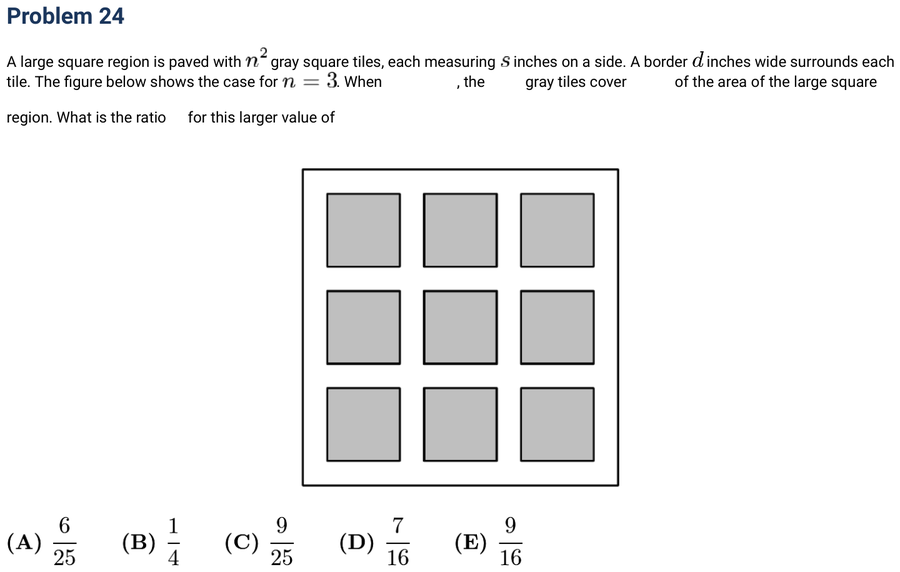
Set the large square's side to 1. Gray tiles cover 64% ⇒ total tile area = 64/100, so each tile is (64/100)/576 = (1/30)2. So each tile's side s = 1/30.
Show hint (sharpest)
Along a side: 24 tiles + 25 borders = 1. With 24/30 = 0.8 in tiles, the borders share 0.2 across 25 of them ⇒ d = 0.2/25.
Show solution
Total gray area as a fraction of the large square: 64% = (4/5)2. So each of 576 = 242 tiles has area (4/5)2 / 242 = (1/30)2.
So each tile's side s = 1/30 (with large side = 1).
Along a side: 24 tile widths + 25 border widths sum to 1: 24/30 + 25d = 1 ⇒ 25d = 6/30 = 1/5 ⇒ d = 1/125.