Logic & Word Problemsageswork-backwardsum-constraint
Anna and Bella are celebrating their birthdays together. Five years ago, when Bella turned 6 years old, she received a newborn kitten as a birthday present. Today the sum of the ages of the two children and the kitten is 30. How many years older than Bella is Anna?
Show hint (soft nudge)
Don't solve for ages directly — figure out who is how old today first.
Show hint (sharpest)
Work out each one's age today first. Bella was 6 five years ago; the kitten was newborn five years ago. The leftover part of 30 is Anna's age.
Show solution
Bella today: 6 + 5 = 11. Kitten today: 0 + 5 = 5.
The three ages sum to 30, so Anna = 30 − 11 − 5 = 14.
Three positive integers are equally spaced on a number line. The middle number is 15 and the largest number is 4 times the smallest number. What is the smallest of these three numbers?
Show hint (soft nudge)
Equally spaced means the middle equals the average of the outer two.
Show hint (sharpest)
Let smallest = x, largest = 4x. Their average = 5x/2 = 15.
Show solution
Let smallest = x, so largest = 4x. Equally spaced ⇒ middle = (x + 4x)/2 = 5x/2.
When the World Wide Web first became popular in the 1990s, download speeds reached a maximum of about 56 kilobits per second. Approximately how many minutes would the download of a 4.2-megabyte song have taken at that speed? (Note that there are 8000 kilobits in a megabyte.)
Show hint (soft nudge)
Convert the song to kilobits first (units of the speed), then time = size ÷ speed.
A cup of boiling water (212°F) is placed to cool in a room whose temperature remains constant at 68°F. Suppose the difference between the water temperature and the room temperature is halved every 5 minutes. What is the water temperature, in degrees Fahrenheit, after 15 minutes?
Show hint (soft nudge)
Don't track the temperature directly — track the difference from room temp.
Show hint (sharpest)
Initial gap: 212 − 68 = 144. Halved three times in 15 minutes: 144 / 23 = 18. Add to room temp.
Henry the donkey has a very long piece of pasta. He takes a number of bites of pasta, each time eating 3 inches of pasta from the middle of one piece. In the end, he has 10 pieces of pasta whose total length is 17 inches. How long, in inches, was the piece of pasta he started with?
Show hint (soft nudge)
Each bite turns one piece into two. How many bites does it take to end with 10 pieces?
In how many ways can the letters in BEEKEEPER be rearranged so that two or more E's do not appear together?
Show hint (soft nudge)
BEEKEEPER has 5 E's and 4 non-E letters (B, K, P, R) in 9 positions. Where can the 5 E's go without two being adjacent?
Show hint (sharpest)
5 non-adjacent positions in a row of 9 force the E's into positions 1, 3, 5, 7, 9. Then the 4 non-E letters fill positions 2, 4, 6, 8 in some order.
Show solution
BEEKEEPER = 5 E's + {B, K, P, R} in 9 slots. To keep no two E's adjacent, the 5 E's must occupy all 5 odd positions (1, 3, 5, 7, 9) — the only way to fit 5 non-adjacent positions in 9.
The other 4 letters fill positions 2, 4, 6, 8 in any order: 4! = 24 arrangements.
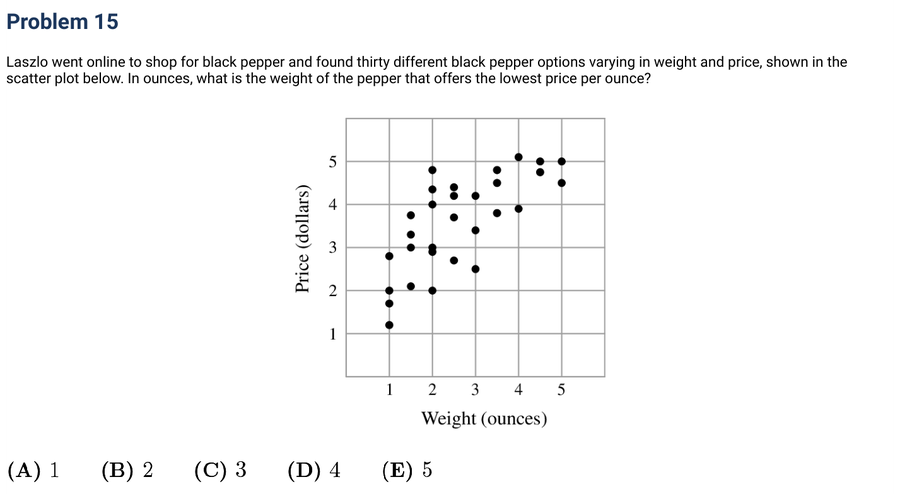
For each weight, find the lowest price dot in that column. Then compute price ÷ weight.
Show hint (sharpest)
Lowest-price-per-ounce will favor a weight where the cheapest available pepper drops well below the dollar-per-ounce line.
Show solution
Lowest price at each weight (reading off the scatter): 1 oz ≈ $1.25 (rate ≈ 1.25), 2 oz ≈ $2 (1.00), 3 oz ≈ $2.5 (≈ 0.83), 4 oz ≈ $3.9 (≈ 0.97), 5 oz ≈ $4.5 (≈ 0.90).
The 3-ounce option has the lowest rate (~$0.83/oz). Answer: 3 ounces.
Four numbers are written in a row. The average of the first two is 21, the average of the middle two is 26, and the average of the last two is 30. What is the average of the first and last of the numbers?
Show hint (soft nudge)
Convert each average into a sum (multiply by 2). You don't need the four numbers individually — just a + d.
Show hint (sharpest)
(a + b) + (c + d) = (a+b+c+d), and you can subtract (b+c) to leave a+d.
Show solution
a + b = 42, b + c = 52, c + d = 60.
(a+b) + (c+d) − (b+c) = a + d = 42 + 60 − 52 = 50.
If n is an even positive integer, the double-factorial notation n!! represents the product of all the even integers from 2 to n. For example: 8!! = 2 × 4 × 6 × 8. What is the units digit of the following sum?
2!! + 4!! + 6!! + … + 2022!!
Show hint (soft nudge)
Once a double-factorial includes 10 as a factor, it ends in 0. Which terms in the sum still affect the ones digit?
Show hint (sharpest)
Only 2!!, 4!!, 6!!, 8!! contribute — everything from 10!! onward ends in 0.
Show solution
n!! for n ≥ 10 contains the factor 10, so its units digit is 0.
Compute only the survivors: 2!! = 2, 4!! = 8, 6!! = 48, 8!! = 384. Their units digits: 2, 8, 8, 4.
Sum of units digits: 2 + 8 + 8 + 4 = 22. Units digit: 2.
Steph scored 15 baskets out of 20 attempts in the first half of a game, and 10 baskets out of 10 attempts in the second half. Candace took 12 attempts in the first half and 18 attempts in the second. In each half, Steph scored a higher percentage of baskets than Candace. Surprisingly they ended with the same overall percentage of baskets scored. How many more baskets did Candace score in the second half than in the first?
Show hint (soft nudge)
Steph took 20 + 10 = 30 attempts; Candace took 12 + 18 = 30. Same total, same overall % ⇒ same total makes.
Show hint (sharpest)
Steph: 15 + 10 = 25 makes. Candace must also make 25. With her per-half percentages strictly below Steph's, only one (f, s) split works.
Show solution
Same total attempts (30 each) + same overall percentage ⇒ same total makes. Steph made 15 + 10 = 25, so Candace also made 25.
Let Candace's makes be f (first half, out of 12) and s (second, out of 18). Per-half percentages strictly below Steph: f/12 < 15/20 = 3/4 ⇒ f ≤ 8. And s/18 < 1 ⇒ s ≤ 17.
f + s = 25, f ≤ 8, s ≤ 17 ⇒ only f = 8, s = 17 fits.
A bus takes 2 minutes to drive from one stop to the next, and waits 1 minute at each stop to let passengers board. Zia takes 5 minutes to walk from one bus stop to the next. As Zia reaches a bus stop, if the bus is at the previous stop or has already left the previous stop, then she will wait for the bus. Otherwise she will start walking toward the next stop. Suppose the bus and Zia start at the same time toward the library, with the bus 3 stops behind. After how many minutes will Zia board the bus?
Show hint (soft nudge)
Zia only checks at multiples of 5 minutes (when she reaches a stop). At each check, see where the bus is and whether to wait.
Show hint (sharpest)
Bus cycle: 2 min driving + 1 min stopped = 3 min per stop. Track stop indexes at t = 0, 5, 10, 15.
Show solution
Index stops by the bus's start (stop 0). At t = 0, Zia is at stop 3, bus at stop 0.
t = 5: Zia at stop 4. Bus took 5 min → finished stop 1 (arrived at 2 min, left at 3 min, arrived at stop 2 at 5 min). Bus is at stop 2 — not yet at the previous stop (3), so Zia walks on.
t = 10: Zia at stop 5. Bus: from t = 5 (at stop 2) waits 1 min (leaves at 6), drives 2 min to stop 3 (arrives at 8), waits till 9, drives to stop 4 (arrives at 11). So at t = 10, bus is mid-drive between stops 3 and 4 — not at the previous stop (4), so Zia walks on.
t = 15: Zia at stop 6. Bus: arrives at stop 4 at 11, waits till 12, drives to stop 5 (arrives 14, waits till 15). At t = 15, bus is at stop 5 — the previous stop. Zia waits.
Bus leaves stop 5 at t = 15 and drives 2 min to stop 6: arrives at t = 17.
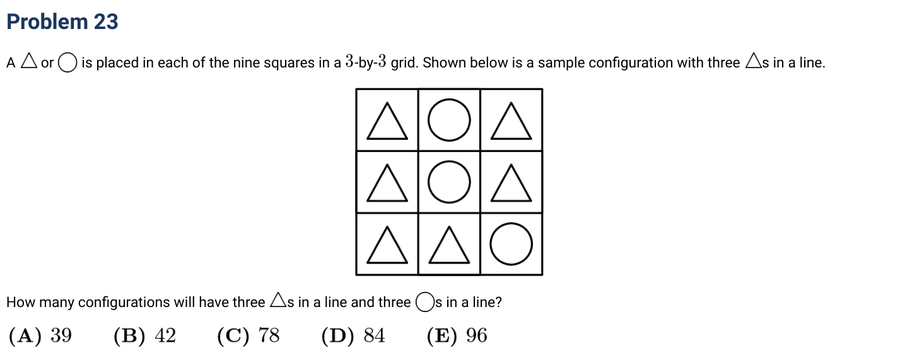
If ▵'s form a horizontal line, the ○'s line must also be horizontal (otherwise a cell would need to be both shapes). Same for vertical. So count vertical-line configurations and double.
Show hint (sharpest)
Casework on number of vertical lines: 3 (one for each column) or exactly 2.
Show solution
A ▵ line and a ○ line can't be perpendicular (a cell would be both shapes). So both lines are horizontal, OR both are vertical. Count vertical, then multiply by 2.
Vertical: case 3 lines — each of the 3 columns is monochromatic. 2³ = 8 colorings, minus the 2 all-same colorings (only one shape gets a line) → 6.
Vertical: case 2 lines — one ▵ column, one ○ column, one mixed. 3 ways to pick the ▵ column × 2 remaining for ○ × 6 mixed configurations for the leftover column (2³ minus the two all-same = 6) = 36.
Vertical total: 6 + 36 = 42. By symmetry, horizontal also = 42. Total: 42 + 42 = 84.
A cricket randomly hops between 4 leaves, on each turn hopping to one of the other 3 leaves with equal probability. After 4 hops, what is the probability that the cricket has returned to the leaf where it started?
Show hint (soft nudge)
Track only one number: pn = probability the cricket is on the starting leaf after n hops.
Show hint (sharpest)
From start, the cricket must leave (contributes 0 to pn+1). From any other leaf, prob 1/3 of returning. So pn+1 = (1 − pn)/3.
Show solution
Let pn = P(on starting leaf after n hops). From the start, the cricket can't stay; from any non-start, it returns with probability 1/3.