Where does each folded layer sit on the original sheet? That tells you how many spots the cut actually hits.
Show hint (sharpest)
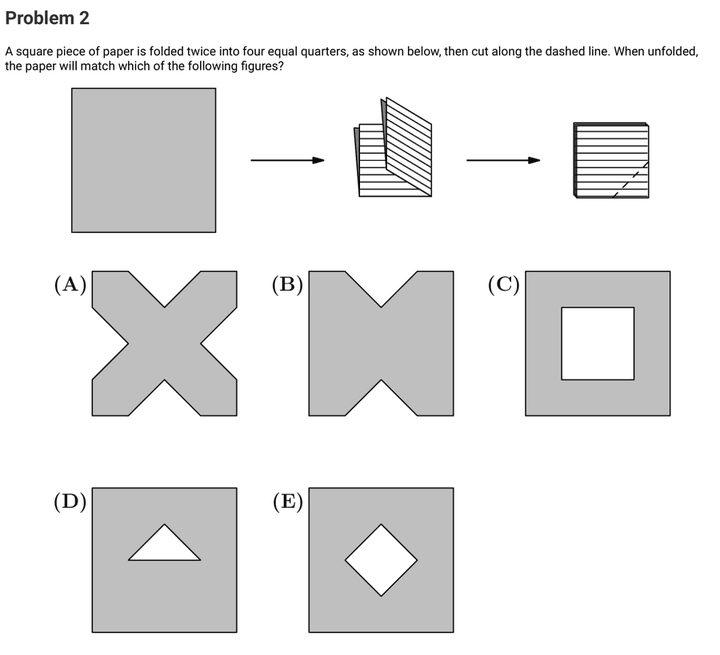
Folding twice into quarters stacks four layers at one corner — and that corner is the center of the original sheet. Whatever the cut removes there happens four times, around the middle.
Show solution
Folding the square twice into quarters brings all four corners together; the folded corner is the center of the full sheet.
The diagonal cut slices across that folded stack, snipping a small triangle from all four layers at once.
Unfolding, those four snips open up into a single diamond-shaped hole in the middle of the paper — figure (E).
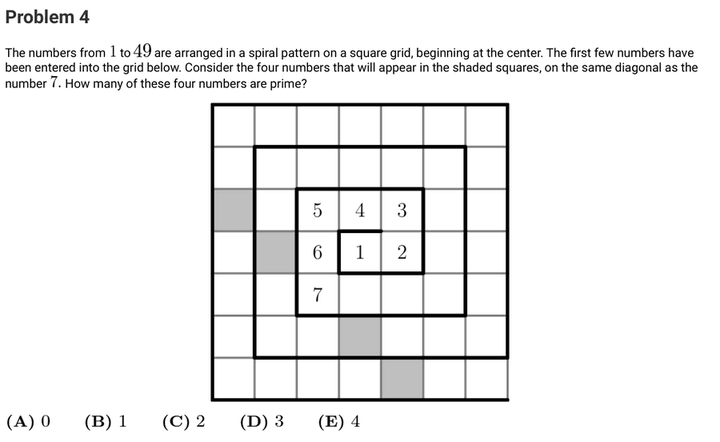
Forget the spiral pattern — what matters is which numbers end up on those four squares.
Show hint (sharpest)
Find the four shaded numbers first (they sit on the diagonal through 7), then test each one for being prime.
Show solution
Continuing the spiral outward, the diagonal through 7 (going up-left and down-right) contains the four shaded numbers 19, 23, 39, 47.
Test each: 19 prime, 23 prime, 47 prime; but 39 = 3 × 13 is composite.
So 3 of the four shaded numbers are prime.
D
Three of them are prime.
Another way: use perfect squares as landmarks (MAA)
Without filling the whole grid: on an n×n spiral the number n2 sits in the upper-left (n even) or lower-right (n odd) corner. So 9 is at lower-right of the 3×3 block, 25 at lower-right of 5×5, 49 at lower-right of 7×7; 16 at upper-left of 4×4, 36 at upper-left of 6×6.
Walking outward from those anchors locates the four shaded squares as 19, 23, 39, 47 — with 39 = 3 × 13 the only composite.
A lake contains 250 trout, along with a variety of other fish. When a marine biologist catches and releases a sample of 180 fish from the lake, 30 are identified as trout. Assume the ratio of trout to the total number of fish is the same in both the sample and the lake. How many fish are there in the lake?
Show hint (soft nudge)
The fraction of trout should be the same in the sample as in the whole lake.
Show hint (sharpest)
The fraction of the sample that is trout should equal the fraction of the whole lake that is trout. Set the two fractions equal.
Show solution
In the sample, 30 of 180 are trout: 30 ÷ 180 = 16.
So trout make up 16 of the whole lake too.
If 250 trout are 16 of the fish, the total is 250 × 6 = 1500.
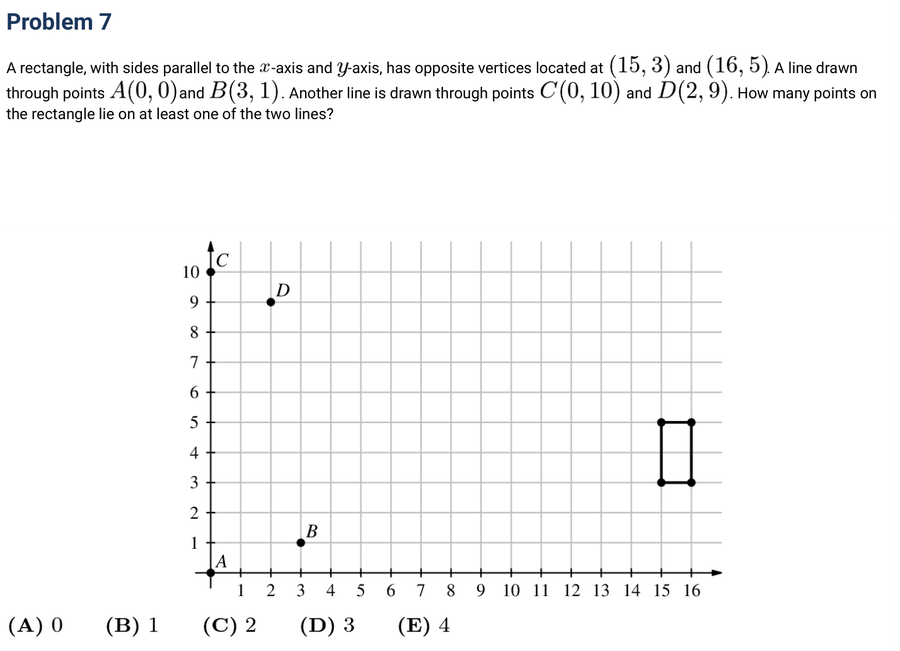
Each line has a simple equation. Plug in x = 15 and x = 16 (the rectangle's left and right sides) and see whether the resulting y falls between 3 and 5.
Show hint (sharpest)
Line AB: y = x/3. Line CD: y = 10 − x/2. Test each at x = 15 and 16.
Show solution
Rectangle: x ∈ [15, 16], y ∈ [3, 5].
Line AB: y = x/3. At x = 15: y = 5 ✓ (hits the corner (15, 5)). At x = 16: y ≈ 5.33, above the rectangle.
Line CD: y = 10 − x/2. At x = 15: y = 2.5, below. At x = 16: y = 2, below.
Harold made a plum pie to take on a picnic. He was able to eat only 14 of the pie, and he left the rest for his friends. A moose came by and ate 13 of what Harold left behind. After that, a porcupine ate 13 of what the moose left behind. How much of the original pie still remained after the porcupine left?
Show hint (soft nudge)
Each eater leaves behind a fraction of what they found. Multiply those leftovers together.
NASA's Perseverance Rover was launched on July 30, 2020. After traveling 292,526,838 miles, it landed on Mars in Jezero Crater about 6.5 months later. Which of the following is closest to the Rover's average interplanetary speed in miles per hour?
Show hint (soft nudge)
The choices span orders of magnitude, so round generously. Distance ≈ 3 × 10⁸ miles.
Show hint (sharpest)
6.5 months ≈ 200 days ≈ 5000 hours. Then speed ≈ distance ÷ time.
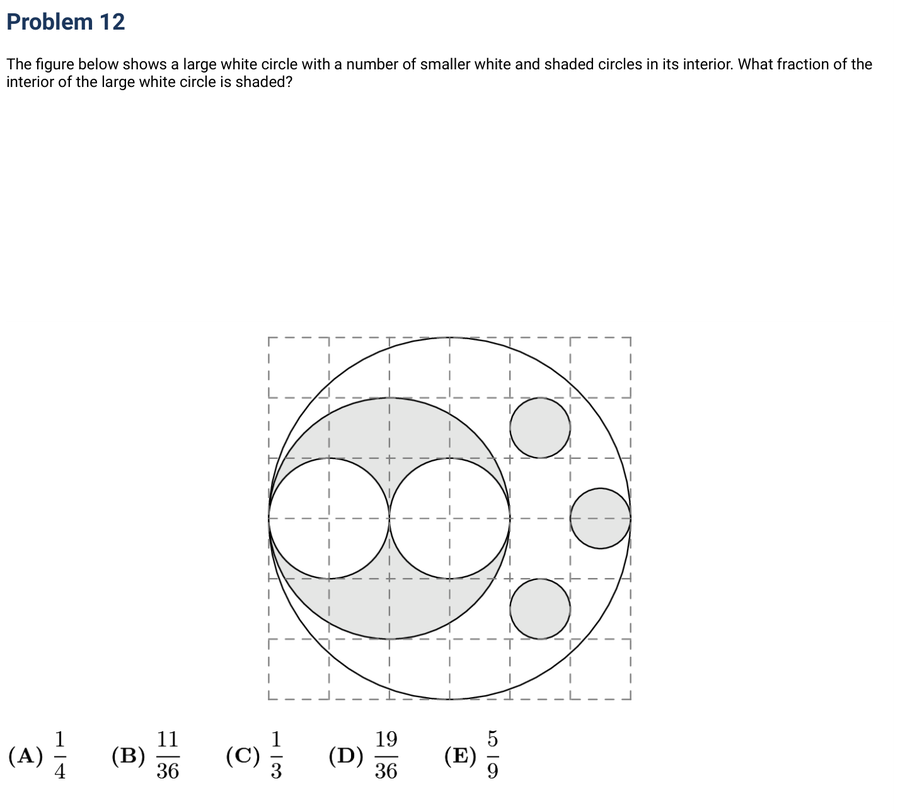
Sum the shaded areas, subtract the white circles that sit inside the big shaded disk, divide by the area of the outer circle.
Show hint (sharpest)
Outer circle area = 9π. Three small shaded circles (radius 1/2): total 3π/4. Big shaded disk (radius 2) minus 2 inner whites (radius 1 each): 4π − 2π = 2π.
Show solution
Outer white circle area: π · 32 = 9π.
Three small shaded circles (radius 12): each has area π4; together 3π4.
Big shaded disk (radius 2): area 4π, minus two white inner circles (radius 1 each, total 2π): net 2π.
Number Theorycomplementary-countingcareful-counting
Nicolas is planning to send a package to his friend Anton, who is a stamp collector. To pay for the postage, Nicolas would like to cover the package with a large number of stamps. Suppose he has a collection of 5-cent, 10-cent, and 25-cent stamps, with exactly 20 of each type. What is the greatest number of stamps Nicolas can use to make exactly $7.10 in postage?
Show hint (soft nudge)
Maximizing stamps used = minimizing stamps removed from his whole collection. What does the whole collection total?
Show hint (sharpest)
Total of all 60 stamps = $8. He needs to remove $0.90. Minimize the number of stamps that sum to $0.90.
Show solution
Total value of all 60 stamps: 20·($0.05 + $0.10 + $0.25) = 20 · $0.40 = $8.00.
He needs to make $7.10, so he removes $8.00 − $7.10 = $0.90 worth. Maximizing stamps used ≡ minimizing stamps removed.
Minimum stamps summing to $0.90: three 25¢ (75¢) + one 10¢ + one 5¢ = $0.90 in 5 stamps.
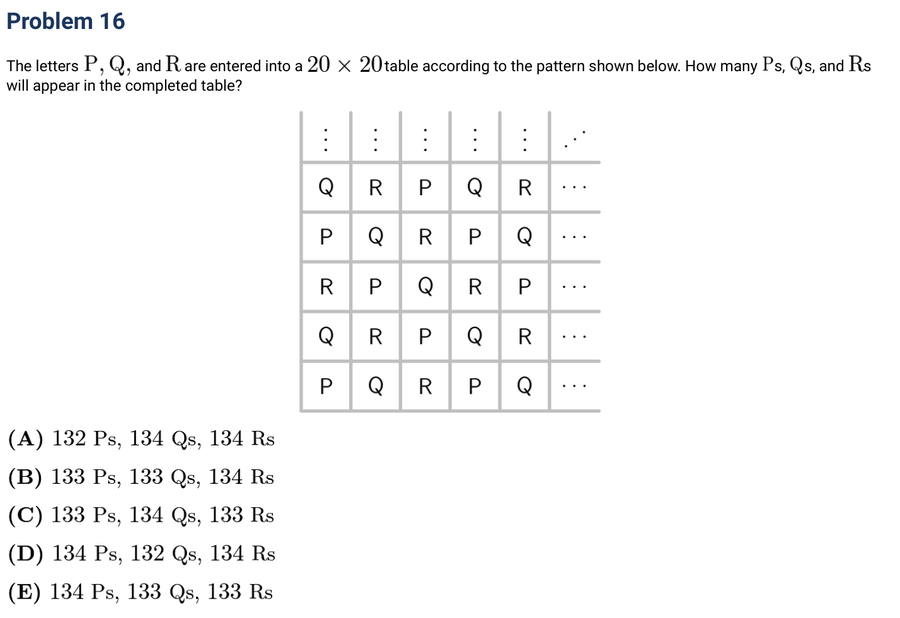
20 × 20 = 400 cells, with the letters cycling P, Q, R. How does 400 split among three letters?
Show hint (sharpest)
400 = 3 × 133 + 1, so one letter gets the extra 1. By the table's diagonals, P-count = R-count — so Q takes the extra.
Show solution
The board has 20 × 20 = 400 cells, and the P/Q/R pattern repeats every 3 cells diagonally. 400 = 3 × 133 + 1, so the counts are 133, 133, 134 in some order.
Look at the lower-left 2 × 2 corner of the pattern: Q R / P Q — one P, two Qs, one R. By the rest of the board's symmetry (P and R balance), the corner's extra Q is the surplus.
Greta Grasshopper sits on a long line of lily pads in a pond. From any lily pad, Greta can jump 5 pads to the right or 3 pads to the left. What is the fewest number of jumps Greta must make to reach the lily pad located 2023 pads to the right of her starting position?
Show hint (soft nudge)
Order doesn't matter — only the counts of right and left jumps. Set up an equation in R and L.
Show hint (sharpest)
5R − 3L = 2023. Need R ≥ 405 and 5R − 2023 divisible by 3.
Show solution
Order doesn't matter. Let R = right jumps, L = left jumps. Then 5R − 3L = 2023, with R, L ≥ 0.
Minimum R: R ≥ 405 (else 5R < 2023, leaving negative L). And 5R − 2023 must be divisible by 3.
Mod 3: 5R ≡ 2R, and 2023 ≡ 1, so 2R ≡ 1 ⇒ R ≡ 2 (mod 3). The smallest R ≥ 405 satisfying this is 407.
Then L = (5·407 − 2023)/3 = 12/3 = 4. Total: 407 + 4 = 411 jumps.
Two integers are inserted into the list 3, 3, 8, 11, 28 to double its range. The mode and median remain unchanged. What is the maximum possible sum of two additional numbers?
Show hint (soft nudge)
Original range = 28 − 3 = 25. New range = 50. To maximize the sum, push the new max as high as possible.
Show hint (sharpest)
Keep min = 3 ⇒ new max = 3 + 50 = 53. That's one insert. Now find the largest second insert that keeps median = 8 and mode = 3.
Show solution
Range doubles from 25 to 50. To maximize the sum, leave the min at 3 and stretch the max: one insert = 3 + 50 = 53.
With 7 numbers, the median is the 4th. Sorted so far: 3, 3, 8, 11, 28, 53 (6 values). The 2nd insert x must keep median = 8.
If x > 8, the 4th value shifts off 8 (and choosing x = 8 ties the mode with two 8's). So x ≤ 7.
Maximum x = 7 (mode stays uniquely 3). Sum = 53 + 7 = 60.
Alina writes the numbers 1, 2, …, 9 on separate cards, one number per card. She wishes to divide the cards into 3 groups of 3 cards so that the sum of the numbers in each group will be the same. In how many ways can this be done?
Show hint (soft nudge)
What must each group sum to? And what constraint does that put on where the biggest (and smallest) numbers go?
Show hint (sharpest)
Each group sums to 15. 7, 8, 9 must be in different groups (and so must 1, 2, 3). Then case-split on which group holds 5.
Show solution
1+2+…+9 = 45, so each group sums to 15.
7, 8, 9 must each go in a different group (else one group is already ≥ 15 with too much room left). Similarly 1, 2, 3 must go in different groups.
Consider the group containing 5. Its other two values sum to 10. Possibilities: {3, 5, 7}, {2, 5, 8}, or {1, 5, 9}. The {2, 5, 8} option fails (no way to finish), leaving 2 valid partitions: {1,5,9}/{3,4,8}/{2,6,7} and {3,5,7}/{1,6,8}/{2,4,9}.
In a sequence of positive integers, each term after the second is the product of the previous two terms. The sixth term in the sequence is 4000. What is the first term?
Show hint (soft nudge)
Write the first six terms as a, b, and powers of a and b. The 6th term will be a3b5.
Show hint (sharpest)
Factor 4000: 4000 = 53 × 25. Match exponents.
Show solution
Let the first two terms be a, b. Then the next four are ab, ab2, a2b3, a3b5. (Each term sums the exponents of the previous two.)
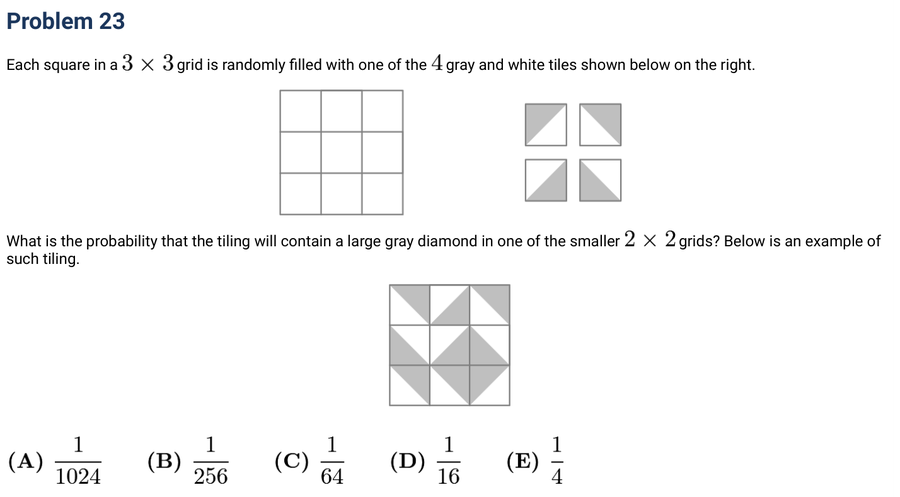
Where could the gray diamond go? Its center must be at one of the four corners of the middle cell.
Show hint (sharpest)
For a chosen diamond location, the 4 surrounding tiles are forced (1 valid orientation each); the remaining 5 tiles are free (4 choices each).
Show solution
Total tilings: 49 (each of 9 cells gets 1 of 4 tiles).
Favorable: choose 1 of 4 possible diamond positions (corners of the center cell), forcing 4 specific tile orientations. The remaining 5 tiles are free: 45 options. Total: 4 × 45 = 46.
Probability = 4649 = 143 = 164.
C
1/64.
Another way: probability the 3 neighbors of the center orient correctly (MAA)
If the diamond exists, the center cell has one all-gray corner; the 3 tiles adjacent to that corner must orient to extend the gray.
Each of those 3 tiles has probability 1/4 of the right orientation. So total probability = (1/4)3 = 1/64.