AMC 8

2024 AMC 8

25 problems — read each, give it a real try, then peek at the hints.

Practice: Take as test →
Problem 1 · 2024 AMC 8 Easy
Number Theory last-digit mod-10

What is the ones digit of

222,222 − 22,222 − 2,222 − 222 − 22 − 2 ?
Show hint (soft nudge)
You don't need to do the whole subtraction. What part of the answer is the question actually asking about?
Show hint (sharpest)
Only the ones digits matter — and every number ends in 2. So skip the big subtraction entirely.
Show solution
  1. Only the ones digit matters. The five numbers being subtracted all end in 2, so their ones digits sum to 5 × 2 = 10 — together they take away something ending in 0.
  2. Subtracting a multiple of 10 from 222,222 doesn't touch its ones digit: it stays 2.
B The ones digit is 2.
Another way: keep the intermediate positive (MAA)
  1. Look only at the last two digits so the running total never goes negative: 22 − 2 − 2 − 2 − 2 − 2.
  2. = 22 − 10 = 12. Ones digit: 2.
Mark: · log in to save
Problem 2 · 2024 AMC 8 Easy
Fractions, Decimals & Percents fraction-to-decimal

What is the value of this expression in decimal form?

4411 + 11044 + 441100
Show hint
Turn each fraction into a decimal by itself, then add. Two of them are very friendly.
Show solution
  1. 4411 = 4.
  2. 11044 = 2.5.
  3. 441100 = 0.04.
  4. Add: 4 + 2.5 + 0.04 = 6.54.
C 6.54.
Mark: · log in to save
Problem 3 · 2024 AMC 8 Medium
Geometry & Measurement area-decomposition difference-of-squares

Four squares of side lengths 4, 7, 9, and 10 units are arranged in increasing size order so that their left edges and bottom edges align. The squares alternate in the color pattern white-gray-white-gray, respectively, as shown in the figure. What is the area of the visible gray region, in square units?

91074
Sides 4, 7, 9, 10 share a bottom-left corner; smaller squares lie on top.
Show hint (soft nudge)
Each gray square is only partly visible. What shape is the gray you can actually see?
Show hint (sharpest)
Each smaller square sits on top, so every gray square shows just a frame: its area minus the square covering it. And a2 − b2 = (a+b)(a−b) makes that instant.
Show solution
  1. Smaller squares sit on top, so each gray square shows a frame = (its area) − (the square on top of it).
  2. Gray 10 under white 9: 102 − 92 = (10+9)(10−9) = 19.
  3. Gray 7 under white 4: 72 − 42 = (7+4)(7−4) = 33.
  4. Add the two frames: 19 + 33 = 52.
E 52 square units.
Another way: alternating add and subtract (MAA)
  1. The visible gray is the 10-square minus the 9-square plus the 7-square minus the 4-square: 100 − 81 + 49 − 16.
  2. = 52.
Mark: · log in to save
Problem 4 · 2024 AMC 8 Medium
Number Theory digit-sum perfect-square work-backward

When Yunji added all the integers from 1 to 9, she mistakenly left out a number. Her incorrect sum turned out to be a square number. What number did Yunji leave out?

Show hint (soft nudge)
Start from the correct total 1+2+…+9. Taking one number out lands you near a special number — which one?
Show hint (sharpest)
Find the correct total of 1 through 9. Leaving out x makes the sum 45 − x. Which x makes that a perfect square?
Show solution
  1. 1 + 2 + 3 + … + 9 = 45.
  2. Leaving out x (from 1 to 9) gives 45 − x, which is between 36 and 44.
  3. The only perfect square in that range is 36 = 62.
  4. 45 − x = 36, so x = 9.
E She left out 9.
Mark: · log in to save
Problem 5 · 2024 AMC 8 Stretch
Number Theory divisibility factor-pairs casework

Aaliyah rolls two standard 6-sided dice. She notices that the product of the two numbers rolled is a multiple of 6. Which of the following integers cannot be the sum of the two numbers?

Show hint (soft nudge)
The product is a multiple of 6 only when the two dice meet a special condition. Test each answer choice against it.
Show hint (sharpest)
A product is a multiple of 6 only if the pair contains a 3 or 6 (factor of 3) and an even number (factor of 2). Just test the answer choices against that.
Show solution
  1. The pair must include a multiple of 3 (a 3 or a 6) and an even number.
  2. Sum 6 comes only from (1,5), (2,4), (3,3) — products 5, 8, 9, none a multiple of 6. So 6 is impossible.
  3. Every other choice has a good pair: 5 = (2,3)→6, 7 = (1,6)→6, 8 = (2,6)→12, 9 = (3,6)→18.
B The sum cannot be 6.
Another way: list every valid pair (MAA)
  1. Pairs whose product is a multiple of 6 (need a multiple of 3 and an even number): (1,6), (2,3), (2,6), (3,6), (4,6), (5,6), (6,6).
  2. Their sums: 7, 5, 8, 9, 10, 11, 12. Among A–E, only 6 is missing.
Mark: · log in to save
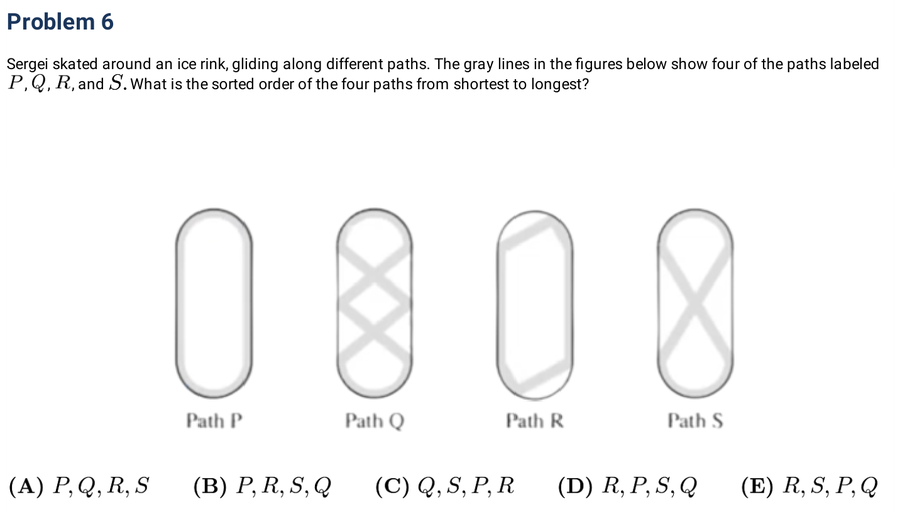
Problem 6 · 2024 AMC 8 Medium
Geometry & Measurement spatial-reasoning perimeter
amc8-2024-06
Show hint (soft nudge)
Use the plain oval P as a baseline. Which paths cut corners (shorter) and which add diagonals (longer)?
Show hint (sharpest)
R uses straight shortcuts across the rounded ends — shorter than P. S and Q swap edges for diagonals; a diagonal is a hypotenuse, always longer than the legs it replaces.
Show solution
  1. R cuts the rounded ends with straight chords, so R is strictly shorter than P. Shortest.
  2. S adds one diagonal X inside the oval — the diagonal is a hypotenuse, longer than the legs P would take. So S > P.
  3. Q adds two diagonals, longer still: Q > S.
  4. Order: R, P, S, Q — choice D.
D R, P, S, Q.
Mark: · log in to save
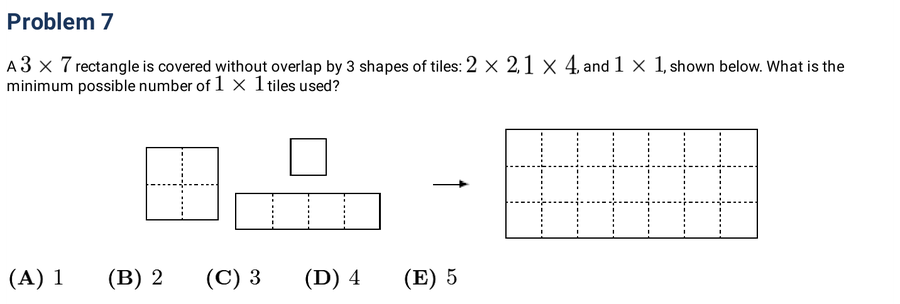
Problem 7 · 2024 AMC 8 Medium
Geometry & Measurement spatial-reasoning casework divisibility
amc8-2024-07
Show hint (soft nudge)
The 2×2 and 1×4 tiles each cover 4 squares. What does that tell you about the number of 1×1 tiles needed?
Show hint (sharpest)
21 squares total, and the 2×2 + 1×4 tiles fill a multiple of 4. So the 1×1 count is 1, 5, 9, … Try the smallest that actually fits.
Show solution
  1. Each 2×2 and 1×4 tile covers 4 unit squares, so together they fill a multiple of 4. The 1×1 count must equal 21 − (multiple of 4) ≡ 1 (mod 4): possible values 1, 5, 9, …
  2. Can we cover 20 of the 21 squares with 2×2 and 1×4 tiles, leaving just one 1×1? Trying shows it doesn't fit (a 3×7 rectangle with one cell removed can't be partitioned into 2×2's and 1×4's).
  3. 5 works: place four 2×2 and 1×4 tiles covering 16 squares, with the 5 remaining cells filled by 1×1's. Minimum = 5.
E 5 unit tiles.
Mark: · log in to save
Problem 8 · 2024 AMC 8 Medium
Counting & Probability careful-counting casework

On Monday Taye has $2. Every day, he either gains $3 or doubles the amount of money he had on the previous day. How many different dollar amounts could Taye have on Thursday, 3 days later?

Show hint (soft nudge)
Build a tree: from each daily amount, branch on +$3 or ×2. Some branches collide — just list the unique values.
Show hint (sharpest)
Tuesday: {$4, $5}. Wednesday: {$7, $8, $10} (the $8 from two paths). Thursday will land on 6 distinct values.
Show solution
  1. From $2 each day choose +$3 or ×2. Tuesday: 2+3=5 or 2×2=4 → {$4, $5}.
  2. Wednesday from {$4, $5}: 4+3=7, 4×2=8, 5+3=8, 5×2=10 → {$7, $8, $10}.
  3. Thursday from {$7, $8, $10}: 10, 14, 11, 16, 13, 20 → {$10, $11, $13, $14, $16, $20}.
  4. 6 distinct amounts.
D 6 different amounts.
Mark: · log in to save
Problem 9 · 2024 AMC 8 Medium
Number Theory divisibility substitution

All of the marbles in Maria's collection are red, green, or blue. Maria has half as many red marbles as green marbles and twice as many blue marbles as green marbles. Which of the following could be the total number of marbles in Maria's collection?

Show hint (soft nudge)
Pick one color to stand for a variable, then write the others in terms of it. The total reveals a hidden factor.
Show hint (sharpest)
Let r = red count. Green = 2r, blue = 4r. Total = 7r — it must be a multiple of 7.
Show solution
  1. Let r be the number of red marbles. Half as many red as green → green = 2r. Twice as many blue as green → blue = 4r.
  2. Total = r + 2r + 4r = 7r — always a multiple of 7.
  3. Among the choices, only 28 = 7 × 4 is a multiple of 7.
E 28 marbles.
Mark: · log in to save
Problem 10 · 2024 AMC 8 Easy
Arithmetic & Operations unit-rate

In January 1980 the Mauna Loa Observatory recorded carbon dioxide CO2 levels of 338 ppm (parts per million). Over the years the average CO2 reading has increased by about 1.515 ppm each year. What is the expected CO2 level in ppm in January 2030? Round your answer to the nearest integer.

Show hint
Multiply the per-year rate by the number of years, then add to the starting value.
Show solution
  1. Years elapsed: 2030 − 1980 = 50.
  2. Total increase: 50 × 1.515 = 75.75 ≈ 76 ppm.
  3. New level: 338 + 76 = 414.
B 414 ppm.
Mark: · log in to save
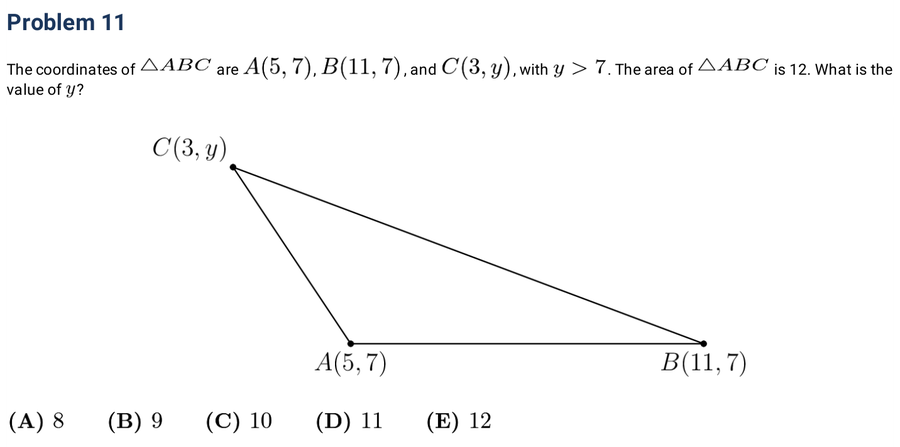
Problem 11 · 2024 AMC 8 Medium
Geometry & Measurement area
amc8-2024-11
Show hint (soft nudge)
Pick the side that's easiest — AB is horizontal. Use that as the base.
Show hint (sharpest)
Base AB has length 6 and lies on y = 7. The height is just (y − 7) since C is above that line.
Show solution
  1. AB lies on the line y = 7 with length 11 − 5 = 6.
  2. Height from C to line y = 7 is y − 7. Area = 12 · 6 · (y − 7) = 12.
  3. So y − 7 = 4 ⇒ y = 11.
D y = 11.
Mark: · log in to save
Problem 12 · 2024 AMC 8 Medium
Algebra & Patterns substitution sum-constraint

Rohan keeps a total of 90 guppies in 4 fish tanks.

  • There is 1 more guppy in the 2nd tank than in the 1st tank.
  • There are 2 more guppies in the 3rd tank than in the 2nd tank.
  • There are 3 more guppies in the 4th tank than in the 3rd tank.

How many guppies are in the 4th tank?

Show hint (soft nudge)
Stack the increments from tank 1: tank 2 = tank 1 + 1, tank 3 = tank 1 + 3, tank 4 = tank 1 + 6.
Show hint (sharpest)
Add all four expressions: 4·(tank 1) + 10 = 90, so tank 1 = 20.
Show solution
  1. Let tank 1 = x. Then tank 2 = x + 1, tank 3 = x + 3, tank 4 = x + 6.
  2. Sum: 4x + 10 = 90, so x = 20.
  3. Tank 4 = 20 + 6 = 26.
E 26 guppies.
Mark: · log in to save
Problem 13 · 2024 AMC 8 Medium
Counting & Probability careful-counting casework

Buzz Bunny is hopping up and down a set of stairs, one step at a time. In how many ways can Buzz start on the ground, make a sequence of 6 hops, and end up back on the ground? (For example, one sequence of hops is up-up-down-down-up-down.)

Show hint (soft nudge)
Each sequence needs 3 ups and 3 downs. But Buzz can never go below the ground — the running count of downs can never exceed ups.
Show hint (sharpest)
Start with U, end with D. Enumerate carefully without breaking the rule.
Show solution
  1. The sequence has 3 U's and 3 D's, with D's never exceeding U's at any point (otherwise Buzz goes below the ground).
  2. All valid sequences: UUUDDD, UUDUDD, UUDDUD, UDUUDD, UDUDUD.
  3. 5 sequences in total.
B 5 sequences.
Mark: · log in to save
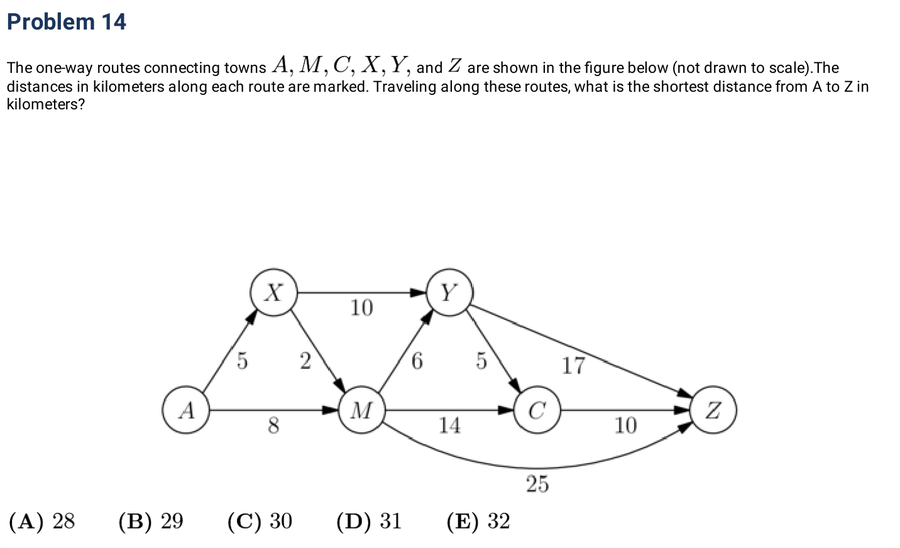
Problem 14 · 2024 AMC 8 Hard
Logic & Word Problems work-backward casework
amc8-2024-14
Show hint (soft nudge)
Build up the shortest distance to each town in turn, always coming from the cheapest predecessor seen so far.
Show hint (sharpest)
Go A → X → M → Y → C → Z, each time choosing the cheapest way in.
Show solution
  1. Shortest A→X = 5 (direct).
  2. Shortest A→M = min(8 direct, 5 + 2 via X) = 7.
  3. Shortest A→Y = min(5 + 10 via X, 7 + 6 via M) = 13.
  4. Shortest A→C = min(7 + 14 via M, 13 + 5 via Y) = 18.
  5. Shortest A→Z = min(7 + 25 via M, 13 + 17 via Y, 18 + 10 via C) = 28.
A 28 km.
Mark: · log in to save
Problem 15 · 2024 AMC 8 Hard
Number Theory factorization casework work-backward

Let the letters F, L, Y, B, U, G represent distinct digits. Suppose FLYFLY is the greatest number that satisfies the equation

8 · FLYFLY = BUGBUG.

What is the value of FLY + BUG?

Show hint (soft nudge)
A six-digit number that repeats a three-digit block (like ABCABC) has a hidden common factor.
Show hint (sharpest)
FLYFLY = 1001 · FLY and BUGBUG = 1001 · BUG, so the equation just says 8 · FLY = BUG.
Show solution
  1. FLYFLY = 1001 · FLY and BUGBUG = 1001 · BUG, so the equation reduces to 8 · FLY = BUG.
  2. BUG is a 3-digit number, so 8 · FLY < 1000 → FLY ≤ 124. So F = 1, and L ≤ 2 (else 8 · FLY ≥ 1040).
  3. Maximize: L = 2 (can't be 1, F took it). Then 8 · 12Y needs all 6 digits distinct. Y = 4: 8 · 124 = 992 (two 9s, fails). Y = 3: 8 · 123 = 984 — digits {1, 2, 3, 9, 8, 4} all distinct ✓.
  4. FLY + BUG = 123 + 984 = 1107.
C 1107.
Mark: · log in to save
Problem 16 · 2024 AMC 8 Hard
Counting & Probability careful-counting divisibility

Minh enters the numbers 1 through 81 into the cells of a 9 × 9 grid in some order. She calculates the product of the numbers in each row and column. What is the least number of rows and columns that could have a product divisible by 3?

Show hint (soft nudge)
Any row or column with even one multiple of 3 has a divisible-by-3 product. So you want the multiples of 3 packed into as few rows and columns as possible.
Show hint (sharpest)
Count of multiples of 3 in 1–81: 27. A 5×5 corner block fits 25; the other 2 spill into a 6th column.
Show solution
  1. There are 27 multiples of 3 in 1–81. Any row or column containing a multiple of 3 gets a product divisible by 3, so we want the multiples confined to as few rows and columns as possible.
  2. A 5×5 corner block holds only 25 multiples. The remaining 2 must spill out — place them in the 6th column of rows 1 and 2.
  3. Rows touched: 5 (rows 1–5). Columns touched: 6 (columns 1–6). Total: 5 + 6 = 11.
D 11 rows and columns.
Mark: · log in to save
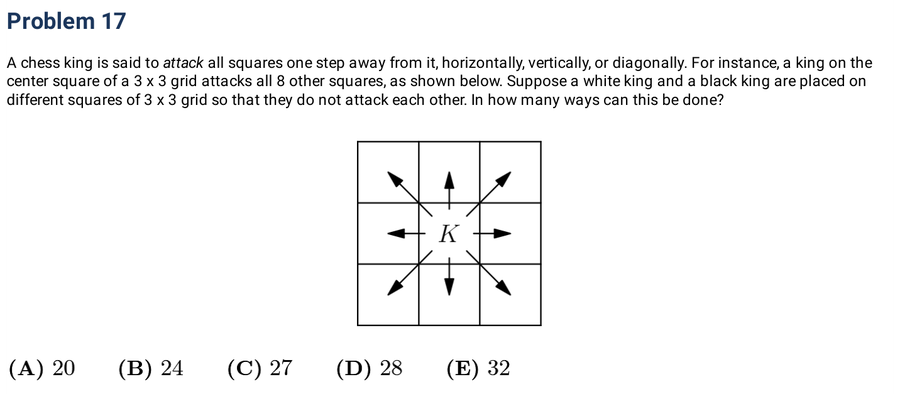
Problem 17 · 2024 AMC 8 Hard
Counting & Probability casework careful-counting
amc8-2024-17
Show hint (soft nudge)
A king on the center attacks every other square — so neither king can be there.
Show hint (sharpest)
Two cases by where the first king sits: corner (3 squares attacked, 5 safe for the other) or edge-middle (5 attacked, 3 safe).
Show solution
  1. Neither king sits on the center (the center attacks all 8 surrounding squares). So both kings are on the 8 border squares.
  2. Corner first king (4 corners): the corner attacks 3 squares, leaving 5 safe for the other king. 4 × 5 = 20.
  3. Edge-middle first king (4 edge midpoints): attacks 5 squares, leaving 3 safe. 4 × 3 = 12.
  4. Total: 20 + 12 = 32.
E 32 ways.
Mark: · log in to save
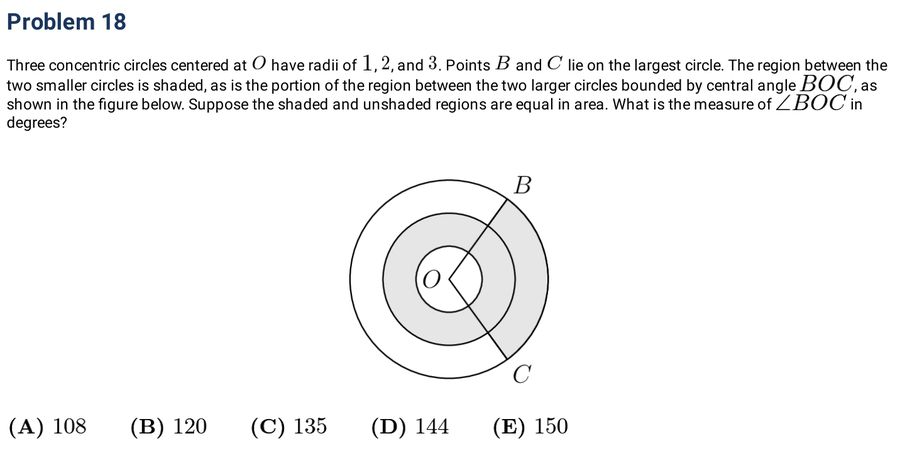
Problem 18 · 2024 AMC 8 Hard
Geometry & Measurement area area-fraction
amc8-2024-18
Show hint (soft nudge)
Break the disk into the inner disk, the middle annulus, and the outer annulus. Which of those are fully shaded, and which is split by the angle?
Show hint (sharpest)
Inner annulus (radii 1 to 2): area 3π, fully shaded. Outer annulus (2 to 3): area 5π, only the θ-sector is shaded. Set shaded = unshaded.
Show solution
  1. Inner annulus area: π(22 − 12) = 3π. Outer annulus area: π(32 − 22) = 5π. Inner disk: π.
  2. Total disk = 9π; shaded = unshaded means each = 2 = 4.5π.
  3. Shaded = 3π + θ360(5π) = 4.5π, so θ360(5π) = 1.5π, giving θ = 108°.
A 108&deg;.
Mark: · log in to save
Problem 19 · 2024 AMC 8 Hard
Fractions, Decimals & Percents percent-multiplier careful-counting

Jordan owns 15 pairs of sneakers. Three fifths of the pairs are red and the rest are white. Two thirds of the pairs are high-top and the rest are low-top. The red high-top sneakers make up a fraction of the collection. What is the least possible value of this fraction?

Show hint (soft nudge)
To minimize the overlap of "red AND high-top", let the OTHER kind (white) soak up as many high-tops as it can.
Show hint (sharpest)
9 red, 6 white. 10 high-top, 5 low-top. Make all 6 whites high-top; only 4 high-top spots remain — those must be red.
Show solution
  1. Counts: 35 × 15 = 9 red, 6 white. 23 × 15 = 10 high-top, 5 low-top.
  2. Minimize red high-tops by letting all 6 white pairs be high-top. That accounts for 6 of the 10 high-top spots.
  3. The remaining 10 − 6 = 4 high-top pairs must be red. Fraction = 415.
C 4/15.
Mark: · log in to save
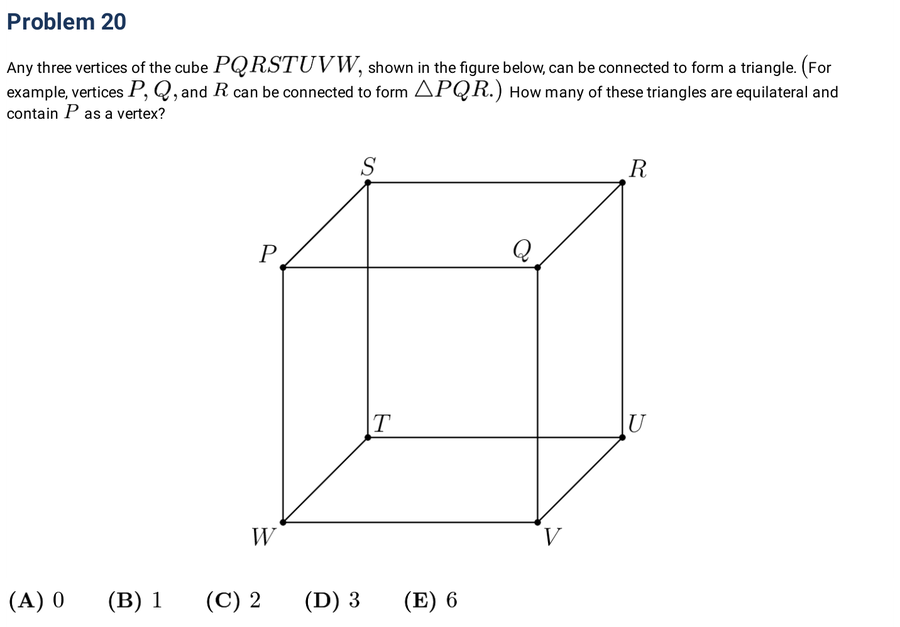
Problem 20 · 2024 AMC 8 Hard
Geometry & Measurement spatial-reasoning careful-counting
amc8-2024-20
Show hint (soft nudge)
An equilateral triangle in a cube can't use edges or space diagonals as sides — only face diagonals work.
Show hint (sharpest)
P has 3 face-diagonal neighbors (one on each of P's three faces). Any 2 of those 3 are also face-diagonal apart, so each pair forms an equilateral triangle with P.
Show solution
  1. Edges have length 1, face diagonals √2, space diagonals √3. An equilateral triangle must use sides of one length, and only face diagonals can form a closed triangle on a cube.
  2. The vertices at face-diagonal distance from P are R, T, V (one on each of P's three faces).
  3. Every pair of {R, T, V} is also a face diagonal (they lie on the three faces opposite to P), so {P, R, T}, {P, R, V}, {P, T, V} are all equilateral.
  4. 3 triangles.
D 3 equilateral triangles.
Mark: · log in to save
Problem 21 · 2024 AMC 8 Hard
Algebra & Patterns ratio proportion substitution

A group of frogs (called an army) is living in a tree. A frog turns green when in the shade and turns yellow when in the sun. Initially, the ratio of green to yellow frogs was 3 : 1. Then 3 green frogs moved to the sunny side and 5 yellow frogs moved to the shady side. Now the ratio is 4 : 1. What is the difference between the number of green frogs and yellow frogs now?

Show hint (soft nudge)
Express both populations in one variable (yellow), then write the new ratio as an equation.
Show hint (sharpest)
After moves: green = 3y + 2, yellow = y − 2. Set (3y+2)/(y−2) = 4.
Show solution
  1. Let y = initial yellow count, so initial green = 3y.
  2. After the moves: green = 3y + 5 − 3 = 3y + 2 (5 in, 3 out). Yellow = y + 3 − 5 = y − 2.
  3. New ratio: 3y + 2y − 2 = 4 ⇒ 3y + 2 = 4y − 8 ⇒ y = 10. So initial green = 30, yellow = 10.
  4. After: green = 32, yellow = 8. Difference = 32 − 8 = 24.
E 24 frogs.
Mark: · log in to save
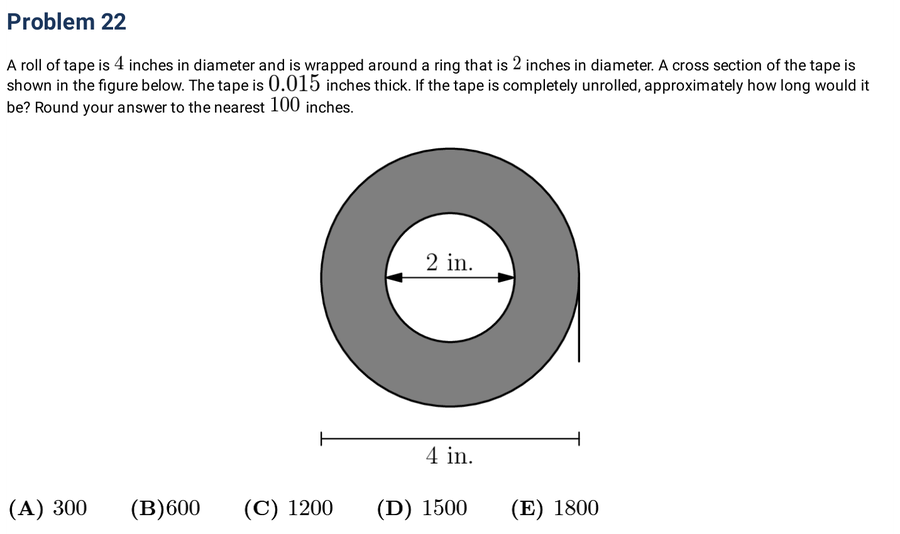
Problem 22 · 2024 AMC 8 Hard
Geometry & Measurement area area-decomposition
amc8-2024-22
Show hint (soft nudge)
Forget the spiral. Unrolled, the tape is a long thin rectangle of area = (length) × (thickness). What is the total area of the tape?
Show hint (sharpest)
Area of the ring cross-section equals the area of the unrolled rectangle. Ring area = π(22 − 12) = 3π.
Show solution
  1. Unrolled, the tape is a long strip of length L and thickness 0.015 in: area = 0.015L.
  2. Rolled up, the same area is the annular ring between outer radius 2 (diameter 4) and inner radius 1 (diameter 2): π(22 − 12) = 3π.
  3. L = 0.015 = 200π ≈ 628 inches, which rounds to 600.
B About 600 inches.
Mark: · log in to save
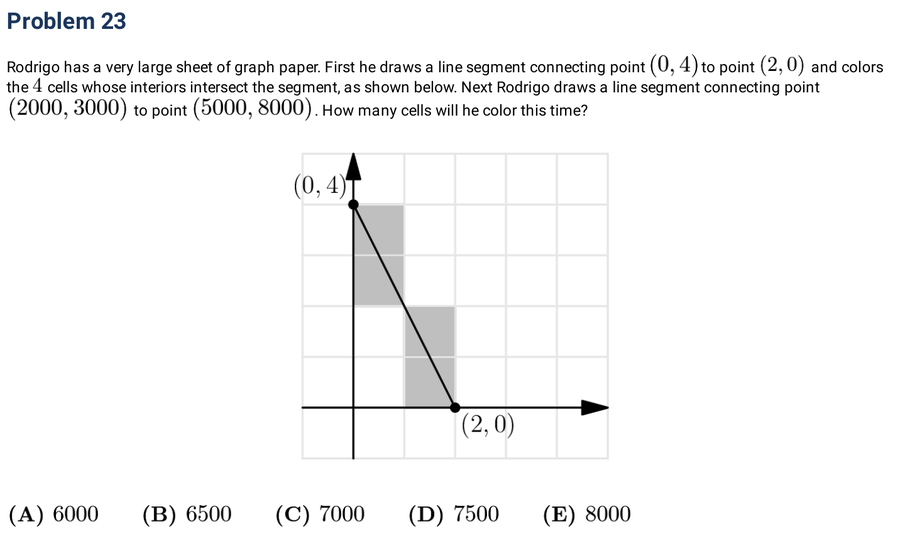
Problem 23 · 2024 AMC 8 Hard
Number Theory factorization grid grid-counting
amc8-2024-23
Show hint (soft nudge)
The example (0,4) to (2,0) crosses 4 cells. Notice: 2 + 4 − gcd(2,4) = 4. That's a general formula.
Show hint (sharpest)
Apply the formula to (3000, 5000) horizontal/vertical offsets: 3000 + 5000 − gcd(3000, 5000).
Show solution
  1. A line segment whose horizontal offset is a and vertical offset is b crosses a + b − gcd(a, b) grid cells. (You'd cross a + b cells if the line never hit a grid corner; each lattice-point crossing collapses two cell-entries into one, saving 1 per shared factor.)
  2. From (2000, 3000) to (5000, 8000): horizontal offset 3000, vertical offset 5000.
  3. gcd(3000, 5000) = 1000. Cells = 3000 + 5000 − 1000 = 7000.
C 7000 cells.
Another way: scale down (MAA)
  1. The slope from (2000, 3000) to (5000, 8000) is 5/3. The segment is equivalent to 1000 copies of a primitive (0,0)→(3,5) piece, since gcd(3000, 5000) = 1000.
  2. Each primitive (3,5) segment crosses 7 cells. Total: 7 × 1000 = 7000.
Mark: · log in to save
Problem 24 · 2024 AMC 8 Hard
Geometry & Measurement area area-decomposition
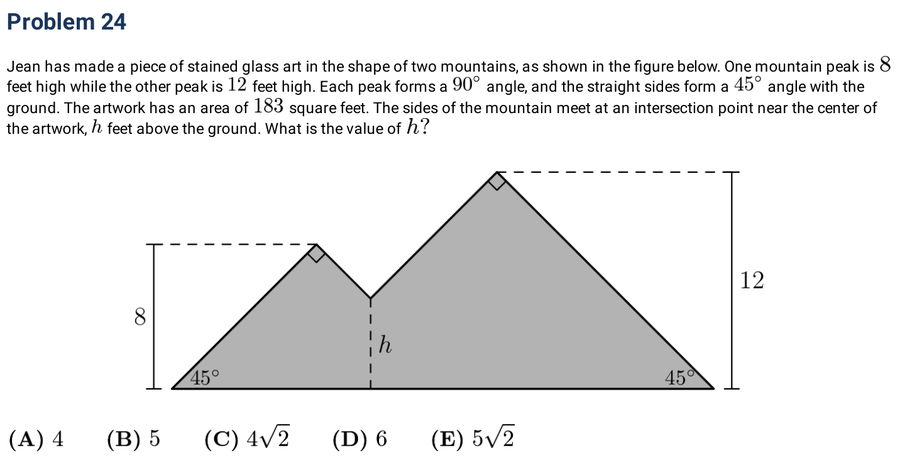
amc8-2024-24
Show hint (soft nudge)
Extend each mountain to a full right-isoceles triangle (peak 90°, base angles 45°). They overlap in a small triangle of the same shape, height h.
Show hint (sharpest)
A 45-45-90 triangle with vertical leg H has area H2. Use inclusion–exclusion on the two mountain triangles.
Show solution
  1. Each mountain is a right-isoceles triangle (the 90° peak with two 45° base angles). For peak height H, the area is H2.
  2. Areas: 82 = 64 and 122 = 144. The dip between them is the double-counted overlap — a third 45-45-90 triangle of height h, area h2.
  3. Inclusion–exclusion: 64 + 144 − h2 = 183, so h2 = 25, h = 5.
B h = 5.
Mark: · log in to save
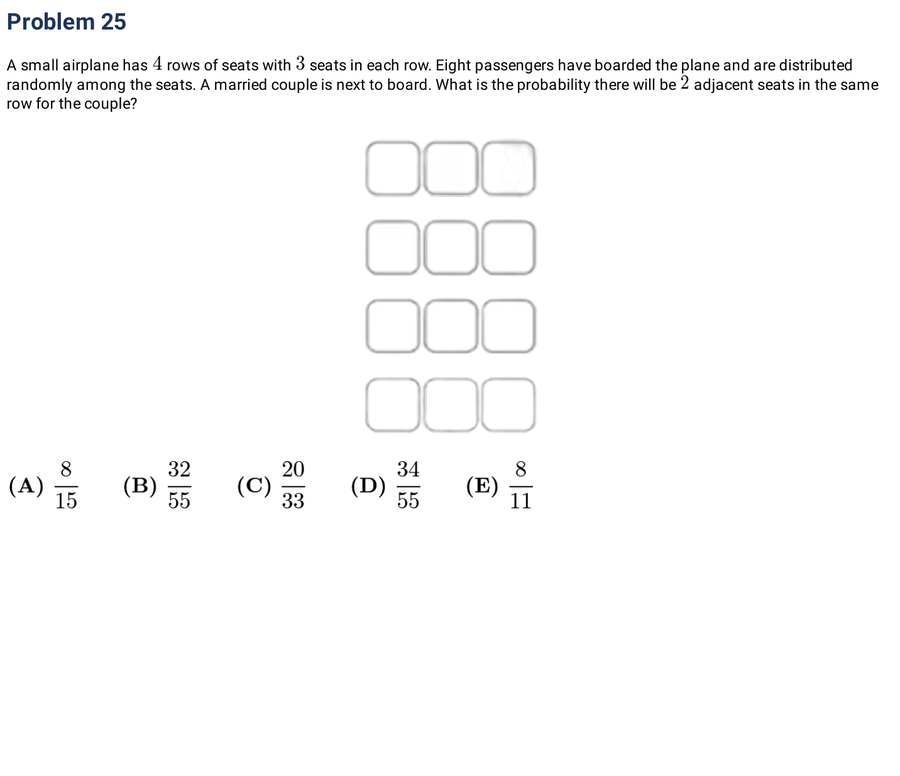
Problem 25 · 2024 AMC 8 Stretch
Counting & Probability complementary-counting casework
amc8-2024-25
Show hint (soft nudge)
Count the complement: when can the couple not sit together? Then subtract from 1.
Show hint (sharpest)
Per row of L-M-R, no adjacent pair is open iff M is occupied OR both L and R are occupied. Case-split on how many of the 4 middle seats are occupied.
Show solution
  1. Total arrangements: choose 8 of 12 seats for passengers, C(12, 8) = 495.
  2. For NO adjacent pair to be open in a row L–M–R: either M is occupied, or both L and R are occupied. Casework on k = number of rows with M occupied:
  3. k = 0: all four M's empty ⇒ all 8 edge seats filled. 1 way.
  4. k = 1: 4 choices of row, then 2 choices for the extra passenger in that row's edges. 8 ways.
  5. k = 2: C(4,2) = 6 row-choices × C(4,2) = 6 placements of remaining 2 passengers in the 4 unfilled edges. 36 ways.
  6. k = 3: C(4,3) = 4 row-choices × C(6,3) = 20 placements of remaining 3 passengers. 80 ways.
  7. k = 4: all middles filled (4 passengers); C(8,4) = 70 placements of the remaining 4 on edges. 70 ways.
  8. Total "no adjacent": 1 + 8 + 36 + 80 + 70 = 195. So adjacent count = 495 − 195 = 300.
  9. Probability = 300495 = 2033.
C 20/33.
Mark: · log in to save