AMC 8 · Test Mode

2025 AMC 8

Test mode — hints and solutions are locked. Pick an answer for each, then submit at the bottom to see your score.

← Exit test mode No hints or solutions until you submit.
Problem 1 · 2025 AMC 8 Easy
Geometry & Measurement symmetry area-fraction
amc8-2025-01
Show hint (soft nudge)
Can you pair each shaded piece with an unshaded piece of the same size?
Show hint (sharpest)
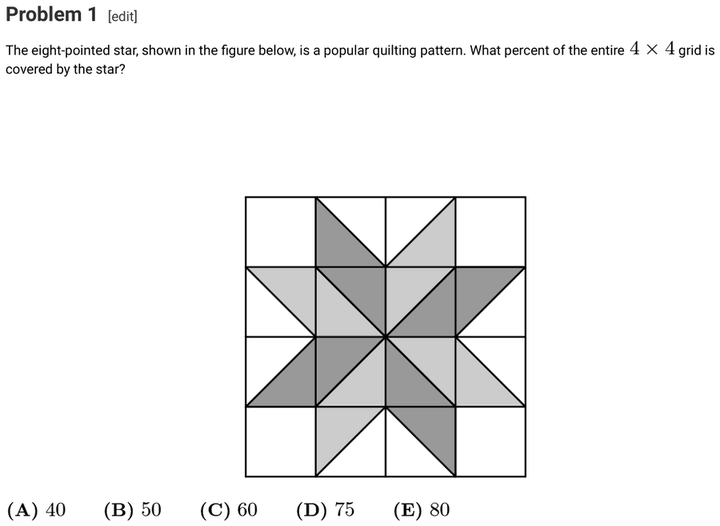
Look for symmetry. For every shaded triangle of the star, is there a matching white triangle the same size in the grid?
Show solution
  1. The whole pattern sits on a 4 × 4 grid, so its total area is 16 unit squares.
  2. The star is built from triangles, and each shaded triangle has a congruent white triangle as its partner — the shaded and white regions match up exactly.
  3. So the star covers exactly half of the grid: 8 of the 16 squares, which is 50%.
B 50%.
Mark: · log in to save
Problem 2 · 2025 AMC 8 Easy
Arithmetic & Operations place-value number-systems
amc8-2025-02
Show hint
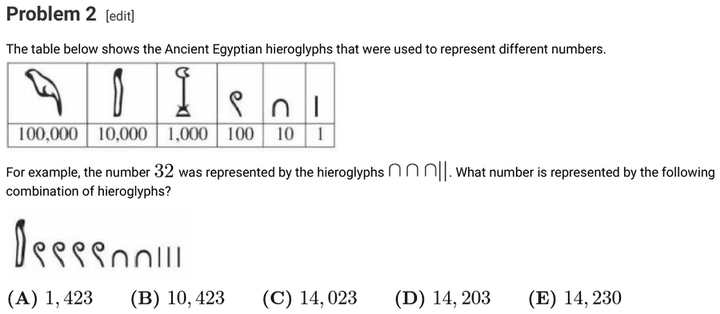
Each symbol has a fixed value from the table. Add up the values, just like the example (where three ∩ arches and two | strokes made 32).
Show solution
  1. Read the symbols using the table: one 10,000 symbol, four 100 symbols, two 10 symbols, and three 1 symbols.
  2. Add their values: 10,000 + 4×100 + 2×10 + 3×1.
  3. = 10,000 + 400 + 20 + 3 = 10,423.
B 10,423.
Mark: · log in to save
Problem 3 · 2025 AMC 8 Medium
Arithmetic & Operations total-then-divide division

Buffalo Shuffle-o is a card game in which all the cards are distributed evenly among all players at the start of the game. When Annika and 3 of her friends play Buffalo Shuffle-o, each player is dealt 15 cards. Suppose 2 more friends join the next game. How many cards will be dealt to each player?

Show hint (soft nudge)
The total number of cards doesn't change. Find that total first.
Show hint (sharpest)
First find the total number of cards (it doesn't change), then share it among the new, larger group.
Show solution
  1. Annika + 3 friends = 4 players, each dealt 15, so there are 4 × 15 = 60 cards.
  2. With 2 more friends, there are now 4 + 2 = 6 players.
  3. 60 cards shared among 6 players: 60 ÷ 6 = 10 cards each.
C 10 cards each.
Mark: · log in to save
Problem 4 · 2025 AMC 8 Medium
Algebra & Patterns arithmetic-sequence off-by-one

Lucius is counting backward by 7s. His first three numbers are 100, 93, and 86. What is his 10th number?

Show hint (soft nudge)
From the 1st number to the 10th, how many steps do you actually take?
Show hint (sharpest)
From the 1st number to the 10th you take 9 steps of 7. How much do you subtract in total?
Show solution
  1. Each step subtracts 7, and from the 1st to the 10th number is 9 steps.
  2. Total subtracted: 9 × 7 = 63.
  3. 10th number: 100 − 63 = 37.
B 37.
Mark: · log in to save
Problem 5 · 2025 AMC 8 Stretch
Geometry & Measurement taxicab-distance grid
amc8-2025-05
Show hint (soft nudge)
On a street grid you can't cut corners. Each leg's length is just sideways blocks + up-and-down blocks.
Show hint (sharpest)
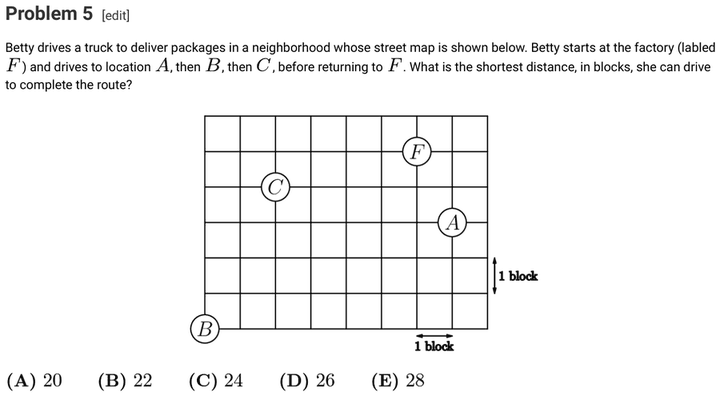
Betty drives along streets, so each leg's length is its sideways blocks plus its up-and-down blocks (you can't cut diagonally). Add the four legs F→A→B→C→F.
Show solution
  1. On a street grid, each leg's length = (horizontal blocks) + (vertical blocks). You can't cut diagonals, and as long as you don't backtrack, the route within a leg doesn't matter — only the start and end do.
  2. Read the four legs off the map: F→A = 1 + 2 = 3, A→B = 7 + 3 = 10, B→C = 2 + 4 = 6, C→F = 4 + 1 = 5.
  3. Total: 3 + 10 + 6 + 5 = 24 blocks.
C 24 blocks.
Another way: C is already on the way back (MAA)
  1. Notice C lies on a shortest path from B back to F, so visiting C costs nothing extra. The problem reduces to F → A → B → F.
  2. F→A = 3, A→B = 10, B→F (through C) = 6 + 5 = 11. Total: 3 + 10 + 11 = 24 blocks.
Mark: · log in to save
Problem 6 · 2025 AMC 8 Medium
Number Theory divisibility mod-10

Sekou writes down the numbers 15, 16, 17, 18, 19. After he erases one of his numbers, the sum of the remaining four numbers is a multiple of 4. Which number did he erase?

Show hint (soft nudge)
Adding the five up and testing each removal is slow. What does each number have in common with 4?
Show hint (sharpest)
Look at each number's remainder when divided by 4. The remainder of the whole sum tells you which one to erase.
Show solution
  1. Remainders mod 4: 15→3, 16→0, 17→1, 18→2, 19→3. Their sum is 9, which leaves remainder 1 mod 4.
  2. To make the remaining four sum divisible by 4, erase the one whose remainder is 1 — that's 17.
C 17.
Mark: · log in to save
Problem 7 · 2025 AMC 8 Easy
Counting & Probability complementary-counting

On the most recent exam in Prof. Xochi's class,

  • 5 students earned a score of at least 95%,
  • 13 students earned a score of at least 90%,
  • 27 students earned a score of at least 85%, and
  • 50 students earned a score of at least 80%.

How many students earned a score of at least 80% and less than 90%?

Show hint (soft nudge)
The four categories nest inside each other — "at least 80%" includes the "at least 90%" group.
Show hint (sharpest)
Take "at least 80%" and subtract off "at least 90%" to get the 80–90% band.
Show solution
  1. The 13 students who scored at least 90% are inside the 50 who scored at least 80%.
  2. Students in [80%, 90%) = 50 − 13 = 37.
D 37 students.
Mark: · log in to save
Problem 8 · 2025 AMC 8 Medium
Geometry & Measurement spatial-reasoning area square-area
amc8-2025-08
Show hint (soft nudge)
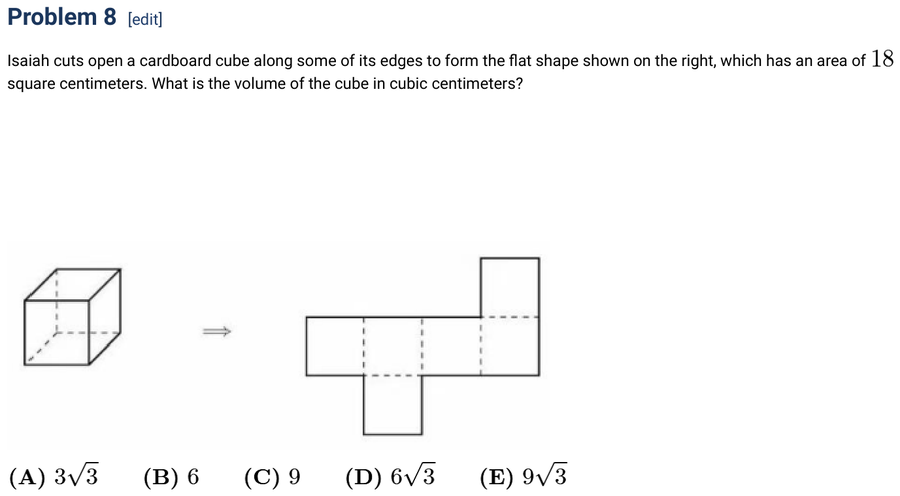
A cube has the same area on every face. The flat shape just lets you count those faces.
Show hint (sharpest)
Six identical squares with total area 18 means each has area 3 — so each side of the cube is √3.
Show solution
  1. The unfolded cube is 6 identical squares (one for each face). So each face has area 18 ÷ 6 = 3, and the side length is √3.
  2. Volume = side3 = (√3)3 = 3√3.
A 3√3 cubic centimeters.
Mark: · log in to save
Problem 9 · 2025 AMC 8 Medium
Arithmetic & Operations arithmetic-series
amc8-2025-09
Show hint (soft nudge)
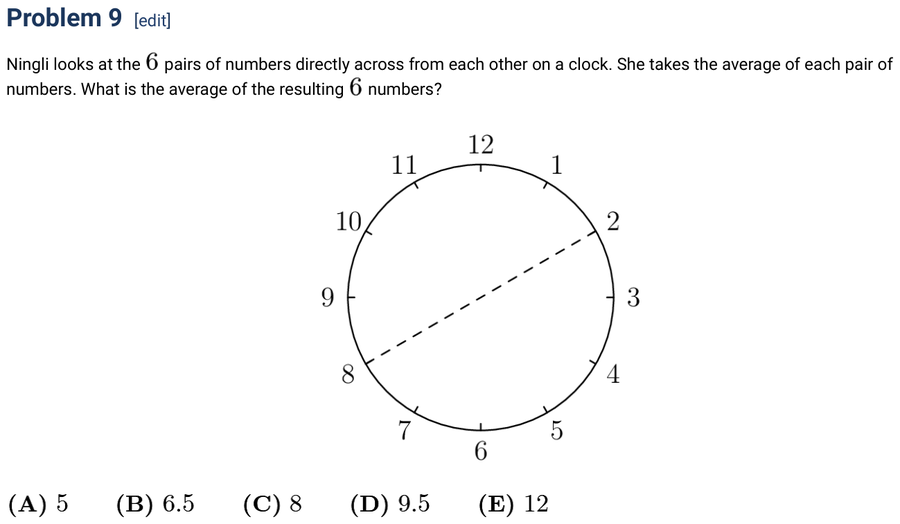
Each of the 12 clock numbers appears in exactly one pair. So the 6 pair-averages together "see" all 12 numbers.
Show hint (sharpest)
When every number shows up exactly once across the pairs, the average of the pair-averages equals the average of all 12 numbers.
Show solution
  1. The six pairs together include every clock number 1–12 exactly once, so the average of the six pair-averages is the same as the average of 1–12.
  2. 1–12 are evenly spaced, so their average is the midpoint: (1 + 12)/2 = 6.5.
B 6.5.
Mark: · log in to save
Problem 10 · 2025 AMC 8 Medium
Geometry & Measurement area area-decomposition transformations
amc8-2025-10
Show hint (soft nudge)
When two shapes overlap, adding their areas counts the overlap twice. What's the shape of that overlap?
Show hint (sharpest)
Inclusion–exclusion: (area of one) + (area of the other) − (area of overlap). The overlap is a square of side 2.5.
Show solution
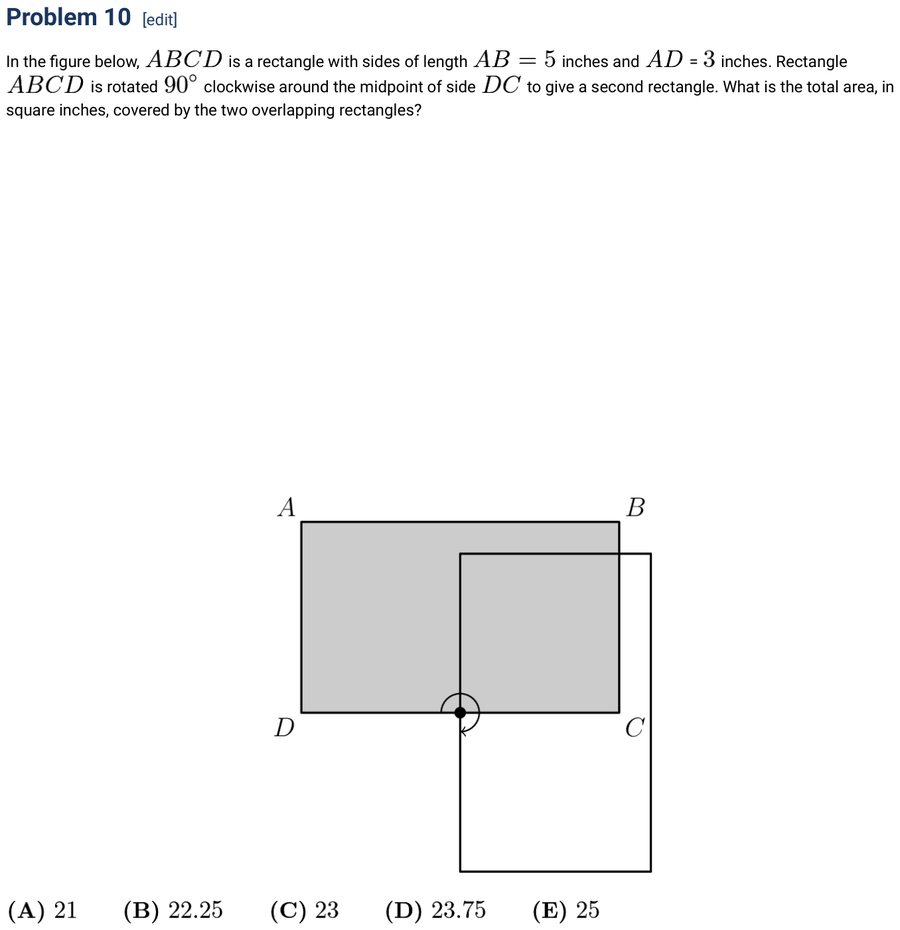
  1. Each rectangle has area 5 × 3 = 15.
  2. Rotated 90° about the midpoint of DC, the second rectangle's lower-left quarter overlaps the first rectangle's lower-right quarter — a 2.5 by 2.5 square (half of DC = 2.5), area 2.52 = 6.25.
  3. Total area covered = 15 + 15 − 6.25 = 23.75.
D 23.75 square inches.
Mark: · log in to save
Problem 11 · 2025 AMC 8 Medium
Geometry & Measurement spatial-reasoning area-decomposition
amc8-2025-11
Show hint (soft nudge)
Place the S tile first — it's the most awkward. What's left over?
Show hint (sharpest)
If S sits in a corner, the remaining 8 squares form an L-shape that splits into two L tetrominoes.
Show solution
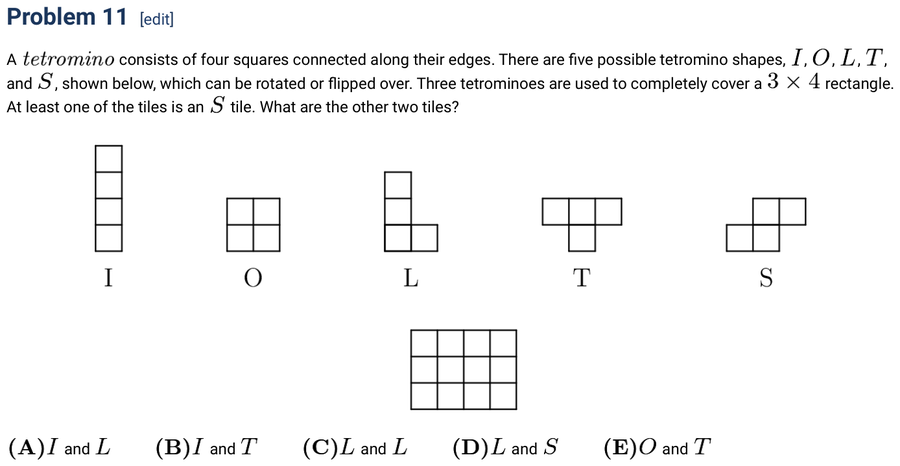
  1. The 3 × 4 rectangle has 12 squares; three tetrominoes (4 squares each) must cover them all.
  2. Place the S piece against an edge so it doesn't block too much. The remaining 8 squares form an L-shape.
  3. That L-shape splits cleanly into two L tetrominoes — answer L and L.
C L and L.
Mark: · log in to save
Problem 12 · 2025 AMC 8 Medium
Geometry & Measurement area spatial-reasoning
amc8-2025-12
Show hint (soft nudge)
The biggest circle that fits is limited by whichever inward corners of the region poke closest to the center.
Show hint (sharpest)
Each inward corner sits 1 unit horizontally and 2 units vertically from the center. Use the Pythagorean theorem to get the radius.
Show solution
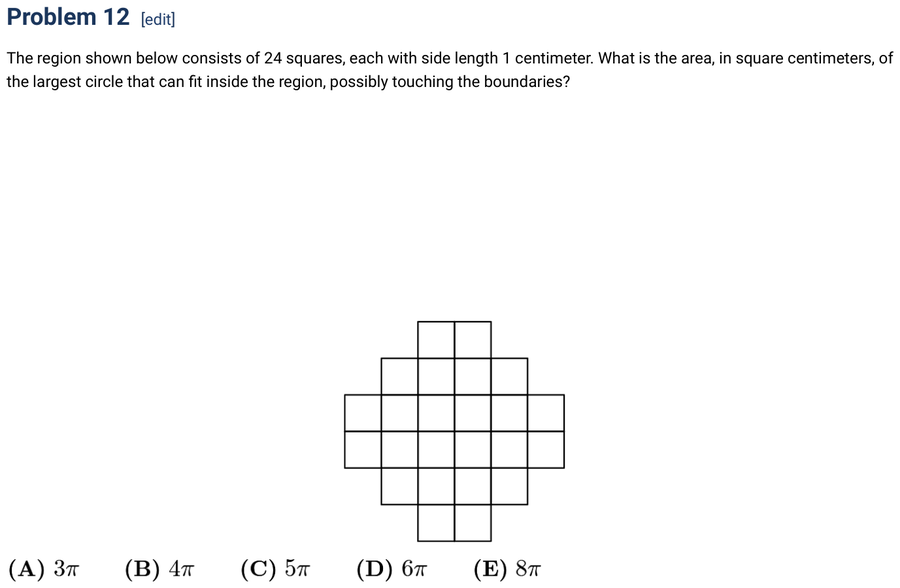
  1. By symmetry, the largest inscribed circle is centered at the region's center. Its radius is the distance from there to the nearest inward-poking corner.
  2. Each such corner is 1 unit across and 2 units up (or down) from the center: distance = √(12 + 22) = √5.
  3. Area = π × (√5)2 = .
C 5π square centimeters.
Mark: · log in to save
Problem 13 · 2025 AMC 8 Medium
Number Theory divisibility spiral-pattern
amc8-2025-13
Show hint (soft nudge)
Don't compute 25 separate remainders — even numbers' remainders mod 7 repeat in a pattern.
Show hint (sharpest)
The cycle is 2, 4, 6, 1, 3, 5, 0 (period 7). 25 numbers = 3 full cycles + 4 extras.
Show solution
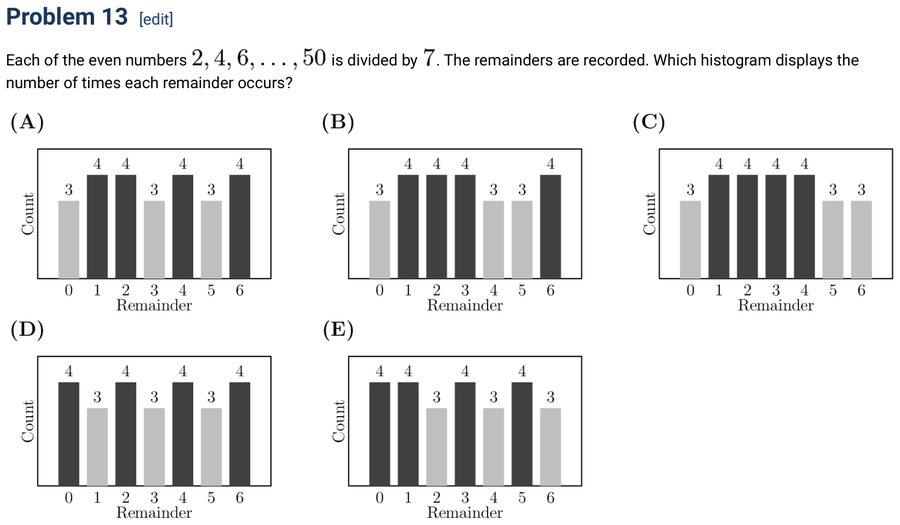
  1. The remainders mod 7 of 2, 4, 6, 8, 10, 12, 14, … cycle through 2, 4, 6, 1, 3, 5, 0 with period 7.
  2. 25 even numbers = 3 full cycles (21 numbers, hitting each remainder 3 times) plus 4 extras: 2, 4, 6, 1.
  3. So remainders 1, 2, 4, 6 occur 4 times each; remainders 0, 3, 5 occur 3 times each — the pattern in choice A.
A Histogram (A).
Mark: · log in to save
Problem 14 · 2025 AMC 8 Medium
Arithmetic & Operations work-backward substitution

A number N is inserted into the list 2, 6, 7, 7, 28. The mean is now twice as great as the median. What is N?

Show hint (soft nudge)
With 6 numbers, the median is the average of the middle two. Where in the sorted list does N land?
Show hint (sharpest)
Every answer choice is at least 7, so the middle two are always 7 and 7 — the median locks in at 7 no matter what.
Show solution
  1. All answer choices are ≥ 7, so when N is inserted into the sorted list, the middle two stay 7 and 7. The median is always 7.
  2. Mean = 2 × 7 = 14, so the six numbers must sum to 6 × 14 = 84.
  3. The original five sum to 2 + 6 + 7 + 7 + 28 = 50, so N = 84 − 50 = 34.
E 34.
Mark: · log in to save
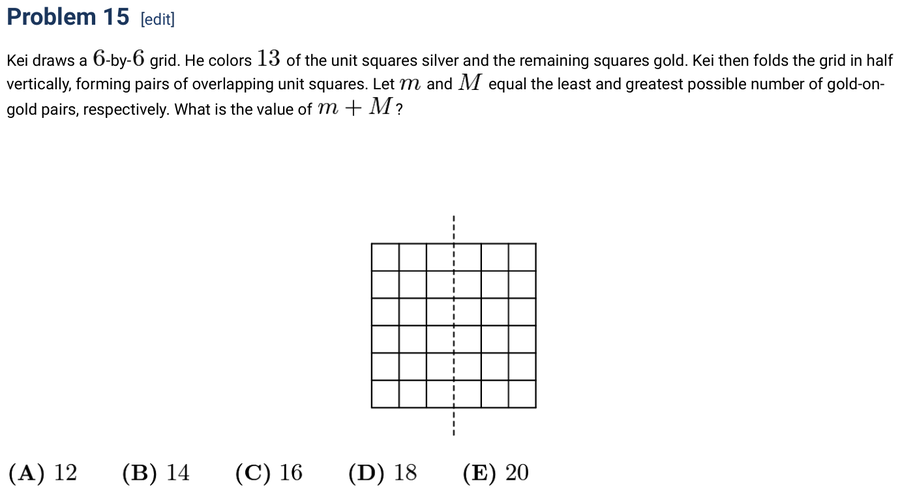
Problem 15 · 2025 AMC 8 Stretch
Counting & Probability careful-counting casework
amc8-2025-15
Show hint (soft nudge)
First count the gold squares. Then think about the 18 pairs the fold creates.
Show hint (sharpest)
For the minimum, spread golds across pairs first (one per pair). For the maximum, pair golds together first.
Show solution
  1. Gold squares: 36 − 13 = 23. Folding pairs up the 36 squares into 18 overlap pairs.
  2. Minimum m: spread golds so each pair gets one gold first — that uses 18 of them, leaving 23 − 18 = 5 to double up. So m = 5.
  3. Maximum M: pair golds 2-at-a-time. 23 = 2 × 11 + 1, so M = 11 gold-on-gold pairs (1 lone gold left).
  4. m + M = 5 + 11 = 16.
C 16.
Mark: · log in to save
Problem 16 · 2025 AMC 8 Hard
Number Theory complementary-counting sum-constraint

Five distinct integers from 1 to 10 are chosen, and five distinct integers from 11 to 20 are chosen. No two numbers differ by exactly 10. What is the sum of the ten chosen numbers?

Show hint (soft nudge)
Each chosen low number blocks exactly one high number. How many highs are left to choose from?
Show hint (sharpest)
Five chosen lows block five highs — leaving exactly five unblocked highs, which are forced to be picked. They're the highs matching the unchosen lows + 10.
Show solution
  1. Each chosen low (say x) blocks the high x + 10. With 5 lows chosen, 5 highs are blocked — so the 5 chosen highs are exactly the 5 unblocked ones: those that are 10 more than the 5 unchosen lows.
  2. Sum of chosen highs = (sum of unchosen lows) + 5 × 10. So (chosen lows) + (chosen highs) = (chosen lows) + (unchosen lows) + 50 = (sum of 1 to 10) + 50.
  3. 1 + 2 + … + 10 = 55, so the total is 55 + 50 = 105.
C 105.
Mark: · log in to save
Problem 17 · 2025 AMC 8 Medium
Fractions, Decimals & Percents percent-multiplier fraction-to-decimal
amc8-2025-17
Show hint (soft nudge)
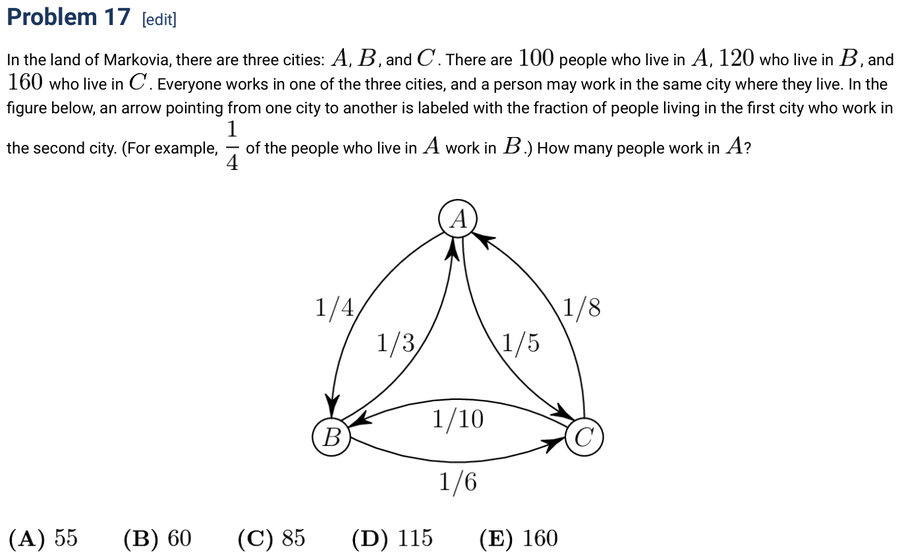
Workers in A come from all three cities. Tally each city's contribution.
Show hint (sharpest)
From A, the workers who stay are everyone not leaving for B or C. From B and C, just multiply by the labeled fraction.
Show solution
  1. From A → A: those who don't leave. 100 − 100×14 − 100×15 = 100 − 25 − 20 = 55.
  2. From B → A: 120 × 13 = 40.
  3. From C → A: 160 × 18 = 20.
  4. Total working in A: 55 + 40 + 20 = 115.
D 115 people.
Mark: · log in to save
Problem 18 · 2025 AMC 8 Hard
Geometry & Measurement area area-fraction
amc8-2025-18
Show hint (soft nudge)
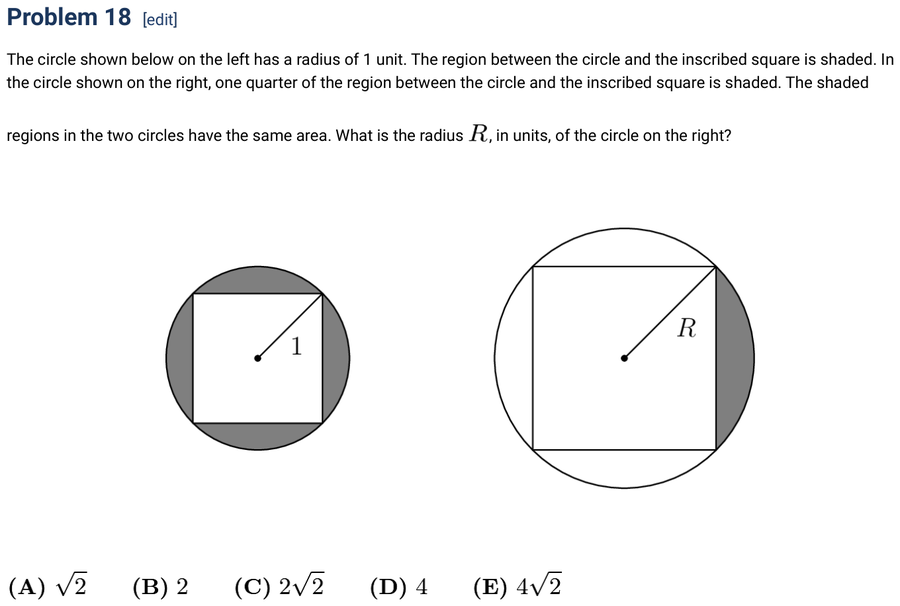
Both diagrams are the same shape, just scaled. How do areas scale when you change the size?
Show hint (sharpest)
On the right, one quarter of the between-region equals the whole on the left. So the right's between-region is 4× the left's. Areas scale as length2.
Show solution
  1. The two pictures are similar — both show a square inscribed in a circle. So the right's full between-region has area R2 times the left's.
  2. We're told one quarter of the right's between-region equals the left's whole between-region, so the right's whole is 4× the left's: R2 = 4.
  3. R = 2.
B R = 2.
Mark: · log in to save
Problem 19 · 2025 AMC 8 Hard
Ratios, Rates & Proportions distance-speed-time
amc8-2025-19
Show hint (soft nudge)
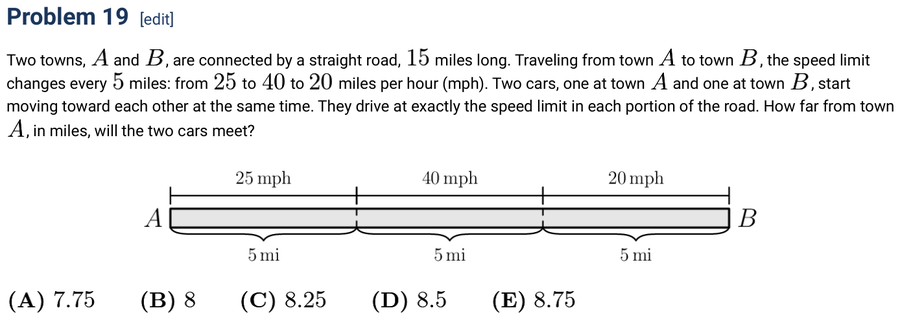
Once both cars are in the middle section, they're going the same speed — the asymmetry is in how they got there.
Show hint (sharpest)
Car A reaches the middle in 5/25 = 1/5 hr; car B in 5/20 = 1/4 hr. A has a 1/20-hr head start in the middle section — that's 2 miles.
Show solution
  1. Car A's left section is 5 miles at 25 mph → reaches the middle in 5/25 = 1/5 hr. Car B's right section is 5 miles at 20 mph → reaches the middle in 5/20 = 1/4 hr. A enters the middle 1/20 hr before B.
  2. In that 1/20 hr, A travels 40 × 1/20 = 2 miles, so when B enters the middle, A is at mile 7, B at mile 10 — a 3-mile gap.
  3. Both now go 40 mph, closing at 80 mph. They split the 3-mile gap equally: each covers 1.5 miles. A is at 7 + 1.5 = 8.5 miles from A.
D 8.5 miles from A.
Mark: · log in to save
Problem 20 · 2025 AMC 8 Hard
Algebra & Patterns arithmetic-series fraction-to-decimal

Sarika, Dev, and Rajiv are sharing a large block of cheese. They take turns cutting off half of what remains and eating it: first Sarika eats half of the cheese, then Dev eats half of the remaining half, then Rajiv eats half of what remains, then back to Sarika, and so on. They stop when the cheese is too small to see. About what fraction of the original block of cheese does Sarika eat in total?

Show hint (soft nudge)
Sarika eats on turns 1, 4, 7, … — every third turn. What fraction does each Sarika-bite eat?
Show hint (sharpest)
Sarika's bites are 1/2, then 1/16, then 1/128, … — a geometric series with ratio 1/8.
Show solution
  1. Each turn eats half of what's left, so the cheese remaining after turn n is 1/2n. Sarika eats at turns 1, 4, 7, …, taking 12, 116, 1128, … of the original block.
  2. Geometric series with first term a = 12 and ratio r = 18.
  3. Sum = a1 − r = 1/27/8 = 4/7.
A 4/7.
Mark: · log in to save
Problem 21 · 2025 AMC 8 Hard
Logic & Word Problems casework work-backward
amc8-2025-21
Show hint (soft nudge)
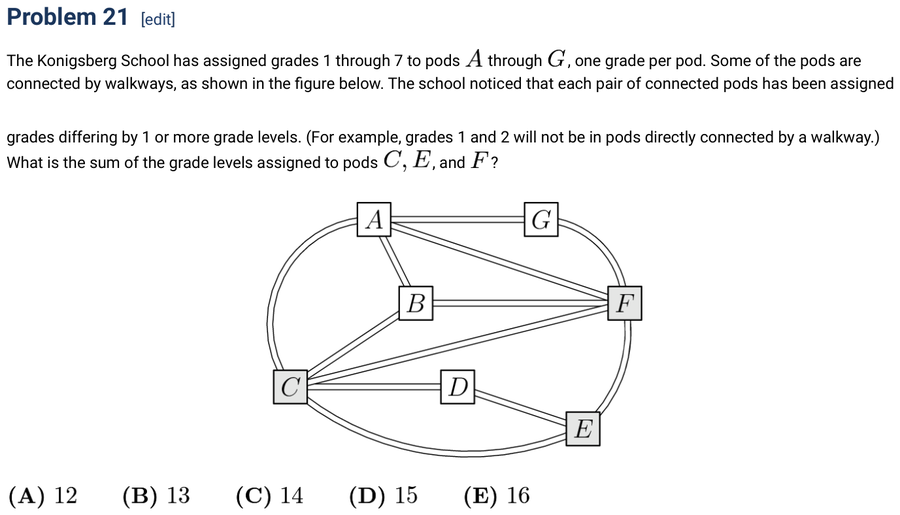
Look at the largest group of pods that are all directly connected to each other — their grades are forced into a small set.
Show hint (sharpest)
Pods A, B, C, F form a 4-clique. The only 4-element subset of {1,…,7} with every pair differing by at least 2 is {1, 3, 5, 7}.
Show solution
  1. Among A, B, C, F every pair is directly connected, so all four pairs differ by ≥ 2. The only way to pick 4 numbers from 1–7 with that property is the set {1, 3, 5, 7}.
  2. G connects to A and F. If G = 2, then A, F ≠ 1 or 3, forcing {A, F} ⊂ {5, 7} and {B, C} = {1, 3}.
  3. D and E only touch C and F. The extreme grades 1 and 7 each have just one neighbor in this clique, so place 1 at C and 7 at F. The remaining {4, 6} go to D, E.
  4. Filling in: D = 6 (avoids 7 enough), E = 4 (avoids 1 and 7), B = 3 (next to C = 1), A = 5. All constraints hold.
  5. C + E + F = 1 + 4 + 7 = 12.
A 12.
Mark: · log in to save
Problem 22 · 2025 AMC 8 Hard
Number Theory factorization factor-pairs
amc8-2025-22
Show hint (soft nudge)
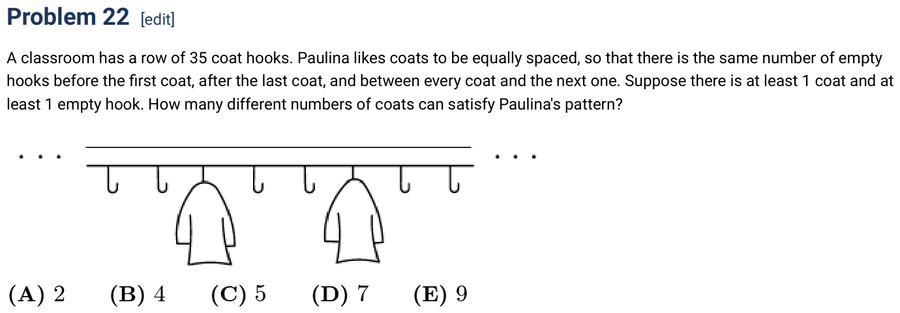
Imagine adding a phantom coat after the last one. Now the row is a clean repeating pattern.
Show hint (sharpest)
After the phantom, you have 36 hooks split into d identical blocks of b hooks each, with b ≥ 2 and d ≥ 2. How many (b, d) factorizations of 36 are there?
Show solution
  1. Add a phantom coat after the last real coat. Now 36 hooks form a perfectly repeating pattern: each block is (some empty hooks) + (one coat), of length b ≥ 2.
  2. If there are d blocks, then bd = 36, and the real coat count = d − 1 (we added one).
  3. Both b ≥ 2 (each block has ≥ 1 empty + 1 coat) and d ≥ 2 (at least 1 original coat + the phantom).
  4. 36 = 22 × 32 has (2+1)(2+1) = 9 divisors. Removing the two ordered factorizations with a 1 (1×36 and 36×1) leaves 9 − 2 = 7.
D 7 different coat counts.
Mark: · log in to save
Problem 23 · 2025 AMC 8 Hard
Number Theory primes difference-of-squares prime-test

How many four-digit numbers have all three of the following properties?

  1. The tens digit and ones digit are both 9.
  2. The number is 1 less than a perfect square.
  3. The number is the product of exactly two prime numbers.
Show hint (soft nudge)
The number ends in 99, so the perfect square just above it ends in 00. What does that say about its square root?
Show hint (sharpest)
Use a2 − 1 = (a − 1)(a + 1). For the number to be a product of exactly two primes, both factors must be prime — twin primes.
Show solution
  1. A 4-digit number ending in 99 plus 1 ends in 00. So that perfect square = (10k)2, and our number is (10k)2 − 1 = (10k − 1)(10k + 1).
  2. Four-digit range gives 10k ∈ {40, 50, 60, 70, 80, 90, 100}.
  3. We need both 10k − 1 and 10k + 1 prime. Check: 39×41 (39 = 3×13, no), 49×51 (49 = 72, no), 59×61 (both prime ✓), 69×71 (69 = 3×23, no), 79×81 (81 = 34, no), 89×91 (91 = 7×13, no), 99×101 (99 = 9×11, no).
  4. Only 59 × 61 = 3599 works. Exactly 1.
B Exactly 1.
Mark: · log in to save
Problem 24 · 2025 AMC 8 Hard
Geometry & Measurement perimeter casework area-decomposition
amc8-2025-24
Show hint (soft nudge)
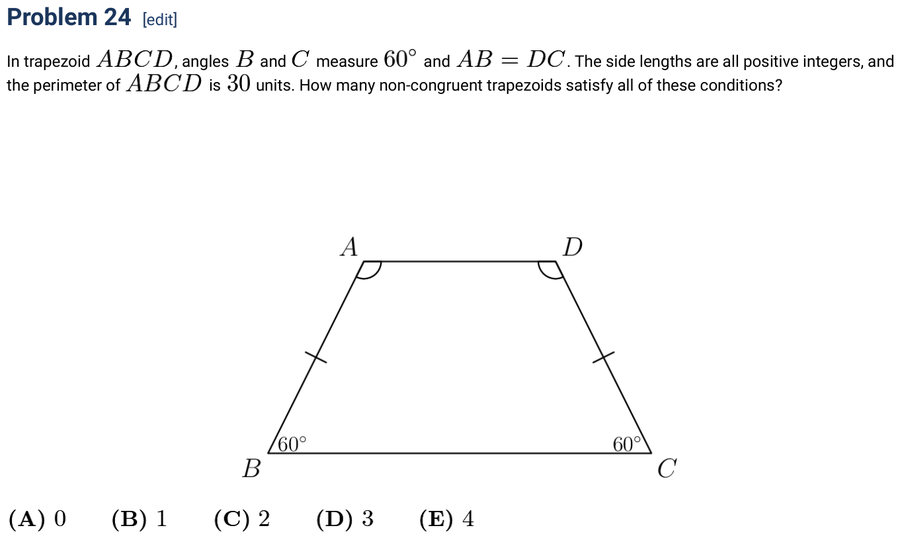
Drop a line through A parallel to side CD. With both base angles 60°, a familiar shape appears.
Show hint (sharpest)
That construction makes an equilateral triangle ABE and a parallelogram ADCE. The perimeter becomes 3x + 2y = 30.
Show solution
  1. Drop a segment through A parallel to CD, meeting BC at E. Since ∠B = 60° and AB = DC, triangle ABE is equilateral: AB = BE = AE = x.
  2. ADCE is a parallelogram (AE ∥ DC and AD ∥ EC), so AD = EC = y.
  3. Perimeter = AB + BC + CD + DA = x + (x + y) + x + y = 3x + 2y = 30.
  4. Positive integer solutions: y = (30 − 3x)/2 needs 30 − 3x > 0 (so x < 10) and even (so x even). That gives x ∈ {2, 4, 6, 8} — 4 trapezoids.
E 4 trapezoids.
Mark: · log in to save
Problem 25 · 2025 AMC 8 Stretch
Counting & Probability careful-counting symmetry
amc8-2025-25
Show hint (soft nudge)
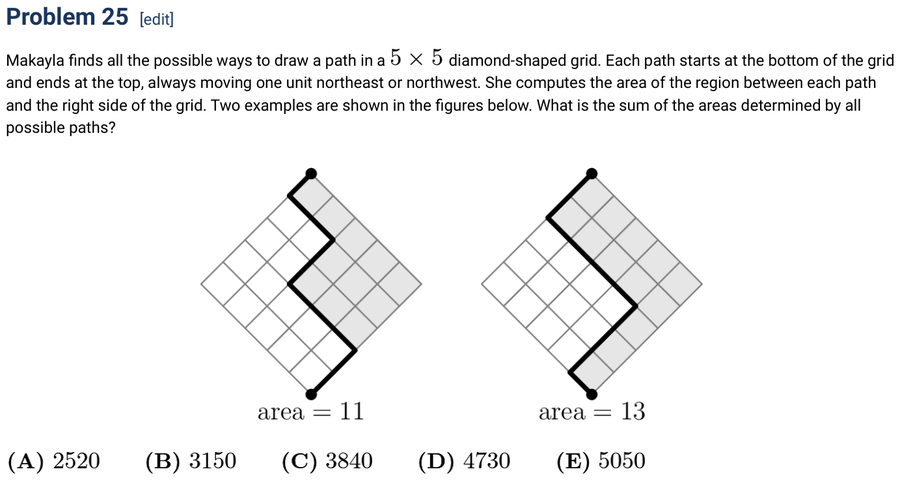
By left/right symmetry, the total of right-side areas equals the total of left-side areas. What does each path's left + right equal?
Show hint (sharpest)
Per path: area_left + area_right = 25 (the whole diamond). And the number of paths = ways to interleave 5 NE moves with 5 NW moves.
Show solution
  1. Let X = the sum of right-side areas. By mirroring every path L ↔ R, the sum of left-side areas across all paths is also X. So 2X = total of (left + right) over all paths.
  2. For each individual path, (left area) + (right area) = 25 (the full 5×5 diamond).
  3. Number of paths: 5 NE moves and 5 NW moves interleaved = 10!5! · 5! = 252.
  4. 2X = 25 × 252 = 6300, so X = 3150.
B 3150.
Mark: · log in to save