Brynn's savings decreased by 20% in July, then increased by 50% of the new amount in August. Brynn's savings are now what percent of the original amount?
Show hint (soft nudge)
Don't pick a starting amount — that's extra work. Each percent change is something you can just multiply by.
Show hint (sharpest)
Each percent change is just a multiplier — you don't even need a starting amount. Multiply the two.
Casey went on a road trip that covered 100 miles, stopping only for a lunch break along the way. The trip took 3 hours in total and her average speed while driving was 40 miles per hour. In minutes, how long was the lunch break?
Show hint (soft nudge)
The 3 hours includes the break. Find the driving time first.
Show hint (sharpest)
Time = distance ÷ speed gives only the driving time. Whatever's left of the 3 hours is the break.
Mika wants to estimate how far a new electric bike goes on a full charge. She made two trips totaling 40 miles: the first used 12 of the battery and the second used 310 of the battery. How many miles can the bike go on a fully charged battery?
Show hint (soft nudge)
Add the two battery fractions to see what share of a full charge covered the 40 miles.
Show hint (sharpest)
Then scale up from that share to a whole battery.
Show solution
The two trips used ½ + 3/10 = 4/5 of the battery for 40 miles.
A poll asked some people whether they liked solving mathematics problems, and exactly 74% answered "yes." What is the fewest possible number of people who could have been asked?
Show hint (soft nudge)
74% of the group must be a whole number of people.
Show hint (sharpest)
Reduce 74/100 to lowest terms; the denominator is the smallest possible group size.
Show solution
74% = 74/100 = 37/50 in lowest terms, so the number of people must be a multiple of 50.
Five runners finished a race: Luke, Melina, Nico, Olympia, and Pedro. Nico finished 11 minutes behind Pedro. Olympia finished 2 minutes ahead of Melina but 3 minutes behind Pedro. Olympia finished 6 minutes ahead of Luke. Which runner finished fourth?
Show hint (soft nudge)
Place everyone on a timeline measured from Pedro.
Show hint (sharpest)
Then read off who is fourth from the front.
Show solution
Measuring minutes behind Pedro: Olympia +3, Melina +5 (2 behind Olympia), Luke +9 (6 behind Olympia), Nico +11.
The order is Pedro, Olympia, Melina, Luke, Nico, so fourth is Luke.
Jami picked three equally spaced integers on the number line. The sum of the first and second is 40, and the sum of the second and third is 60. What is the sum of all three numbers?
Show hint (soft nudge)
For equally spaced numbers, the middle one is the average of the other two.
Show hint (sharpest)
Add the two given sums and see how many times the middle number appears.
Show solution
Since the numbers are equally spaced, first + third = 2 × second. Adding the two given sums: 40 + 60 = first + 2·second + third = 4·second, so the middle is 25.
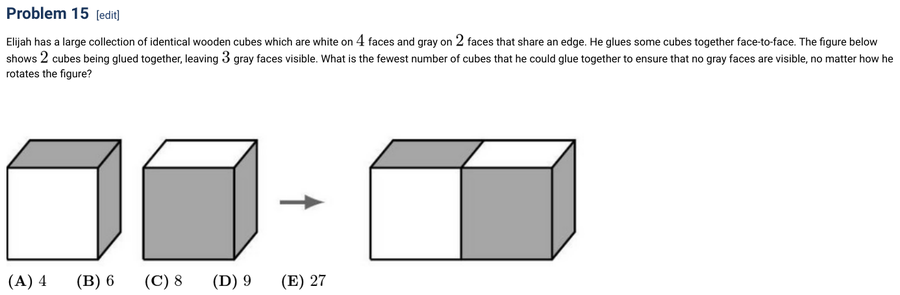
A cube's two shaded faces share an edge, so both must be glued to neighbors to hide them.
Show hint (sharpest)
Look for an arrangement where every cube has two glued faces that meet at an edge.
Show solution
To hide a cube's two shaded faces — which meet at an edge — it must be glued to neighbors on two faces sharing an edge.
Four cubes arranged in a 2 × 2 square give each cube exactly two such adjacent glued faces; with three or fewer, some cube has only one glued face (or two opposite ones), so a shaded face shows.
Consider all positive four-digit integers whose digits are all even. What fraction of these integers are divisible by 4?
Show hint (soft nudge)
Divisibility by 4 depends only on the last two digits.
Show hint (sharpest)
With an even tens digit, the tens part is already a multiple of 4, so only the units digit decides it.
Show solution
A number is divisible by 4 exactly when its last two digits are. With an even tens digit, 10·(tens) is already a multiple of 4, so it comes down to the units digit being 0, 4, or 8.
That's 3 of the 5 even units digits, and it holds for every choice of the other digits, so the fraction is 3/5.
Four students sit in a row and chat with the people next to them. They then rearrange themselves so that no one is seated next to anyone they sat next to before. How many such rearrangements are possible?
Show hint (soft nudge)
Label the seats 1, 2, 3, 4; the forbidden neighbor-pairs are 1-2, 2-3, and 3-4.
Show hint (sharpest)
Try to build a valid order — the options turn out to be very tight.
Show solution
No two originally-adjacent students may be neighbors, so none of 1-2, 2-3, 3-4 can touch.
The only orders that work are 2-4-1-3 and its reverse 3-1-4-2, giving 2 rearrangements.
Miguel and his dog Luna start together at a park entrance. Miguel throws a ball straight ahead to a tree and keeps walking at a steady pace. Luna sprints to the ball and immediately brings it back to Miguel. Luna runs 5 times as fast as Miguel walks. What fraction of the entrance-to-tree distance does Miguel cover by the time Luna brings him the ball?
Show hint (soft nudge)
In the same time, Luna covers 5 times the distance Miguel does.
Show hint (sharpest)
Luna's path is entrance → tree → Miguel; set its length to 5 times Miguel's walk.
Show solution
Let the entrance-to-tree distance be 1 and Miguel's distance be d. Luna runs to the tree and back to Miguel: 1 + (1 − d) = 2 − d.
Since Luna covers 5 times Miguel's distance, 5d = 2 − d, so 6d = 2 and d = 1/3.
The land of Catania uses gold coins (1 mm thick) and silver coins (3 mm thick). In how many ways can Taylor make a stack exactly 8 mm tall using any arrangement of gold and silver coins, where order matters?
Show hint (soft nudge)
Let f(n) count stacks of height n; the top coin is either gold (leaving n − 1) or silver (leaving n − 3).
Show hint (sharpest)
Build the counts up from small heights using f(n) = f(n−1) + f(n−3).
The integers 1 through 25 are arbitrarily separated into five groups of 5 numbers each. The median of each group is found, and M is the median of those five medians. What is the least possible value of M?
Show hint (soft nudge)
M is the 3rd-smallest of the five medians, so you want three groups with small medians.
Show hint (sharpest)
Each small median needs two even-smaller numbers beneath it, and small numbers are in limited supply.
Show solution
To make M small, three groups need small medians, each requiring two smaller numbers below it. Using 1–6 as those "below" numbers lets three groups have medians 7, 8, and 9, while the other two groups absorb the large numbers.
Trying for M = 8 fails: three medians ≤ 8 would need six distinct numbers below them all drawn from {1,…,5}, which isn't enough.
The notation n! is the product of the first n positive integers. Define the superfactorial of n to be the product of the factorials 1! · 2! · 3! · … · n! (so the superfactorial of 3 is 1! · 2! · 3! = 12). How many factors of 7 appear in the prime factorization of the superfactorial of 51?
Show hint (soft nudge)
The 7-count of the superfactorial is the sum of the 7-counts of 1! through 51!.
Show hint (sharpest)
Each k! holds ⌊k/7⌋ + ⌊k/49⌋ sevens; group the values of k by that count.
Show solution
The number of 7s is the sum of v₇(k!) for k = 1 to 51, where v₇(k!) = ⌊k/7⌋ + ⌊k/49⌋.
Seven values of k each contribute 1, 2, 3, 4, 5, and 6, totaling 7(1+2+3+4+5+6) = 147; and k = 49, 50, 51 contribute 8 each, adding 24.
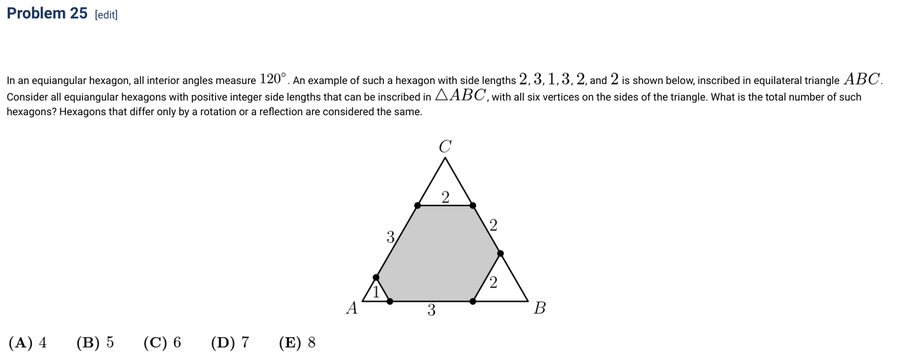
Such a hexagon is the equilateral triangle with three corner equilateral triangles cut off.
Show hint (sharpest)
If the triangle has side 6, the three integer cut sizes must leave each middle segment ≥ 1, so each pair of cuts sums to at most 5.
Show solution
The triangle ABC has side 6 (from the example: 1 + 3 + 2). Cutting integer-sized corners a, b, c leaves middle segments 6 − a − b, 6 − b − c, 6 − c − a, which must each be ≥ 1, so every pair of cuts sums to at most 5.
Counting unordered cut-triples {a, b, c} of positive integers with all pairwise sums ≤ 5 gives {1,1,1}, {1,1,2}, {1,2,2}, {2,2,2}, {1,1,3}, {1,2,3}, {2,2,3}, {1,1,4} — that's 8 hexagons (rotations and reflections counted once).