Brynn's savings decreased by 20% in July, then increased by 50% of the new amount in August. Brynn's savings are now what percent of the original amount?
Show hint (soft nudge)
Don't pick a starting amount — that's extra work. Each percent change is something you can just multiply by.
Show hint (sharpest)
Each percent change is just a multiplier — you don't even need a starting amount. Multiply the two.
Casey went on a road trip that covered 100 miles, stopping only for a lunch break along the way. The trip took 3 hours in total and her average speed while driving was 40 miles per hour. In minutes, how long was the lunch break?
Show hint (soft nudge)
The 3 hours includes the break. Find the driving time first.
Show hint (sharpest)
Time = distance ÷ speed gives only the driving time. Whatever's left of the 3 hours is the break.
Mika wants to estimate how far a new electric bike goes on a full charge. She made two trips totaling 40 miles: the first used 12 of the battery and the second used 310 of the battery. How many miles can the bike go on a fully charged battery?
Show hint (soft nudge)
Add the two battery fractions to see what share of a full charge covered the 40 miles.
Show hint (sharpest)
Then scale up from that share to a whole battery.
Show solution
The two trips used ½ + 3/10 = 4/5 of the battery for 40 miles.
A poll asked some people whether they liked solving mathematics problems, and exactly 74% answered "yes." What is the fewest possible number of people who could have been asked?
Show hint (soft nudge)
74% of the group must be a whole number of people.
Show hint (sharpest)
Reduce 74/100 to lowest terms; the denominator is the smallest possible group size.
Show solution
74% = 74/100 = 37/50 in lowest terms, so the number of people must be a multiple of 50.
Five runners finished a race: Luke, Melina, Nico, Olympia, and Pedro. Nico finished 11 minutes behind Pedro. Olympia finished 2 minutes ahead of Melina but 3 minutes behind Pedro. Olympia finished 6 minutes ahead of Luke. Which runner finished fourth?
Show hint (soft nudge)
Place everyone on a timeline measured from Pedro.
Show hint (sharpest)
Then read off who is fourth from the front.
Show solution
Measuring minutes behind Pedro: Olympia +3, Melina +5 (2 behind Olympia), Luke +9 (6 behind Olympia), Nico +11.
The order is Pedro, Olympia, Melina, Luke, Nico, so fourth is Luke.
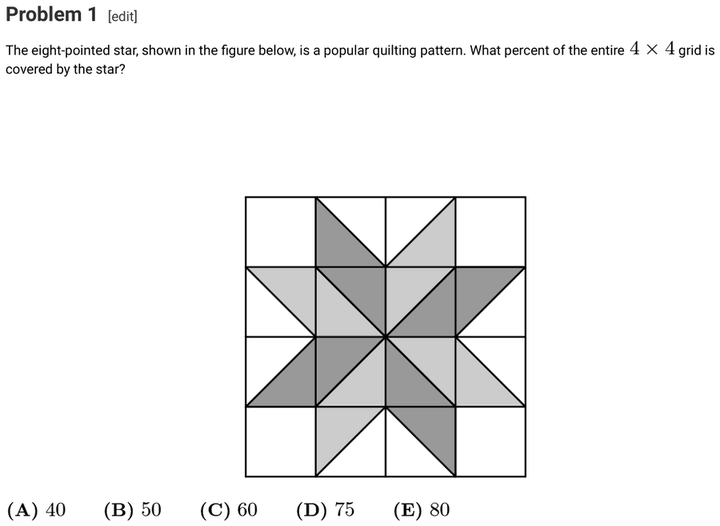
Can you pair each shaded piece with an unshaded piece of the same size?
Show hint (sharpest)
Look for symmetry. For every shaded triangle of the star, is there a matching white triangle the same size in the grid?
Show solution
The whole pattern sits on a 4 × 4 grid, so its total area is 16 unit squares.
The star is built from triangles, and each shaded triangle has a congruent white triangle as its partner — the shaded and white regions match up exactly.
So the star covers exactly half of the grid: 8 of the 16 squares, which is 50%.
Buffalo Shuffle-o is a card game in which all the cards are distributed evenly among all players at the start of the game. When Annika and 3 of her friends play Buffalo Shuffle-o, each player is dealt 15 cards. Suppose 2 more friends join the next game. How many cards will be dealt to each player?
Show hint (soft nudge)
The total number of cards doesn't change. Find that total first.
Show hint (sharpest)
First find the total number of cards (it doesn't change), then share it among the new, larger group.
Show solution
Annika + 3 friends = 4 players, each dealt 15, so there are 4 × 15 = 60 cards.
With 2 more friends, there are now 4 + 2 = 6 players.
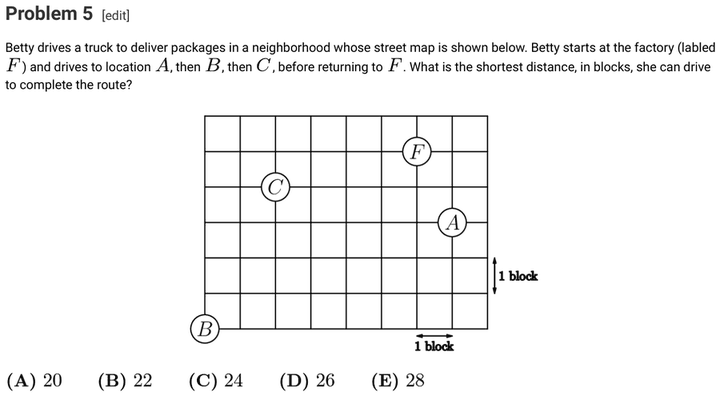
On a street grid you can't cut corners. Each leg's length is just sideways blocks + up-and-down blocks.
Show hint (sharpest)
Betty drives along streets, so each leg's length is its sideways blocks plus its up-and-down blocks (you can't cut diagonally). Add the four legs F→A→B→C→F.
Show solution
On a street grid, each leg's length = (horizontal blocks) + (vertical blocks). You can't cut diagonals, and as long as you don't backtrack, the route within a leg doesn't matter — only the start and end do.
Read the four legs off the map: F→A = 1 + 2 = 3, A→B = 7 + 3 = 10, B→C = 2 + 4 = 6, C→F = 4 + 1 = 5.
Total: 3 + 10 + 6 + 5 = 24 blocks.
C
24 blocks.
Another way: C is already on the way back (MAA)
Notice C lies on a shortest path from B back to F, so visiting C costs nothing extra. The problem reduces to F → A → B → F.
Sekou writes down the numbers 15, 16, 17, 18, 19. After he erases one of his numbers, the sum of the remaining four numbers is a multiple of 4. Which number did he erase?
Show hint (soft nudge)
Adding the five up and testing each removal is slow. What does each number have in common with 4?
Show hint (sharpest)
Look at each number's remainder when divided by 4. The remainder of the whole sum tells you which one to erase.
Show solution
Remainders mod 4: 15→3, 16→0, 17→1, 18→2, 19→3. Their sum is 9, which leaves remainder 1 mod 4.
To make the remaining four sum divisible by 4, erase the one whose remainder is 1 — that's 17.
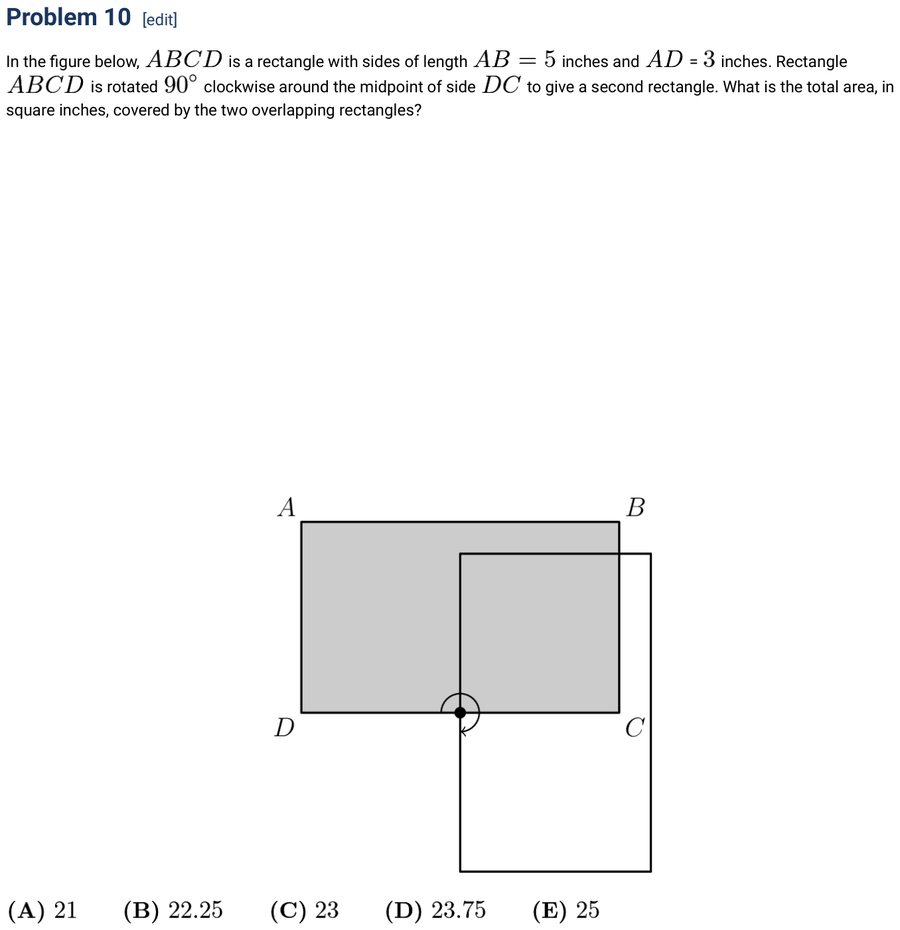
When two shapes overlap, adding their areas counts the overlap twice. What's the shape of that overlap?
Show hint (sharpest)
Inclusion–exclusion: (area of one) + (area of the other) − (area of overlap). The overlap is a square of side 2.5.
Show solution
Each rectangle has area 5 × 3 = 15.
Rotated 90° about the midpoint of DC, the second rectangle's lower-left quarter overlaps the first rectangle's lower-right quarter — a 2.5 by 2.5 square (half of DC = 2.5), area 2.52 = 6.25.