Focused Practice

Across all years

Tick one or more bands and topics — problems are pulled from every authored year.

Showing 20 of 615 matching
Difficulty bands: (none = all 25)
Topics: (none = all topics)
Order:
Problem 1 · 2026 AMC 8 Easy
Arithmetic & Operations grouping arithmetic-series

What is the value of the following expression?

1 + 2 − 3 + 4 + 5 − 6 + 7 + 8 − 9 + 10 + 11 − 12
Show hint (soft nudge)
Doing it left-to-right is slow. Look at the sign pattern (+, +, −) and see if it suggests a group size.
Show hint (sharpest)
The signs repeat +, +, −. Group the terms in threes and watch the group totals.
Show solution
  1. Group in threes: (1+2−3), (4+5−6), (7+8−9), (10+11−12).
  2. The totals climb by 3 each time: 0, 3, 6, 9.
  3. Sum: 0 + 3 + 6 + 9 = 18.
A The answer is 18.
Mark: · log in to save
Problem 2 · 2026 AMC 8 Easy
Arithmetic & Operations symmetry careful-counting

In the array shown below, three 3s are surrounded by 2s, which are in turn surrounded by a border of 1s. What is the sum of the numbers in the array?

1111111
1222221
1233321
1222221
1111111
A 5 × 7 array of numbers.
Show hint (soft nudge)
Several rows of the grid are duplicates. Add one of each kind, then count copies.
Show hint (sharpest)
Use the symmetry: the top and bottom rows match, and the 2nd and 4th match — so you only really add three different rows.
Show solution
  1. Top and bottom rows are all 1s: 7 + 7 = 14.
  2. Second and fourth rows: 1 + (2+2+2+2+2) + 1 = 12 each, so 12 + 12 = 24.
  3. Middle row: 1 + 2 + 3 + 3 + 3 + 2 + 1 = 15.
  4. Total: 14 + 24 + 15 = 53.
C The answer is 53.
Mark: · log in to save
Problem 3 · 2026 AMC 8 Medium
Geometry & Measurement perimeter pythagorean-triple square-area

Haruki has a piece of wire that is 24 centimeters long. He wants to bend it to form each of the following shapes, one at a time.

  • A regular hexagon with side length 5 cm.
  • A square of area 36 cm2.
  • A right triangle whose legs are 6 and 8 cm long.

Which of the shapes can Haruki make?

Show hint (soft nudge)
The wire is 24 cm and won't stretch. For each shape, just ask: would its perimeter be exactly 24?
Show hint (sharpest)
The wire can't stretch, so a shape works only if its perimeter is exactly 24 cm. Find each perimeter.
Show solution
  1. Hexagon: perimeter = 6 × 5 = 30 cm. Longer than 24 — not possible.
  2. Square of area 36: side = √36 = 6, so perimeter = 4 × 6 = 24 cm. Possible. ✓
  3. Right triangle with legs 6 and 8: hypotenuse = √(62+82) = √100 = 10, so perimeter = 6 + 8 + 10 = 24 cm. Possible. ✓
  4. Only the square and the triangle can be made.
D Square and triangle only.
Mark: · log in to save
Problem 4 · 2026 AMC 8 Medium
Fractions, Decimals & Percents percent-multiplier

Brynn's savings decreased by 20% in July, then increased by 50% of the new amount in August. Brynn's savings are now what percent of the original amount?

Show hint (soft nudge)
Don't pick a starting amount — that's extra work. Each percent change is something you can just multiply by.
Show hint (sharpest)
Each percent change is just a multiplier — you don't even need a starting amount. Multiply the two.
Show solution
  1. Down 20% means × 0.8; up 50% means × 1.5.
  2. Multiply the changes: 0.8 × 1.5 = 1.2.
  3. 1.2 = 120% of the original.
E 120%.
Mark: · log in to save
Problem 5 · 2026 AMC 8 Stretch
Ratios, Rates & Proportions distance-speed-time

Casey went on a road trip that covered 100 miles, stopping only for a lunch break along the way. The trip took 3 hours in total and her average speed while driving was 40 miles per hour. In minutes, how long was the lunch break?

Show hint (soft nudge)
The 3 hours includes the break. Find the driving time first.
Show hint (sharpest)
Time = distance ÷ speed gives only the driving time. Whatever's left of the 3 hours is the break.
Show solution
  1. Driving time = 100 ÷ 40 = 2.5 hours.
  2. Break = total − driving = 3 − 2.5 = 0.5 hour.
  3. 0.5 hour = 30 minutes.
B 30 minutes.
Mark: · log in to save
Problem 6 · 2026 AMC 8 Medium
Geometry & Measurement area-decomposition
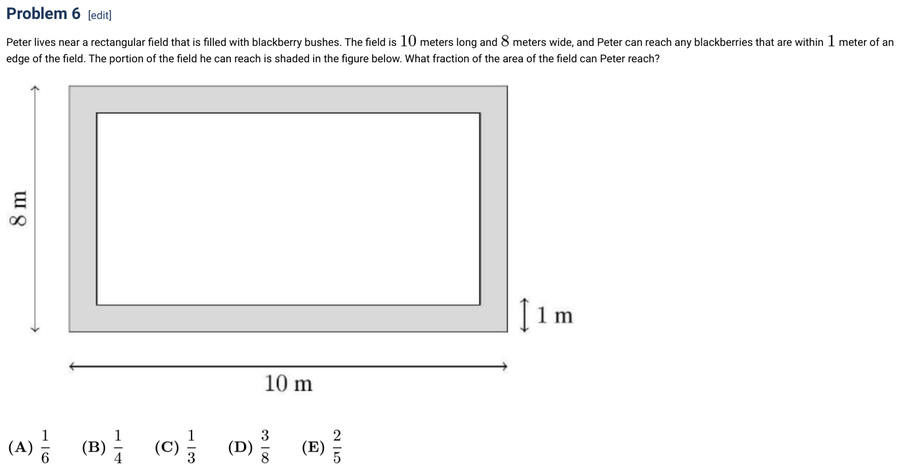
amc8-2026-06
Show hint (soft nudge)
The part Peter can't reach is the inner rectangle more than 1 m from every edge.
Show hint (sharpest)
Shrink each dimension by 2 (one meter on each side).
Show solution
  1. The unreachable middle is (10 − 2) × (8 − 2) = 48, out of the field's 10 × 8 = 80.
  2. So the reachable border is 80 − 48 = 32, a fraction 32/80 = 2/5.
E 2/5.
Mark: · log in to save
Problem 7 · 2026 AMC 8 Medium
Fractions, Decimals & Percents fraction-of

Mika wants to estimate how far a new electric bike goes on a full charge. She made two trips totaling 40 miles: the first used 12 of the battery and the second used 310 of the battery. How many miles can the bike go on a fully charged battery?

Show hint (soft nudge)
Add the two battery fractions to see what share of a full charge covered the 40 miles.
Show hint (sharpest)
Then scale up from that share to a whole battery.
Show solution
  1. The two trips used ½ + 3/10 = 4/5 of the battery for 40 miles.
  2. A full battery covers 40 ÷ (4/5) = 50 miles.
C 50 miles.
Mark: · log in to save
Problem 8 · 2026 AMC 8 Medium
Fractions, Decimals & Percents reduce-fraction

A poll asked some people whether they liked solving mathematics problems, and exactly 74% answered "yes." What is the fewest possible number of people who could have been asked?

Show hint (soft nudge)
74% of the group must be a whole number of people.
Show hint (sharpest)
Reduce 74/100 to lowest terms; the denominator is the smallest possible group size.
Show solution
  1. 74% = 74/100 = 37/50 in lowest terms, so the number of people must be a multiple of 50.
  2. The fewest is 50.
D 50 people.
Mark: · log in to save
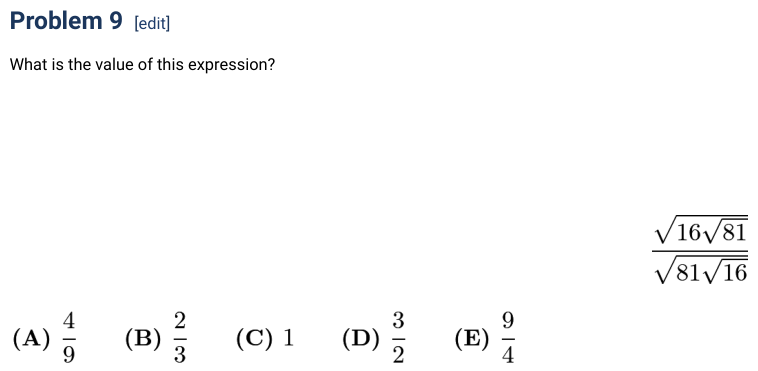
Problem 9 · 2026 AMC 8 Medium
Number Theory simplify-radicals
amc8-2026-09
Show hint (soft nudge)
Work the inner square roots first: √81 = 9 and √16 = 4.
Show hint (sharpest)
Then take the outer square roots of the two products.
Show solution
  1. Inside the radicals, 16√81 = 16 · 9 = 144 and 81√16 = 81 · 4 = 324.
  2. So the value is √144 / √324 = 12 / 18 = 2/3.
B 2/3.
Mark: · log in to save
Problem 10 · 2026 AMC 8 Medium
Logic & Word Problems ordering

Five runners finished a race: Luke, Melina, Nico, Olympia, and Pedro. Nico finished 11 minutes behind Pedro. Olympia finished 2 minutes ahead of Melina but 3 minutes behind Pedro. Olympia finished 6 minutes ahead of Luke. Which runner finished fourth?

Show hint (soft nudge)
Place everyone on a timeline measured from Pedro.
Show hint (sharpest)
Then read off who is fourth from the front.
Show solution
  1. Measuring minutes behind Pedro: Olympia +3, Melina +5 (2 behind Olympia), Luke +9 (6 behind Olympia), Nico +11.
  2. The order is Pedro, Olympia, Melina, Luke, Nico, so fourth is Luke.
A Luke.
Mark: · log in to save
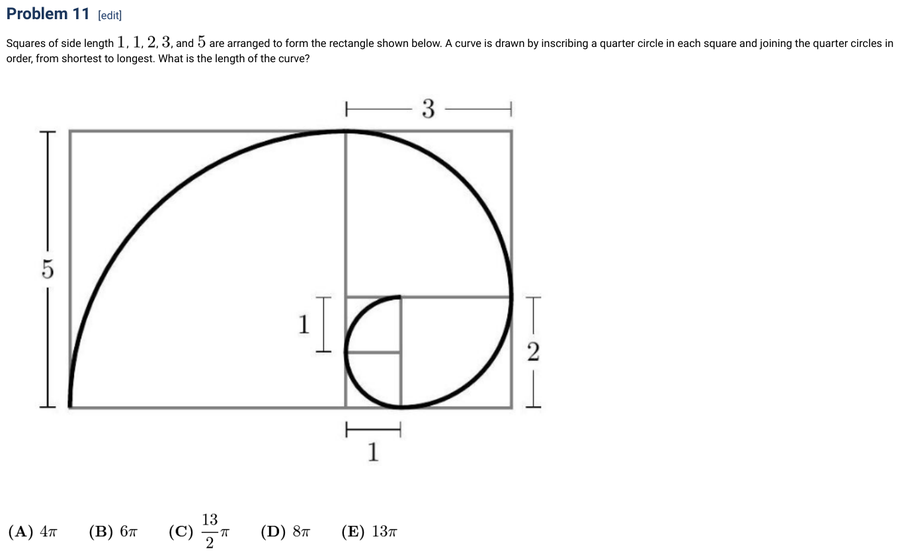
Problem 11 · 2026 AMC 8 Medium
Geometry & Measurement arc-length
amc8-2026-11
Show hint (soft nudge)
A quarter circle in a square of side s has arc length one-fourth of 2πs.
Show hint (sharpest)
Add up the arcs for all five squares.
Show solution
  1. Each square of side s contributes a quarter-circle of length ¼ · 2πs = πs/2.
  2. Total = (π/2)(1 + 1 + 2 + 3 + 5) = (π/2)(12) = .
B 6π.
Mark: · log in to save
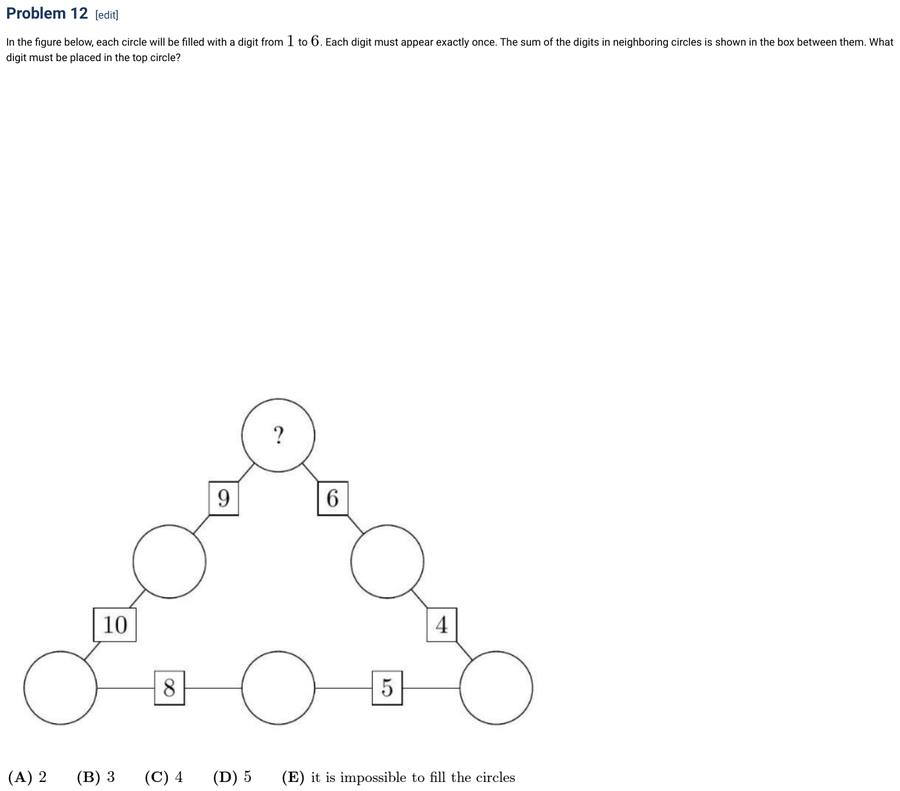
Problem 12 · 2026 AMC 8 Hard
Logic & Word Problems constraint-propagation
amc8-2026-12
Show hint (soft nudge)
Start at the most restrictive sum and see which digits can make it.
Show hint (sharpest)
A sum of 10 between two circles can only be 4 and 6.
Show solution
  1. The edge summing to 10 forces those two circles to be 4 and 6; taking the upper one as 4 makes the top circle 9 − 4 = 5 and the bottom-left 6.
  2. Then the remaining sums give 8 − 6 = 2, 5 − 2 = 3, 4 − 3 = 1, and 5 + 1 = 6 checks out — using each digit 1–6 once.
  3. So the top circle must be 5.
D 5.
Mark: · log in to save
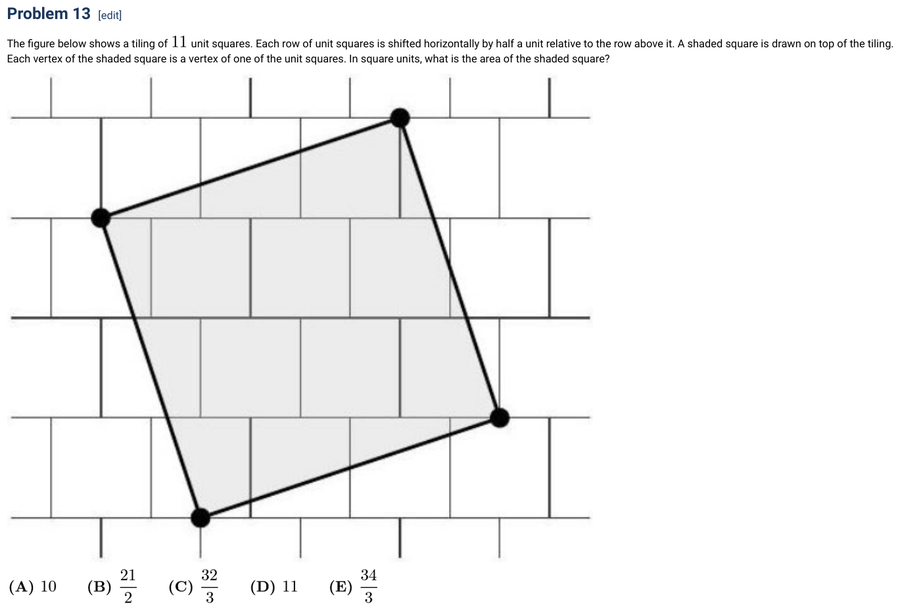
Problem 13 · 2026 AMC 8 Hard
Geometry & Measurement tilted-square pythagorean
amc8-2026-13
Show hint (soft nudge)
The square is tilted, so its area equals the square of its side length.
Show hint (sharpest)
Read one side as a step across the lattice and use the Pythagorean theorem.
Show solution
  1. Each side of the shaded square is the hypotenuse of a right triangle with legs 3 and 1, measured across the tiling.
  2. So the area is the side squared: 3² + 1² = 10.
A 10.
Mark: · log in to save
Problem 14 · 2026 AMC 8 Medium
Algebra & Patterns arithmetic-sequence

Jami picked three equally spaced integers on the number line. The sum of the first and second is 40, and the sum of the second and third is 60. What is the sum of all three numbers?

Show hint (soft nudge)
For equally spaced numbers, the middle one is the average of the other two.
Show hint (sharpest)
Add the two given sums and see how many times the middle number appears.
Show solution
  1. Since the numbers are equally spaced, first + third = 2 × second. Adding the two given sums: 40 + 60 = first + 2·second + third = 4·second, so the middle is 25.
  2. The total is 3 × 25 = 75.
B 75.
Mark: · log in to save
Problem 15 · 2026 AMC 8 Hard
Geometry & Measurement spatial-reasoning
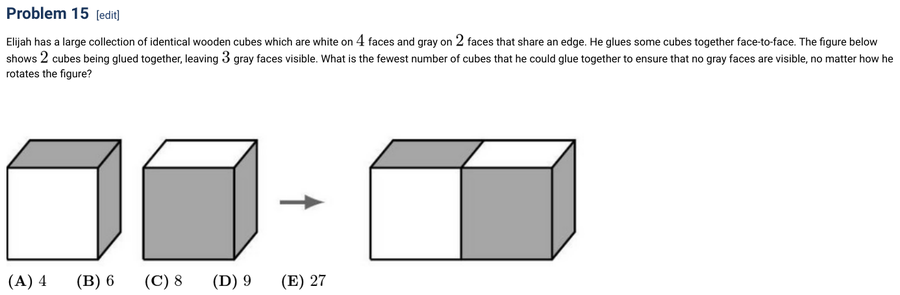
amc8-2026-15
Show hint (soft nudge)
A cube's two shaded faces share an edge, so both must be glued to neighbors to hide them.
Show hint (sharpest)
Look for an arrangement where every cube has two glued faces that meet at an edge.
Show solution
  1. To hide a cube's two shaded faces — which meet at an edge — it must be glued to neighbors on two faces sharing an edge.
  2. Four cubes arranged in a 2 × 2 square give each cube exactly two such adjacent glued faces; with three or fewer, some cube has only one glued face (or two opposite ones), so a shaded face shows.
  3. The fewest is 4.
A 4 cubes.
Mark: · log in to save
Problem 1 · 2025 AMC 8 Easy
Geometry & Measurement symmetry area-fraction
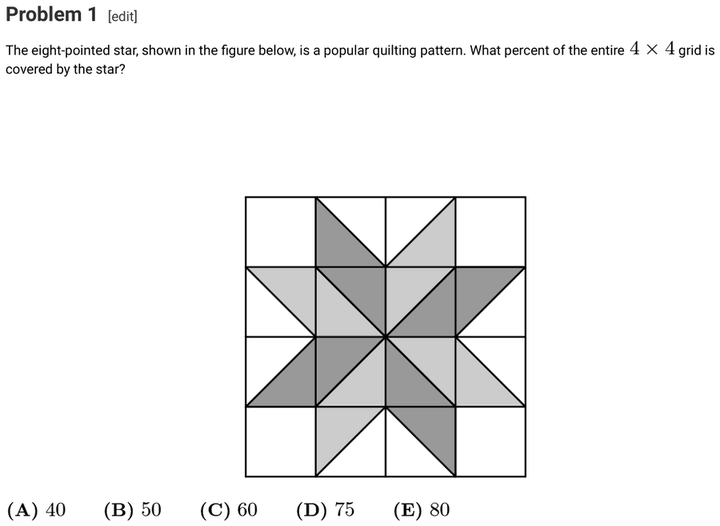
amc8-2025-01
Show hint (soft nudge)
Can you pair each shaded piece with an unshaded piece of the same size?
Show hint (sharpest)
Look for symmetry. For every shaded triangle of the star, is there a matching white triangle the same size in the grid?
Show solution
  1. The whole pattern sits on a 4 × 4 grid, so its total area is 16 unit squares.
  2. The star is built from triangles, and each shaded triangle has a congruent white triangle as its partner — the shaded and white regions match up exactly.
  3. So the star covers exactly half of the grid: 8 of the 16 squares, which is 50%.
B 50%.
Mark: · log in to save
Problem 2 · 2025 AMC 8 Easy
Arithmetic & Operations place-value number-systems
amc8-2025-02
Show hint
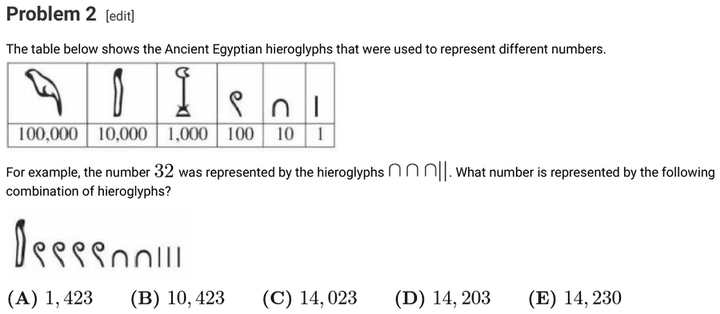
Each symbol has a fixed value from the table. Add up the values, just like the example (where three ∩ arches and two | strokes made 32).
Show solution
  1. Read the symbols using the table: one 10,000 symbol, four 100 symbols, two 10 symbols, and three 1 symbols.
  2. Add their values: 10,000 + 4×100 + 2×10 + 3×1.
  3. = 10,000 + 400 + 20 + 3 = 10,423.
B 10,423.
Mark: · log in to save
Problem 3 · 2025 AMC 8 Medium
Arithmetic & Operations total-then-divide division

Buffalo Shuffle-o is a card game in which all the cards are distributed evenly among all players at the start of the game. When Annika and 3 of her friends play Buffalo Shuffle-o, each player is dealt 15 cards. Suppose 2 more friends join the next game. How many cards will be dealt to each player?

Show hint (soft nudge)
The total number of cards doesn't change. Find that total first.
Show hint (sharpest)
First find the total number of cards (it doesn't change), then share it among the new, larger group.
Show solution
  1. Annika + 3 friends = 4 players, each dealt 15, so there are 4 × 15 = 60 cards.
  2. With 2 more friends, there are now 4 + 2 = 6 players.
  3. 60 cards shared among 6 players: 60 ÷ 6 = 10 cards each.
C 10 cards each.
Mark: · log in to save
Problem 4 · 2025 AMC 8 Medium
Algebra & Patterns arithmetic-sequence off-by-one

Lucius is counting backward by 7s. His first three numbers are 100, 93, and 86. What is his 10th number?

Show hint (soft nudge)
From the 1st number to the 10th, how many steps do you actually take?
Show hint (sharpest)
From the 1st number to the 10th you take 9 steps of 7. How much do you subtract in total?
Show solution
  1. Each step subtracts 7, and from the 1st to the 10th number is 9 steps.
  2. Total subtracted: 9 × 7 = 63.
  3. 10th number: 100 − 63 = 37.
B 37.
Mark: · log in to save
Problem 5 · 2025 AMC 8 Stretch
Geometry & Measurement taxicab-distance grid
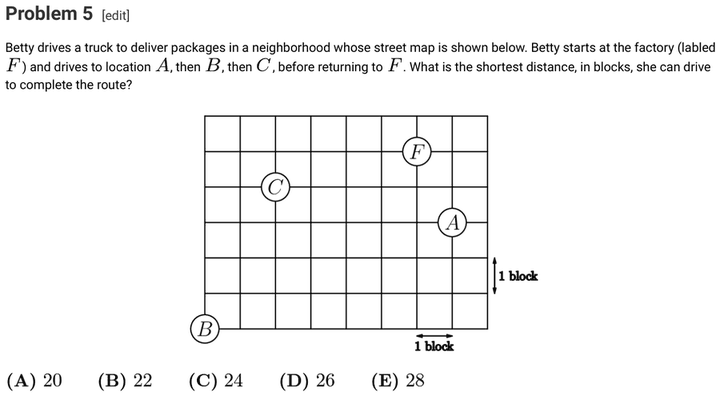
amc8-2025-05
Show hint (soft nudge)
On a street grid you can't cut corners. Each leg's length is just sideways blocks + up-and-down blocks.
Show hint (sharpest)
Betty drives along streets, so each leg's length is its sideways blocks plus its up-and-down blocks (you can't cut diagonally). Add the four legs F→A→B→C→F.
Show solution
  1. On a street grid, each leg's length = (horizontal blocks) + (vertical blocks). You can't cut diagonals, and as long as you don't backtrack, the route within a leg doesn't matter — only the start and end do.
  2. Read the four legs off the map: F→A = 1 + 2 = 3, A→B = 7 + 3 = 10, B→C = 2 + 4 = 6, C→F = 4 + 1 = 5.
  3. Total: 3 + 10 + 6 + 5 = 24 blocks.
C 24 blocks.
Another way: C is already on the way back (MAA)
  1. Notice C lies on a shortest path from B back to F, so visiting C costs nothing extra. The problem reduces to F → A → B → F.
  2. F→A = 3, A→B = 10, B→F (through C) = 6 + 5 = 11. Total: 3 + 10 + 11 = 24 blocks.
Mark: · log in to save