Brynn's savings decreased by 20% in July, then increased by 50% of the new amount in August. Brynn's savings are now what percent of the original amount?
Show hint (soft nudge)
Don't pick a starting amount — that's extra work. Each percent change is something you can just multiply by.
Show hint (sharpest)
Each percent change is just a multiplier — you don't even need a starting amount. Multiply the two.
Casey went on a road trip that covered 100 miles, stopping only for a lunch break along the way. The trip took 3 hours in total and her average speed while driving was 40 miles per hour. In minutes, how long was the lunch break?
Show hint (soft nudge)
The 3 hours includes the break. Find the driving time first.
Show hint (sharpest)
Time = distance ÷ speed gives only the driving time. Whatever's left of the 3 hours is the break.
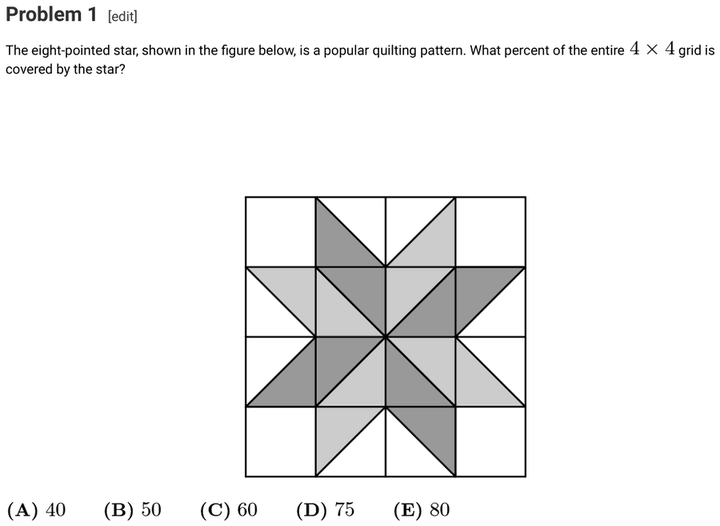
Can you pair each shaded piece with an unshaded piece of the same size?
Show hint (sharpest)
Look for symmetry. For every shaded triangle of the star, is there a matching white triangle the same size in the grid?
Show solution
The whole pattern sits on a 4 × 4 grid, so its total area is 16 unit squares.
The star is built from triangles, and each shaded triangle has a congruent white triangle as its partner — the shaded and white regions match up exactly.
So the star covers exactly half of the grid: 8 of the 16 squares, which is 50%.
Buffalo Shuffle-o is a card game in which all the cards are distributed evenly among all players at the start of the game. When Annika and 3 of her friends play Buffalo Shuffle-o, each player is dealt 15 cards. Suppose 2 more friends join the next game. How many cards will be dealt to each player?
Show hint (soft nudge)
The total number of cards doesn't change. Find that total first.
Show hint (sharpest)
First find the total number of cards (it doesn't change), then share it among the new, larger group.
Show solution
Annika + 3 friends = 4 players, each dealt 15, so there are 4 × 15 = 60 cards.
With 2 more friends, there are now 4 + 2 = 6 players.
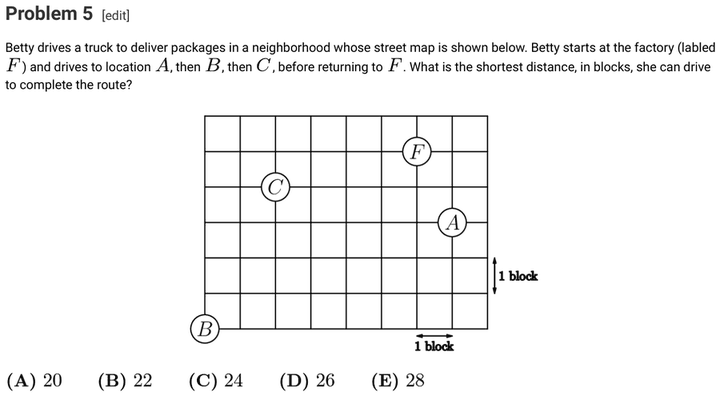
On a street grid you can't cut corners. Each leg's length is just sideways blocks + up-and-down blocks.
Show hint (sharpest)
Betty drives along streets, so each leg's length is its sideways blocks plus its up-and-down blocks (you can't cut diagonally). Add the four legs F→A→B→C→F.
Show solution
On a street grid, each leg's length = (horizontal blocks) + (vertical blocks). You can't cut diagonals, and as long as you don't backtrack, the route within a leg doesn't matter — only the start and end do.
Read the four legs off the map: F→A = 1 + 2 = 3, A→B = 7 + 3 = 10, B→C = 2 + 4 = 6, C→F = 4 + 1 = 5.
Total: 3 + 10 + 6 + 5 = 24 blocks.
C
24 blocks.
Another way: C is already on the way back (MAA)
Notice C lies on a shortest path from B back to F, so visiting C costs nothing extra. The problem reduces to F → A → B → F.
You don't need to do the whole subtraction. What part of the answer is the question actually asking about?
Show hint (sharpest)
Only the ones digits matter — and every number ends in 2. So skip the big subtraction entirely.
Show solution
Only the ones digit matters. The five numbers being subtracted all end in 2, so their ones digits sum to 5 × 2 = 10 — together they take away something ending in 0.
Subtracting a multiple of 10 from 222,222 doesn't touch its ones digit: it stays 2.
B
The ones digit is 2.
Another way: keep the intermediate positive (MAA)
Look only at the last two digits so the running total never goes negative: 22 − 2 − 2 − 2 − 2 − 2.
Four squares of side lengths 4, 7, 9, and 10 units are arranged in increasing size order so that their left edges and bottom edges align. The squares alternate in the color pattern white-gray-white-gray, respectively, as shown in the figure. What is the area of the visible gray region, in square units?
Sides 4, 7, 9, 10 share a bottom-left corner; smaller squares lie on top.
Show hint (soft nudge)
Each gray square is only partly visible. What shape is the gray you can actually see?
Show hint (sharpest)
Each smaller square sits on top, so every gray square shows just a frame: its area minus the square covering it. And a2 − b2 = (a+b)(a−b) makes that instant.
Show solution
Smaller squares sit on top, so each gray square shows a frame = (its area) − (the square on top of it).
Gray 10 under white 9: 102 − 92 = (10+9)(10−9) = 19.
Gray 7 under white 4: 72 − 42 = (7+4)(7−4) = 33.
Add the two frames: 19 + 33 = 52.
E
52 square units.
Another way: alternating add and subtract (MAA)
The visible gray is the 10-square minus the 9-square plus the 7-square minus the 4-square: 100 − 81 + 49 − 16.
When Yunji added all the integers from 1 to 9, she mistakenly left out a number. Her incorrect sum turned out to be a square number. What number did Yunji leave out?
Show hint (soft nudge)
Start from the correct total 1+2+…+9. Taking one number out lands you near a special number — which one?
Show hint (sharpest)
Find the correct total of 1 through 9. Leaving out x makes the sum 45 − x. Which x makes that a perfect square?
Show solution
1 + 2 + 3 + … + 9 = 45.
Leaving out x (from 1 to 9) gives 45 − x, which is between 36 and 44.
Aaliyah rolls two standard 6-sided dice. She notices that the product of the two numbers rolled is a multiple of 6. Which of the following integers cannot be the sum of the two numbers?
Show hint (soft nudge)
The product is a multiple of 6 only when the two dice meet a special condition. Test each answer choice against it.
Show hint (sharpest)
A product is a multiple of 6 only if the pair contains a 3 or 6 (factor of 3) and an even number (factor of 2). Just test the answer choices against that.
Show solution
The pair must include a multiple of 3 (a 3 or a 6) and an even number.
Sum 6 comes only from (1,5), (2,4), (3,3) — products 5, 8, 9, none a multiple of 6. So 6 is impossible.
Every other choice has a good pair: 5 = (2,3)→6, 7 = (1,6)→6, 8 = (2,6)→12, 9 = (3,6)→18.
B
The sum cannot be 6.
Another way: list every valid pair (MAA)
Pairs whose product is a multiple of 6 (need a multiple of 3 and an even number): (1,6), (2,3), (2,6), (3,6), (4,6), (5,6), (6,6).
Their sums: 7, 5, 8, 9, 10, 11, 12. Among A–E, only 6 is missing.
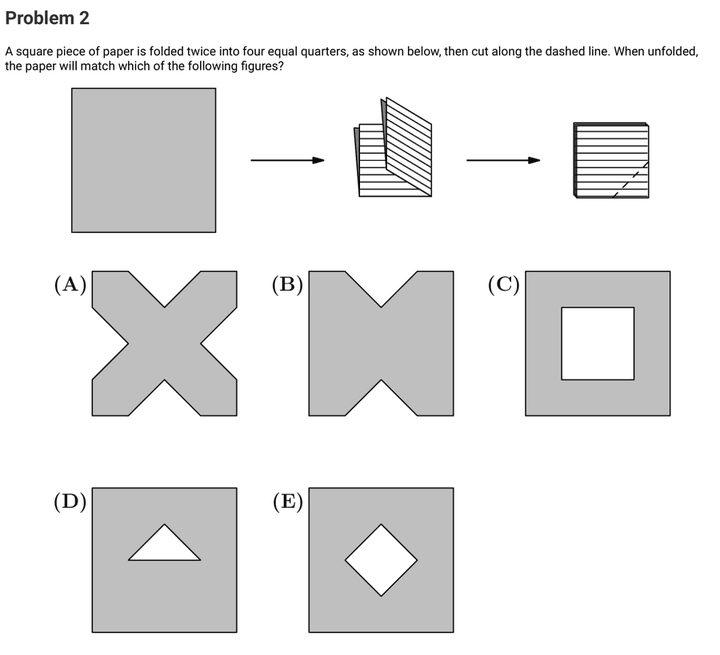
Where does each folded layer sit on the original sheet? That tells you how many spots the cut actually hits.
Show hint (sharpest)
Folding twice into quarters stacks four layers at one corner — and that corner is the center of the original sheet. Whatever the cut removes there happens four times, around the middle.
Show solution
Folding the square twice into quarters brings all four corners together; the folded corner is the center of the full sheet.
The diagonal cut slices across that folded stack, snipping a small triangle from all four layers at once.
Unfolding, those four snips open up into a single diamond-shaped hole in the middle of the paper — figure (E).
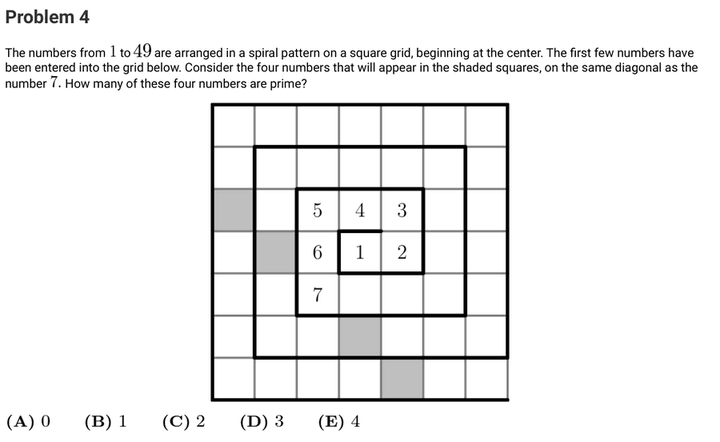
Forget the spiral pattern — what matters is which numbers end up on those four squares.
Show hint (sharpest)
Find the four shaded numbers first (they sit on the diagonal through 7), then test each one for being prime.
Show solution
Continuing the spiral outward, the diagonal through 7 (going up-left and down-right) contains the four shaded numbers 19, 23, 39, 47.
Test each: 19 prime, 23 prime, 47 prime; but 39 = 3 × 13 is composite.
So 3 of the four shaded numbers are prime.
D
Three of them are prime.
Another way: use perfect squares as landmarks (MAA)
Without filling the whole grid: on an n×n spiral the number n2 sits in the upper-left (n even) or lower-right (n odd) corner. So 9 is at lower-right of the 3×3 block, 25 at lower-right of 5×5, 49 at lower-right of 7×7; 16 at upper-left of 4×4, 36 at upper-left of 6×6.
Walking outward from those anchors locates the four shaded squares as 19, 23, 39, 47 — with 39 = 3 × 13 the only composite.
A lake contains 250 trout, along with a variety of other fish. When a marine biologist catches and releases a sample of 180 fish from the lake, 30 are identified as trout. Assume the ratio of trout to the total number of fish is the same in both the sample and the lake. How many fish are there in the lake?
Show hint (soft nudge)
The fraction of trout should be the same in the sample as in the whole lake.
Show hint (sharpest)
The fraction of the sample that is trout should equal the fraction of the whole lake that is trout. Set the two fractions equal.
Show solution
In the sample, 30 of 180 are trout: 30 ÷ 180 = 16.
So trout make up 16 of the whole lake too.
If 250 trout are 16 of the fish, the total is 250 × 6 = 1500.