Tick one or more bands and topics — problems are pulled from every authored year.
Showing 20 of 205 matching
Problem 16 · 2026 AMC 8
Hard
Number Theorydivisibility-rule
Consider all positive four-digit integers whose digits are all even. What fraction of these integers are divisible by 4?
Show hint (soft nudge)
Divisibility by 4 depends only on the last two digits.
Show hint (sharpest)
With an even tens digit, the tens part is already a multiple of 4, so only the units digit decides it.
Show solution
A number is divisible by 4 exactly when its last two digits are. With an even tens digit, 10·(tens) is already a multiple of 4, so it comes down to the units digit being 0, 4, or 8.
That's 3 of the 5 even units digits, and it holds for every choice of the other digits, so the fraction is 3/5.
Four students sit in a row and chat with the people next to them. They then rearrange themselves so that no one is seated next to anyone they sat next to before. How many such rearrangements are possible?
Show hint (soft nudge)
Label the seats 1, 2, 3, 4; the forbidden neighbor-pairs are 1-2, 2-3, and 3-4.
Show hint (sharpest)
Try to build a valid order — the options turn out to be very tight.
Show solution
No two originally-adjacent students may be neighbors, so none of 1-2, 2-3, 3-4 can touch.
The only orders that work are 2-4-1-3 and its reverse 3-1-4-2, giving 2 rearrangements.
Miguel and his dog Luna start together at a park entrance. Miguel throws a ball straight ahead to a tree and keeps walking at a steady pace. Luna sprints to the ball and immediately brings it back to Miguel. Luna runs 5 times as fast as Miguel walks. What fraction of the entrance-to-tree distance does Miguel cover by the time Luna brings him the ball?
Show hint (soft nudge)
In the same time, Luna covers 5 times the distance Miguel does.
Show hint (sharpest)
Luna's path is entrance → tree → Miguel; set its length to 5 times Miguel's walk.
Show solution
Let the entrance-to-tree distance be 1 and Miguel's distance be d. Luna runs to the tree and back to Miguel: 1 + (1 − d) = 2 − d.
Since Luna covers 5 times Miguel's distance, 5d = 2 − d, so 6d = 2 and d = 1/3.
The land of Catania uses gold coins (1 mm thick) and silver coins (3 mm thick). In how many ways can Taylor make a stack exactly 8 mm tall using any arrangement of gold and silver coins, where order matters?
Show hint (soft nudge)
Let f(n) count stacks of height n; the top coin is either gold (leaving n − 1) or silver (leaving n − 3).
Show hint (sharpest)
Build the counts up from small heights using f(n) = f(n−1) + f(n−3).
Five distinct integers from 1 to 10 are chosen, and five distinct integers from 11 to 20 are chosen. No two numbers differ by exactly 10. What is the sum of the ten chosen numbers?
Show hint (soft nudge)
Each chosen low number blocks exactly one high number. How many highs are left to choose from?
Show hint (sharpest)
Five chosen lows block five highs — leaving exactly five unblocked highs, which are forced to be picked. They're the highs matching the unchosen lows + 10.
Show solution
Each chosen low (say x) blocks the high x + 10. With 5 lows chosen, 5 highs are blocked — so the 5 chosen highs are exactly the 5 unblocked ones: those that are 10 more than the 5 unchosen lows.
Sum of chosen highs = (sum of unchosen lows) + 5 × 10. So (chosen lows) + (chosen highs) = (chosen lows) + (unchosen lows) + 50 = (sum of 1 to 10) + 50.
1 + 2 + … + 10 = 55, so the total is 55 + 50 = 105.
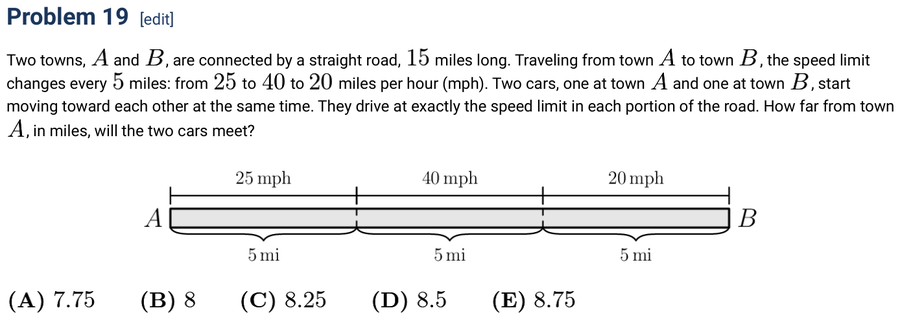
Once both cars are in the middle section, they're going the same speed — the asymmetry is in how they got there.
Show hint (sharpest)
Car A reaches the middle in 5/25 = 1/5 hr; car B in 5/20 = 1/4 hr. A has a 1/20-hr head start in the middle section — that's 2 miles.
Show solution
Car A's left section is 5 miles at 25 mph → reaches the middle in 5/25 = 1/5 hr. Car B's right section is 5 miles at 20 mph → reaches the middle in 5/20 = 1/4 hr. A enters the middle 1/20 hr before B.
In that 1/20 hr, A travels 40 × 1/20 = 2 miles, so when B enters the middle, A is at mile 7, B at mile 10 — a 3-mile gap.
Both now go 40 mph, closing at 80 mph. They split the 3-mile gap equally: each covers 1.5 miles. A is at 7 + 1.5 = 8.5 miles from A.
Sarika, Dev, and Rajiv are sharing a large block of cheese. They take turns cutting off half of what remains and eating it: first Sarika eats half of the cheese, then Dev eats half of the remaining half, then Rajiv eats half of what remains, then back to Sarika, and so on. They stop when the cheese is too small to see. About what fraction of the original block of cheese does Sarika eat in total?
Show hint (soft nudge)
Sarika eats on turns 1, 4, 7, … — every third turn. What fraction does each Sarika-bite eat?
Show hint (sharpest)
Sarika's bites are 1/2, then 1/16, then 1/128, … — a geometric series with ratio 1/8.
Show solution
Each turn eats half of what's left, so the cheese remaining after turn n is 1/2n. Sarika eats at turns 1, 4, 7, …, taking 12, 116, 1128, … of the original block.
Geometric series with first term a = 12 and ratio r = 18.
Minh enters the numbers 1 through 81 into the cells of a 9 × 9 grid in some order. She calculates the product of the numbers in each row and column. What is the least number of rows and columns that could have a product divisible by 3?
Show hint (soft nudge)
Any row or column with even one multiple of 3 has a divisible-by-3 product. So you want the multiples of 3 packed into as few rows and columns as possible.
Show hint (sharpest)
Count of multiples of 3 in 1–81: 27. A 5×5 corner block fits 25; the other 2 spill into a 6th column.
Show solution
There are 27 multiples of 3 in 1–81. Any row or column containing a multiple of 3 gets a product divisible by 3, so we want the multiples confined to as few rows and columns as possible.
A 5×5 corner block holds only 25 multiples. The remaining 2 must spill out — place them in the 6th column of rows 1 and 2.
Jordan owns 15 pairs of sneakers. Three fifths of the pairs are red and the rest are white. Two thirds of the pairs are high-top and the rest are low-top. The red high-top sneakers make up a fraction of the collection. What is the least possible value of this fraction?
Show hint (soft nudge)
To minimize the overlap of "red AND high-top", let the OTHER kind (white) soak up as many high-tops as it can.
Show hint (sharpest)
9 red, 6 white. 10 high-top, 5 low-top. Make all 6 whites high-top; only 4 high-top spots remain — those must be red.
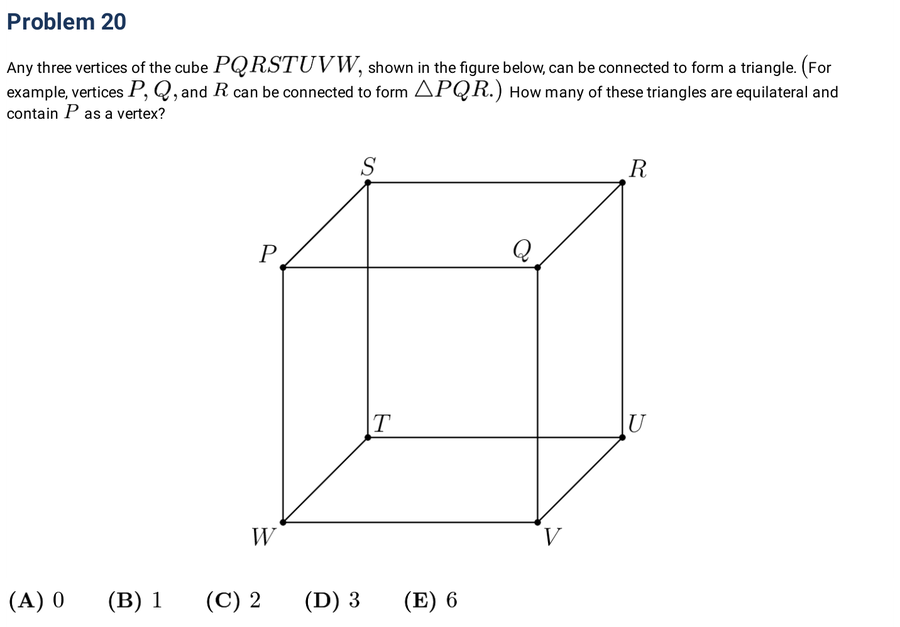
An equilateral triangle in a cube can't use edges or space diagonals as sides — only face diagonals work.
Show hint (sharpest)
P has 3 face-diagonal neighbors (one on each of P's three faces). Any 2 of those 3 are also face-diagonal apart, so each pair forms an equilateral triangle with P.
Show solution
Edges have length 1, face diagonals √2, space diagonals √3. An equilateral triangle must use sides of one length, and only face diagonals can form a closed triangle on a cube.
The vertices at face-diagonal distance from P are R, T, V (one on each of P's three faces).
Every pair of {R, T, V} is also a face diagonal (they lie on the three faces opposite to P), so {P, R, T}, {P, R, V}, {P, T, V} are all equilateral.
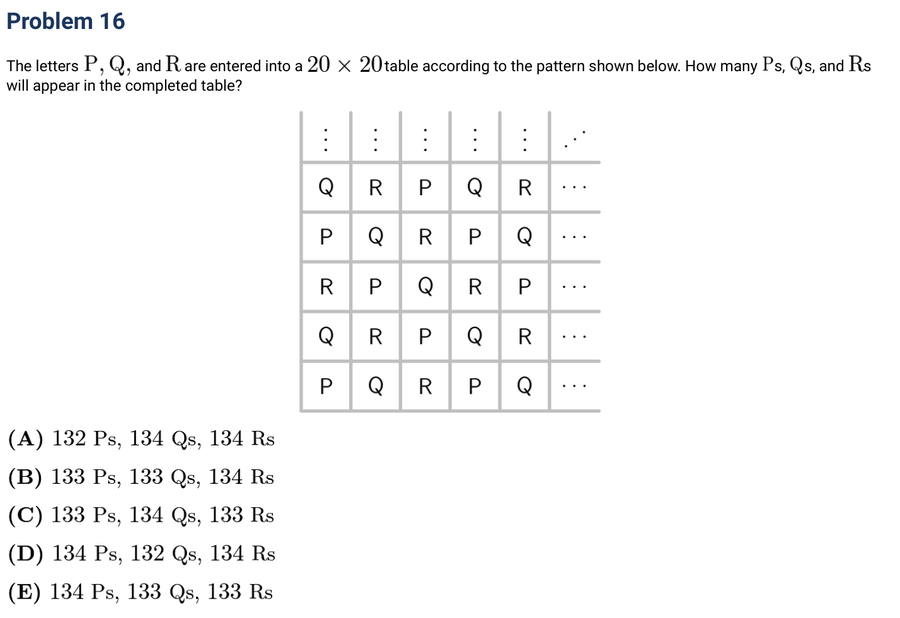
20 × 20 = 400 cells, with the letters cycling P, Q, R. How does 400 split among three letters?
Show hint (sharpest)
400 = 3 × 133 + 1, so one letter gets the extra 1. By the table's diagonals, P-count = R-count — so Q takes the extra.
Show solution
The board has 20 × 20 = 400 cells, and the P/Q/R pattern repeats every 3 cells diagonally. 400 = 3 × 133 + 1, so the counts are 133, 133, 134 in some order.
Look at the lower-left 2 × 2 corner of the pattern: Q R / P Q — one P, two Qs, one R. By the rest of the board's symmetry (P and R balance), the corner's extra Q is the surplus.
Greta Grasshopper sits on a long line of lily pads in a pond. From any lily pad, Greta can jump 5 pads to the right or 3 pads to the left. What is the fewest number of jumps Greta must make to reach the lily pad located 2023 pads to the right of her starting position?
Show hint (soft nudge)
Order doesn't matter — only the counts of right and left jumps. Set up an equation in R and L.
Show hint (sharpest)
5R − 3L = 2023. Need R ≥ 405 and 5R − 2023 divisible by 3.
Show solution
Order doesn't matter. Let R = right jumps, L = left jumps. Then 5R − 3L = 2023, with R, L ≥ 0.
Minimum R: R ≥ 405 (else 5R < 2023, leaving negative L). And 5R − 2023 must be divisible by 3.
Mod 3: 5R ≡ 2R, and 2023 ≡ 1, so 2R ≡ 1 ⇒ R ≡ 2 (mod 3). The smallest R ≥ 405 satisfying this is 407.
Then L = (5·407 − 2023)/3 = 12/3 = 4. Total: 407 + 4 = 411 jumps.
Two integers are inserted into the list 3, 3, 8, 11, 28 to double its range. The mode and median remain unchanged. What is the maximum possible sum of two additional numbers?
Show hint (soft nudge)
Original range = 28 − 3 = 25. New range = 50. To maximize the sum, push the new max as high as possible.
Show hint (sharpest)
Keep min = 3 ⇒ new max = 3 + 50 = 53. That's one insert. Now find the largest second insert that keeps median = 8 and mode = 3.
Show solution
Range doubles from 25 to 50. To maximize the sum, leave the min at 3 and stretch the max: one insert = 3 + 50 = 53.
With 7 numbers, the median is the 4th. Sorted so far: 3, 3, 8, 11, 28, 53 (6 values). The 2nd insert x must keep median = 8.
If x > 8, the 4th value shifts off 8 (and choosing x = 8 ties the mode with two 8's). So x ≤ 7.
Maximum x = 7 (mode stays uniquely 3). Sum = 53 + 7 = 60.