The integers 1 through 25 are arbitrarily separated into five groups of 5 numbers each. The median of each group is found, and M is the median of those five medians. What is the least possible value of M?
Show hint (soft nudge)
M is the 3rd-smallest of the five medians, so you want three groups with small medians.
Show hint (sharpest)
Each small median needs two even-smaller numbers beneath it, and small numbers are in limited supply.
Show solution
To make M small, three groups need small medians, each requiring two smaller numbers below it. Using 1–6 as those "below" numbers lets three groups have medians 7, 8, and 9, while the other two groups absorb the large numbers.
Trying for M = 8 fails: three medians ≤ 8 would need six distinct numbers below them all drawn from {1,…,5}, which isn't enough.
The notation n! is the product of the first n positive integers. Define the superfactorial of n to be the product of the factorials 1! · 2! · 3! · … · n! (so the superfactorial of 3 is 1! · 2! · 3! = 12). How many factors of 7 appear in the prime factorization of the superfactorial of 51?
Show hint (soft nudge)
The 7-count of the superfactorial is the sum of the 7-counts of 1! through 51!.
Show hint (sharpest)
Each k! holds ⌊k/7⌋ + ⌊k/49⌋ sevens; group the values of k by that count.
Show solution
The number of 7s is the sum of v₇(k!) for k = 1 to 51, where v₇(k!) = ⌊k/7⌋ + ⌊k/49⌋.
Seven values of k each contribute 1, 2, 3, 4, 5, and 6, totaling 7(1+2+3+4+5+6) = 147; and k = 49, 50, 51 contribute 8 each, adding 24.
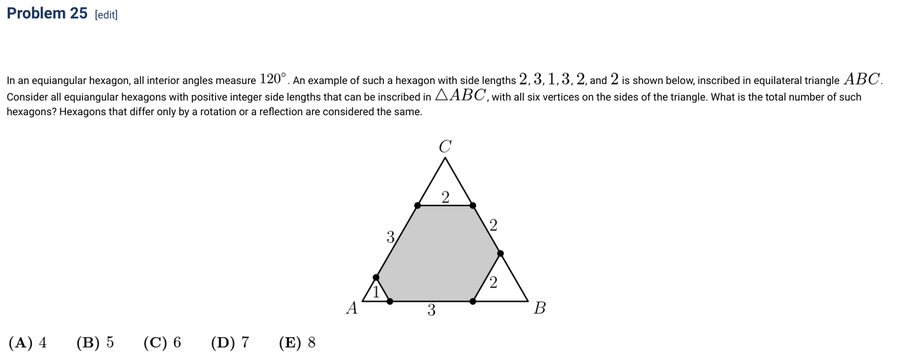
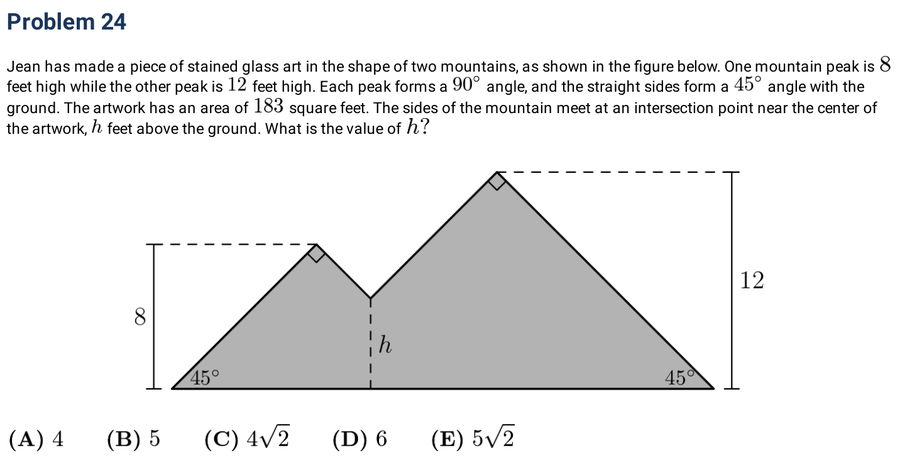
Such a hexagon is the equilateral triangle with three corner equilateral triangles cut off.
Show hint (sharpest)
If the triangle has side 6, the three integer cut sizes must leave each middle segment ≥ 1, so each pair of cuts sums to at most 5.
Show solution
The triangle ABC has side 6 (from the example: 1 + 3 + 2). Cutting integer-sized corners a, b, c leaves middle segments 6 − a − b, 6 − b − c, 6 − c − a, which must each be ≥ 1, so every pair of cuts sums to at most 5.
Counting unordered cut-triples {a, b, c} of positive integers with all pairwise sums ≤ 5 gives {1,1,1}, {1,1,2}, {1,2,2}, {2,2,2}, {1,1,3}, {1,2,3}, {2,2,3}, {1,1,4} — that's 8 hexagons (rotations and reflections counted once).
Look at the largest group of pods that are all directly connected to each other — their grades are forced into a small set.
Show hint (sharpest)
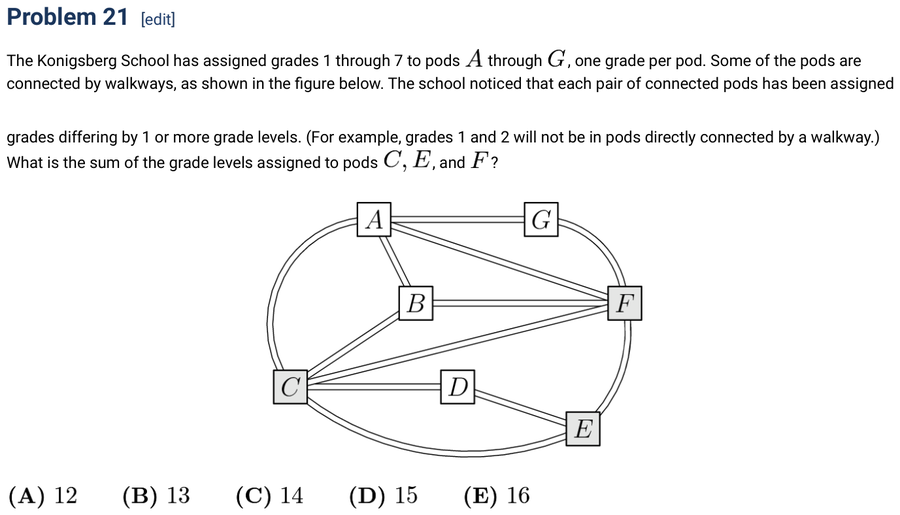
Pods A, B, C, F form a 4-clique. The only 4-element subset of {1,…,7} with every pair differing by at least 2 is {1, 3, 5, 7}.
Show solution
Among A, B, C, F every pair is directly connected, so all four pairs differ by ≥ 2. The only way to pick 4 numbers from 1–7 with that property is the set {1, 3, 5, 7}.
G connects to A and F. If G = 2, then A, F ≠ 1 or 3, forcing {A, F} ⊂ {5, 7} and {B, C} = {1, 3}.
D and E only touch C and F. The extreme grades 1 and 7 each have just one neighbor in this clique, so place 1 at C and 7 at F. The remaining {4, 6} go to D, E.
Filling in: D = 6 (avoids 7 enough), E = 4 (avoids 1 and 7), B = 3 (next to C = 1), A = 5. All constraints hold.
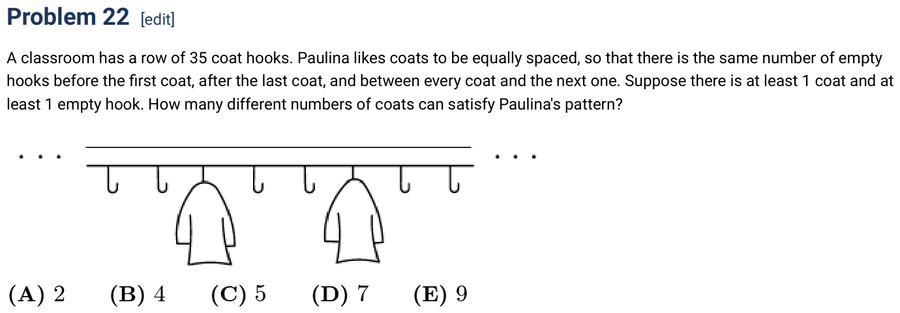
Imagine adding a phantom coat after the last one. Now the row is a clean repeating pattern.
Show hint (sharpest)
After the phantom, you have 36 hooks split into d identical blocks of b hooks each, with b ≥ 2 and d ≥ 2. How many (b, d) factorizations of 36 are there?
Show solution
Add a phantom coat after the last real coat. Now 36 hooks form a perfectly repeating pattern: each block is (some empty hooks) + (one coat), of length b ≥ 2.
If there are d blocks, then bd = 36, and the real coat count = d − 1 (we added one).
Both b ≥ 2 (each block has ≥ 1 empty + 1 coat) and d ≥ 2 (at least 1 original coat + the phantom).
36 = 22 × 32 has (2+1)(2+1) = 9 divisors. Removing the two ordered factorizations with a 1 (1×36 and 36×1) leaves 9 − 2 = 7.
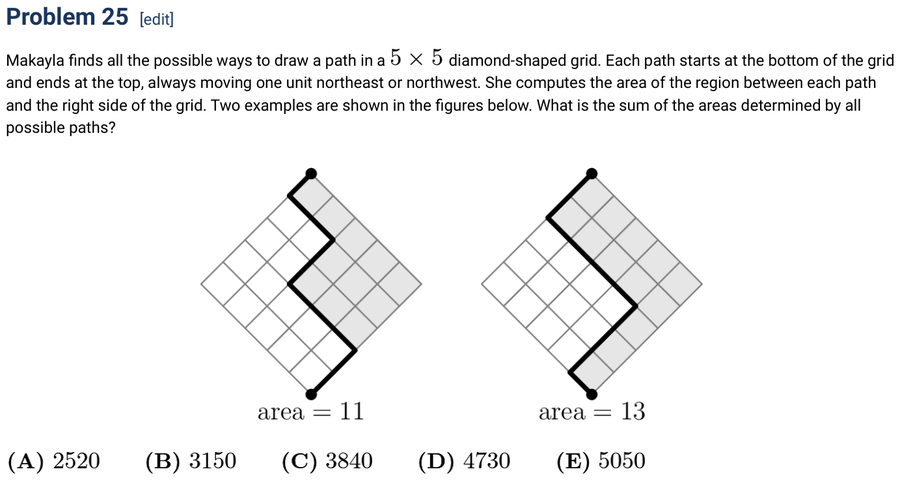
By left/right symmetry, the total of right-side areas equals the total of left-side areas. What does each path's left + right equal?
Show hint (sharpest)
Per path: area_left + area_right = 25 (the whole diamond). And the number of paths = ways to interleave 5 NE moves with 5 NW moves.
Show solution
Let X = the sum of right-side areas. By mirroring every path L ↔ R, the sum of left-side areas across all paths is also X. So 2X = total of (left + right) over all paths.
For each individual path, (left area) + (right area) = 25 (the full 5×5 diamond).
Number of paths: 5 NE moves and 5 NW moves interleaved = 10!5! · 5! = 252.
A group of frogs (called an army) is living in a tree. A frog turns green when in the shade and turns yellow when in the sun. Initially, the ratio of green to yellow frogs was 3 : 1. Then 3 green frogs moved to the sunny side and 5 yellow frogs moved to the shady side. Now the ratio is 4 : 1. What is the difference between the number of green frogs and yellow frogs now?
Show hint (soft nudge)
Express both populations in one variable (yellow), then write the new ratio as an equation.
Show hint (sharpest)
After moves: green = 3y + 2, yellow = y − 2. Set (3y+2)/(y−2) = 4.
Show solution
Let y = initial yellow count, so initial green = 3y.
After the moves: green = 3y + 5 − 3 = 3y + 2 (5 in, 3 out). Yellow = y + 3 − 5 = y − 2.
New ratio: 3y + 2y − 2 = 4 ⇒ 3y + 2 = 4y − 8 ⇒ y = 10. So initial green = 30, yellow = 10.
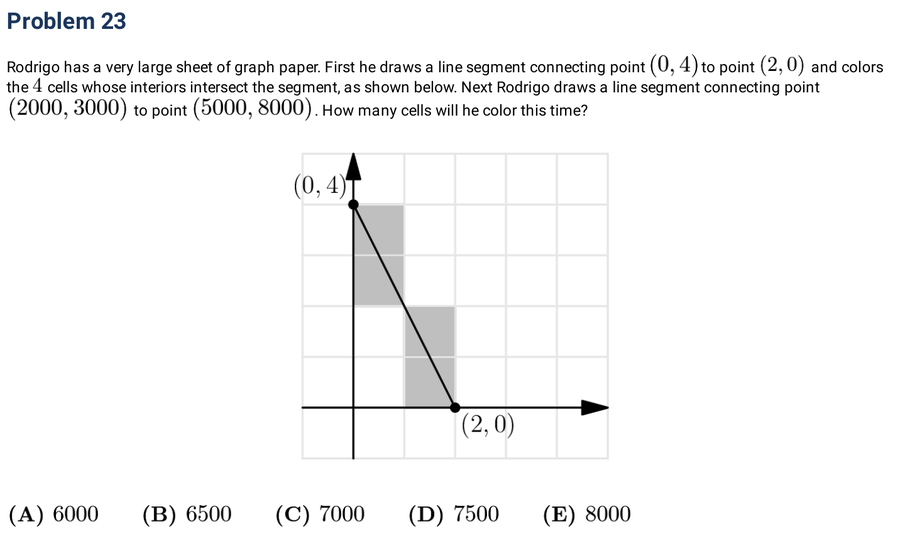
The example (0,4) to (2,0) crosses 4 cells. Notice: 2 + 4 − gcd(2,4) = 4. That's a general formula.
Show hint (sharpest)
Apply the formula to (3000, 5000) horizontal/vertical offsets: 3000 + 5000 − gcd(3000, 5000).
Show solution
A line segment whose horizontal offset is a and vertical offset is b crosses a + b − gcd(a, b) grid cells. (You'd cross a + b cells if the line never hit a grid corner; each lattice-point crossing collapses two cell-entries into one, saving 1 per shared factor.)
From (2000, 3000) to (5000, 8000): horizontal offset 3000, vertical offset 5000.
The slope from (2000, 3000) to (5000, 8000) is 5/3. The segment is equivalent to 1000 copies of a primitive (0,0)→(3,5) piece, since gcd(3000, 5000) = 1000.
Alina writes the numbers 1, 2, …, 9 on separate cards, one number per card. She wishes to divide the cards into 3 groups of 3 cards so that the sum of the numbers in each group will be the same. In how many ways can this be done?
Show hint (soft nudge)
What must each group sum to? And what constraint does that put on where the biggest (and smallest) numbers go?
Show hint (sharpest)
Each group sums to 15. 7, 8, 9 must be in different groups (and so must 1, 2, 3). Then case-split on which group holds 5.
Show solution
1+2+…+9 = 45, so each group sums to 15.
7, 8, 9 must each go in a different group (else one group is already ≥ 15 with too much room left). Similarly 1, 2, 3 must go in different groups.
Consider the group containing 5. Its other two values sum to 10. Possibilities: {3, 5, 7}, {2, 5, 8}, or {1, 5, 9}. The {2, 5, 8} option fails (no way to finish), leaving 2 valid partitions: {1,5,9}/{3,4,8}/{2,6,7} and {3,5,7}/{1,6,8}/{2,4,9}.
In a sequence of positive integers, each term after the second is the product of the previous two terms. The sixth term in the sequence is 4000. What is the first term?
Show hint (soft nudge)
Write the first six terms as a, b, and powers of a and b. The 6th term will be a3b5.
Show hint (sharpest)
Factor 4000: 4000 = 53 × 25. Match exponents.
Show solution
Let the first two terms be a, b. Then the next four are ab, ab2, a2b3, a3b5. (Each term sums the exponents of the previous two.)
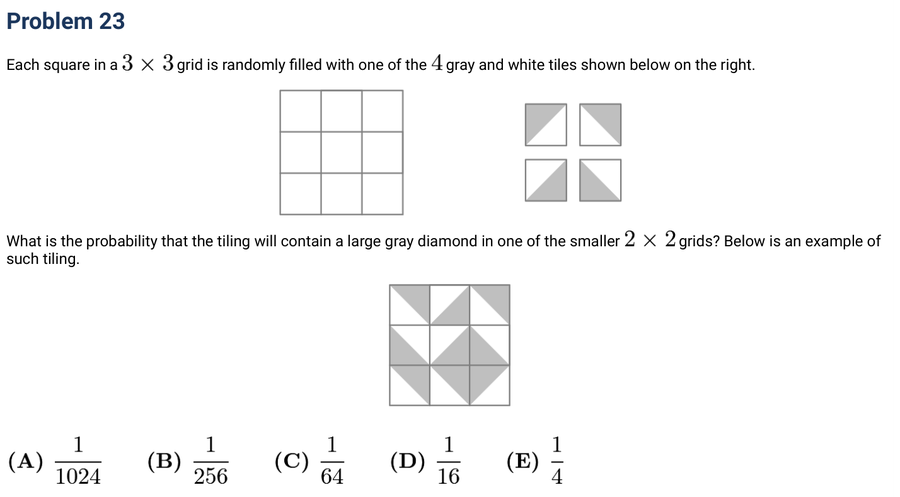
Where could the gray diamond go? Its center must be at one of the four corners of the middle cell.
Show hint (sharpest)
For a chosen diamond location, the 4 surrounding tiles are forced (1 valid orientation each); the remaining 5 tiles are free (4 choices each).
Show solution
Total tilings: 49 (each of 9 cells gets 1 of 4 tiles).
Favorable: choose 1 of 4 possible diamond positions (corners of the center cell), forcing 4 specific tile orientations. The remaining 5 tiles are free: 45 options. Total: 4 × 45 = 46.
Probability = 4649 = 143 = 164.
C
1/64.
Another way: probability the 3 neighbors of the center orient correctly (MAA)
If the diamond exists, the center cell has one all-gray corner; the 3 tiles adjacent to that corner must orient to extend the gray.
Each of those 3 tiles has probability 1/4 of the right orientation. So total probability = (1/4)3 = 1/64.