Focused Practice

Across all years

Tick one or more bands and topics — problems are pulled from every authored year.

Showing 20 of 205 matching
Difficulty bands: (none = all 25)
Topics: (none = all topics)
Order:
Problem 6 · 2026 AMC 8 Medium
Geometry & Measurement area-decomposition
amc8-2026-06
Show hint (soft nudge)
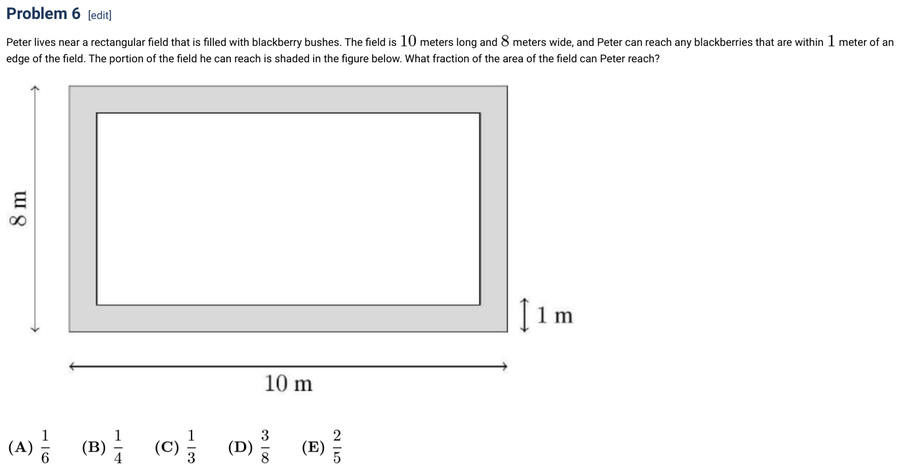
The part Peter can't reach is the inner rectangle more than 1 m from every edge.
Show hint (sharpest)
Shrink each dimension by 2 (one meter on each side).
Show solution
  1. The unreachable middle is (10 − 2) × (8 − 2) = 48, out of the field's 10 × 8 = 80.
  2. So the reachable border is 80 − 48 = 32, a fraction 32/80 = 2/5.
E 2/5.
Mark: · log in to save
Problem 7 · 2026 AMC 8 Medium
Fractions, Decimals & Percents fraction-of

Mika wants to estimate how far a new electric bike goes on a full charge. She made two trips totaling 40 miles: the first used 12 of the battery and the second used 310 of the battery. How many miles can the bike go on a fully charged battery?

Show hint (soft nudge)
Add the two battery fractions to see what share of a full charge covered the 40 miles.
Show hint (sharpest)
Then scale up from that share to a whole battery.
Show solution
  1. The two trips used ½ + 3/10 = 4/5 of the battery for 40 miles.
  2. A full battery covers 40 ÷ (4/5) = 50 miles.
C 50 miles.
Mark: · log in to save
Problem 8 · 2026 AMC 8 Medium
Fractions, Decimals & Percents reduce-fraction

A poll asked some people whether they liked solving mathematics problems, and exactly 74% answered "yes." What is the fewest possible number of people who could have been asked?

Show hint (soft nudge)
74% of the group must be a whole number of people.
Show hint (sharpest)
Reduce 74/100 to lowest terms; the denominator is the smallest possible group size.
Show solution
  1. 74% = 74/100 = 37/50 in lowest terms, so the number of people must be a multiple of 50.
  2. The fewest is 50.
D 50 people.
Mark: · log in to save
Problem 9 · 2026 AMC 8 Medium
Number Theory simplify-radicals
amc8-2026-09
Show hint (soft nudge)
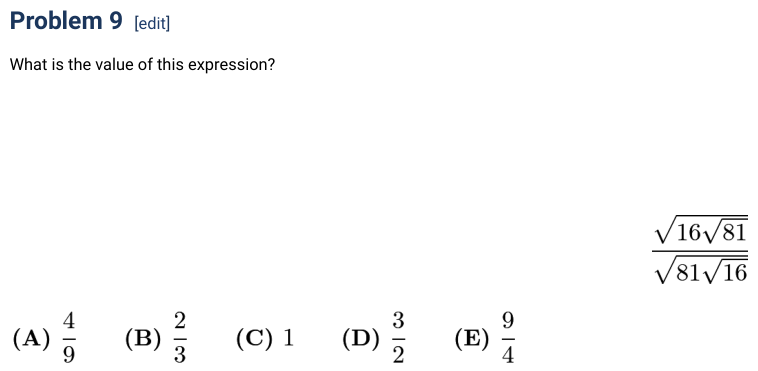
Work the inner square roots first: √81 = 9 and √16 = 4.
Show hint (sharpest)
Then take the outer square roots of the two products.
Show solution
  1. Inside the radicals, 16√81 = 16 · 9 = 144 and 81√16 = 81 · 4 = 324.
  2. So the value is √144 / √324 = 12 / 18 = 2/3.
B 2/3.
Mark: · log in to save
Problem 10 · 2026 AMC 8 Medium
Logic & Word Problems ordering

Five runners finished a race: Luke, Melina, Nico, Olympia, and Pedro. Nico finished 11 minutes behind Pedro. Olympia finished 2 minutes ahead of Melina but 3 minutes behind Pedro. Olympia finished 6 minutes ahead of Luke. Which runner finished fourth?

Show hint (soft nudge)
Place everyone on a timeline measured from Pedro.
Show hint (sharpest)
Then read off who is fourth from the front.
Show solution
  1. Measuring minutes behind Pedro: Olympia +3, Melina +5 (2 behind Olympia), Luke +9 (6 behind Olympia), Nico +11.
  2. The order is Pedro, Olympia, Melina, Luke, Nico, so fourth is Luke.
A Luke.
Mark: · log in to save
Problem 6 · 2025 AMC 8 Medium
Number Theory divisibility mod-10

Sekou writes down the numbers 15, 16, 17, 18, 19. After he erases one of his numbers, the sum of the remaining four numbers is a multiple of 4. Which number did he erase?

Show hint (soft nudge)
Adding the five up and testing each removal is slow. What does each number have in common with 4?
Show hint (sharpest)
Look at each number's remainder when divided by 4. The remainder of the whole sum tells you which one to erase.
Show solution
  1. Remainders mod 4: 15→3, 16→0, 17→1, 18→2, 19→3. Their sum is 9, which leaves remainder 1 mod 4.
  2. To make the remaining four sum divisible by 4, erase the one whose remainder is 1 — that's 17.
C 17.
Mark: · log in to save
Problem 7 · 2025 AMC 8 Easy
Counting & Probability complementary-counting

On the most recent exam in Prof. Xochi's class,

  • 5 students earned a score of at least 95%,
  • 13 students earned a score of at least 90%,
  • 27 students earned a score of at least 85%, and
  • 50 students earned a score of at least 80%.

How many students earned a score of at least 80% and less than 90%?

Show hint (soft nudge)
The four categories nest inside each other — "at least 80%" includes the "at least 90%" group.
Show hint (sharpest)
Take "at least 80%" and subtract off "at least 90%" to get the 80–90% band.
Show solution
  1. The 13 students who scored at least 90% are inside the 50 who scored at least 80%.
  2. Students in [80%, 90%) = 50 − 13 = 37.
D 37 students.
Mark: · log in to save
Problem 8 · 2025 AMC 8 Medium
Geometry & Measurement spatial-reasoning area square-area
amc8-2025-08
Show hint (soft nudge)
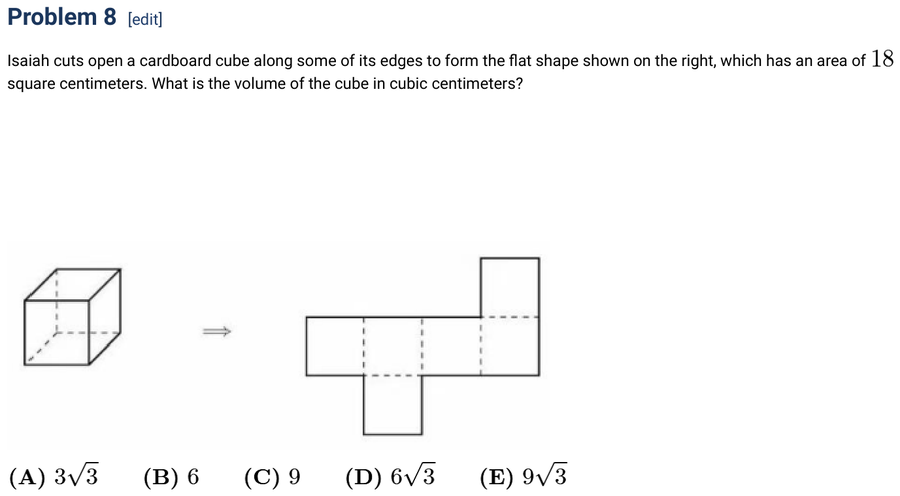
A cube has the same area on every face. The flat shape just lets you count those faces.
Show hint (sharpest)
Six identical squares with total area 18 means each has area 3 — so each side of the cube is √3.
Show solution
  1. The unfolded cube is 6 identical squares (one for each face). So each face has area 18 ÷ 6 = 3, and the side length is √3.
  2. Volume = side3 = (√3)3 = 3√3.
A 3√3 cubic centimeters.
Mark: · log in to save
Problem 9 · 2025 AMC 8 Medium
Arithmetic & Operations arithmetic-series
amc8-2025-09
Show hint (soft nudge)
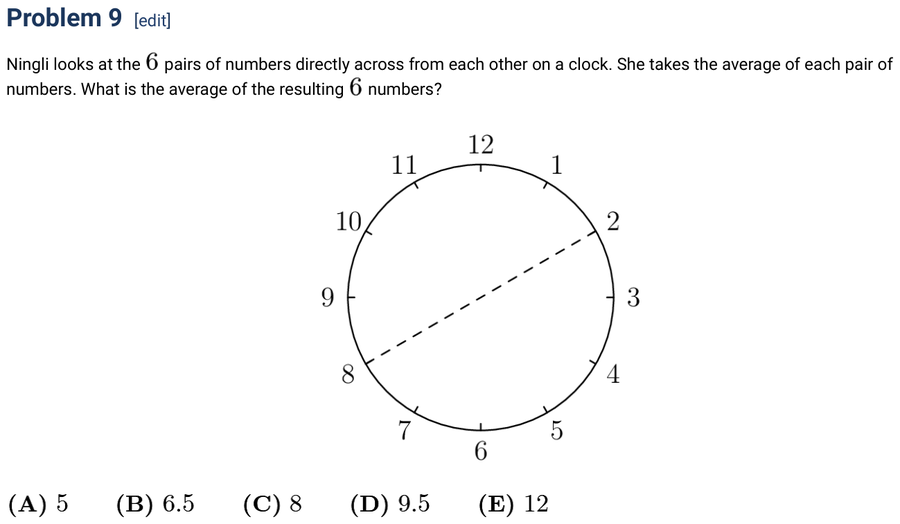
Each of the 12 clock numbers appears in exactly one pair. So the 6 pair-averages together "see" all 12 numbers.
Show hint (sharpest)
When every number shows up exactly once across the pairs, the average of the pair-averages equals the average of all 12 numbers.
Show solution
  1. The six pairs together include every clock number 1–12 exactly once, so the average of the six pair-averages is the same as the average of 1–12.
  2. 1–12 are evenly spaced, so their average is the midpoint: (1 + 12)/2 = 6.5.
B 6.5.
Mark: · log in to save
Problem 10 · 2025 AMC 8 Medium
Geometry & Measurement area area-decomposition transformations
amc8-2025-10
Show hint (soft nudge)
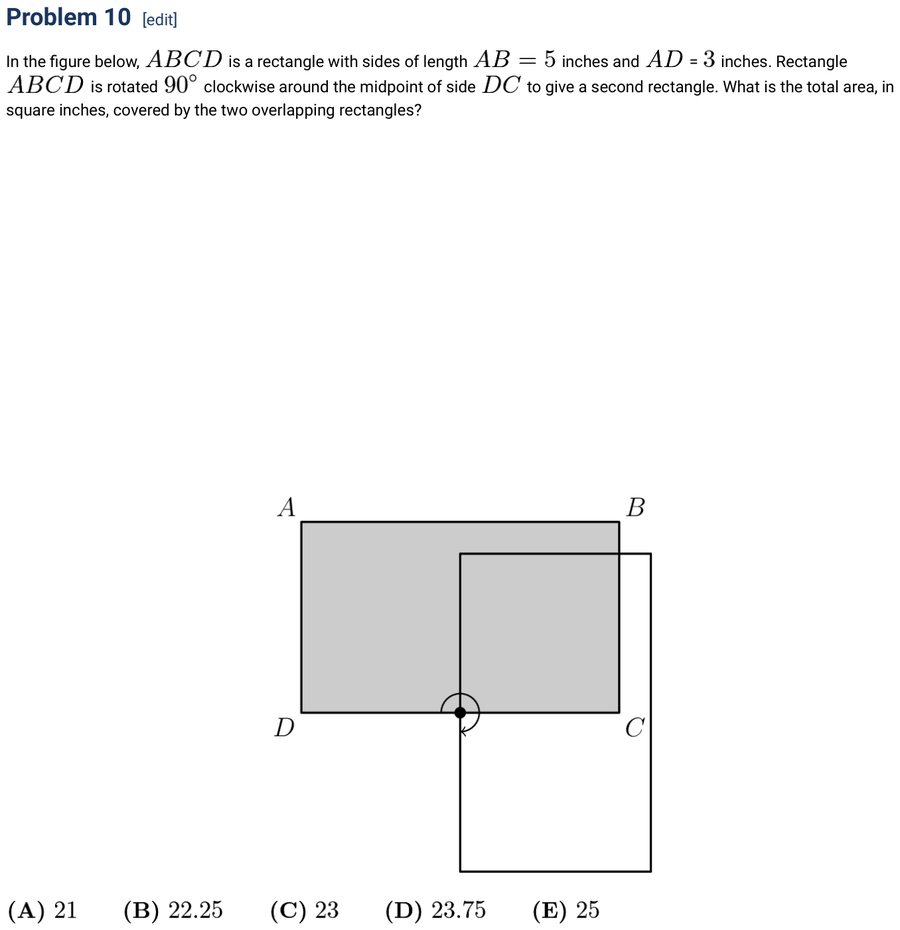
When two shapes overlap, adding their areas counts the overlap twice. What's the shape of that overlap?
Show hint (sharpest)
Inclusion–exclusion: (area of one) + (area of the other) − (area of overlap). The overlap is a square of side 2.5.
Show solution
  1. Each rectangle has area 5 × 3 = 15.
  2. Rotated 90° about the midpoint of DC, the second rectangle's lower-left quarter overlaps the first rectangle's lower-right quarter — a 2.5 by 2.5 square (half of DC = 2.5), area 2.52 = 6.25.
  3. Total area covered = 15 + 15 − 6.25 = 23.75.
D 23.75 square inches.
Mark: · log in to save
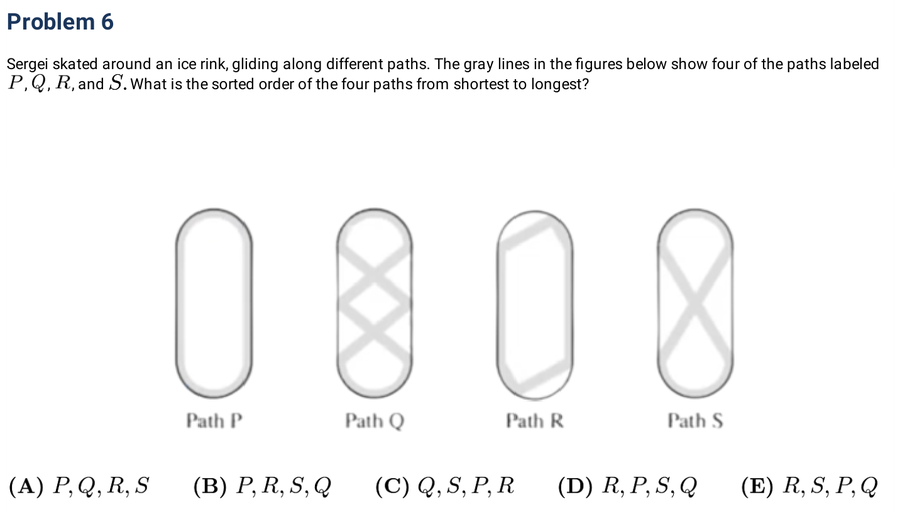
Problem 6 · 2024 AMC 8 Medium
Geometry & Measurement spatial-reasoning perimeter
amc8-2024-06
Show hint (soft nudge)
Use the plain oval P as a baseline. Which paths cut corners (shorter) and which add diagonals (longer)?
Show hint (sharpest)
R uses straight shortcuts across the rounded ends — shorter than P. S and Q swap edges for diagonals; a diagonal is a hypotenuse, always longer than the legs it replaces.
Show solution
  1. R cuts the rounded ends with straight chords, so R is strictly shorter than P. Shortest.
  2. S adds one diagonal X inside the oval — the diagonal is a hypotenuse, longer than the legs P would take. So S > P.
  3. Q adds two diagonals, longer still: Q > S.
  4. Order: R, P, S, Q — choice D.
D R, P, S, Q.
Mark: · log in to save
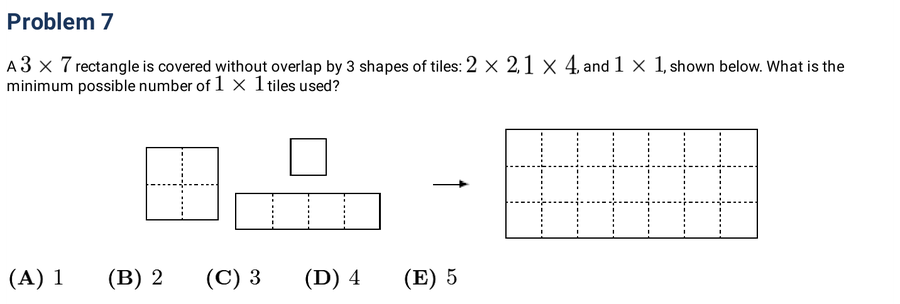
Problem 7 · 2024 AMC 8 Medium
Geometry & Measurement spatial-reasoning casework divisibility
amc8-2024-07
Show hint (soft nudge)
The 2×2 and 1×4 tiles each cover 4 squares. What does that tell you about the number of 1×1 tiles needed?
Show hint (sharpest)
21 squares total, and the 2×2 + 1×4 tiles fill a multiple of 4. So the 1×1 count is 1, 5, 9, … Try the smallest that actually fits.
Show solution
  1. Each 2×2 and 1×4 tile covers 4 unit squares, so together they fill a multiple of 4. The 1×1 count must equal 21 − (multiple of 4) ≡ 1 (mod 4): possible values 1, 5, 9, …
  2. Can we cover 20 of the 21 squares with 2×2 and 1×4 tiles, leaving just one 1×1? Trying shows it doesn't fit (a 3×7 rectangle with one cell removed can't be partitioned into 2×2's and 1×4's).
  3. 5 works: place four 2×2 and 1×4 tiles covering 16 squares, with the 5 remaining cells filled by 1×1's. Minimum = 5.
E 5 unit tiles.
Mark: · log in to save
Problem 8 · 2024 AMC 8 Medium
Counting & Probability careful-counting casework

On Monday Taye has $2. Every day, he either gains $3 or doubles the amount of money he had on the previous day. How many different dollar amounts could Taye have on Thursday, 3 days later?

Show hint (soft nudge)
Build a tree: from each daily amount, branch on +$3 or ×2. Some branches collide — just list the unique values.
Show hint (sharpest)
Tuesday: {$4, $5}. Wednesday: {$7, $8, $10} (the $8 from two paths). Thursday will land on 6 distinct values.
Show solution
  1. From $2 each day choose +$3 or ×2. Tuesday: 2+3=5 or 2×2=4 → {$4, $5}.
  2. Wednesday from {$4, $5}: 4+3=7, 4×2=8, 5+3=8, 5×2=10 → {$7, $8, $10}.
  3. Thursday from {$7, $8, $10}: 10, 14, 11, 16, 13, 20 → {$10, $11, $13, $14, $16, $20}.
  4. 6 distinct amounts.
D 6 different amounts.
Mark: · log in to save
Problem 9 · 2024 AMC 8 Medium
Number Theory divisibility substitution

All of the marbles in Maria's collection are red, green, or blue. Maria has half as many red marbles as green marbles and twice as many blue marbles as green marbles. Which of the following could be the total number of marbles in Maria's collection?

Show hint (soft nudge)
Pick one color to stand for a variable, then write the others in terms of it. The total reveals a hidden factor.
Show hint (sharpest)
Let r = red count. Green = 2r, blue = 4r. Total = 7r — it must be a multiple of 7.
Show solution
  1. Let r be the number of red marbles. Half as many red as green → green = 2r. Twice as many blue as green → blue = 4r.
  2. Total = r + 2r + 4r = 7r — always a multiple of 7.
  3. Among the choices, only 28 = 7 × 4 is a multiple of 7.
E 28 marbles.
Mark: · log in to save
Problem 10 · 2024 AMC 8 Easy
Arithmetic & Operations unit-rate

In January 1980 the Mauna Loa Observatory recorded carbon dioxide CO2 levels of 338 ppm (parts per million). Over the years the average CO2 reading has increased by about 1.515 ppm each year. What is the expected CO2 level in ppm in January 2030? Round your answer to the nearest integer.

Show hint
Multiply the per-year rate by the number of years, then add to the starting value.
Show solution
  1. Years elapsed: 2030 − 1980 = 50.
  2. Total increase: 50 × 1.515 = 75.75 ≈ 76 ppm.
  3. New level: 338 + 76 = 414.
B 414 ppm.
Mark: · log in to save
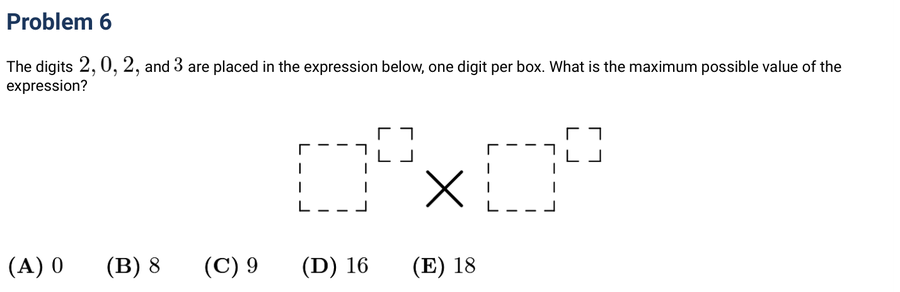
Problem 6 · 2023 AMC 8 Medium
Arithmetic & Operations order-of-operations casework
amc8-2023-06
Show hint (soft nudge)
Where should the 0 go to not kill the answer? Putting 0 in the base or as a factor makes things bad — what about as an exponent?
Show hint (sharpest)
Use 0 as an exponent (anything0 = 1) so that side becomes 1. Then maximize the other side with the digits {2, 2, 3}.
Show solution
  1. If 0 goes in a base or as a stand-alone factor, the product is 0. Use 0 as an exponent — that side becomes 1.
  2. The other side is baseexp using {2, 2, 3}: 23 = 8, 32 = 9, 22 = 4 (one digit unused). The largest is 32 = 9.
  3. Maximum product: 1 × 9 = 9.
C 9.
Mark: · log in to save
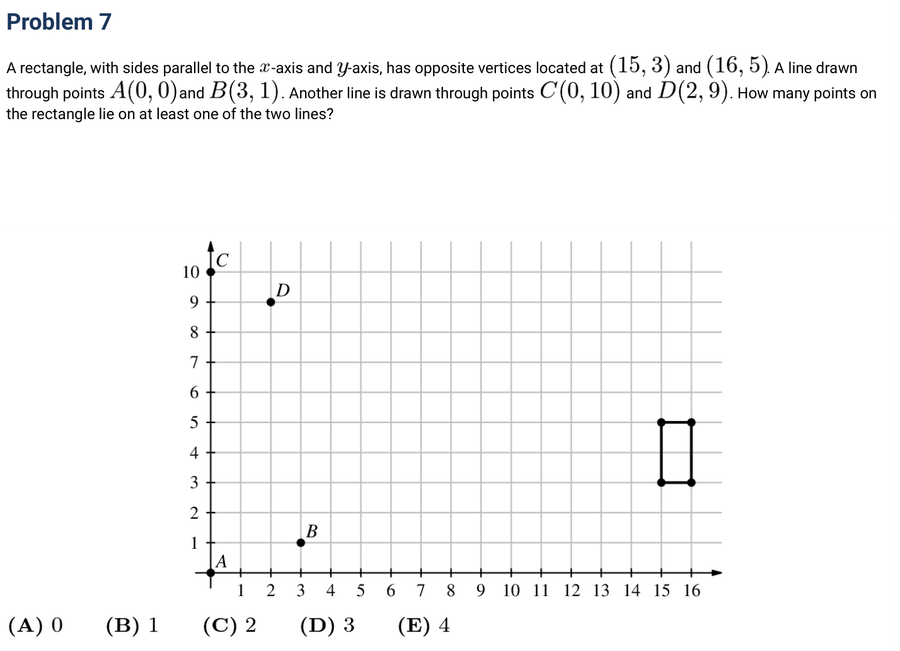
Problem 7 · 2023 AMC 8 Medium
Geometry & Measurement evaluate-formula grid
amc8-2023-07
Show hint (soft nudge)
Each line has a simple equation. Plug in x = 15 and x = 16 (the rectangle's left and right sides) and see whether the resulting y falls between 3 and 5.
Show hint (sharpest)
Line AB: y = x/3. Line CD: y = 10 − x/2. Test each at x = 15 and 16.
Show solution
  1. Rectangle: x ∈ [15, 16], y ∈ [3, 5].
  2. Line AB: y = x/3. At x = 15: y = 5 ✓ (hits the corner (15, 5)). At x = 16: y ≈ 5.33, above the rectangle.
  3. Line CD: y = 10 − x/2. At x = 15: y = 2.5, below. At x = 16: y = 2, below.
  4. Only (15, 5) lands on the rectangle — 1 point.
B 1 point.
Mark: · log in to save
Problem 8 · 2023 AMC 8 Medium
Logic & Word Problems sum-constraint casework
amc8-2023-08
Show hint (soft nudge)
Each round of the tournament has exactly two winners and two losers across the four players. So each column of the table sums to 2.
Show hint (sharpest)
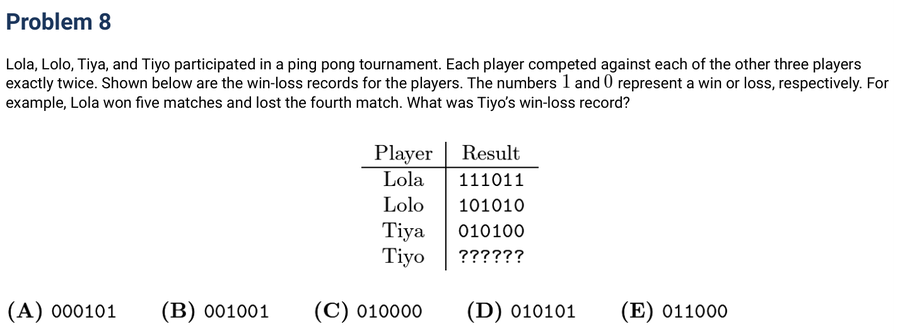
Add Lola + Lolo + Tiya for each of the 6 rounds. If that sum is 2, Tiyo lost; if 1, Tiyo won.
Show solution
  1. Per round, four players play two pairings, so exactly 2 wins and 2 losses are distributed each round.
  2. Sum Lola + Lolo + Tiya per round: 1+1+0=2, 1+0+1=2, 1+1+0=2, 0+0+1=1, 1+1+0=2, 1+0+0=1.
  3. Tiyo's slot = 2 − that sum each round: 0, 0, 0, 1, 0, 1 = 000101.
A 000101.
Mark: · log in to save
Problem 9 · 2023 AMC 8 Medium
Algebra & Patterns evaluate-formula
amc8-2023-09
Show hint (soft nudge)
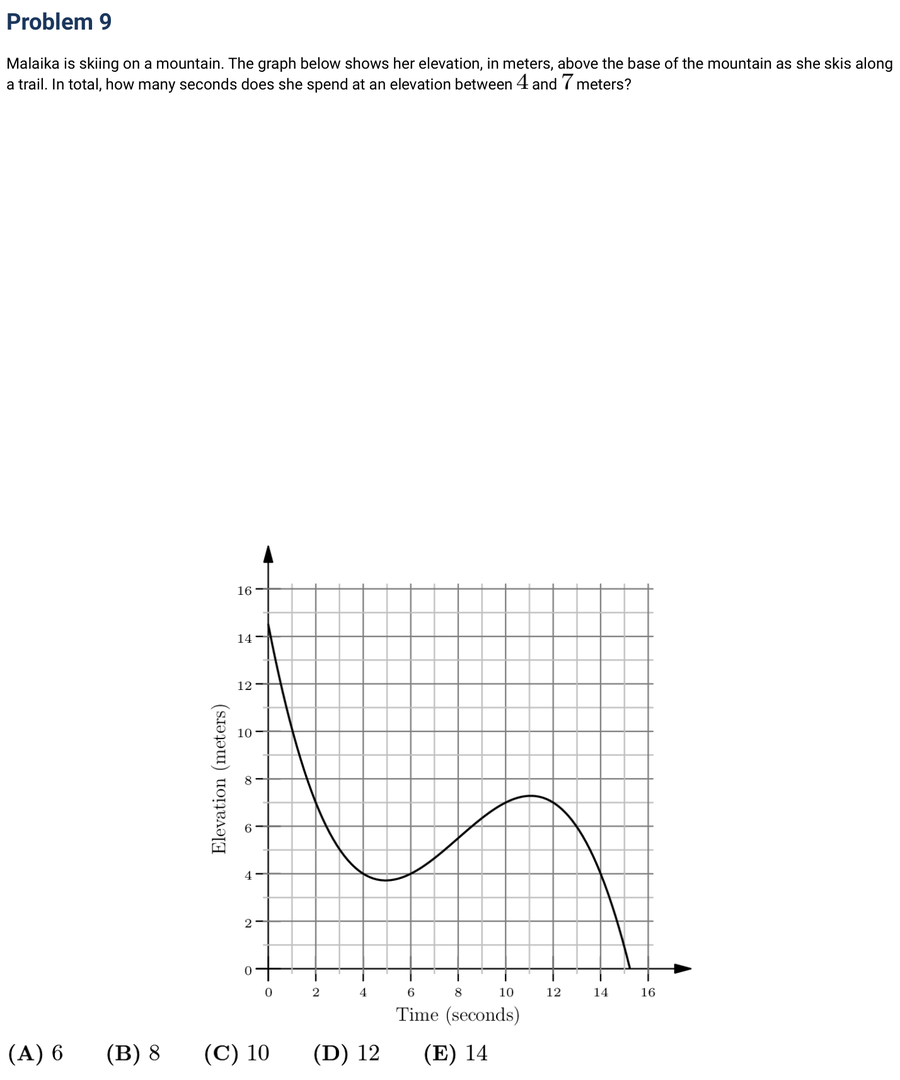
Draw two horizontal lines on the graph at elevations 4 and 7. Read off the time intervals where the curve sits between them.
Show hint (sharpest)
There are three such time intervals; add their durations.
Show solution
  1. The curve sits between elevations 4 and 7 over three intervals: roughly t = 2 to 4 (2 sec), t = 6 to 10 (4 sec), and t = 12 to 14 (2 sec).
  2. Total: 2 + 4 + 2 = 8 seconds.
B 8 seconds.
Mark: · log in to save
Problem 10 · 2023 AMC 8 Medium
Fractions, Decimals & Percents fraction-to-decimal percent-multiplier

Harold made a plum pie to take on a picnic. He was able to eat only 14 of the pie, and he left the rest for his friends. A moose came by and ate 13 of what Harold left behind. After that, a porcupine ate 13 of what the moose left behind. How much of the original pie still remained after the porcupine left?

Show hint (soft nudge)
Each eater leaves behind a fraction of what they found. Multiply those leftovers together.
Show hint (sharpest)
Harold leaves 3/4, moose leaves 2/3, porcupine leaves 2/3. Multiply: 3/4 × 2/3 × 2/3.
Show solution
  1. Each step's leftover is (1 − what they ate). Harold leaves 34. Moose leaves 23 of that. Porcupine leaves 23 of that.
  2. 34 × 23 × 23 = 1236 = 13.
D 1/3.
Another way: twelve slices (MAA)
  1. Cut the pie into 12 equal slices. Harold eats 3, leaving 9. Moose eats 13 of 9 = 3, leaving 6. Porcupine eats 13 of 6 = 2, leaving 4.
  2. 4 of 12 = 1/3.
Mark: · log in to save