The Centerville Middle School chess team consists of two boys and three girls. A photographer wants to take a picture of the team to appear in the local newspaper. She decides to have them sit in a row with a boy at each end and the three girls in the middle. How many such arrangements are possible?
Show hint
Two independent decisions: order the 2 boys at the ends (2!), and order the 3 girls in the middle (3!). Multiply.
Show solution
Boys at the two ends: 2! = 2 arrangements.
Girls in the middle three spots: 3! = 6 arrangements.
A magazine printed photos of three celebrities along with three photos of the celebrities as babies. The baby pictures did not identify the celebrities. Readers were asked to match each celebrity with the correct baby pictures. What is the probability that a reader guessing at random will match all three correctly?
Show hint
How many ways can 3 baby photos be ordered? Only one ordering matches the celebrities.
Show solution
3 baby photos can be assigned in 3! = 6 ways. Exactly 1 is the correct matching.
Abe holds 1 green and 1 red jelly bean in his hand. Bob holds 1 green, 1 yellow, and 2 red jelly beans in his hand. Each randomly picks a jelly bean to show the other. What is the probability that the colors match?
Show hint
Match in two ways: both green, or both red. Multiply each person's color probability per case, then add.
In a town of 351 adults, every adult owns a car, motorcycle, or both. If 331 adults own cars and 45 adults own motorcycles, how many of the car owners do not own a motorcycle?
Show hint
Everyone owns at least one. So car-only count = total − motorcycle-owners.
Show solution
Each non-motorcycle-owner must own a car (since every adult has at least one).
Bag A has three chips labeled 1, 3, and 5. Bag B has three chips labeled 2, 4, and 6. If one chip is drawn from each bag, how many different values are possible for the sum of the two numbers on the chips?
Show hint
All sums are odd + even = odd. List the 9 sums and count distinct values.
Angie, Bridget, Carlos, and Diego are seated at random around a square table, one person to a side. What is the probability that Angie and Carlos are seated opposite each other?
Show hint
Fix Angie's seat. Carlos lands in any of the 3 remaining seats with equal probability; only 1 is opposite.
Show solution
Fix Angie in any seat. Carlos has 3 equally likely seats among the remaining 3.
Each of the 39 students in the eighth grade at Lincoln Middle School has one dog or one cat or both a dog and a cat. Twenty students have a dog and 26 students have a cat. How many students have both a dog and a cat?
Show hint
|A ∪ B| = |A| + |B| − |A ∩ B|. Everyone has at least one, so |A ∪ B| = 39.
A singles tournament had six players. Each player played every other player only once, with no ties. If Helen won 4 games, Ines won 3 games, Janet won 2 games, Kendra won 2 games and Lara won 2 games, how many games did Monica (the sixth player) win?
Show hint
Total games = C(6, 2) = 15 ⇒ total wins = 15. Subtract the five known.
Show solution
Total games: 15. Sum of known wins: 4 + 3 + 2 + 2 + 2 = 13.
Ms. Hamilton's eighth-grade class wants to participate in the annual three-person-team basketball tournament. Lance, Sally, Joy, and Fred are chosen for the team. In how many ways can the three starters be chosen?
Show hint
Choosing 3 starters from 4 = choosing the 1 non-starter.
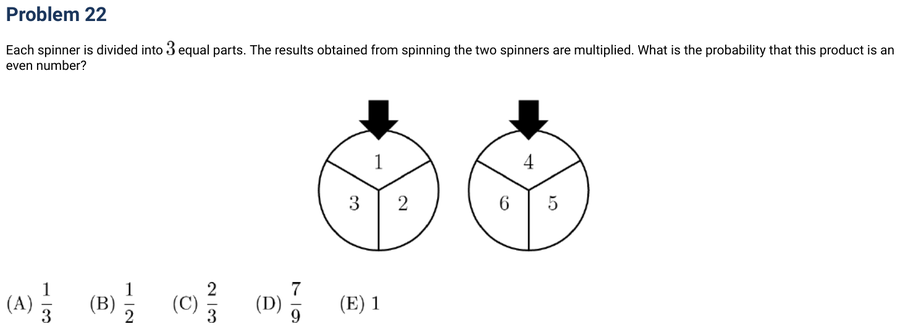
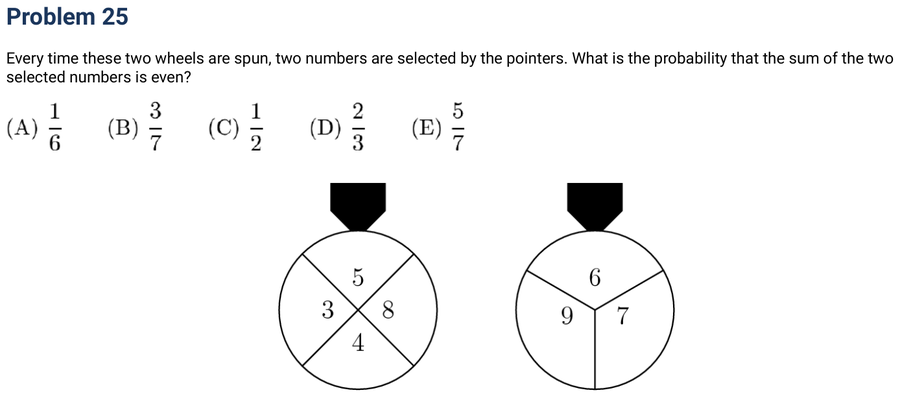
Spinners A and B are spun. On each spinner, the arrow is equally likely to land on each number. What is the probability that the product of the two spinners' numbers is even?
Four students sit in a row and chat with the people next to them. They then rearrange themselves so that no one is seated next to anyone they sat next to before. How many such rearrangements are possible?
Show hint (soft nudge)
Label the seats 1, 2, 3, 4; the forbidden neighbor-pairs are 1-2, 2-3, and 3-4.
Show hint (sharpest)
Try to build a valid order — the options turn out to be very tight.
Show solution
No two originally-adjacent students may be neighbors, so none of 1-2, 2-3, 3-4 can touch.
The only orders that work are 2-4-1-3 and its reverse 3-1-4-2, giving 2 rearrangements.
Buzz Bunny is hopping up and down a set of stairs, one step at a time. In how many ways can Buzz start on the ground, make a sequence of 6 hops, and end up back on the ground? (For example, one sequence of hops is up-up-down-down-up-down.)
Show hint (soft nudge)
Each sequence needs 3 ups and 3 downs. But Buzz can never go below the ground — the running count of downs can never exceed ups.
Show hint (sharpest)
Start with U, end with D. Enumerate carefully without breaking the rule.
Show solution
The sequence has 3 U's and 3 D's, with D's never exceeding U's at any point (otherwise Buzz goes below the ground).
All valid sequences: UUUDDD, UUDUDD, UUDDUD, UDUUDD, UDUDUD.
Minh enters the numbers 1 through 81 into the cells of a 9 × 9 grid in some order. She calculates the product of the numbers in each row and column. What is the least number of rows and columns that could have a product divisible by 3?
Show hint (soft nudge)
Any row or column with even one multiple of 3 has a divisible-by-3 product. So you want the multiples of 3 packed into as few rows and columns as possible.
Show hint (sharpest)
Count of multiples of 3 in 1–81: 27. A 5×5 corner block fits 25; the other 2 spill into a 6th column.
Show solution
There are 27 multiples of 3 in 1–81. Any row or column containing a multiple of 3 gets a product divisible by 3, so we want the multiples confined to as few rows and columns as possible.
A 5×5 corner block holds only 25 multiples. The remaining 2 must spill out — place them in the 6th column of rows 1 and 2.
In how many ways can the letters in BEEKEEPER be rearranged so that two or more E's do not appear together?
Show hint (soft nudge)
BEEKEEPER has 5 E's and 4 non-E letters (B, K, P, R) in 9 positions. Where can the 5 E's go without two being adjacent?
Show hint (sharpest)
5 non-adjacent positions in a row of 9 force the E's into positions 1, 3, 5, 7, 9. Then the 4 non-E letters fill positions 2, 4, 6, 8 in some order.
Show solution
BEEKEEPER = 5 E's + {B, K, P, R} in 9 slots. To keep no two E's adjacent, the 5 E's must occupy all 5 odd positions (1, 3, 5, 7, 9) — the only way to fit 5 non-adjacent positions in 9.
The other 4 letters fill positions 2, 4, 6, 8 in any order: 4! = 24 arrangements.
The eighth grade class at Lincoln Middle School has 93 students. Each student takes a math class or a foreign language class or both. There are 70 eighth graders taking a math class, and there are 54 eighth graders taking a foreign language class. How many eighth graders take only a math class and not a foreign language class?
Show hint (soft nudge)
Use inclusion-exclusion: |M ∪ F| = |M| + |F| − |M ∩ F|. That gives the overlap count.
Show hint (sharpest)
Both = 70 + 54 − 93 = 31. Math only = 70 − 31.
Show solution
|Math| + |Foreign| − |Both| = |Total| ⇒ 70 + 54 − Both = 93 ⇒ Both = 31.
The faces of each of two fair dice are numbered 1, 2, 3, 5, 7, and 8. When the two dice are tossed, what is the probability that their sum will be an even number?
Show hint (soft nudge)
Sum is even iff both rolls are odd or both are even.
Show hint (sharpest)
Faces: 4 odd (1, 3, 5, 7) and 2 even (2, 8). Compute both probabilities and add.
Show solution
Odd faces: 1, 3, 5, 7 → 4 of 6. Even faces: 2, 8 → 2 of 6.
Sum even = both odd (4/6 · 4/6 = 16/36) or both even (2/6 · 2/6 = 4/36).
Abby, Bridget, and four of their classmates will be seated in two rows of three for a group picture. If the seating positions are assigned randomly, what is the probability that Abby and Bridget are adjacent to each other in the same row or the same column?
Show hint (soft nudge)
Count unordered Abby-Bridget seat pairs that are adjacent. Total pairs = C(6,2) = 15.
Professor Chang has nine different language books lined up on a bookshelf: two Arabic, three German, and four Spanish. How many ways are there to arrange the nine books on the shelf keeping the Arabic books together and keeping the Spanish books together?
Show hint (soft nudge)
Glue the Arabic books into one block and the Spanish books into another. Then arrange 5 objects (block-A, 3 German, block-S).
Treat the 2 Arabic books as one block and the 4 Spanish books as one block. Together with the 3 German books, we have 5 objects to order: 5! = 120 ways.
Inside the Arabic block: 2! = 2 orderings. Inside the Spanish block: 4! = 24 orderings.
An ATM password at Fred's Bank is composed of four digits from 0 to 9, with repeated digits allowable. If no password may begin with the sequence 9, 1, 1, then how many passwords are possible?
Show hint
Total - bad. Total = 104. Bad: first three digits forced to 9, 1, 1; last digit anything (10 options).
Show solution
Total passwords: 104 = 10,000.
Bad passwords (starting 9, 1, 1): the last digit can be any of 10 → 10 bad passwords.
Tom has twelve slips of paper which he wants to put into five cups labeled A, B, C, D, E. He wants the sum of the numbers on the slips in each cup to be an integer. Furthermore, he wants the five integers to be consecutive and increasing from A to E. The numbers on the papers are 2, 2, 2, 2.5, 2.5, 3, 3, 3, 3, 3.5, 4, and 4.5. If a slip with 2 goes into cup E and a slip with 3 goes into cup B, then the slip with 3.5 must go into what cup?
Show hint (soft nudge)
Find the five cup totals. The slips sum to 35, so the five consecutive integers sum to 35 ⇒ their average (and middle) is 7.
Show hint (more)
Cups must be 5, 6, 7, 8, 9 for A through E. Now place the 3.5 by elimination using the remaining slips.
Show hint (sharpest)
Cup B already has a 3 and needs a total of 6, so it also has another 3. Cup E has a 2 and needs 7 more.
Show solution
Sum of slips: 2+2+2+2.5+2.5+3+3+3+3+3.5+4+4.5 = 35. Five consecutive integers summing to 35 must be 5, 6, 7, 8, 9, so A=5, B=6, C=7, D=8, E=9.
B has a 3 and needs 6 total ⇒ the other slip in B is another 3.
Try placing the 3.5 in each cup; the rest of that cup must come from the leftover slips {2, 2, 2.5, 2.5, 3, 3.5, 4, 4.5} minus the 3.5 itself.
A (need 5): 5 − 3.5 = 1.5 — no slip equals 1.5 and no combo of leftovers sums to 1.5. ✗
C (need 7): 7 − 3.5 = 3.5 from leftovers — no such combo without using the only 3.5. ✗
E (already has 2, need 7 more): 7 − 3.5 = 3.5 — same issue. ✗
D (need 8): 8 − 3.5 = 4.5 — pair with the 4.5 slip. ✓ The remaining slips fill the other cups, e.g. A = {2.5, 2.5}, C = {3, 4}, E = {2, 2, 3}.
Samantha lives 2 blocks west and 1 block south of the southwest corner of City Park. Her school is 2 blocks east and 2 blocks north of the northeast corner of City Park. On school days she bikes on streets to the southwest corner of City Park, then takes a diagonal path through the park to the northeast corner, and then bikes on streets to school. If her route is as short as possible, how many different routes can she take?
Show hint (soft nudge)
Three independent legs: home → SW corner, the unique diagonal through the park, NE corner → school. Count lattice paths for each leg and multiply.
Show hint (sharpest)
Home to SW corner: 2 E + 1 N. NE corner to school: 2 E + 2 N.
Show solution
Home → SW corner: choose 1 of 3 step-orderings = C(3, 1) = 3.
How many 4-digit positive integers have four different digits, where the leading digit is not zero, the integer is a multiple of 5, and 5 is the largest digit?
Show hint (soft nudge)
All digits come from {0, 1, 2, 3, 4, 5}, with 5 present (it's the largest). Units digit is 0 or 5 (divisible by 5).
Show hint (sharpest)
Split into two cases by units digit.
Show solution
Case A: units = 0. The remaining three slots contain 5 and two distinct digits chosen from {1, 2, 3, 4}: C(4, 2) = 6 ways to pick the other two; 3! = 6 ways to arrange them. Subtotal: 6 × 6 = 36.
Case B: units = 5. The remaining three slots use three distinct digits from {0, 1, 2, 3, 4}. Choose and arrange: 5 · 4 · 3 = 60. Subtract leading-zero arrangements: 4 · 3 = 12 with 0 first. Subtotal: 60 − 12 = 48.
In a room, 2/5 of the people are wearing gloves, and 3/4 of the people are wearing hats. What is the minimum number of people in the room wearing both a hat and a glove?
Show hint (soft nudge)
Total people must be divisible by 5 and 4 ⇒ multiple of 20. Smallest is 20.
Everyday at school, Jo climbs a flight of 6 stairs. Jo can take the stairs 1, 2, or 3 at a time. For example, Jo could climb 3, then 1, then 2. In how many ways can Jo climb the stairs?
Show hint (soft nudge)
Let f(n) be the number of ways to climb n stairs. Each climb ends in a 1, 2, or 3 step: f(n) = f(n−1) + f(n−2) + f(n−3).
Ten tiles numbered 1 through 10 are turned face down. One tile is turned up at random, and a die is rolled. What is the probability that the product of the numbers on the tile and the die will be a square?
Show hint
Case on the die roll d; for each, count tiles t in 1–10 with dt a perfect square.
On the dart board shown in the figure, the outer circle has radius 6 and the inner circle has a radius of 3. Three radii divide each circle into three congruent regions, with point values shown. The probability that a dart will hit a given region is proportional to the area of the region. When two darts hit this board, the score is the sum of the point values of the regions hit. What is the probability that the score is odd?
Show hint (soft nudge)
Score is odd iff exactly one dart hits a 1 and the other hits a 2.
Show hint (sharpest)
Find probability of hitting a 1 and probability of hitting a 2, then 2 · P(1) · P(2).
Show solution
Outer ring area: 36π − 9π = 27π. Each outer sector: 9π ⇒ prob 9π/36π = 1/4.
Inner sectors: 3π each ⇒ prob 1/12 each.
Inner has one 1 and two 2s. Outer has two 1s and one 2.
Ali, Bonnie, Carlo, and Dianna are going to drive together to a nearby theme park. The car they are using has four seats: one driver's seat, one front passenger seat, and two back passenger seats. Bonnie and Carlo are the only ones who know how to drive the car. How many possible seating arrangements are there?
Show hint (soft nudge)
Fill the most restricted seat first — only two people can take the driver's seat.
Show hint (sharpest)
Once the driver is chosen, the other three sit anywhere.
Show solution
Only Bonnie or Carlo can drive: 2 choices for the driver's seat.
The other 3 people fill the remaining 3 seats in 3! = 6 ways.
Tyler has entered a buffet line in which he chooses one kind of meat, two different vegetables, and one dessert. If the order of food items is not important, how many different meals might he choose?
Bicycle license plates in Flatville each contain three letters. The first is chosen from the set {C, H, L, P, R}, the second from {A, I, O}, and the third from {D, M, N, T}. When Flatville needed more license plates, they added two new letters. The new letters may both be added to one set, or one letter may be added to one set and one to another. What is the largest possible number of additional license plates that can be made by adding two letters?
Show hint (soft nudge)
The number of plates is the product of the three set sizes — right now 5 × 3 × 4 = 60.
Show hint (sharpest)
Growing the smallest factors multiplies the count the most; try a couple of placements.
Show solution
Now there are 5 × 3 × 4 = 60 plates; two new letters change one or two of the factors.
The best is to enlarge the small factors: 5 × 5 × 4 (both into the size-3 set) or 5 × 4 × 5 each give 100 plates.
Tamika selects two different numbers at random from the set {8, 9, 10} and adds them. Carlos takes two different numbers at random from the set {3, 5, 6} and multiplies them. What is the probability that Tamika's result is greater than Carlos' result?
Show hint (soft nudge)
List Tamika's possible sums and Carlos's possible products.
Show hint (sharpest)
Compare each of the 3 × 3 equally likely pairings.
Show solution
Tamika's sums are 17, 18, 19; Carlos's products are 15, 18, 30 — each value equally likely.
Tamika beats 15 all 3 times, beats 18 once (with 19), and never beats 30: that's 3 + 1 + 0 = 4 of 9 cases.
How many subsets containing three different numbers can be selected from the set {89, 95, 99, 132, 166, 173} so that the sum of the three numbers is even?
Show hint (soft nudge)
Only the parity (odd/even) of each number matters: there are 4 odds and 2 evens.
Show hint (sharpest)
A sum of three is even only when an even count of them are odd — here that means exactly 2 odds and 1 even.
Show solution
The set has 4 odd numbers (89, 95, 99, 173) and 2 even (132, 166). Three numbers sum to even only with 2 odds and 1 even (zero odds would need 3 evens, impossible).
Diana and Apollo each roll a standard die, obtaining a number at random from 1 to 6. What is the probability that Diana's number is larger than Apollo's number?
Show hint (soft nudge)
By symmetry, 'Diana larger' and 'Apollo larger' are equally likely.
Show hint (sharpest)
Subtract the ties first, then split the rest in half.
Show solution
Of the 36 outcomes, 6 are ties, leaving 30 where one is larger.
By symmetry half of those favor Diana: 15/36 = 5/12.
A gumball machine contains 9 red, 7 white, and 8 blue gumballs. The least number of gumballs a person must buy to be sure of getting four gumballs of the same color is
Show hint (soft nudge)
Imagine the worst luck: as many gumballs as possible without four of any color.
Show hint (sharpest)
That's three of each color; the next one must make a fourth.
Show solution
You could draw 3 red, 3 white, 3 blue — 9 gumballs — with no color yet reaching four.
The 10th gumball must complete a set of four, so the answer is 10.
There are twenty-four 4-digit numbers that use each of the four digits 2, 4, 5, and 7 exactly once. Listed in numerical order from smallest to largest, the number in the 17th position in the list is
Show hint (soft nudge)
Each choice of leading digit fixes 3! = 6 numbers.
Show hint (sharpest)
Find which leading-digit block holds the 17th, then list within it.
Show solution
Leading 2: positions 1–6, leading 4: 7–12, leading 5: 13–18. So the 17th is the 5th number starting with 5.
Those are 5247, 5274, 5427, 5472, 5724 — the 5th is 5724.
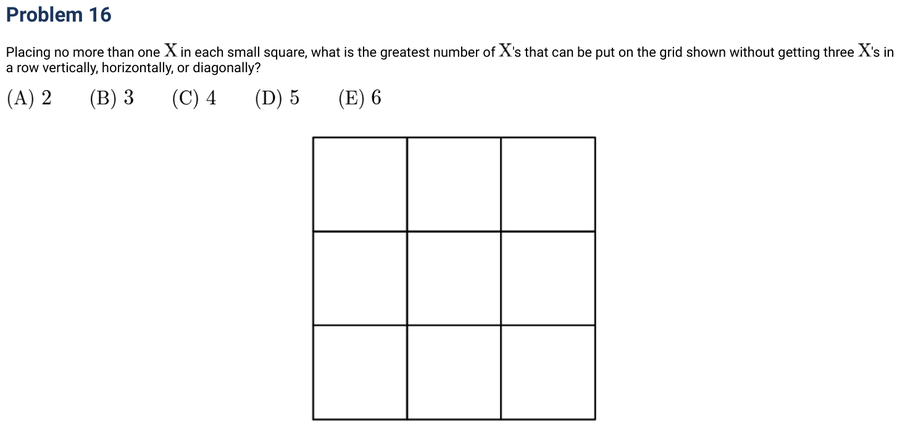
There are 8 lines (3 rows, 3 columns, 2 diagonals); each must miss at least one square.
Show hint (sharpest)
Leaving the center plus two opposite corners empty kills every line.
Show solution
Leave the center and two opposite corners empty (3 squares). The center kills the middle row, middle column, and both diagonals; the two opposite corners kill the remaining four edge lines.
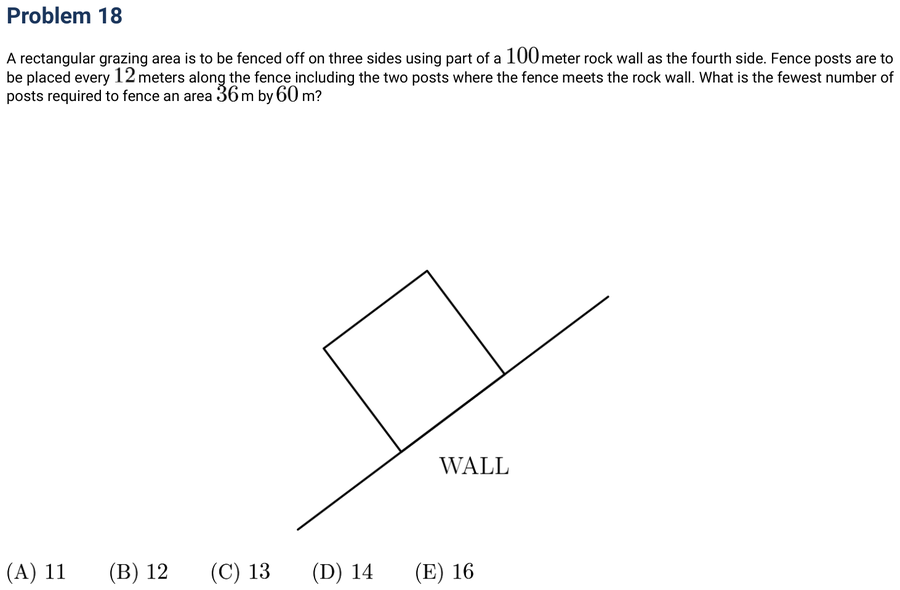
Place the long 60 m side against the wall so the fence runs 36 + 60 + 36 = 132 m.
Show hint (sharpest)
Posts every 12 m on a 132 m path including both ends = 132⁄12 + 1.
Show solution
With the 60 m side along the wall, the fence has length 36 + 60 + 36 = 132 m. Posts every 12 m including both endpoints give 132⁄12 + 1 = 12 posts; the corners (at 36 m and 96 m) are multiples of 12, so no extras.
On Monday Taye has $2. Every day, he either gains $3 or doubles the amount of money he had on the previous day. How many different dollar amounts could Taye have on Thursday, 3 days later?
Show hint (soft nudge)
Build a tree: from each daily amount, branch on +$3 or ×2. Some branches collide — just list the unique values.
Show hint (sharpest)
Tuesday: {$4, $5}. Wednesday: {$7, $8, $10} (the $8 from two paths). Thursday will land on 6 distinct values.
Show solution
From $2 each day choose +$3 or ×2. Tuesday: 2+3=5 or 2×2=4 → {$4, $5}.
How many integers between 2020 and 2400 have four distinct digits arranged in increasing order? (For example, 2347 is one integer.)
Show hint (soft nudge)
Pin down the leading digits first. The thousands digit is forced; the hundreds digit has only one valid value.
Show hint (sharpest)
First digit = 2. For the digits to be increasing and the number ≤ 2400, the second digit must be 3 (since it must exceed 2 and be ≤ 3). Then the last two digits are any two distinct digits from {4,5,6,7,8,9}.
Show solution
Digits must be increasing, so they're strictly ascending. First digit = 2 (number is between 2020 and 2400). Second digit must be > 2 and ≤ 3 (else the number exceeds 2400): second digit = 3.
Last two digits: any 2 distinct values from {4, 5, 6, 7, 8, 9}, arranged in increasing order. That's C(6, 2) = 15.
Zara has a collection of 4 marbles: an Aggie, a Bumblebee, a Steelie, and a Tiger. She wants to display them in a row on a shelf, but does not want to put the Steelie and the Tiger next to one another. In how many ways can she do this?
Show hint (soft nudge)
Count all arrangements, then subtract the bad ones (Steelie next to Tiger).
Show hint (sharpest)
Total: 4! = 24. Steelie-Tiger adjacent: glue them as a block → 3! = 6 arrangements, × 2 internal orders = 12.
Show solution
Total arrangements of 4 marbles: 4! = 24.
Bad arrangements (Steelie and Tiger adjacent): treat ST as a single block → 3! = 6 arrangements; the block can be ST or TS → × 2 = 12.
A box contains five cards, numbered 1, 2, 3, 4, and 5. Three cards are selected randomly without replacement from the box. What is the probability that 4 is the largest value selected?
Show hint
For 4 to be the largest, the draw must include 4 and the other two come from {1, 2, 3}.
Show solution
Total ways to choose 3 of 5 cards: C(5, 3) = 10.
Favorable: pick 4, then pick the other 2 from {1, 2, 3}: C(3, 2) = 3 ways.
Each of two boxes contains three chips numbered 1, 2, 3. A chip is drawn randomly from each box and the numbers on the two chips are multiplied. What is the probability that their product is even?
Show hint
Complement: product is odd iff both chips are odd. Two odd values out of {1, 2, 3} each → (2/3)(2/3).
In the small country of Mathland, all automobile license plates have four symbols. The first must be a vowel (A, E, I, O, or U), the second and third must be two different letters among the 21 non-vowels, and the fourth must be a digit (0 through 9). If the symbols are chosen at random subject to these conditions, what is the probability that the plate will read "AMC8"?
Show hint (soft nudge)
Count the total number of allowed plates by multiplying choices for each slot. The probability of AMC8 is 1 over that total.
How many subsets of two elements can be removed from the set {1, 2, 3, 4, 5, 6, 7, 8, 9, 10, 11} so that the mean (average) of the remaining numbers is 6?
Show hint (soft nudge)
Original sum is 1 + 2 + ... + 11 = 66. After removing 2 elements, 9 remain with mean 6, so the remaining sum is 54.
Show hint (sharpest)
The removed pair must sum to 66 − 54 = 12. Count two-element subsets of {1, ..., 11} with sum 12.
Show solution
Sum of 1 through 11 is 66. After removing 2 numbers, 9 remain; mean 6 means remaining sum is 9 × 6 = 54.
So the removed pair sums to 66 − 54 = 12.
Pairs from {1, …, 11} summing to 12: {1,11}, {2,10}, {3,9}, {4,8}, {5,7}. That is 5 pairs.
At Euler Middle School, 198 students voted on two issues in a school referendum with the following results: 149 voted in favor of the first issue and 119 voted in favor of the second issue. If there were exactly 29 students who voted against both issues, how many students voted in favor of both issues?
Show hint (soft nudge)
Voters in favor of at least one issue = total − voted against both.
Jack wants to bike from his house to Jill's house, which is located three blocks east and two blocks north of Jack's house. After biking each block, Jack can continue either east or north, but he needs to avoid a dangerous intersection one block east and one block north of his house. In how many ways can he reach Jill's house by biking a total of five blocks?
Show hint (soft nudge)
Total paths from (0,0) to (3,2) with E/N steps: C(5, 2) = 10. Subtract the ones that pass through the bad corner (1,1).
Show hint (sharpest)
Paths through (1,1) = (paths to (1,1)) × (paths from (1,1) to (3,2)) = 2 × 3 = 6.
The "Middle School Eight" basketball conference has 8 teams. Every season, each team plays every other conference team twice (home and away), and each team also plays 4 games against non-conference opponents. What is the total number of games in a season involving the "Middle School Eight" teams?
Show hint
Conference games: pairs of teams, each pair plays twice. Non-conference: each of 8 teams plays 4 extras — those involve only one MSE team, so don't divide by 2.
Show solution
Conference pairs: C(8, 2) = 28. Each pair plays 2 games ⇒ 56 games.
Non-conference: 8 teams × 4 games each = 32 games (the opponent is outside MSE, so no double-counting).
Four children were born at City Hospital yesterday. Assume each child is equally likely to be a boy or a girl. Which of the following outcomes is most likely?
Show hint (soft nudge)
All 16 sequences of BBBB … GGGG are equally likely. Count how many sequences each described outcome covers.
Show hint (sharpest)
C(4, k) for k = 0, 1, 2, 3, 4 gives 1, 4, 6, 4, 1. Note "3 of one, 1 of other" covers both k=1 and k=3.
In the BIG N, a middle school football conference, each team plays every other team exactly once. If a total of 21 conference games were played during the 2012 season, how many teams were members of the BIG N conference?
Show hint
Round-robin: number of games = C(N, 2) = N(N − 1)/2.
The two spinners shown are spun once and each lands on one of the numbered sectors. What is the probability that the sum of the numbers in the two sectors is prime?
Show hint
Odd + even = odd, so all 9 sums are odd. Just count which are prime.
Show solution
Sums: 3, 5, 7, 5, 7, 9, 7, 9, 11. Non-prime: the two 9s.
The diagram represents a 7-foot-by-7-foot floor that is tiled with 1-square-foot light tiles and dark tiles. Notice that the corners have dark tiles. If a 15-foot-by-15-foot floor is to be tiled in the same manner, how many dark tiles will be needed?
Show hint
Dark tiles sit at (odd row, odd column). In a 7×7: 4 odd rows × 4 odd cols = 16. In a 15×15: 8 × 8.
Show solution
7-foot floor: odd positions 1, 3, 5, 7 ⇒ 4 each direction; 4 × 4 = 16 (consistent with diagram).
Three A's, three B's, and three C's are placed in the nine spaces so that each row and column contain one of each letter. If A is placed in the upper left corner, how many arrangements are possible?
Show hint
Place B in the second row (2 choices for column) and then in the third row (constrained). C is then forced.
Show solution
Row 1 is fixed up to permutation of B, C (2 ways). Row 2 starts with B or C (2 choices), then is determined. Each row 2 case constrains row 3 to one arrangement.
Eight points are spaced around at intervals of one unit around a 2 × 2 square, as shown. Two of the 8 points are chosen at random. What is the probability that the two points are one unit apart?
Show hint
Each point has exactly 2 neighbors at distance 1 (its left and right neighbors on the perimeter).
Show solution
Fix one point. Of the remaining 7, exactly 2 are 1 unit away.
Sets A and B, shown in the Venn diagram, have the same number of elements. Their union has 2007 elements and their intersection has 1001 elements. Find the number of elements in A.
Two cards are dealt from a deck of four red cards labeled A, B, C, D and four green cards labeled A, B, C, D. A winning pair is two of the same color or two of the same letter. What is the probability of drawing a winning pair?
Show hint
Fix the first card. Of the 7 remaining cards, count those that win against it: 3 of the same color and 1 of the same letter (different color).
Show solution
Same color: 3 of the remaining 7.
Same letter (different color): 1 of the remaining 7.
A bag contains four pieces of paper, each labeled with one of the digits 1, 2, 3, or 4, with no repeats. Three of these pieces are drawn, one at a time without replacement, to construct a three-digit number. What is the probability that the three-digit number is a multiple of 3?
Show hint
Divisible by 3 iff digit-sum divisible by 3. The chosen 3 digits' sum is what matters; the order is irrelevant for divisibility.
Show solution
Subsets of size 3 from {1, 2, 3, 4}: 4 total ({1,2,3}, {1,2,4}, {1,3,4}, {2,3,4}).
Digit sums: 6 ✓, 7, 8, 9 ✓ ⇒ 2 subsets give a multiple of 3.
The Little Twelve Basketball League has two divisions, with six teams in each division. Each team plays each of the other teams in its own division twice and every team in the other division once. How many games are scheduled?
Show hint (soft nudge)
Intra-division pairs per division: C(6, 2) = 15; each pair plays twice. Two divisions.
Thirteen black and six white hexagonal tiles were used to create the figure below. If a new figure is created by attaching a border of white tiles with the same size and shape as the others, what will be the difference between the total number of white tiles and the total number of black tiles in the new figure?
Show hint
Ring n contains 6n hexagons. The new border (3rd ring) has 18 tiles.
When a fair six-sided die is tossed on a table top, the bottom face cannot be seen. What is the probability that the product of the numbers on the five faces that can be seen is divisible by 6?
Show hint (soft nudge)
6 = 2 × 3, so you just need a 2 and a 3 both showing somewhere.
Show hint (sharpest)
Only one face is hidden — check the worst case, where it's the 6.
Show solution
6 = 2 × 3, so the product is divisible by 6 as long as a 2 and a 3 both appear among the visible faces.
Only one face is hidden. If it isn't the 6, then the 6 is visible. If it is the 6, then 2 and 3 are both still visible.
Either way the product is divisible by 6, so the probability is 1.
A board game spinner is divided into three regions labeled A, B, and C. The probability the arrow stops on region A is 13 and on region B is 12. What is the probability the arrow stops on region C?
Show hint (soft nudge)
The three probabilities have to add up to 1.
Show hint (sharpest)
So region C gets whatever is left after A and B.
Show solution
Since the arrow must land somewhere, P(C) = 1 − 13 − 12.
A complete cycle of a traffic light takes 60 seconds. During each cycle the light is green for 25 seconds, yellow for 5 seconds, and red for 30 seconds. At a randomly chosen time, what is the probability that the light will NOT be green?
Show hint (soft nudge)
"Not green" just means yellow or red.
Show hint (sharpest)
Compare that time to the full 60-second cycle.
Show solution
Not green means yellow or red: 5 + 30 = 35 seconds out of 60.
There are several sets of three different numbers whose sum is 15 which can be chosen from {1, 2, 3, 4, 5, 6, 7, 8, 9}. How many of these sets contain a 5?
Show hint (soft nudge)
If 5 is in the set, the other two numbers must add to 10.
Show hint (sharpest)
Count distinct pairs (not using 5) that sum to 10.
Show solution
The other two numbers must sum to 15 − 5 = 10, both different and not 5.
Those pairs are (1,9), (2,8), (3,7), (4,6) — 4 sets.
A bag contains only blue balls and green balls. There are 6 blue balls. If the probability of drawing a blue ball at random from this bag is 14, then the number of green balls in the bag is
Show hint (soft nudge)
If blue is 1/4 of the balls, the total is 4 times the blue count.
Show hint (sharpest)
Subtract the blue balls to get the green ones.
Show solution
Blue = 1/4 of all, so the total is 4 × 6 = 24 balls.
The land of Catania uses gold coins (1 mm thick) and silver coins (3 mm thick). In how many ways can Taylor make a stack exactly 8 mm tall using any arrangement of gold and silver coins, where order matters?
Show hint (soft nudge)
Let f(n) count stacks of height n; the top coin is either gold (leaving n − 1) or silver (leaving n − 3).
Show hint (sharpest)
Build the counts up from small heights using f(n) = f(n−1) + f(n−3).
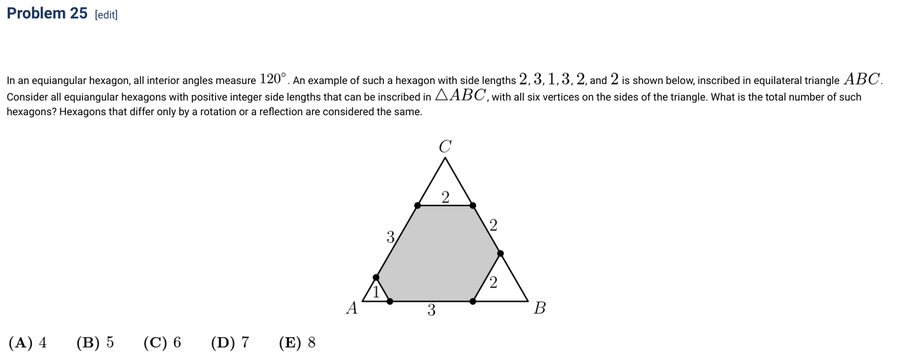
Such a hexagon is the equilateral triangle with three corner equilateral triangles cut off.
Show hint (sharpest)
If the triangle has side 6, the three integer cut sizes must leave each middle segment ≥ 1, so each pair of cuts sums to at most 5.
Show solution
The triangle ABC has side 6 (from the example: 1 + 3 + 2). Cutting integer-sized corners a, b, c leaves middle segments 6 − a − b, 6 − b − c, 6 − c − a, which must each be ≥ 1, so every pair of cuts sums to at most 5.
Counting unordered cut-triples {a, b, c} of positive integers with all pairwise sums ≤ 5 gives {1,1,1}, {1,1,2}, {1,2,2}, {2,2,2}, {1,1,3}, {1,2,3}, {2,2,3}, {1,1,4} — that's 8 hexagons (rotations and reflections counted once).
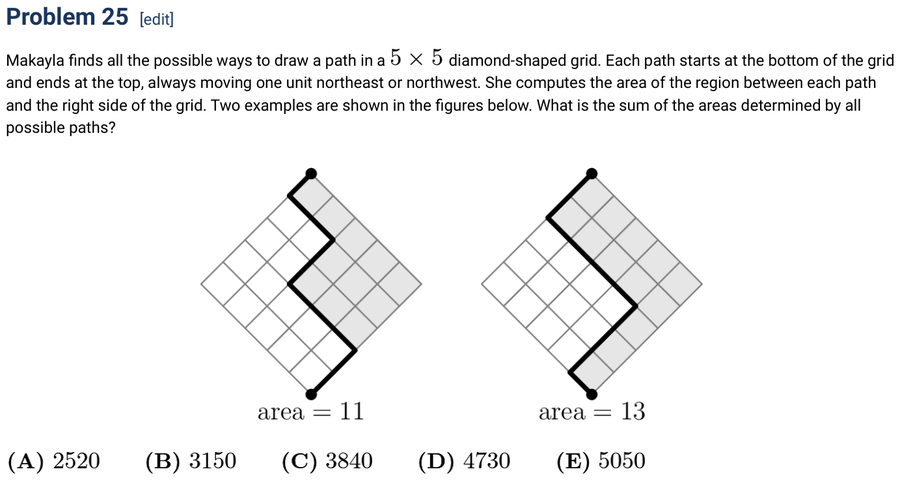
By left/right symmetry, the total of right-side areas equals the total of left-side areas. What does each path's left + right equal?
Show hint (sharpest)
Per path: area_left + area_right = 25 (the whole diamond). And the number of paths = ways to interleave 5 NE moves with 5 NW moves.
Show solution
Let X = the sum of right-side areas. By mirroring every path L ↔ R, the sum of left-side areas across all paths is also X. So 2X = total of (left + right) over all paths.
For each individual path, (left area) + (right area) = 25 (the full 5×5 diamond).
Number of paths: 5 NE moves and 5 NW moves interleaved = 10!5! · 5! = 252.
Alina writes the numbers 1, 2, …, 9 on separate cards, one number per card. She wishes to divide the cards into 3 groups of 3 cards so that the sum of the numbers in each group will be the same. In how many ways can this be done?
Show hint (soft nudge)
What must each group sum to? And what constraint does that put on where the biggest (and smallest) numbers go?
Show hint (sharpest)
Each group sums to 15. 7, 8, 9 must be in different groups (and so must 1, 2, 3). Then case-split on which group holds 5.
Show solution
1+2+…+9 = 45, so each group sums to 15.
7, 8, 9 must each go in a different group (else one group is already ≥ 15 with too much room left). Similarly 1, 2, 3 must go in different groups.
Consider the group containing 5. Its other two values sum to 10. Possibilities: {3, 5, 7}, {2, 5, 8}, or {1, 5, 9}. The {2, 5, 8} option fails (no way to finish), leaving 2 valid partitions: {1,5,9}/{3,4,8}/{2,6,7} and {3,5,7}/{1,6,8}/{2,4,9}.
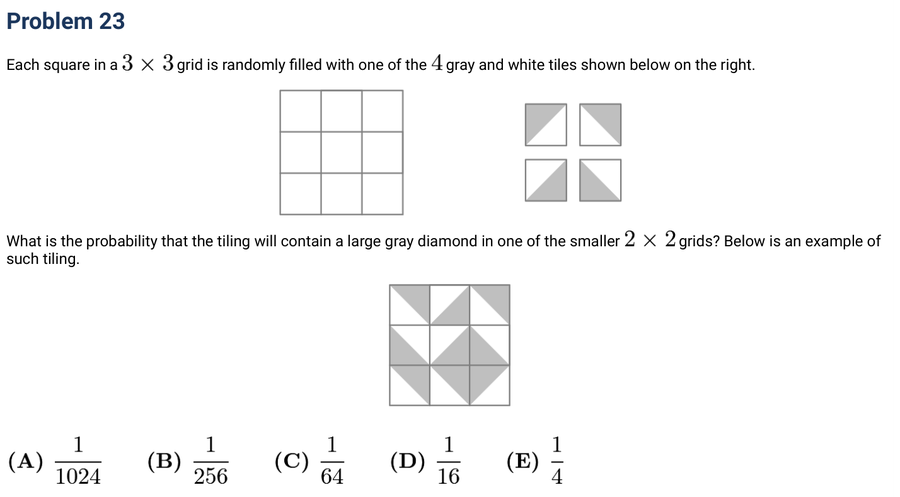
Where could the gray diamond go? Its center must be at one of the four corners of the middle cell.
Show hint (sharpest)
For a chosen diamond location, the 4 surrounding tiles are forced (1 valid orientation each); the remaining 5 tiles are free (4 choices each).
Show solution
Total tilings: 49 (each of 9 cells gets 1 of 4 tiles).
Favorable: choose 1 of 4 possible diamond positions (corners of the center cell), forcing 4 specific tile orientations. The remaining 5 tiles are free: 45 options. Total: 4 × 45 = 46.
Probability = 4649 = 143 = 164.
C
1/64.
Another way: probability the 3 neighbors of the center orient correctly (MAA)
If the diamond exists, the center cell has one all-gray corner; the 3 tiles adjacent to that corner must orient to extend the gray.
Each of those 3 tiles has probability 1/4 of the right orientation. So total probability = (1/4)3 = 1/64.
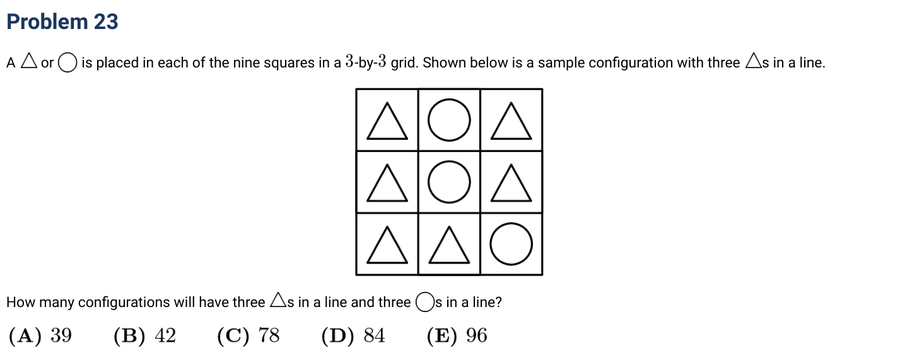
If ▵'s form a horizontal line, the ○'s line must also be horizontal (otherwise a cell would need to be both shapes). Same for vertical. So count vertical-line configurations and double.
Show hint (sharpest)
Casework on number of vertical lines: 3 (one for each column) or exactly 2.
Show solution
A ▵ line and a ○ line can't be perpendicular (a cell would be both shapes). So both lines are horizontal, OR both are vertical. Count vertical, then multiply by 2.
Vertical: case 3 lines — each of the 3 columns is monochromatic. 2³ = 8 colorings, minus the 2 all-same colorings (only one shape gets a line) → 6.
Vertical: case 2 lines — one ▵ column, one ○ column, one mixed. 3 ways to pick the ▵ column × 2 remaining for ○ × 6 mixed configurations for the leftover column (2³ minus the two all-same = 6) = 36.
Vertical total: 6 + 36 = 42. By symmetry, horizontal also = 42. Total: 42 + 42 = 84.
A cricket randomly hops between 4 leaves, on each turn hopping to one of the other 3 leaves with equal probability. After 4 hops, what is the probability that the cricket has returned to the leaf where it started?
Show hint (soft nudge)
Track only one number: pn = probability the cricket is on the starting leaf after n hops.
Show hint (sharpest)
From start, the cricket must leave (contributes 0 to pn+1). From any other leaf, prob 1/3 of returning. So pn+1 = (1 − pn)/3.
Show solution
Let pn = P(on starting leaf after n hops). From the start, the cricket can't stay; from any non-start, it returns with probability 1/3.
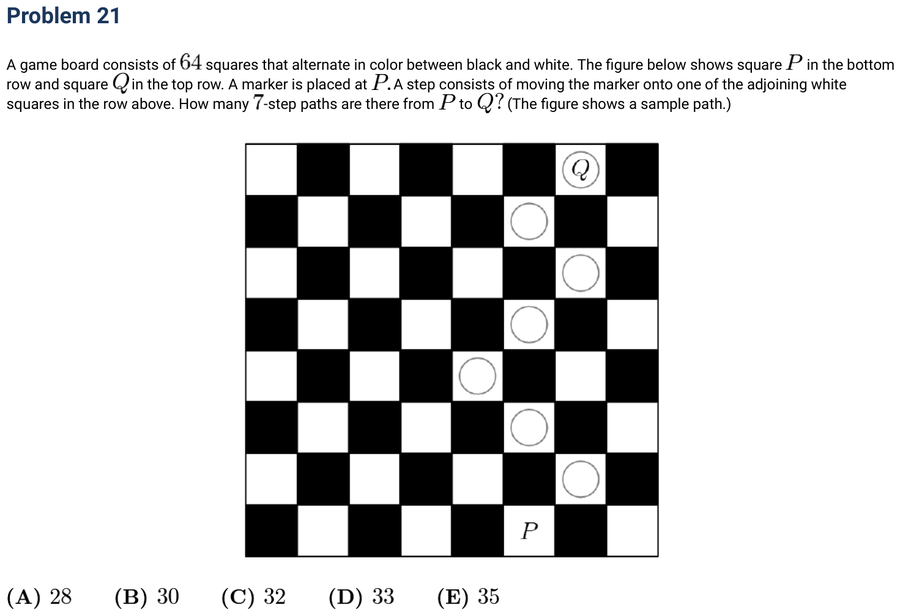
Each move goes up one row and shifts left or right one square. Build up Pascal-style: ways-to-reach a square = sum of ways to reach the two squares below it.
Show hint (sharpest)
Fill in each row from P upward. Each cell's count = sum of the down-left and down-right neighbors. Read off Q.
Show solution
Every step adds exactly one row, branching to one of two squares above. So the number of paths to a given white square equals the sum of paths to the two squares diagonally below it.
Starting from P (count 1) and propagating row by row up to Q, the counts grow Pascal-style.
When the 7th row is reached, the entry at Q is 28.
Five different awards are to be given to three students. Each student will receive at least one award. In how many different ways can the awards be distributed?
Show hint (soft nudge)
Count all assignments (3 choices per award), then subtract the ones where someone is left out.
Show hint (sharpest)
Total = 35 = 243. Subtract: 3 students × 25 = 96 "misses a student", but you've subtracted twice the cases where TWO students miss out (one student gets everything), so add 3 × 1 back.
Show solution
Total assignments (each of 5 distinct awards to one of 3 students): 35 = 243.
Subtract assignments where a particular student gets nothing (other two split the awards): C(3,1) × 25 = 3 × 32 = 96.
Add back assignments where TWO specific students get nothing (one gets everything — we subtracted these twice): C(3,2) × 15 = 3.
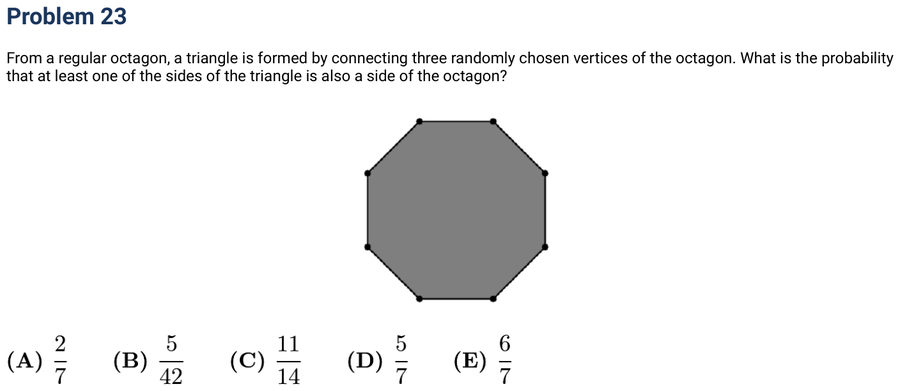
Complement: count triangles with NO octagon-side. The three chosen vertices then have gaps ≥ 1 around the octagon.
Show hint (sharpest)
Stars and bars: with three gaps summing to 5 and each ≥ 1, there are C(4, 2) = 6 ways (with one vertex fixed). Total triangles through that fixed vertex: C(7, 2) = 21.
Show solution
Fix a vertex A. Choose the other two vertices around the octagon, leaving gaps x, y, z between consecutive chosen vertices (each gap = number of skipped octagon vertices), with x + y + z = 5.
Total ways: C(7, 2) = 21 (choose 2 of the remaining 7 vertices).
No-side cases: each gap ≥ 1, i.e. x, y, z ≥ 1 and sum 5. Stars-and-bars: C(4, 2) = 6.
P(no side on octagon) = 6/21 = 2/7. P(at least one side) = 1 − 2/7 = 5/7.
A top hat contains 3 red chips and 2 green chips. Chips are drawn randomly, one at a time without replacement, until all 3 of the reds are drawn or until both green chips are drawn. What is the probability that the 3 reds are drawn?
Show hint
Imagine all 5 chips drawn in random order. The 3 reds get drawn first iff the LAST chip in the order is green — not the second-green.
Show solution
Imagine shuffling all 5 chips and drawing them all. The drawing stops as soon as you have all 3 reds OR both greens.
All 3 reds come out before both greens ⇔ the last chip in the shuffle is green.
By symmetry, the last chip is one of the 5 uniformly — probability it's green is 2/5 (2 green chips of 5).
On a twenty-question test, each correct answer is worth 5 points, each unanswered question is worth 1 point, and each incorrect answer is worth 0 points. Which of the following scores is NOT possible?
Show hint (soft nudge)
Start from the top: what's the maximum score, and the next one just below it?
Show hint (sharpest)
There's a gap right under the maximum that no score can land in.
Show solution
All 20 correct scores 20 × 5 = 100. The next-best is 19 correct plus 1 unanswered: 95 + 1 = 96.
So 97, 98, 99 are unreachable — 97 is the impossible score (90, 91, 92, 95 are all attainable).
Keiko tosses one penny and Ephraim tosses two pennies. The probability that Ephraim gets the same number of heads that Keiko gets is
Show hint (soft nudge)
Keiko can only land on 0 or 1 head, so those are the only two cases you have to match.
Show hint (sharpest)
Find Ephraim's chance of 0 heads and of 1 head, then pair each with Keiko's.
Show solution
Keiko gets 1 head or 0 heads, each with probability ½. Ephraim's two tosses give 1 head with probability ½ (HT or TH) and 0 heads with probability ¼ (TT).
Both at 1 head: ½ · ½ = ¼. Both at 0 heads: ½ · ¼ = ⅛.
A pair of 8-sided dice have sides numbered 1 through 8, each equally likely. What is the probability that the product of the two numbers facing up exceeds 36?
Show hint (soft nudge)
A big product needs big rolls — case on each high value of one die.
Show hint (sharpest)
Count the ordered pairs whose product is more than 36 out of all 64.
Show solution
Going through the high rolls: a 5 needs an 8 (1 way), a 6 needs 7–8 (2), a 7 needs 6–8 (3), and an 8 needs 5–8 (4).
That's 1 + 2 + 3 + 4 = 10 ordered pairs out of 64, a probability of 10/64 = 5/32.
A 2 by 2 square is divided into four 1 by 1 squares. Each small square is painted green or red. In how many ways can this be done so that no green square shares its top or right side with a red square? (There may be from zero to four green squares.)
Show hint (soft nudge)
The rule means: anything directly above or to the right of a green square must also be green.
Show hint (sharpest)
So the green squares must form an 'up-and-right' staircase region.
Show solution
If a square is green, the squares above it and to its right can't be red, so they're green too.
The green sets that satisfy this are: none, just the top-right, top-right + top-left, top-right + bottom-right, those three together, and all four — 6 ways.
Pat Peano has plenty of 0's, 1's, 3's, 4's, 5's, 6's, 7's, 8's and 9's, but he has only twenty-two 2's. How far can he number the pages of his scrapbook with these digits?
Show hint (soft nudge)
The only limit is the supply of 2's — count how many 2's the page numbers use.
Show hint (sharpest)
Pages 1–99 use 20 twos; then keep going until the 2's run out.
Show solution
Pages 1–99 use 20 twos (ten in the units place, ten in the tens place). That leaves 2 twos.
Pages 102 and 112 use one 2 each, exhausting the supply; pages 113–119 need no 2, but 120 would, so he can reach 119.
Several students are competing in a series of three races. A student earns 5 points for winning a race, 3 points for finishing second, and 1 point for finishing third. There are no ties. What is the smallest number of points a student must earn in the three races to be guaranteed of earning more points than any other student?
Show hint (soft nudge)
Each race awards 5, 3, 1 — all odd — so a 3-race total is always odd.
Show hint (sharpest)
Find the lowest odd total that no rival can match.
Show solution
Race totals are sums of three odd numbers, hence always odd. With 13 points (say 5 + 5 + 3), the best a rival can scrape together from the leftovers is 5 + 3 + 3 = 11.
Any total of 11 could be tied, so the guaranteed-winning minimum is 13.
An auditorium with 20 rows of seats has 10 seats in the first row. Each successive row has one more seat than the previous row. If students taking an exam are permitted to sit in any row, but not next to another student in that row, then the maximum number of students that can be seated for an exam is
Show hint (soft nudge)
In a row of n seats, the most students with gaps between them is ⌈n/2⌉.
Show hint (sharpest)
Add ⌈n/2⌉ for n = 10, 11, …, 29.
Show solution
Rows hold 10 through 29 seats; each fits ⌈n/2⌉ students: 5, 6, 6, 7, 7, …, 15.
The Pythagoras High School band has 100 female and 80 male members. The orchestra has 80 female and 100 male members. There are 60 females who are in both band and orchestra. Altogether there are 230 students who are in either band or orchestra or both. The number of males in the band who are NOT in the orchestra is
Show hint (soft nudge)
First find how many distinct females there are, then subtract to get the distinct males.
Show hint (sharpest)
Use inclusion-exclusion on the males to find those in both groups.
Show solution
Distinct females = 100 + 80 − 60 = 120, so distinct males = 230 − 120 = 110. Then males in both = 80 + 100 − 110 = 70.
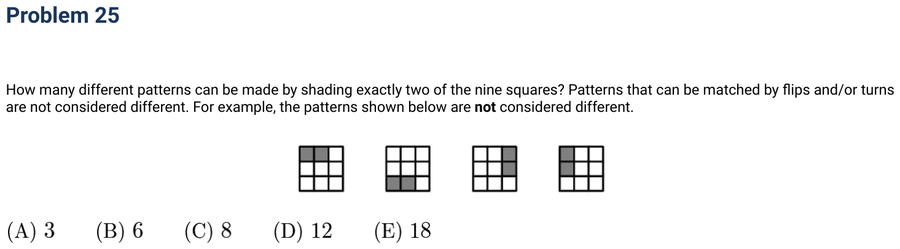
The nine cells come in three kinds: center, edges, and corners.
Show hint (sharpest)
Group the chosen pairs by the kinds of the two cells and their relative position.
Show solution
Sort the two-cell choices by type: center+edge, center+corner, two adjacent edges, two opposite edges, two adjacent corners, two diagonal corners, corner+touching edge, corner+far edge.
These give 8 patterns that can't be matched by any flip or turn, so the answer is 8.
A palindrome is a whole number that reads the same forwards and backwards. If one neglects the colon, certain times displayed on a digital watch are palindromes. Three examples are: 1:01, 4:44, and 12:21. How many times during a 12-hour period will be palindromes?
Show hint (soft nudge)
Split into 1-digit hours (1–9) and 2-digit hours (10–12) and count each.
Show hint (sharpest)
For h:mm to be a palindrome, the last digit of mm must equal h, and the middle digit can be 0–5.
Show solution
1-digit hours h:mm (h = 1–9): need mm's ones digit = h with mm's tens digit 0–5; that's 6 minutes per hour, so 9 × 6 = 54 palindromes.
2-digit hours hh:mm (10, 11, 12): only 10:01, 11:11, 12:21 work — 3 more. Total = 54 + 3 = 57.
Ten balls numbered 1 to 10 are in a jar. Jack reaches into the jar and randomly removes one of the balls. Then Jill reaches into the jar and randomly removes a different ball. The probability that the sum of the two numbers on the balls removed is even is
Show hint (soft nudge)
The sum is even when both balls have the same parity.
Show hint (sharpest)
5 odd and 5 even balls; second draw is without replacement, so the denominator becomes 9.
The 600 students at King Middle School are divided into three groups of equal size for lunch. Each group has lunch at a different time. A computer randomly assigns each student to one of three lunch groups. The probability that three friends, Al, Bob, and Carol, will be assigned to the same lunch group is approximately
Show hint (soft nudge)
Fix Al's group, then ask the chance Bob and Carol each land in the same one.
Show hint (sharpest)
Each independently lands in any group with chance ≈ 1⁄3.
Show solution
Whatever group Al is in, Bob lands there with chance ≈ 1⁄3 and Carol independently with chance ≈ 1⁄3.
Assume every 7-digit whole number is a possible telephone number except those that begin with 0 or 1. What fraction of telephone numbers begin with 9 and end with 0?
Show hint (soft nudge)
Count valid telephone numbers and those starting with 9 ending in 0, then take the ratio.
Show hint (sharpest)
Valid first digit: 8 choices. Last digit fixed: 1 choice. Middle five: 10 choices each.
Show solution
Total: 8 · 10⁶. Starting with 9 and ending in 0: 1 · 10⁵ · 1 = 10⁵.