Topic

Fractions, Decimals & Percents

Switching between the three; percent as a multiplier.

151 problems
Practice
Problem 4 · 2026 AMC 8 Medium
Fractions, Decimals & Percents percent-multiplier

Brynn's savings decreased by 20% in July, then increased by 50% of the new amount in August. Brynn's savings are now what percent of the original amount?

Show hint (soft nudge)
Don't pick a starting amount — that's extra work. Each percent change is something you can just multiply by.
Show hint (sharpest)
Each percent change is just a multiplier — you don't even need a starting amount. Multiply the two.
Show solution
  1. Down 20% means × 0.8; up 50% means × 1.5.
  2. Multiply the changes: 0.8 × 1.5 = 1.2.
  3. 1.2 = 120% of the original.
E 120%.
Mark: · log in to save
Problem 2 · 2024 AMC 8 Easy
Fractions, Decimals & Percents fraction-to-decimal

What is the value of this expression in decimal form?

4411 + 11044 + 441100
Show hint
Turn each fraction into a decimal by itself, then add. Two of them are very friendly.
Show solution
  1. 4411 = 4.
  2. 11044 = 2.5.
  3. 441100 = 0.04.
  4. Add: 4 + 2.5 + 0.04 = 6.54.
C 6.54.
Mark: · log in to save
Problem 5 · 2020 AMC 8 Easy
Fractions, Decimals & Percents fraction-to-decimal percent-multiplier

Three fourths of a pitcher is filled with pineapple juice. The pitcher is emptied by pouring an equal amount of juice into each of 5 cups. What percent of the total capacity of the pitcher did each cup receive?

Show hint (soft nudge)
Split 34 into 5 equal shares — what fraction of the whole pitcher is each share?
Show hint (sharpest)
Each cup gets 34 ÷ 5 = 320 of the pitcher. Now turn that into a percent.
Show solution
  1. Each cup gets 34 ÷ 5 = 320 of the pitcher.
  2. 320 = 15100 = 15%.
C 15%.
Mark: · log in to save
Problem 3 · 2019 AMC 8 Medium
Fractions, Decimals & Percents fraction-comparison
amc8-2019-03
Show hint (soft nudge)
Each fraction is just a little more than 1. By how much?
Show hint (sharpest)
Notice the numerator is always 4 more than the denominator. So each fraction = 1 + 4/(denominator).
Show solution
  1. Each fraction has numerator − denominator = 4, so write each as 1 + 4denom.
  2. Bigger denominator means smaller extra. Denominators 11, 13, 15 give extras 411 > 413 > 415.
  3. So the order from least to greatest is 1915 < 1713 < 1511 (choice E).
E 19/15 < 17/13 < 15/11.
Mark: · log in to save
Problem 2 · 2018 AMC 8 Easy
Fractions, Decimals & Percents fraction-to-decimal

What is the value of the product

(1 + 11) · (1 + 12) · (1 + 13) · (1 + 14) · (1 + 15) · (1 + 16) ?
Show hint
Rewrite each factor as n+1n. Then watch consecutive numerators and denominators cancel.
Show solution
  1. 1 + 1/n = (n+1)/n. So the product is 21 · 32 · 43 · 54 · 65 · 76.
  2. Everything cancels except 7/1 = 7.
D 7.
Mark: · log in to save
Problem 2 · 2017 AMC 8 Easy
Fractions, Decimals & Percents percent-multiplier proportion
amc8-2017-02
Show hint
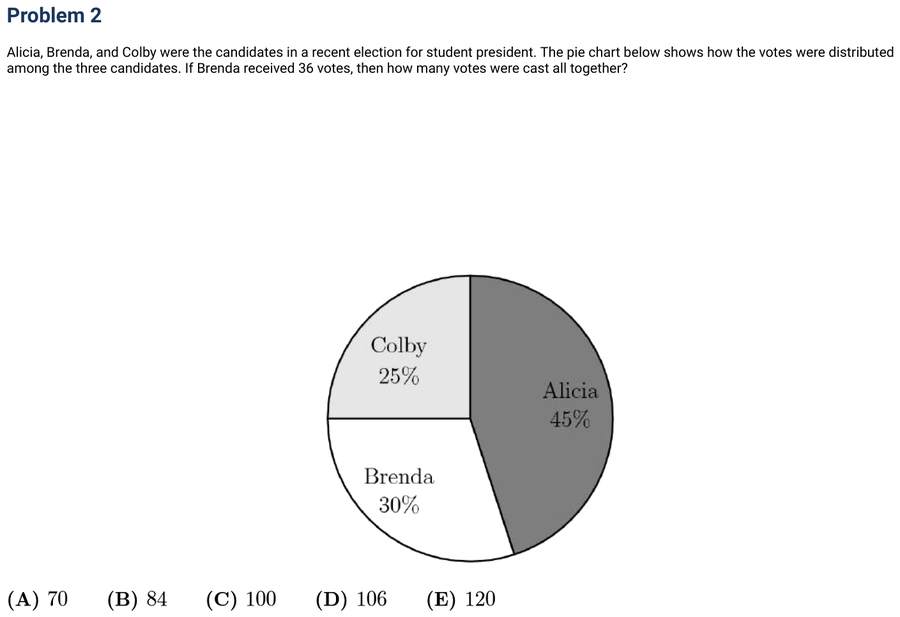
Brenda has 30% of the votes — 36 votes. Find 100%.
Show solution
  1. 30% of total = 36 ⇒ total = 36 / 0.30 = 120.
E 120 votes.
Mark: · log in to save
Problem 2 · 2013 AMC 8 Easy
Fractions, Decimals & Percents percent-of-price

A sign at the fish market says, "50% off, today only: half-pound packages for just $3 per package." What is the regular price for a full pound of fish, in dollars? (Assume that there are no deals for bulk.)

Show hint
First scale half-pound to full-pound; then undo the 50% discount.
Show solution
  1. Sale price per pound: 2 × $3 = $6.
  2. 50% off means regular = 2 × sale: 2 × $6 = $12.
D $12.
Mark: · log in to save
Problem 12 · 2013 AMC 8 Easy
Fractions, Decimals & Percents percent-savings

At the 2013 Winnebago County Fair a vendor is offering a "fair special" on sandals. If you buy one pair of sandals at the regular price of $50, you get a second pair at a 40% discount, and a third pair at half the regular price. Javier took advantage of the "fair special" to buy three pairs of sandals. What percentage of the $150 regular price did he save?

Show hint
Compute the dollar saved on the 2nd and 3rd pairs (the 1st is full price). Then divide by $150.
Show solution
  1. 2nd pair saves 40% of $50 = $20. 3rd pair saves half of $50 = $25.
  2. Total saved: $45. Regular price: $150.
  3. Percentage saved: 45/150 = 30%.
B 30%.
Mark: · log in to save
Problem 4 · 2012 AMC 8 Easy
Fractions, Decimals & Percents fraction-of-whole

Peter's family ordered a 12-slice pizza for dinner. Peter ate one slice and shared another slice equally with his brother Paul. What fraction of the pizza did Peter eat?

Show hint
Peter ate 1 full slice + half a slice = 1.5 slices out of 12.
Show solution
  1. Peter's slices: 1 + 1/2 = 1.5 = 3/2.
  2. Fraction: (3/2) / 12 = 3/24 = 1/8.
C 1/8.
Mark: · log in to save
Problem 8 · 2012 AMC 8 Easy
Fractions, Decimals & Percents successive-percentages

A shop advertises everything is "half price in today's sale." In addition, a coupon gives a 20% discount on sale prices. Using the coupon, the price today represents what percentage off the original price?

Show hint
Multiply the surviving fractions: 50% × 80% = 40% of original. Customer saves 100% − 40%.
Show solution
  1. After 50% off: 0.5 of original. After 20% off that: 0.5 × 0.8 = 0.4 of original.
  2. Saved: 1 − 0.4 = 60%.
D 60%.
Mark: · log in to save
Problem 3 · 2010 AMC 8 Easy
Fractions, Decimals & Percents percent-increase

The graph shows the price of five gallons of gasoline during the first ten months of the year. By what percent is the highest price more than the lowest price?

Show hint
Percent more = (high − low) / low × 100.
Show solution
  1. Highest = 17, lowest = 10.
  2. (17 − 10) / 10 = 0.7 = 70%.
C 70%.
Mark: · log in to save
Problem 9 · 2010 AMC 8 Easy
Fractions, Decimals & Percents weighted-average

Ryan got 80% of the problems correct on a 25-problem test, 90% on a 40-problem test, and 70% on a 10-problem test. What percent of all the problems did Ryan answer correctly?

Show hint
Count correct on each test, then divide by the total number of problems.
Show solution
  1. Correct: 0.8 · 25 + 0.9 · 40 + 0.7 · 10 = 20 + 36 + 7 = 63.
  2. Total: 25 + 40 + 10 = 75.
  3. 63 / 75 = 84%.
D 84%.
Mark: · log in to save
Problem 8 · 2009 AMC 8 Easy
Fractions, Decimals & Percents percent-multiplier

The length of a rectangle is increased by 10% and the width is decreased by 10%. What percent of the old area is the new area?

Show hint
Multiply the two factors: 1.1 · 0.9 = ?
Show solution
  1. New area / old area = 1.1 · 0.9 = 0.99 = 99%.
B 99%.
Mark: · log in to save
Problem 7 · 2008 AMC 8 Easy
Fractions, Decimals & Percents equivalent-fractions

If 35 = M45 = 60N, what is M + N?

Show hint
Cross-multiply each equation.
Show solution
  1. 3 · 45 = 5MM = 27.
  2. 3N = 5 · 60 ⇒ N = 100.
  3. Sum: 27 + 100 = 127.
E 127.
Mark: · log in to save
Problem 9 · 2008 AMC 8 Easy
Fractions, Decimals & Percents successive-percentages

In 2005 Tycoon Tammy invested 100 dollars for two years. During the first year her investment suffered a 15% loss, but during the second year the remaining investment showed a 20% gain. Over the two-year period, what was the change in Tammy's investment?

Show hint
Multiplier: 0.85 × 1.20. Compare to 1.
Show solution
  1. Net multiplier: 0.85 · 1.20 = 1.02 ⇒ 2% gain.
D 2% gain.
Mark: · log in to save
Problem 6 · 2007 AMC 8 Easy
Fractions, Decimals & Percents percent-decrease

The average cost of a long-distance call in the USA in 1985 was 41 cents per minute, and the average cost of a long-distance call in the USA in 2005 was 7 cents per minute. Find the approximate percent decrease in the cost per minute of a long-distance call.

Show hint
Drop / original. 34 / 41 ≈ 0.83.
Show solution
  1. Drop: 41 − 7 = 34. Original: 41.
  2. 34 / 41 ≈ 0.83 ⇒ closest to 80%.
E About 80%.
Mark: · log in to save
Problem 17 · 2007 AMC 8 Easy
Fractions, Decimals & Percents mixture-update

A mixture of 30 liters of paint is 25% red tint, 30% yellow tint and 45% water. Five liters of yellow tint are added to the original mixture. What is the percent of yellow tint in the new mixture?

Show hint
Yellow: 0.30 · 30 = 9 L. After adding 5: 14 L out of 35 L.
Show solution
  1. Original yellow: 9 L. New yellow: 9 + 5 = 14 L.
  2. Total volume: 30 + 5 = 35 L.
  3. Fraction: 14/35 = 40%.
C 40%.
Mark: · log in to save
Problem 4 · 2006 AMC 8 Easy
Fractions, Decimals & Percents net-rotation

Initially, a spinner points west. Chenille moves it clockwise 214 revolutions and then counterclockwise 334 revolutions. In what direction does the spinner point after the two moves?

Show hint
Net rotation = clockwise − counterclockwise. Reduce mod 1 revolution.
Show solution
  1. Net counterclockwise: 3.75 − 2.25 = 1.5 revolutions counterclockwise.
  2. 1.5 mod 1 = 0.5 ⇒ spinner turns half-revolution from west ⇒ east.
B East.
Mark: · log in to save
Problem 8 · 2006 AMC 8 Easy
Fractions, Decimals & Percents two-way-table

The table shows some of the results of a survey by radio station KACL. What percentage of the males surveyed listen to the station? (Total surveyed: 200. Females: 96. Females who listen: 58. Males who don't listen: 26. Total listeners: 136. Total non-listeners: 64.)

Show hint
Total males = 200 − 96 = 104. Of those, 26 don't listen.
Show solution
  1. Males total: 200 − 96 = 104. Males who listen: 104 − 26 = 78.
  2. Percentage: 78 / 104 = 75%.
E 75%.
Mark: · log in to save
Problem 12 · 2006 AMC 8 Easy
Fractions, Decimals & Percents weighted-percentage

Antonette gets 70% on a 10-problem test, 80% on a 20-problem test and 90% on a 30-problem test. If the three tests are combined into one 60-problem test, which percent is closest to her overall score?

Show hint
Total correct / 60.
Show solution
  1. Correct: 7 + 16 + 27 = 50.
  2. 50 / 60 ≈ 0.833 ⇒ closest to 83%.
D 83%.
Mark: · log in to save
Problem 2 · 2005 AMC 8 Easy
Fractions, Decimals & Percents percent-of-amount

Karl bought five folders from Pay-A-Lot at a cost of $2.50 each. Pay-A-Lot had a 20%-off sale the following day. How much could Karl have saved on the purchase by waiting a day?

Show hint
Compute the total then take 20%.
Show solution
  1. Total: 5 · $2.50 = $12.50.
  2. Savings: 0.20 · $12.50 = $2.50.
C $2.50.
Mark: · log in to save
Problem 6 · 2005 AMC 8 Easy
Fractions, Decimals & Percents place-value-comparison

Suppose d is a digit. For how many values of d is 2.00d5 > 2.005?

Show hint
Both numbers share 2.00 prefix. Compare the next two digits: d5 vs 05.
Show solution
  1. Pad to four decimal places: 2.0050 vs 2.00d5.
  2. First three decimals are 005 vs 00d; comparing position-by-position, the deciding digit is d vs 5.
  3. If d > 5: bigger. If d = 5: 2.0055 > 2.0050 still bigger. If d < 5: smaller (e.g., d=4 gives 2.0045 < 2.0050).
  4. Valid: d ∈ {5, 6, 7, 8, 9} ⇒ 5 values.
C 5 values.
Mark: · log in to save
Problem 11 · 2005 AMC 8 Easy
Fractions, Decimals & Percents commutative-multiplication

The sales tax rate in Bergville is 6%. During a sale at the Bergville Coat Closet, the price of a coat is discounted 20% from its $90.00 price. Two clerks, Jack and Jill, calculate the bill independently. Jack rings up $90.00 and adds 6% sales tax, then subtracts 20% from this total. Jill rings up $90.00, subtracts 20% of the price, then adds 6% of the discounted price for sales tax. What is Jack's total minus Jill's total?

Show hint
Multiplication is commutative: order of factors doesn't change the product.
Show solution
  1. Jack: 90 · 1.06 · 0.80. Jill: 90 · 0.80 · 1.06.
  2. Same product ⇒ difference = $0.
C $0.
Mark: · log in to save
Problem 6 · 2004 AMC 8 Easy
Fractions, Decimals & Percents percent-equation

After Sally takes 20 shots, she has made 55% of her shots. After she takes 5 more shots, she raises her percentage to 56%. How many of the last 5 shots did she make?

Show hint
Made so far: 0.55 · 20 = 11. Target made: 0.56 · 25 = 14. Difference is how many she made in the last 5.
Show solution
  1. Made before: 11. Made after: 14.
  2. Made in last 5: 14 − 11 = 3.
C 3.
Mark: · log in to save
Problem 16 · 2004 AMC 8 Easy
Fractions, Decimals & Percents mixture-fraction

Two 600 mL pitchers contain orange juice. One pitcher is 1/3 full and the other pitcher is 2/5 full. Water is added to fill each pitcher completely, then both pitchers are poured into one large container. What fraction of the mixture in the large container is orange juice?

Show hint
Total OJ: 600(1/3) + 600(2/5) = 200 + 240 = 440. Total volume: 1200.
Show solution
  1. OJ: 200 + 240 = 440 mL.
  2. Total: 1200 mL.
  3. Fraction: 440/1200 = 11/30.
C 11/30.
Mark: · log in to save
Problem 3 · 2003 AMC 8 Easy
Fractions, Decimals & Percents proportion

A burger at Ricky C's weighs 120 grams, of which 30 grams are filler. What percent of the burger is not filler?

Show hint
Find the non-filler weight first, then compare it to the whole.
Show solution
  1. Non-filler: 120 − 30 = 90 grams.
  2. 90/120 = 3/4 = 75%.
D 75%.
Mark: · log in to save
Problem 5 · 2003 AMC 8 Easy
Fractions, Decimals & Percents percent-multiplier proportion

If 20% of a number is 12, what is 30% of the same number?

Show hint
You don't need the number itself — how does 30% compare to 20%?
Show solution
  1. 30% is 1.5 times 20%.
  2. So 30% of the number is 1.5 × 12 = 18.
B 18.
Another way: find the whole first
  1. 20% of the number is 12, so the number is 12 ÷ 0.2 = 60.
  2. 30% of 60 = 0.3 × 60 = 18.
Mark: · log in to save
Problem 4 · 2000 AMC 8 Easy
Fractions, Decimals & Percents graph-interpretation percent-multiplier
amc8-2000-04
Show hint (soft nudge)
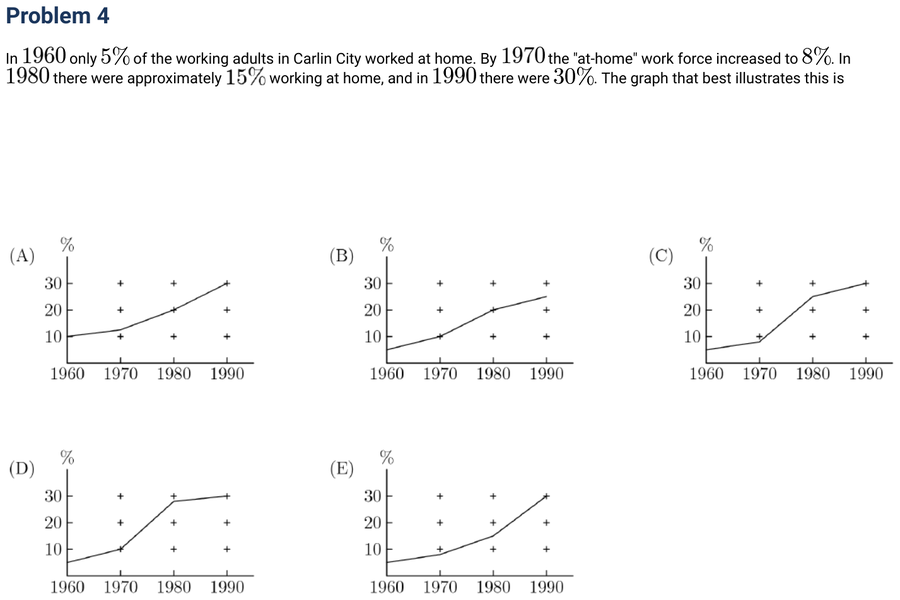
Plot the four data points (5, 8, 15, 30) and see which curve hits them all.
Show hint (sharpest)
The jumps grow each decade, so the rise should steepen.
Show solution
  1. The at-home percentages 5, 8, 15, 30 rise by larger amounts each decade.
  2. Only graph E passes through all four points with that steepening climb.
E Graph E.
Mark: · log in to save
Problem 3 · 1999 AMC 8 Easy
Fractions, Decimals & Percents mental-math

Which triplet of numbers has a sum NOT equal to 1?

Show hint (soft nudge)
Add each triplet, but watch for one that obviously collapses.
Show hint (sharpest)
In choice D the 1.1 and 1.0 sum to exactly 2.1 — which the −2.1 wipes out.
Show solution
  1. Choices A, B, C, and E each total 1 (for instance ½ + ⅓ + ⅙ = 1).
  2. Choice D gives 1.1 − 2.1 + 1.0 = 0, not 1.
  3. So the odd one out is (1.1, −2.1, 1.0).
D (1.1, −2.1, 1.0).
Mark: · log in to save
Problem 3 · 1998 AJHSME Easy
Fractions, Decimals & Percents fraction-arithmetic
ajhsme-1998-03
Show hint (soft nudge)
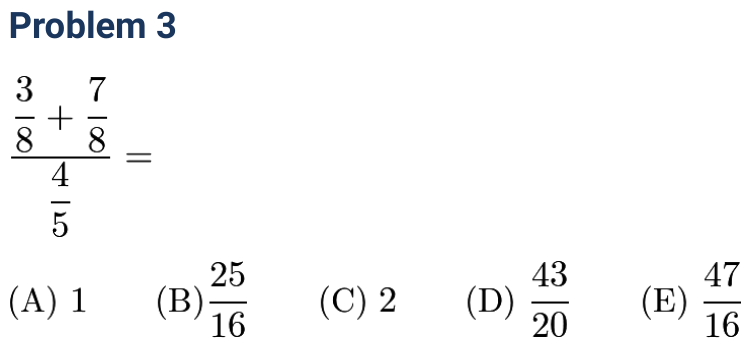
Add the top fractions first, then divide by the bottom one.
Show hint (sharpest)
Dividing by 4/5 is the same as multiplying by 5/4.
Show solution
  1. The top is 3/8 + 7/8 = 10/8 = 5/4, and dividing by 4/5 multiplies by 5/4.
  2. So (5/4)(5/4) = 25/16.
B 25/16.
Mark: · log in to save
Problem 1 · 1997 AJHSME Easy
Fractions, Decimals & Percents place-value
ajhsme-1997-01
Show hint (soft nudge)
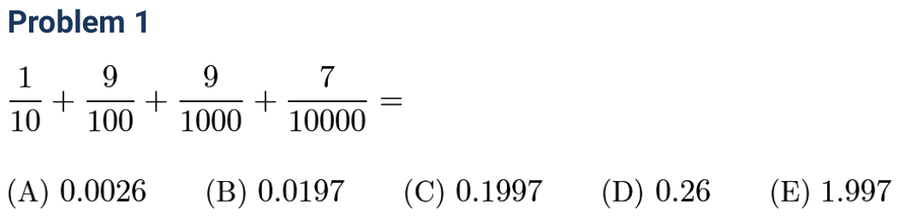
Each fraction is one digit further into the decimal places.
Show hint (sharpest)
Write them as decimals and line them up.
Show solution
  1. The terms are 0.1, 0.09, 0.009, and 0.0007.
  2. Adding them stacks the digits: 0.1997.
C 0.1997.
Mark: · log in to save
Problem 3 · 1997 AJHSME Easy
Fractions, Decimals & Percents compare-decimals

Which of the following numbers is the largest?

Show hint (soft nudge)
Line the decimals up and compare them place by place.
Show hint (sharpest)
0.97, 0.979, and 0.9709 stay tied until the thousandths digit.
Show solution
  1. All have 9 tenths; A, B, C also have 7 hundredths (D and E have 0), so only those three can be largest.
  2. In the thousandths place 0.979 has a 9 while 0.97 and 0.9709 have 0, so 0.979 is largest.
B 0.979.
Mark: · log in to save
Problem 1 · 1995 AJHSME Easy
Fractions, Decimals & Percents mental-math

Walter has exactly one penny, one nickel, one dime, and one quarter in his pocket. What percent of one dollar is in his pocket?

Show hint (soft nudge)
Add the coin values in cents.
Show hint (sharpest)
Cents out of 100 is already a percent of a dollar.
Show solution
  1. 1 + 5 + 10 + 25 = 41 cents.
  2. That is 41% of a dollar.
D 41%.
Mark: · log in to save
Problem 1 · 1994 AJHSME Easy
Fractions, Decimals & Percents common-denominator

Which of the following is the largest?

Show hint (soft nudge)
Put them all over a common denominator of 24.
Show hint (sharpest)
Then just compare numerators.
Show solution
  1. Over 24: 8/24, 6/24, 9/24, 10/24, 7/24.
  2. The biggest numerator is 10, so 5/12 is largest.
D 5/12.
Mark: · log in to save
Problem 2 · 1994 AJHSME Easy
Fractions, Decimals & Percents sum-fractions
ajhsme-1994-02
Show hint (soft nudge)
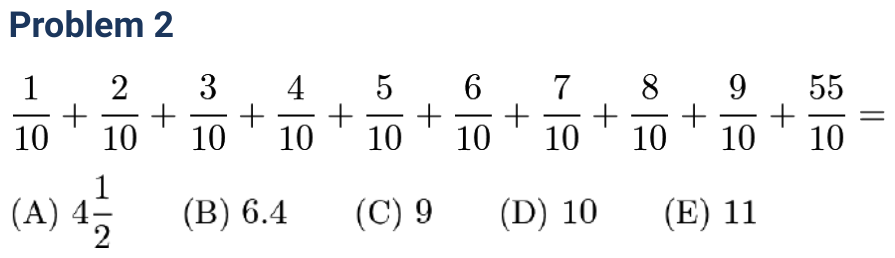
All terms share the denominator 10, so add the numerators first.
Show hint (sharpest)
1 + 2 + … + 9 = 45.
Show solution
  1. The numerators add to (1 + 2 + … + 9) + 55 = 45 + 55 = 100.
  2. So the sum is 100/10 = 10.
D 10.
Mark: · log in to save
Problem 2 · 1993 AJHSME Easy
Fractions, Decimals & Percents simplify-fraction

When the fraction 4984 is expressed in simplest form, the sum of the numerator and the denominator will be

Show hint (soft nudge)
Both 49 and 84 share a factor of 7.
Show hint (sharpest)
Reduce, then add the two parts.
Show solution
  1. 49/84 = 7/12 after dividing top and bottom by 7.
  2. 7 + 12 = 19.
C 19.
Mark: · log in to save
Problem 2 · 1992 AJHSME Easy
Fractions, Decimals & Percents compare-fractions
ajhsme-1992-02
Show hint (soft nudge)
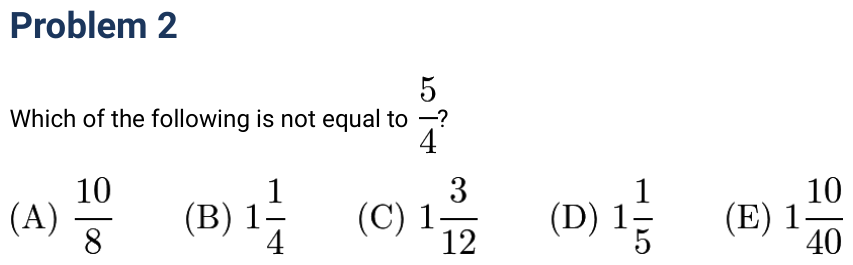
5/4 = 1.25 — convert each choice and compare.
Show hint (sharpest)
A mixed number like 1 1/5 equals 1.2.
Show solution
  1. 5/4 = 1.25. The choices 10/8, 1¼, 1 3/12, and 1 10/40 all equal 1.25.
  2. But 1 1/5 = 1.2, so 1 1/5 is the one that's not equal.
D 1 1/5.
Mark: · log in to save
Problem 2 · 1990 AJHSME Easy
Fractions, Decimals & Percents place-value

Which digit of .12345, when changed to 9, gives the largest number?

Show hint (soft nudge)
Changing a digit helps most where its place value is largest.
Show hint (sharpest)
The leftmost digit is the tenths place.
Show solution
  1. The 1 sits in the tenths place, the most valuable spot. Changing it to 9 makes .92345.
  2. That beats changing any digit further right, so the answer is the 1.
A the 1.
Mark: · log in to save
Problem 2 · 1989 AJHSME Easy
Fractions, Decimals & Percents place-value

210 + 4100 + 61000 =

Show hint (soft nudge)
Each fraction is a decimal in its own place: tenths, hundredths, thousandths.
Show hint (sharpest)
Just write the digits in order.
Show solution
  1. 2/10 = 0.2, 4/100 = 0.04, 6/1000 = 0.006.
  2. Adding gives .246.
D .246.
Mark: · log in to save
Problem 3 · 1989 AJHSME Easy
Fractions, Decimals & Percents compare-decimals

Which of the following numbers is the largest?

Show hint (soft nudge)
Compare the digits right after the decimal point.
Show hint (sharpest)
.99 has a 9 in the hundredths place; the others have 0 there.
Show solution
  1. All start with .9; in the hundredths place .99 has a 9 while the rest have 0.
  2. So .99 is largest.
A .99.
Mark: · log in to save
Problem 1 · 1988 AJHSME Easy
Fractions, Decimals & Percents scale-reading
ajhsme-1988-01
Show hint (soft nudge)
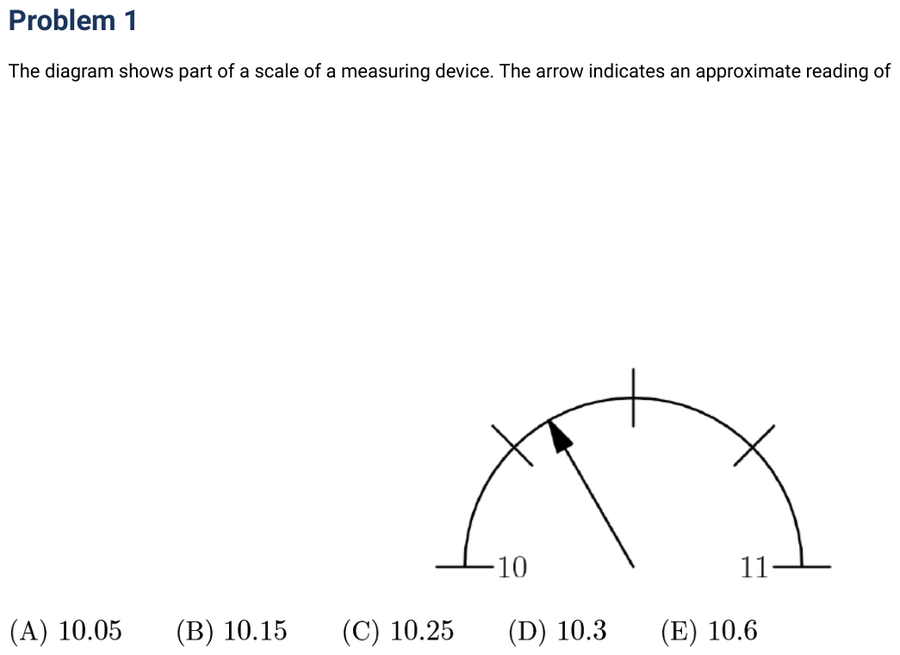
Between the 10 and 11 marks, the arrow points roughly a quarter of the way past 10.
Show hint (sharpest)
A quarter of the gap from 10 to 11 is 0.25.
Show solution
  1. The arrow sits about one-fourth of the way from 10 toward 11.
  2. That's 10 + 0.25 = 10.25.
C 10.25.
Mark: · log in to save
Problem 2 · 1988 AJHSME Easy
Fractions, Decimals & Percents pair-decimals

The product 8 × .25 × 2 × .125 =

Show hint (soft nudge)
Pair numbers whose product is a round number.
Show hint (sharpest)
8 · 0.125 = 1 and 2 · 0.25 = 0.5.
Show solution
  1. Rearrange: (8 × 0.125) × (2 × 0.25) = 1 × 0.5.
  2. Product = 1⁄2.
C 1⁄2.
Mark: · log in to save
Problem 3 · 1988 AJHSME Easy
Fractions, Decimals & Percents simplify-each-fraction

1⁄10 + 2⁄20 + 3⁄30 =

Show hint (soft nudge)
Each fraction simplifies to the same thing.
Show hint (sharpest)
1⁄10 = 2⁄20 = 3⁄30.
Show solution
  1. 2⁄20 = 1⁄10 and 3⁄30 = 1⁄10, so the sum is 1⁄10 + 1⁄10 + 1⁄10 = 3⁄10.
  2. 3⁄10 = 0.3.
D .3.
Mark: · log in to save
Problem 1 · 1987 AJHSME Easy
Fractions, Decimals & Percents align-decimals

.4 + .02 + .006 =

Show hint
Line up the decimal points and add column by column.
Show solution
  1. Tenths 4, hundredths 2, thousandths 6.
  2. Sum = .426.
E .426.
Mark: · log in to save
Problem 2 · 1987 AJHSME Easy
Fractions, Decimals & Percents scale-to-power-of-ten

2 ⁄ 25 =

Show hint
Multiply numerator and denominator by 4 to make the denominator 100.
Show solution
  1. 2⁄25 = 8⁄100 = 0.08.
B .08.
Mark: · log in to save
Problem 4 · 1987 AJHSME Easy
Fractions, Decimals & Percents quarter-of-circle

Martians measure angles in clerts. There are 500 clerts in a full circle. How many clerts are there in a right angle?

Show hint
A right angle is a quarter of a full circle.
Show solution
  1. 500 ⁄ 4 = 125 clerts.
C 125.
Mark: · log in to save
Problem 2 · 1986 AJHSME Easy
Fractions, Decimals & Percents reciprocal-monotonicity

Which of the following numbers has the largest reciprocal?

Show hint
Smaller positive number ↔ larger reciprocal.
Show solution
  1. Among positives, the reciprocal is largest for the smallest number.
  2. 1⁄3 is the smallest of the choices, so its reciprocal (3) is largest.
A 1⁄3.
Mark: · log in to save
Problem 1 · 1985 AJHSME Easy
Fractions, Decimals & Percents cross-cancel

(3 × 5)⁄(9 × 11) × (7 × 9 × 11)⁄(3 × 5 × 7) =

Show hint
Every factor in the top of one fraction shows up on the bottom of the other (or vice versa).
Show solution
  1. 3 and 5 cancel against the second denominator; 7 cancels against the first denominator's 9 × 11.
  2. What's left: 1.
A 1.
Mark: · log in to save
Problem 3 · 1985 AJHSME Easy
Fractions, Decimals & Percents power-of-ten-arithmetic

10⁷ ⁄ (5 × 10⁴) =

Show hint (soft nudge)
Subtract exponents of 10 first.
Show hint (sharpest)
10⁷ ⁄ 10⁴ = 10³, then divide by 5.
Show solution
  1. 10⁷ ⁄ 10⁴ = 1000. Divide by 5.
  2. = 200.
D 200.
Mark: · log in to save
Problem 5 · 1985 AJHSME Easy
Fractions, Decimals & Percents read-bar-chart
ajhsme-1985-05
Show hint
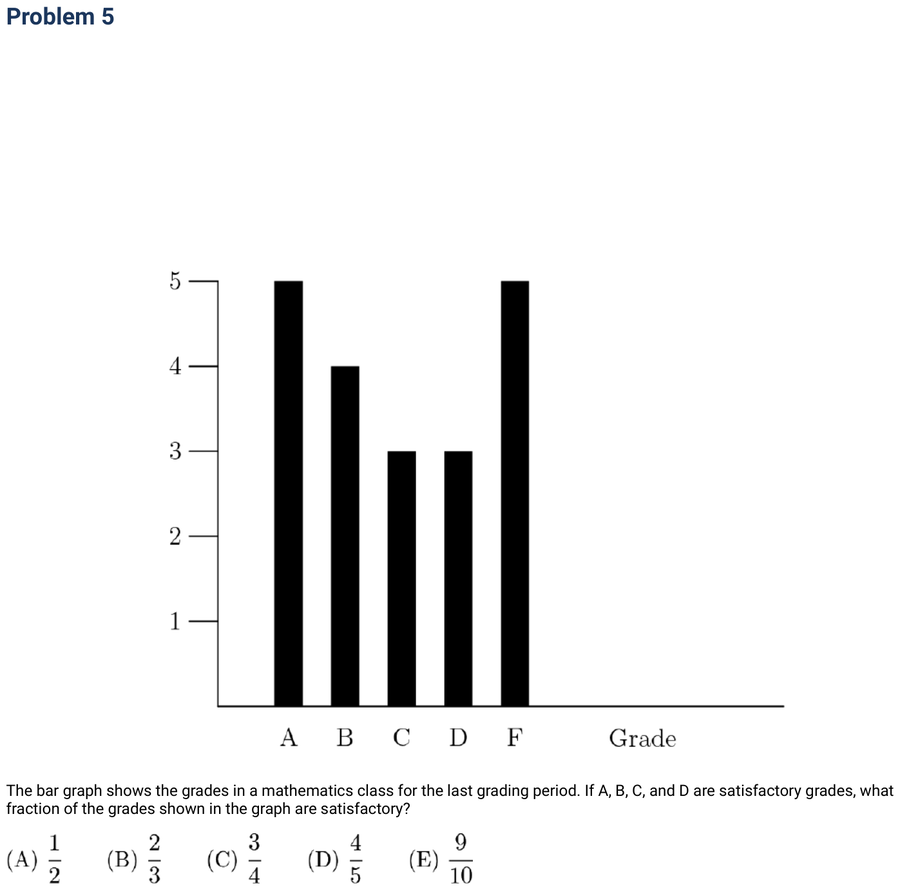
Add the A, B, C, D bars to get the satisfactory count; total includes F as well.
Show solution
  1. Satisfactory: A + B + C + D = 5 + 4 + 3 + 3 = 15. Total including F (= 5) is 20.
  2. Fraction = 15 ⁄ 20 = 3⁄4.
C 3⁄4.
Mark: · log in to save
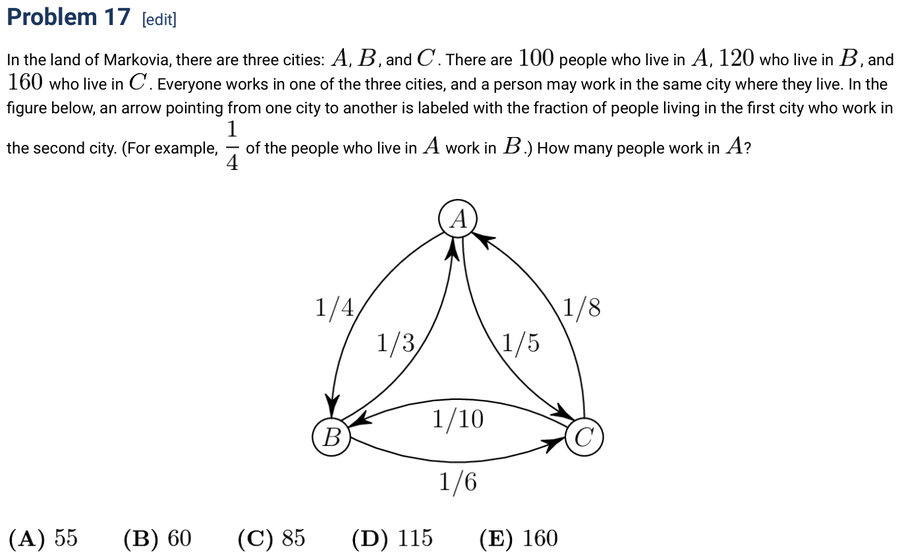
Problem 17 · 2025 AMC 8 Medium
Fractions, Decimals & Percents percent-multiplier fraction-to-decimal
amc8-2025-17
Show hint (soft nudge)
Workers in A come from all three cities. Tally each city's contribution.
Show hint (sharpest)
From A, the workers who stay are everyone not leaving for B or C. From B and C, just multiply by the labeled fraction.
Show solution
  1. From A → A: those who don't leave. 100 − 100×14 − 100×15 = 100 − 25 − 20 = 55.
  2. From B → A: 120 × 13 = 40.
  3. From C → A: 160 × 18 = 20.
  4. Total working in A: 55 + 40 + 20 = 115.
D 115 people.
Mark: · log in to save
Problem 19 · 2024 AMC 8 Hard
Fractions, Decimals & Percents percent-multiplier careful-counting

Jordan owns 15 pairs of sneakers. Three fifths of the pairs are red and the rest are white. Two thirds of the pairs are high-top and the rest are low-top. The red high-top sneakers make up a fraction of the collection. What is the least possible value of this fraction?

Show hint (soft nudge)
To minimize the overlap of "red AND high-top", let the OTHER kind (white) soak up as many high-tops as it can.
Show hint (sharpest)
9 red, 6 white. 10 high-top, 5 low-top. Make all 6 whites high-top; only 4 high-top spots remain — those must be red.
Show solution
  1. Counts: 35 × 15 = 9 red, 6 white. 23 × 15 = 10 high-top, 5 low-top.
  2. Minimize red high-tops by letting all 6 white pairs be high-top. That accounts for 6 of the 10 high-top spots.
  3. The remaining 10 − 6 = 4 high-top pairs must be red. Fraction = 415.
C 4/15.
Mark: · log in to save
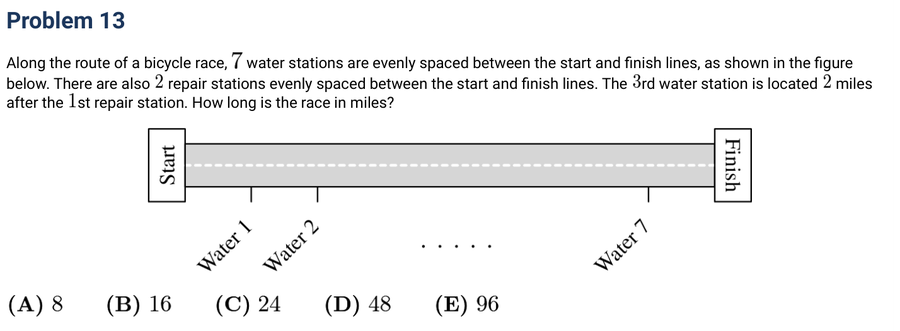
Problem 13 · 2023 AMC 8 Medium
Fractions, Decimals & Percents proportion fraction-to-decimal
amc8-2023-13
Show hint (soft nudge)
Where, as a fraction of the route, are the 1st repair station and the 3rd water station?
Show hint (sharpest)
Repair stations split into thirds: 1st is at 1/3. Water stations split into eighths: 3rd is at 3/8. Difference is 2 miles.
Show solution
  1. Let L be the race length. 2 repair stations evenly spaced between start and finish divide the route into thirds → the 1st repair is at L/3.
  2. 7 water stations evenly spaced divide the route into eighths → the 3rd water is at 3L/8.
  3. Their gap: 3L/8 − L/3 = (9L − 8L)/24 = L/24 = 2 miles.
  4. So L = 48.
D 48 miles.
Mark: · log in to save
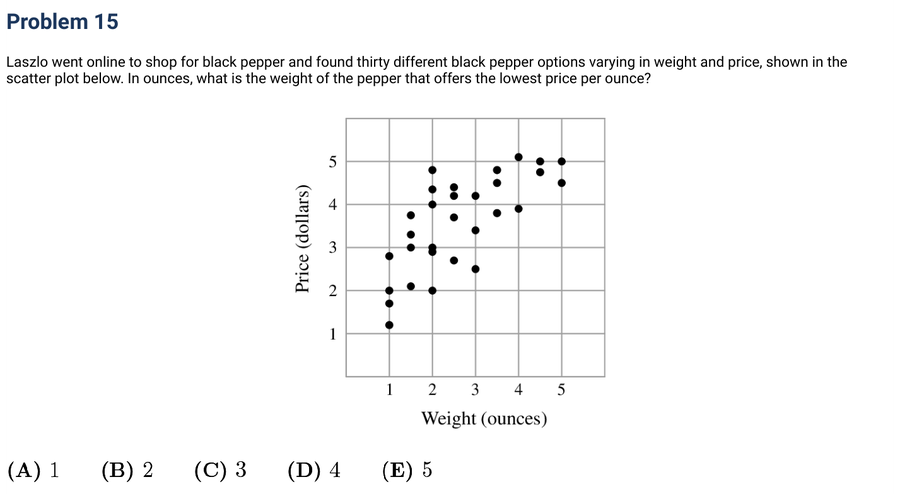
Problem 15 · 2022 AMC 8 Medium
Fractions, Decimals & Percents unit-rate estimate-and-pick
amc8-2022-15
Show hint (soft nudge)
For each weight, find the lowest price dot in that column. Then compute price ÷ weight.
Show hint (sharpest)
Lowest-price-per-ounce will favor a weight where the cheapest available pepper drops well below the dollar-per-ounce line.
Show solution
  1. Lowest price at each weight (reading off the scatter): 1 oz ≈ $1.25 (rate ≈ 1.25), 2 oz ≈ $2 (1.00), 3 oz ≈ $2.5 (≈ 0.83), 4 oz ≈ $3.9 (≈ 0.97), 5 oz ≈ $4.5 (≈ 0.90).
  2. The 3-ounce option has the lowest rate (~$0.83/oz). Answer: 3 ounces.
C 3 ounces.
Mark: · log in to save
Problem 13 · 2020 AMC 8 Medium
Fractions, Decimals & Percents percent-multiplier substitution

Jamal has a drawer containing 6 green socks, 18 purple socks, and 12 orange socks. After adding more purple socks, Jamal noticed that there is now a 60% chance that a sock randomly selected from the drawer is purple. How many purple socks did Jamal add?

Show hint (soft nudge)
If s purple socks are added, what fraction of the new drawer is purple? Set that equal to 0.6.
Show hint (sharpest)
(18 + s) / (36 + s) = 0.6.
Show solution
  1. Original drawer: 6 + 18 + 12 = 36 socks. After adding s purple: 18 + s purple out of 36 + s total.
  2. (18 + s) / (36 + s) = 0.6 ⇒ 18 + s = 21.6 + 0.6s ⇒ 0.4s = 3.6.
  3. s = 9.
B 9 purple socks added.
Mark: · log in to save
Problem 15 · 2020 AMC 8 Easy
Fractions, Decimals & Percents percent-multiplier

Suppose 15% of x equals 20% of y. What percentage of x is y?

Show hint
Write both sides as decimals and solve for y in terms of x.
Show solution
  1. 0.15x = 0.20yy = (0.15 / 0.20) x = 0.75x.
  2. So y is 75% of x.
C 75%.
Mark: · log in to save
Problem 15 · 2019 AMC 8 Medium
Fractions, Decimals & Percents proportion percent-multiplier

On a beach 50 people are wearing sunglasses and 35 people are wearing caps. Some people are wearing both sunglasses and caps. If one of the people wearing a cap is selected at random, the probability that this person is also wearing sunglasses is 25. If instead, someone wearing sunglasses is selected at random, what is the probability that this person is also wearing a cap?

Show hint (soft nudge)
Find the number wearing both first. 2/5 of cap-wearers also wear sunglasses.
Show hint (sharpest)
Both = (2/5) × 35 = 14. Then P(cap | sunglasses) = 14 / 50.
Show solution
  1. P(sunglasses | cap) = 2/5, so (people wearing both) = (2/5) × 35 = 14.
  2. P(cap | sunglasses) = 14 / 50 = 7/25.
B 7/25.
Mark: · log in to save
Problem 17 · 2019 AMC 8 Hard
Fractions, Decimals & Percents fraction-to-decimal

What is the value of the product

(1·32·2)(2·43·3)(3·54·4) … (97·9998·98)(98·10099·99) ?
Show hint (soft nudge)
Regroup. Each fraction is k(k+2)(k+1)2. Pull out a 1/2 from the first term and look for telescoping.
Show hint (sharpest)
Rewrite as (1/2)(3/2 · 2/3)(4/3 · 3/4) … (100/99) — most factors cancel.
Show solution
  1. Each factor is k(k+2)(k+1)2 = kk+1 · k+2k+1.
  2. Product across k = 1 to 98: (1/2 · 3/2)(2/3 · 4/3)…(98/99 · 100/99). Pair telescopes: the kk+1 chain → 1/99 (left telescoping); the k+2k+1 chain → 100/2 (right telescoping).
  3. Product = (1/99) · (100/2) = 50/99.
B 50/99.
Mark: · log in to save
Problem 14 · 2017 AMC 8 Medium
Fractions, Decimals & Percents percent-multiplier substitution

Chloe and Zoe are both students in Ms. Demeanor's math class. Last night they each solved half of the problems in their homework assignment alone and then solved the other half together. Chloe had correct answers to only 80% of the problems she solved alone, but overall 88% of her answers were correct. Zoe had correct answers to 90% of the problems she solved alone. What was Zoe's overall percentage of correct answers?

Show hint (soft nudge)
Pretend there are 100 problems — 50 alone, 50 together. The "together" half is the same for both girls. Find that.
Show hint (sharpest)
Chloe: 80% of 50 = 40 alone; 88% total = 88 correct; so together = 48 of 50.
Show solution
  1. Set 100 problems: 50 alone + 50 together. Chloe alone: 0.8 × 50 = 40 correct. Chloe total: 88. So together: 88 − 40 = 48 correct.
  2. Zoe alone: 0.9 × 50 = 45 correct. Zoe together: same 48 (joint work).
  3. Zoe total: 45 + 48 = 93 out of 100 = 93%.
C 93%.
Mark: · log in to save
Problem 12 · 2016 AMC 8 Medium
Fractions, Decimals & Percents fraction-to-decimal ratio

Jefferson Middle School has the same number of boys and girls. 34 of the girls and 23 of the boys went on a field trip. What fraction of the students on the field trip were girls?

Show hint
Common denominator: 3/4 = 9/12 and 2/3 = 8/12. So per 12 girls there are 9 on the trip; per 12 boys, 8.
Show solution
  1. Same group sizes ⇒ girls : boys = 1 : 1. Their trip fractions: 3/4 vs 2/3 → 9/12 vs 8/12.
  2. Ratio of girls : boys on the trip = 9 : 8.
  3. Fraction girls = 9/17.
B 9/17.
Mark: · log in to save
Problem 14 · 2002 AMC 8 Hard
Fractions, Decimals & Percents percent-multiplier

A merchant offers a large group of items at 30% off. Later, the merchant takes 20% off these sale prices and claims that the final price of these items is 50% off the original price. The total discount is

Show hint (soft nudge)
Discounts don't simply add — track the fraction of the price you still pay.
Show hint (sharpest)
After 30% off you pay 0.7 of the price; the next 20% off pays 0.8 of that.
Show solution
  1. After 30% off you pay 0.70 of the original; taking another 20% off pays 0.80 of that.
  2. So you pay 0.70 × 0.80 = 0.56 of the original — a 44% total discount, not 50%.
B 44%.
Mark: · log in to save
Problem 13 · 2001 AMC 8 Hard
Fractions, Decimals & Percents proportion

Of the 36 students in Richelle's class, 12 prefer chocolate pie, 8 prefer apple, and 6 prefer blueberry. Half of the remaining students prefer cherry pie and half prefer lemon. For Richelle's pie graph showing this data, how many degrees should she use for cherry pie?

Show hint (soft nudge)
Find how many students like cherry pie first.
Show hint (sharpest)
Each student is worth 360° ÷ 36 = 10° of the circle.
Show solution
  1. Remaining students: 36 − 12 − 8 − 6 = 10, and half prefer cherry, so 5 students.
  2. Each student is 360° ÷ 36 = 10°, so cherry pie gets 5 × 10° = 50°.
D 50 degrees.
Mark: · log in to save
Problem 17 · 2001 AMC 8 Hard
Fractions, Decimals & Percents percent-multiplier estimate-and-pick

For the game show Who Wants To Be a Millionaire?, the dollar values of each question are shown in the following table (where K = 1000). Between which two questions is the percent increase of the value the smallest?

Question values (K = 1000)
Question12345678
Value1002003005001K2K4K8K
Question9101112131415
Value16K32K64K125K250K500K1000K
Show hint (soft nudge)
Most steps simply double the value — that's a 100% increase, so ignore them.
Show hint (sharpest)
Only 2→3, 3→4, and 11→12 are not doublings; compare those.
Show solution
  1. Almost every step doubles (a 100% jump), so the smallest increase is among the non-doublings: 2→3, 3→4, and 11→12.
  2. 2→3 is 200→300 = +50%; 3→4 is 300→500 ≈ +67%; 11→12 is 64K→125K ≈ +95%.
  3. The smallest is from question 2 to 3 (50%).
B From 2 to 3.
Mark: · log in to save
Problem 13 · 1997 AJHSME Hard
Fractions, Decimals & Percents weighted-average

Three bags of jelly beans contain 26, 28, and 30 beans. The fractions of yellow beans in the bags are 50%, 25%, and 20%, respectively. All three bags are poured into one bowl. Which of the following is closest to the percent of yellow beans in the bowl?

Show hint (soft nudge)
Count the yellow beans in each bag, then total them.
Show hint (sharpest)
Divide the yellow total by the grand total of beans.
Show solution
  1. Yellow beans: 13 + 7 + 6 = 26, out of 26 + 28 + 30 = 84 beans.
  2. 26/84 ≈ 30.9%, closest to 31%.
A About 31%.
Mark: · log in to save
Problem 16 · 1997 AJHSME Hard
Fractions, Decimals & Percents successive-percent

Penni buys $100 of stock in each of three companies: AA, BB, and CC. After one year AA is up 20%, BB is down 25%, and CC is unchanged. In the second year AA drops 20% from its new value, BB rises 25% from its new value, and CC is unchanged. If A, B, C are the final values, which ordering is correct?

Show hint (soft nudge)
Track each $100 through both years.
Show hint (sharpest)
A 20% rise followed by a 20% fall does not return to the start.
Show solution
  1. AA: 100 → 120 → 96. BB: 100 → 75 → 93.75. CC stays 100.
  2. So 93.75 < 96 < 100, i.e. B < A < C.
E B < A < C.
Mark: · log in to save
Problem 18 · 1997 AJHSME Hard
Fractions, Decimals & Percents percent-decrease

Last week small boxes of facial tissue were priced at 4 boxes for $5. This week they are on sale at 5 boxes for $4. The percent decrease in the price per box during the sale was closest to

Show hint (soft nudge)
Find the price of one box before and during the sale.
Show hint (sharpest)
Percent decrease compares the drop to the original price.
Show solution
  1. A box cost $5 ÷ 4 = $1.25 before and $4 ÷ 5 = $0.80 on sale.
  2. The decrease is $0.45 ÷ $1.25 = 36%, closest to 35%.
B About 35%.
Mark: · log in to save
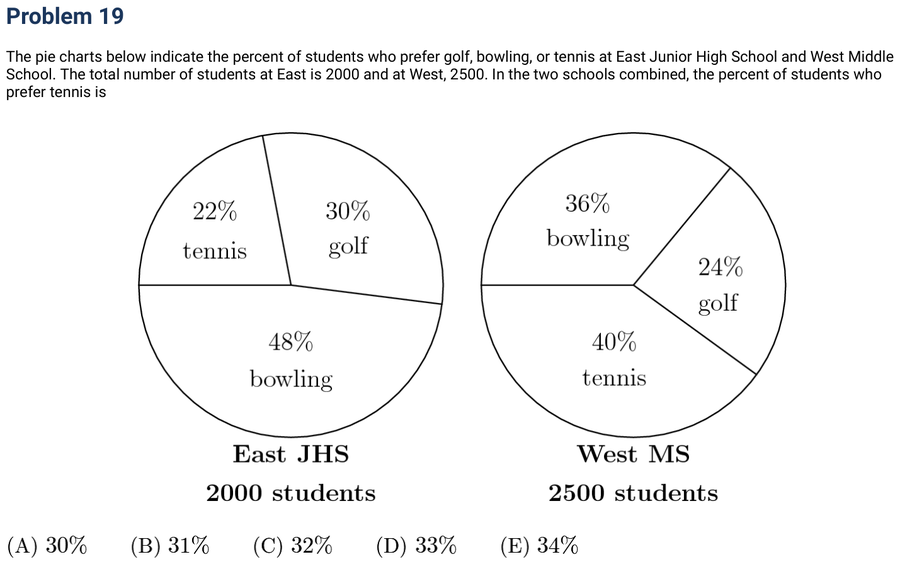
Problem 19 · 1996 AJHSME Hard
Fractions, Decimals & Percents weighted-percent
ajhsme-1996-19
Show hint (soft nudge)
Find the actual number of tennis fans at each school, not the percents.
Show hint (sharpest)
Combine and divide by the total of all students.
Show solution
  1. Tennis fans: East 22% of 2000 = 440, West 40% of 2500 = 1000, totaling 1440.
  2. Out of 2000 + 2500 = 4500 students, that's 1440/4500 = 32%.
C 32%.
Mark: · log in to save
Problem 10 · 1995 AJHSME Hard
Fractions, Decimals & Percents percent-of-total

A jacket and a shirt originally sold for 80 dollars and 40 dollars, respectively. During a sale Chris bought the 80-dollar jacket at a 40% discount and the 40-dollar shirt at a 55% discount. The total amount saved was what percent of the total of the original prices?

Show hint (soft nudge)
Find the dollars saved on each item.
Show hint (sharpest)
Compare the total saved to the total original price of $120.
Show solution
  1. Savings: 40% of $80 = $32, and 55% of $40 = $22, for $54 saved.
  2. Out of $120 original, that's 54/120 = 45%.
A 45%.
Mark: · log in to save
Problem 17 · 1995 AJHSME Hard
Fractions, Decimals & Percents weighted-percent
ajhsme-1995-17
Show hint (soft nudge)
Convert grade-6 percents to actual counts at each school.
Show hint (sharpest)
Add them and divide by the 300 total students.
Show solution
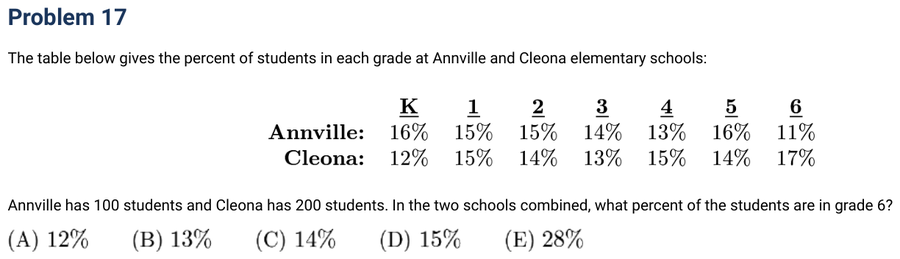
  1. Grade 6: Annville 11% of 100 = 11, Cleona 17% of 200 = 34, totaling 45.
  2. Out of 300 students, that is 45/300 = 15%.
D 15%.
Mark: · log in to save
Problem 9 · 1994 AJHSME Hard
Fractions, Decimals & Percents discount tax

A shopper buys a 100-dollar coat on sale for 20% off. An additional 5 dollars are taken off the sale price by using a discount coupon. A sales tax of 8% is paid on the final selling price. The total amount the shopper pays for the coat is

Show hint (soft nudge)
Apply the discounts in order before the tax.
Show hint (sharpest)
20% off $100, then −$5, then ×1.08.
Show solution
  1. 20% off $100 is $80; the coupon makes it $75.
  2. Adding 8% tax: $75 × 1.08 = $81.00.
A 81.00 dollars.
Mark: · log in to save
Problem 16 · 1993 AJHSME Hard
Fractions, Decimals & Percents continued-fraction
ajhsme-1993-16
Show hint (soft nudge)
Work from the bottom up.
Show hint (sharpest)
Simplify 2 + 1/3 first, then move outward.
Show solution
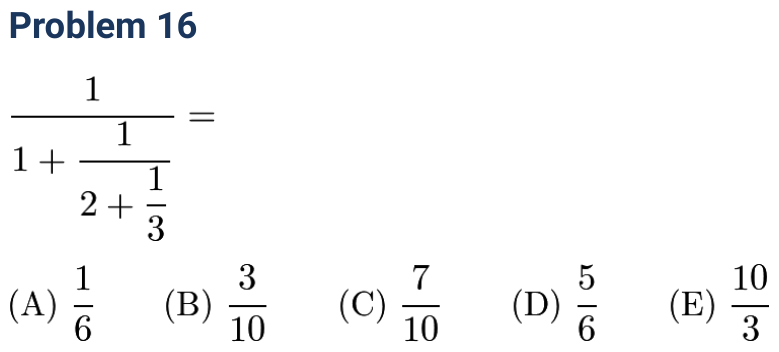
  1. 2 + 1/3 = 7/3, so 1 ÷ (7/3) = 3/7, and 1 + 3/7 = 10/7.
  2. Finally 1 ÷ (10/7) = 7/10.
C 7/10.
Mark: · log in to save
Problem 21 · 1993 AJHSME Hard
Fractions, Decimals & Percents percent-area

If the length of a rectangle is increased by 20% and its width is increased by 50%, then the area is increased by

Show hint (soft nudge)
Area multiplies by the two growth factors.
Show hint (sharpest)
1.2 × 1.5 — how much more than 1 is that?
Show solution
  1. The new area is 1.2 × 1.5 = 1.8 times the old area.
  2. That's an increase of 80%.
D 80%.
Mark: · log in to save
Problem 9 · 1992 AJHSME Hard
Fractions, Decimals & Percents read-graph ratio
ajhsme-1992-09
Show hint (soft nudge)
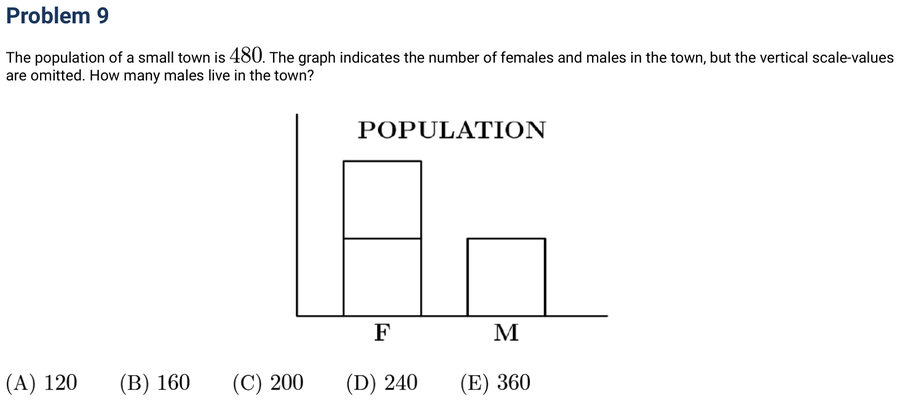
The line across the F bar shows it is twice as tall as the M bar.
Show hint (sharpest)
So females and males split the 480 in a 2 : 1 ratio.
Show solution
  1. The female bar is twice the male bar, so the town is 2 parts female to 1 part male — 3 parts total.
  2. Each part is 480 ÷ 3 = 160, so there are 160 males.
B 160.
Mark: · log in to save
Problem 21 · 1992 AJHSME Hard
Fractions, Decimals & Percents read-graph percent-comparison
ajhsme-1992-21
Show hint (soft nudge)
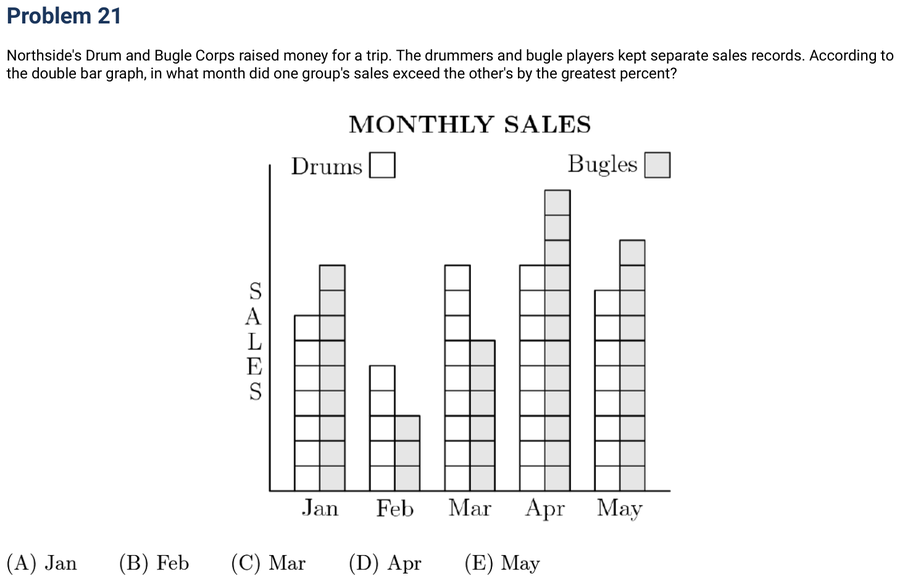
Greatest percent, not greatest amount — a small bar makes a small lead look big.
Show hint (sharpest)
Check the month with the lowest sales, where one bar is a large fraction above the other.
Show solution
  1. In February the bars are smallest, so the one-unit lead of drums over bugles is a 50% difference.
  2. No other month's bars give that large a percentage gap, so the answer is February.
B February.
Mark: · log in to save
Problem 18 · 1991 AJHSME Hard
Fractions, Decimals & Percents pictograph percent
ajhsme-1991-18
Show hint (soft nudge)
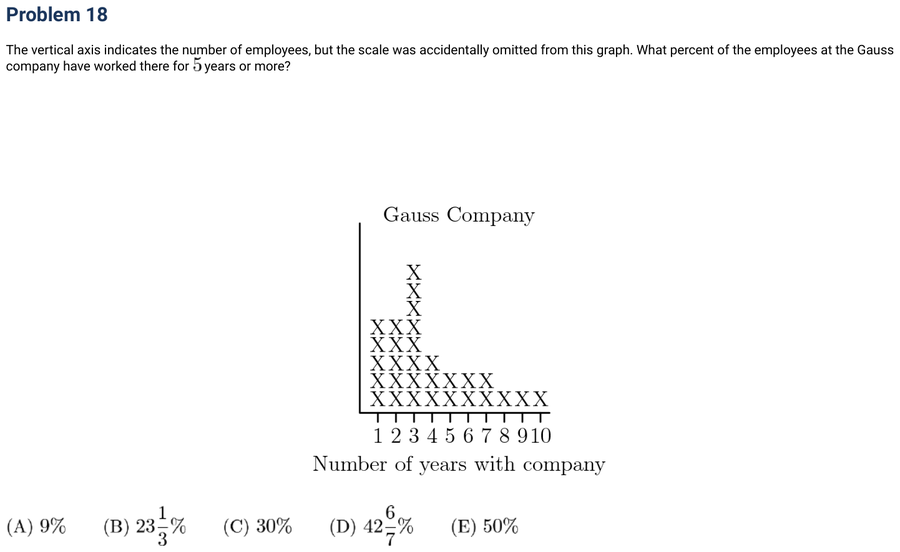
Even with no scale, each X stands for the same number of employees, so count X's.
Show hint (sharpest)
Add the X's for 5 years or more and divide by the total number of X's.
Show solution
  1. Each X represents the same number of employees, so the percent is just (X's for 5+ years) ÷ (total X's).
  2. Counting the columns, that fraction comes out to 30%.
C 30%.
Mark: · log in to save
Problem 9 · 1990 AJHSME Hard
Fractions, Decimals & Percents count-in-range percent
ajhsme-1990-09
Show hint (soft nudge)
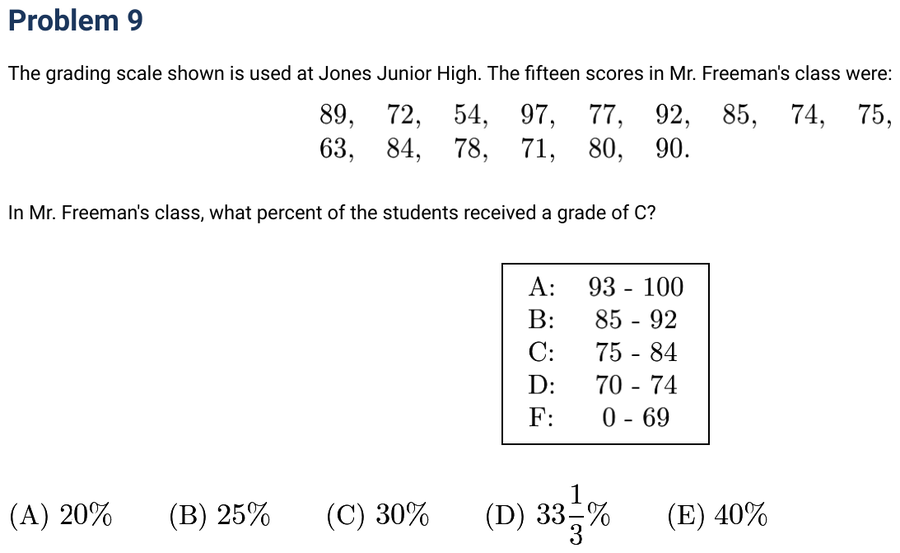
A C is a score from 75 to 84 — count how many of the 15 scores fall there.
Show hint (sharpest)
Then divide by 15.
Show solution
  1. Scores in 75–84 are 77, 75, 84, 78, 80 — that's 5 of the 15.
  2. 5/15 = 33⅓%.
D 33⅓%.
Mark: · log in to save
Problem 12 · 1989 AJHSME Hard
Fractions, Decimals & Percents simplify-complex-fraction
ajhsme-1989-12
Show hint (soft nudge)
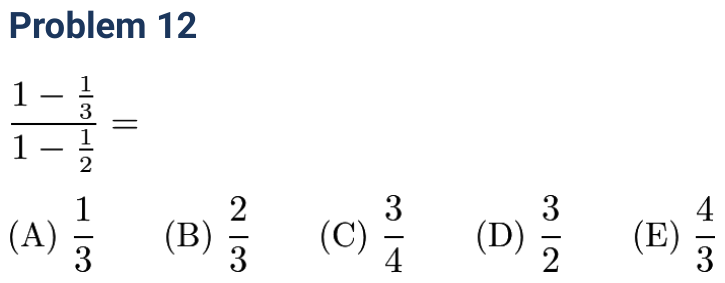
Compute the numerator and denominator separately before dividing.
Show hint (sharpest)
Dividing by a fraction is multiplying by its reciprocal.
Show solution
  1. Top: 1 − 1⁄3 = 2⁄3. Bottom: 1 − 1⁄2 = 1⁄2.
  2. (2⁄3) ÷ (1⁄2) = (2⁄3) × 2 = 4⁄3.
E 4⁄3.
Mark: · log in to save
Problem 13 · 1989 AJHSME Hard
Fractions, Decimals & Percents proportional-scaling
ajhsme-1989-13
Show hint (soft nudge)
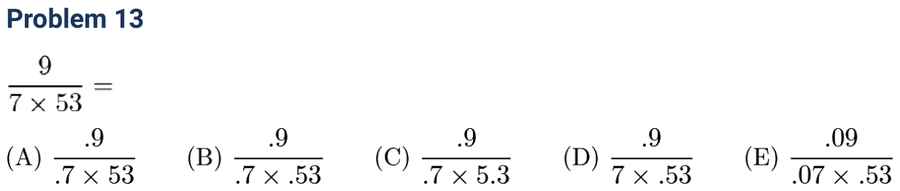
Scaling the numerator and one denominator factor by the same amount leaves the fraction unchanged.
Show hint (sharpest)
Multiply the top and one factor on the bottom both by 0.1.
Show solution
  1. Choice A turns 9 → .9 (×0.1) and 7 → .7 (×0.1). Same ×0.1 on top and bottom cancels: .9 ⁄ (.7 × 53) = 9 ⁄ (7 × 53).
  2. Every other choice changes a different number of factors by 0.1, so its value differs from the original.
A .9 ⁄ (.7 × 53).
Mark: · log in to save
Problem 12 · 1988 AJHSME Hard
Fractions, Decimals & Percents cancel-powers-of-ten

Suppose the estimated 20 billion dollar cost to send a person to the planet Mars is shared equally by the 250 million people in the U.S. Then each person's share is

Show hint (soft nudge)
billion = 1000 × million, so 20 billion = 20,000 million.
Show hint (sharpest)
Divide 20,000 by 250.
Show solution
  1. 20 billion ⁄ 250 million = 20,000 million ⁄ 250 million = 20,000 ⁄ 250.
  2. = 80 dollars.
C 80 dollars.
Mark: · log in to save
Problem 15 · 1988 AJHSME Hard
Fractions, Decimals & Percents add-fractions-then-flip

The reciprocal of (1⁄2 + 1⁄3) is

Show hint (soft nudge)
Add the fractions first, then flip.
Show hint (sharpest)
1⁄2 + 1⁄3 = 5⁄6.
Show solution
  1. 1⁄2 + 1⁄3 = 3⁄6 + 2⁄6 = 5⁄6.
  2. Reciprocal of 5⁄6 is 6⁄5.
C 6⁄5.
Mark: · log in to save
Problem 20 · 1988 AJHSME Hard
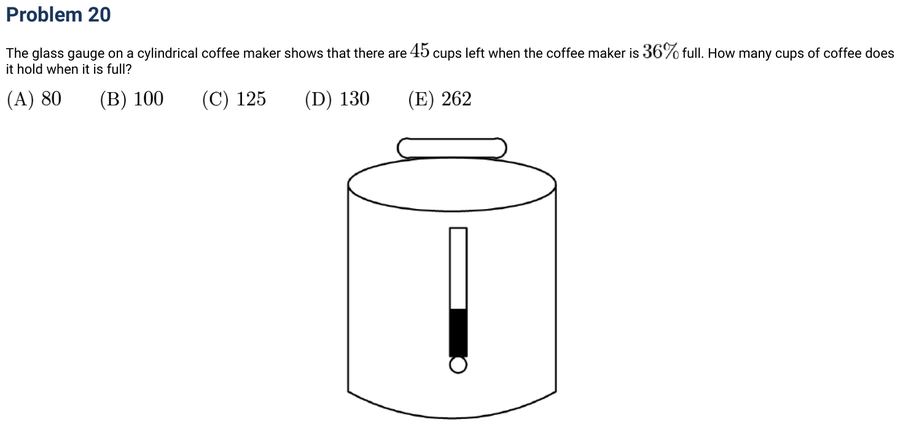
Fractions, Decimals & Percents percent-of-whole
ajhsme-1988-20
Show hint (soft nudge)
45 cups is 36% of the full capacity.
Show hint (sharpest)
Divide 45 by 0.36.
Show solution
  1. If 45 = 0.36 · Full, then Full = 45 ⁄ 0.36 = 4500 ⁄ 36.
  2. = 125 cups.
C 125.
Mark: · log in to save
Problem 11 · 1987 AJHSME Hard
Fractions, Decimals & Percents bound-the-fractional-part

The sum 2 1⁄7 + 3 1⁄2 + 5 1⁄19 is between

Show hint (soft nudge)
Add the whole parts first, then bound the fractions.
Show hint (sharpest)
1⁄7 + 1⁄2 + 1⁄19 — at most 3⁄2, at least 1⁄2.
Show solution
  1. Whole parts: 2 + 3 + 5 = 10. Fractions: 1⁄7 + 1⁄2 + 1⁄19 sits between 1⁄2 and 1 (clearly more than 1⁄2 since one term is already 1⁄2, but less than 1 since 1⁄7 + 1⁄19 < 1⁄2).
  2. Total between 10 + 1⁄2 = 10 1⁄2 and 10 + 1 = 11. Answer B.
B 10 1⁄2 and 11.
Mark: · log in to save
Problem 13 · 1987 AJHSME Hard
Fractions, Decimals & Percents compare-to-half

Which of the following fractions has the largest value?

Show hint (soft nudge)
Compare each fraction to 1⁄2 — only one exceeds it.
Show hint (sharpest)
a⁄b > 1⁄2 ⇔ 2a > b.
Show solution
  1. Doubling each numerator: 6 < 7, 8 < 9, 34 < 35, 200 < 201, but 302 > 301.
  2. Only 151⁄301 exceeds 1⁄2, so it's the largest.
E 151⁄301.
Mark: · log in to save
Problem 16 · 1987 AJHSME Hard
Fractions, Decimals & Percents set-up-percent-equation

Joyce made 12 of her first 30 shots in the first three games of this basketball game, so her seasonal shooting average was 40%. In her next game, she took 10 shots and raised her seasonal shooting average to 50%. How many of these 10 shots did she make?

Show hint (soft nudge)
After the next game her total shots is 40 and average is 50%, so total made = 20.
Show hint (sharpest)
She'd already made 12 — how many more did she need?
Show solution
  1. After 40 shots at 50%, she's made 20. She had 12 before, so she made 20 − 12.
  2. = 8 shots this game.
E 8.
Mark: · log in to save
Problem 18 · 1987 AJHSME Hard
Fractions, Decimals & Percents compose-fractions

Half the people in a room left. One third of those remaining started to dance. There were then 12 people who were not dancing. The original number of people in the room was what?

Show hint (soft nudge)
After the leavers, half remain; of those, 2⁄3 are not dancing.
Show hint (sharpest)
(1⁄2) × (2⁄3) × N = 12.
Show solution
  1. Non-dancers are 1⁄2 × 2⁄3 = 1⁄3 of the original group.
  2. N ⁄ 3 = 12 → N = 36.
C 36.
Mark: · log in to save
Problem 12 · 1986 AJHSME Hard
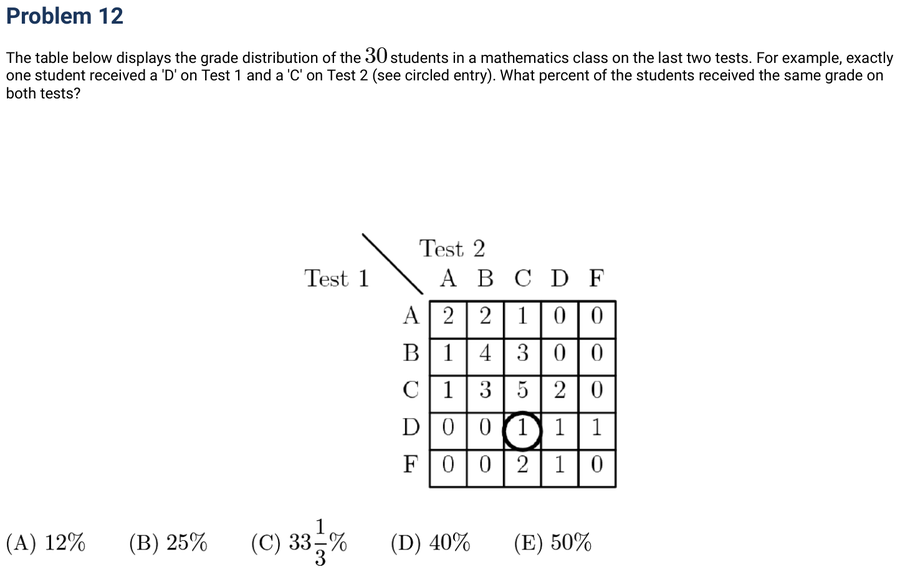
Fractions, Decimals & Percents diagonal-sum
ajhsme-1986-12
Show hint (soft nudge)
Students with the same grade on both tests sit on the table's diagonal (A-A, B-B, …).
Show hint (sharpest)
Add those five diagonal cells, then divide by 30.
Show solution
  1. Diagonal: 2 (A-A) + 4 (B-B) + 5 (C-C) + 1 (D-D) + 0 (F-F) = 12.
  2. 12 ⁄ 30 = 40%.
D 40%.
Mark: · log in to save
Problem 14 · 1986 AJHSME Hard
Fractions, Decimals & Percents maximize-fraction

If 200 ≤ a ≤ 400 and 600 ≤ b ≤ 1200, then the largest value of the quotient b ⁄ a is

Show hint
Maximize a fraction by maximizing the numerator and minimizing the denominator.
Show solution
  1. Take b = 1200 (the maximum) and a = 200 (the minimum).
  2. b ⁄ a = 1200 ⁄ 200 = 6.
C 6.
Mark: · log in to save
Problem 15 · 1986 AJHSME Hard
Fractions, Decimals & Percents multiply-discount-factors

Sale prices at the Ajax Outlet Store are 50% below original prices. On Saturdays an additional discount of 20% off the sale price is given. What is the Saturday price of a coat whose original price is $180?

Show hint
Apply each discount as a multiplier: 0.5 then 0.8.
Show solution
  1. Sale price = $180 × 0.5 = $90. Saturday price = $90 × 0.8.
  2. = $72.
B $72.
Mark: · log in to save
Problem 16 · 1986 AJHSME Hard
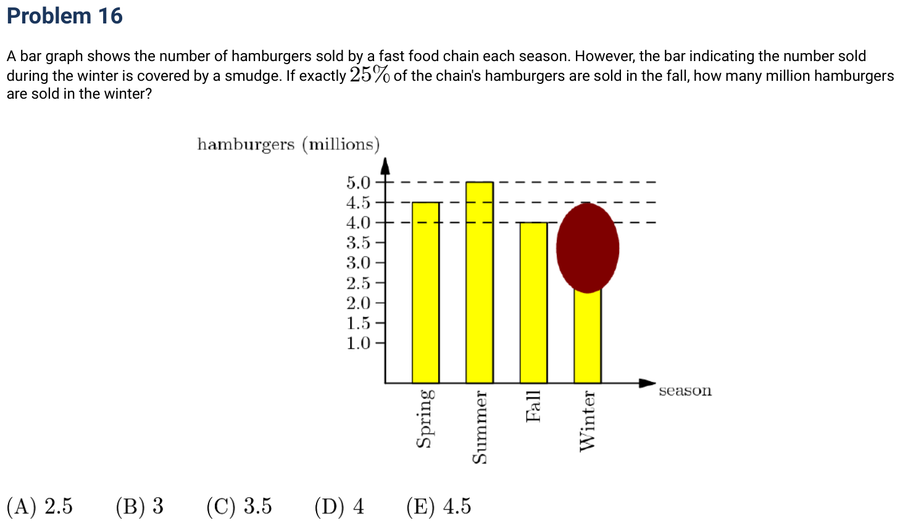
Fractions, Decimals & Percents percent-of-total
ajhsme-1986-16
Show hint (soft nudge)
Fall = 25% of total means total = 4 × Fall.
Show hint (sharpest)
Read Spring, Summer, Fall from the graph and subtract from total.
Show solution
  1. Fall ≈ 4 million, and fall is 25%, so total = 4 × 4 = 16 million. Spring ≈ 4.5, Summer ≈ 5.
  2. Winter = 16 − 4.5 − 5 − 4 = 2.5 million.
A 2.5.
Mark: · log in to save
Problem 20 · 1986 AJHSME Hard
Fractions, Decimals & Percents round-then-estimate

The value of the expression (304)⁵ ⁄ ((29.7)(399)⁴) is closest to

Show hint (soft nudge)
Round 304 ≈ 300, 399 ≈ 400, 29.7 ≈ 30.
Show hint (sharpest)
Then (3⁄4)⁴ × 300⁄30 simplifies the powers.
Show solution
  1. Approximate: 300⁵ ⁄ (30 · 400⁴) = (300⁄400)⁴ · 300⁄30 = (3⁄4)⁴ · 10 = (81⁄256) · 10 ≈ 3.16.
  2. Closest choice: 3.
D 3.
Mark: · log in to save
Problem 14 · 1985 AJHSME Hard
Fractions, Decimals & Percents percent-of-fixed-amount

The difference between a 6.5% sales tax and a 6% sales tax on an item priced at $20 before tax is

Show hint
The difference is just 0.5% of $20.
Show solution
  1. 0.5% × $20 = 0.005 × 20.
  2. = $0.10.
B $.10.
Mark: · log in to save
Problem 7 · 2026 AMC 8 Medium
Fractions, Decimals & Percents fraction-of

Mika wants to estimate how far a new electric bike goes on a full charge. She made two trips totaling 40 miles: the first used 12 of the battery and the second used 310 of the battery. How many miles can the bike go on a fully charged battery?

Show hint (soft nudge)
Add the two battery fractions to see what share of a full charge covered the 40 miles.
Show hint (sharpest)
Then scale up from that share to a whole battery.
Show solution
  1. The two trips used ½ + 3/10 = 4/5 of the battery for 40 miles.
  2. A full battery covers 40 ÷ (4/5) = 50 miles.
C 50 miles.
Mark: · log in to save
Problem 8 · 2026 AMC 8 Medium
Fractions, Decimals & Percents reduce-fraction

A poll asked some people whether they liked solving mathematics problems, and exactly 74% answered "yes." What is the fewest possible number of people who could have been asked?

Show hint (soft nudge)
74% of the group must be a whole number of people.
Show hint (sharpest)
Reduce 74/100 to lowest terms; the denominator is the smallest possible group size.
Show solution
  1. 74% = 74/100 = 37/50 in lowest terms, so the number of people must be a multiple of 50.
  2. The fewest is 50.
D 50 people.
Mark: · log in to save
Problem 10 · 2023 AMC 8 Medium
Fractions, Decimals & Percents fraction-to-decimal percent-multiplier

Harold made a plum pie to take on a picnic. He was able to eat only 14 of the pie, and he left the rest for his friends. A moose came by and ate 13 of what Harold left behind. After that, a porcupine ate 13 of what the moose left behind. How much of the original pie still remained after the porcupine left?

Show hint (soft nudge)
Each eater leaves behind a fraction of what they found. Multiply those leftovers together.
Show hint (sharpest)
Harold leaves 3/4, moose leaves 2/3, porcupine leaves 2/3. Multiply: 3/4 × 2/3 × 2/3.
Show solution
  1. Each step's leftover is (1 − what they ate). Harold leaves 34. Moose leaves 23 of that. Porcupine leaves 23 of that.
  2. 34 × 23 × 23 = 1236 = 13.
D 1/3.
Another way: twelve slices (MAA)
  1. Cut the pie into 12 equal slices. Harold eats 3, leaving 9. Moose eats 13 of 9 = 3, leaving 6. Porcupine eats 13 of 6 = 2, leaving 4.
  2. 4 of 12 = 1/3.
Mark: · log in to save
Problem 8 · 2022 AMC 8 Medium
Fractions, Decimals & Percents fraction-to-decimal

What is the value of

13 · 24 · 35 · … · 1820 · 1921 · 2022 ?
Show hint (soft nudge)
Every number 3 through 20 appears once as a numerator and once as a denominator. What cancels?
Show hint (sharpest)
After cancellation: only 1 · 2 (from numerators) and 21 · 22 (from denominators) survive.
Show solution
  1. Numerators run 1, 2, 3, …, 20. Denominators run 3, 4, 5, …, 22. Every number from 3 to 20 appears in both lists and cancels.
  2. Left over: 1 · 221 · 22 = 2462 = 1231.
B 1/231.
Mark: · log in to save
Problem 9 · 2022 AMC 8 Easy
Fractions, Decimals & Percents percent-multiplier

A cup of boiling water (212°F) is placed to cool in a room whose temperature remains constant at 68°F. Suppose the difference between the water temperature and the room temperature is halved every 5 minutes. What is the water temperature, in degrees Fahrenheit, after 15 minutes?

Show hint (soft nudge)
Don't track the temperature directly — track the difference from room temp.
Show hint (sharpest)
Initial gap: 212 − 68 = 144. Halved three times in 15 minutes: 144 / 23 = 18. Add to room temp.
Show solution
  1. Initial gap above room: 212 − 68 = 144°F.
  2. 15 minutes = three 5-minute halvings: 144 → 72 → 36 → 18.
  3. Final temperature = 68 + 18 = 86°F.
B 86&deg;F.
Mark: · log in to save
Problem 8 · 2019 AMC 8 Medium
Fractions, Decimals & Percents percent-multiplier

Gilda has a bag of marbles. She gives 20% of them to her friend Pedro. Then Gilda gives 10% of what is left to another friend, Ebony. Finally, Gilda gives 25% of what is now left in the bag to her brother Jimmy. What percentage of her original bag of marbles does Gilda have left for herself?

Show hint (soft nudge)
Each transfer leaves a fraction behind. Multiply the "keep" fractions together.
Show hint (sharpest)
Keeps: 0.8 × 0.9 × 0.75.
Show solution
  1. After Pedro: 80% remains. After Ebony: 90% of that. After Jimmy: 75% of what's left.
  2. 0.8 × 0.9 × 0.75 = 0.54 = 54%.
E 54%.
Mark: · log in to save
Problem 10 · 2018 AMC 8 Medium
Fractions, Decimals & Percents fraction-to-decimal evaluate-formula

The harmonic mean of a set of non-zero numbers is the reciprocal of the average of the reciprocals of the numbers. What is the harmonic mean of 1, 2, and 4?

Show hint (soft nudge)
Three steps: take reciprocals, average, take reciprocal again.
Show hint (sharpest)
Reciprocals: 1, 1/2, 1/4. Sum = 7/4. Average = 7/12. Final reciprocal: 12/7.
Show solution
  1. Reciprocals: 1, 1/2, 1/4. Sum: 1 + 1/2 + 1/4 = 7/4.
  2. Average of 3 reciprocals: (7/4)/3 = 7/12.
  3. Harmonic mean = reciprocal: 12/7.
C 12/7.
Mark: · log in to save
Problem 20 · 2012 AMC 8 Medium
Fractions, Decimals & Percents fraction-comparison rewrite-as-1-minus

What is the correct ordering of the three numbers 519, 721, and 923, in increasing order?

Show hint
Each fraction is of the form (n)/(n + 14) for n = 5, 7, 9. Write as 1 − 14/(n + 14). Bigger denominator on the subtracted piece ⇒ bigger overall fraction.
Show solution
  1. 5/19 = 1 − 14/19, 7/21 = 1 − 14/21, 9/23 = 1 − 14/23.
  2. Since 14/19 > 14/21 > 14/23, subtracting the largest gives the smallest fraction.
  3. Order: 5/19 < 7/21 < 9/23.
B 5/19 &lt; 7/21 &lt; 9/23.
Mark: · log in to save
Problem 10 · 2011 AMC 8 Medium
Fractions, Decimals & Percents piecewise-rate

The taxi fare in Gotham City is $2.40 for the first 12 mile and additional mileage charged at the rate $0.20 for each additional 0.1 mile. You plan to give the driver a $2 tip. How many miles can you ride for $10?

Show hint
Subtract the $2 tip from $10. Then subtract the $2.40 flag-drop for the first half-mile. Convert the rest at $0.20 per 0.1 mile = $2 per mile.
Show solution
  1. Available for fare: $10 − $2 = $8.
  2. After the first 1/2 mile costing $2.40: $8 − $2.40 = $5.60 left.
  3. Additional rate: $0.20 / 0.1 mile = $2 per mile. So $5.60 buys 2.80 miles.
  4. Total: 0.5 + 2.80 = 3.3 miles.
C 3.3 miles.
Mark: · log in to save
Problem 14 · 2011 AMC 8 Medium
Fractions, Decimals & Percents ratio-totals

There are 270 students at Colfax Middle School, where the ratio of boys to girls is 5 : 4. There are 180 students at Winthrop Middle School, where the ratio of boys to girls is 4 : 5. The two schools hold a dance and all students from both schools attend. What fraction of the students at the dance are girls?

Show hint
Each ratio uses 9 parts. Compute girls at each school, then total girls / total students.
Show solution
  1. Colfax: girls = (4/9)(270) = 120.
  2. Winthrop: girls = (5/9)(180) = 100.
  3. Total girls: 220 of 450 students ⇒ 22/45.
C 22/45.
Mark: · log in to save
Problem 12 · 2010 AMC 8 Medium
Fractions, Decimals & Percents fix-the-invariant

Of the 500 balls in a large bag, 80% are red and the rest are blue. How many of the red balls must be removed from the bag so that 75% of the remaining balls are red?

Show hint
Blue balls don't change. 75% red ⇒ 25% blue, so the 100 blue balls represent 25% of the new total.
Show solution
  1. Initial: 400 red, 100 blue.
  2. After removal, 25% blue means total = 100 / 0.25 = 400 balls.
  3. Removed: 500 − 400 = 100 red balls.
D 100 red balls.
Mark: · log in to save
Problem 15 · 2010 AMC 8 Medium
Fractions, Decimals & Percents find-total-from-percent

A jar contains five different colors of gumdrops: 30% are blue, 20% are brown, 15% red, 10% yellow, and the other 30 gumdrops are green. If half of the blue gumdrops are replaced with brown gumdrops, how many gumdrops will be brown?

Show hint (soft nudge)
Green = 100% − 30 − 20 − 15 − 10 = 25%, so 30 gumdrops = 25% ⇒ total = 120.
Show hint (sharpest)
Brown starts at 20% · 120 = 24. Add half the blue gumdrops (which switch color).
Show solution
  1. Green % = 25 ⇒ total = 30 / 0.25 = 120.
  2. Blue count: 30% · 120 = 36. Brown count: 20% · 120 = 24.
  3. Half of blue (18) become brown: 24 + 18 = 42.
C 42.
Mark: · log in to save
Problem 22 · 2005 AMC 8 Medium
Fractions, Decimals & Percents unit-price-ranking

A company sells detergent in three different sized boxes: small (S), medium (M) and large (L). The medium size costs 50% more than the small size and contains 20% less detergent than the large size. The large size contains twice as much detergent as the small size and costs 30% more than the medium size. Rank the three sizes from best to worst buy.

Show hint
Set the small price to $1 and the large size to 10 oz. Derive the rest, then compute price per oz.
Show solution
  1. Small: $1, 5 oz (large is twice the small ⇒ small = 5 oz).
  2. Medium: $1.50 (50% more than small), 8 oz (20% less than 10 oz large).
  3. Large: 10 oz, $1.95 (30% more than medium).
  4. $/oz: S = 0.200, M = 0.1875, L = 0.195.
  5. Best (lowest $/oz) to worst: M, L, S.
E MLS (best M, then L, then S).
Mark: · log in to save
Problem 12 · 2004 AMC 8 Medium
Fractions, Decimals & Percents battery-fraction-rates

Niki usually leaves her cell phone on. If her cell phone is on but she is not actually using it, the battery will last for 24 hours. If she is using it constantly, the battery will last for only 3 hours. Since the last recharge, her phone has been on 9 hours, and during that time she has used it for 60 minutes. If she doesn't talk any more but leaves the phone on, how many more hours will the battery last?

Show hint
Idle uses 1/24 per hour; using uses 1/3 per hour. So far: 8 hr idle + 1 hr in use.
Show solution
  1. Used: 8 · (1/24) + 1 · (1/3) = 1/3 + 1/3 = 2/3.
  2. Remaining: 1/3 of battery. At idle rate 1/24 per hour: time = (1/3) · 24 = 8 hr.
B 8 more hours.
Mark: · log in to save
Problem 20 · 2004 AMC 8 Medium
Fractions, Decimals & Percents fraction-from-empty

Two-thirds of the people in a room are seated in three-fourths of the chairs. The rest of the people are standing. If there are 6 empty chairs, how many people are in the room?

Show hint
1/4 of the chairs are empty = 6 ⇒ chairs total. Then 3/4 of chairs gives # seated people.
Show solution
  1. Empty chairs (1/4 of total) = 6 ⇒ chairs = 24.
  2. Seated people = (3/4)(24) = 18, which is 2/3 of all people.
  3. Total people = 18 / (2/3) = 27.
D 27 people.
Mark: · log in to save
Problem 22 · 2004 AMC 8 Medium
Fractions, Decimals & Percents set-up-variables

At a party there are only single women and married men with their wives. The probability that a randomly selected woman is single is 2/5. What fraction of the people in the room are married men?

Show hint
Pick 5 women. 2 single, 3 married. Married women bring 3 husbands. Total people: 5 + 3 = 8.
Show solution
  1. Let women = 5. Single: 2; married: 3.
  2. Married men = 3 (one per married woman). Total people: 5 + 3 = 8.
  3. Fraction: 3/8 = 3/8.
B 3/8.
Mark: · log in to save
Problem 11 · 2003 AMC 8 Medium
Fractions, Decimals & Percents percent-multiplier

Business is a little slow at Lou's Fine Shoes, so Lou decides to have a sale. On Friday, Lou increases all of Thursday's prices by 10%. Over the weekend, Lou advertises the sale: "Ten percent off the listed price. Sale starts Monday." How much does a pair of shoes cost on Monday that cost $40 on Thursday?

Show hint (soft nudge)
A 10% increase followed by a 10% decrease is not a wash — the cut is taken off a bigger number.
Show hint (sharpest)
Multiply the two factors: ×1.1 then ×0.9.
Show solution
  1. Friday: 40 × 1.1 = 44. Monday: 44 × 0.9 = 39.60.
  2. Equivalently 40 × 1.1 × 0.9 = 40 × 0.99 = 39.60 — a hair under the original.
B $39.60.
Mark: · log in to save
Problem 7 · 2002 AMC 8 Medium
Fractions, Decimals & Percents percent-multiplier

The students in Mrs. Sawyer's class each chose one of five kinds of candy in a taste test. The bar graph shows their preferences. What percent of her class chose candy E?

SWEET TOOTH012345678ABCDEKinds of candyNumber of students
Show hint (soft nudge)
First find how many students there are in all.
Show hint (sharpest)
With 25 students total, each one is 4% of the class.
Show solution
  1. The class total is 6 + 8 + 4 + 2 + 5 = 25 students.
  2. Candy E was chosen by 5 of them: 5/25 = 1/5 = 20%.
E 20%.
Mark: · log in to save
Problem 10 · 2001 AMC 8 Medium
Fractions, Decimals & Percents percent-multiplier

A collector offers to buy state quarters for 2000% of their face value. At that rate, how much will Bryden get for his four state quarters?

Show hint (soft nudge)
Four quarters is $1 of face value.
Show hint (sharpest)
2000% means 2000 ÷ 100 = 20 times.
Show solution
  1. Four quarters have a face value of $1, and 2000% is 2000 ÷ 100 = 20 times that.
  2. So Bryden gets 20 × $1 = $20.
A $20.
Mark: · log in to save
Problem 10 · 2000 AMC 8 Medium
Fractions, Decimals & Percents percent-multiplier

Ara and Shea were once the same height. Since then Shea has grown 20% while Ara has grown half as many inches as Shea. Shea is now 60 inches tall. How tall, in inches, is Ara now?

Show hint (soft nudge)
Find the common starting height from Shea's 20% growth.
Show hint (sharpest)
Ara grew half as many inches as Shea — match inches, not percents.
Show solution
  1. Shea grew 20% to reach 60, so the start was 60 ÷ 1.2 = 50 inches, meaning Shea grew 10 inches.
  2. Ara grew half that, 5 inches, ending at 50 + 5 = 55 inches.
E 55 inches.
Mark: · log in to save
Problem 7 · 1999 AMC 8 Medium
Fractions, Decimals & Percents fraction-of

The third exit on a highway is located at milepost 40 and the tenth exit is at milepost 160. There is a service center on the highway located three-fourths of the way from the third exit to the tenth exit. At what milepost would you expect to find this service center?

Show hint (soft nudge)
The two exits are 160 − 40 = 120 mileposts apart.
Show hint (sharpest)
Go three-fourths of that distance past milepost 40.
Show solution
  1. From milepost 40 to 160 is 120 miles, and three-fourths of 120 is 90.
  2. So the center sits at 40 + 90 = 130.
E Milepost 130.
Mark: · log in to save
Problem 12 · 1999 AMC 8 Medium
Fractions, Decimals & Percents ratio-to-percent

The ratio of the number of games won to the number of games lost (no ties) by the Middle School Middies is 114. To the nearest whole percent, what percent of its games did the team lose?

Show hint (soft nudge)
Turn the ratio into parts: 11 won and 4 lost make 15 games in all.
Show hint (sharpest)
The lost fraction is 4 out of 15.
Show solution
  1. Treat the ratio as 11 wins and 4 losses, so 15 games total.
  2. Losses are 4/15 ≈ 26.7%, which rounds to 27%.
B 27%.
Mark: · log in to save
Problem 16 · 1999 AMC 8 Medium
Fractions, Decimals & Percents percent-of

Tori's mathematics test had 75 problems: 10 arithmetic, 30 algebra, and 35 geometry problems. Although she answered 70% of the arithmetic, 40% of the algebra, and 60% of the geometry problems correctly, she did not pass the test because she got less than 60% of the problems right. How many more problems would she have needed to answer correctly to earn a 60% passing grade?

Show hint (soft nudge)
Count how many she actually got right in each subject.
Show hint (sharpest)
Compare that total to 60% of all 75 problems.
Show solution
  1. She got 7 of the arithmetic, 12 of the algebra, and 21 of the geometry right: 7 + 12 + 21 = 40 correct.
  2. A 60% grade needs 0.6 × 75 = 45 correct, so she was short by 5.
B 5 more.
Mark: · log in to save
Problem 18 · 1999 AMC 8 Medium
Fractions, Decimals & Percents percent-decrease round-up

Cookies for a Crowd. The recipe makes a pan of 15 cookies, and only full recipes are made. Normally 108 students each eat 2 cookies, but a concert cuts attendance by 25%. How many recipes should Walter and Gretel make for the smaller party?

Show hint (soft nudge)
A 25% drop leaves three-fourths of the 108 students.
Show hint (sharpest)
Find their cookies, then round up to whole pans of 15.
Show solution
  1. Three-fourths of 108 is 81 students, eating 81 × 2 = 162 cookies.
  2. That needs 162 ÷ 15 = 10.8 → 11 full recipes.
E 11 recipes.
Mark: · log in to save
Problem 5 · 1998 AJHSME Medium
Fractions, Decimals & Percents compare-decimals
ajhsme-1998-05
Show hint (soft nudge)
They all agree through 9.1234 — compare the digits that come after.
Show hint (sharpest)
A repeating 4 keeps adding 4s, beating a number that simply stops.
Show solution
  1. All five begin 9.1234. The next digit is 4 for both A and B, but smaller for C, D, and E.
  2. A stops at 9.12344 while B continues 9.123444…, so B is the largest.
B 9.1234̄ (B).
Mark: · log in to save
Problem 9 · 1998 AJHSME Medium
Fractions, Decimals & Percents successive-discount

For a sale, a store owner reduces the price of a $10 scarf by 20%. Later the price is lowered again, this time by one-half of the reduced price. The price is now

Show hint (soft nudge)
Take 20% off the $10 first.
Show hint (sharpest)
The next markdown removes half of that new price.
Show solution
  1. A 20% cut leaves $10 × 0.8 = $8.
  2. Cutting that in half gives $8 ÷ 2 = $4.00.
C $4.00.
Mark: · log in to save
Problem 14 · 1998 AJHSME Medium
Fractions, Decimals & Percents percent-overlap

At Annville Junior High School, 30% of the students in the Math Club are in the Science Club, and 80% of the students in the Science Club are in the Math Club. There are 15 students in the Science Club. How many students are in the Math Club?

Show hint (soft nudge)
Find how many students are in both clubs, using the Science Club side.
Show hint (sharpest)
That same number is 30% of the Math Club.
Show solution
  1. Both clubs share 80% of 15 = 12 students.
  2. Those 12 make up 30% of the Math Club, so the Math Club has 12 ÷ 0.3 = 40 students.
E 40 students.
Mark: · log in to save
Problem 6 · 1997 AJHSME Medium
Fractions, Decimals & Percents place-value

In the number 74982.1035, the value of the place occupied by the digit 9 is how many times as great as the value of the place occupied by the digit 3?

Show hint (soft nudge)
Each place is 10 times the place to its right.
Show hint (sharpest)
Count how many places separate the 9 from the 3.
Show solution
  1. The 9 sits 5 places to the left of the 3 (hundreds versus thousandths).
  2. Each step left multiplies the place value by 10, so it is 10⁵ = 100,000 times as great.
C 100,000.
Mark: · log in to save
Problem 4 · 1996 AJHSME Medium
Fractions, Decimals & Percents factor-common

What is the value of 2 + 4 + 6 + … + 343 + 6 + 9 + … + 51 ?

Show hint (soft nudge)
Both top and bottom are the same list 1 + 2 + … + 17, just scaled.
Show hint (sharpest)
The top is 2 times it; the bottom is 3 times it.
Show solution
  1. Top = 2(1 + 2 + … + 17) and bottom = 3(1 + 2 + … + 17).
  2. The shared sum cancels, leaving 2/3.
B 2/3.
Mark: · log in to save
Problem 10 · 1996 AJHSME Medium
Fractions, Decimals & Percents fraction-of

When Walter drove up to the gasoline pump, his tank was 1/8 full. He bought 7.5 gallons, after which the tank was 5/8 full. How many gallons does the tank hold when it is full?

Show hint (soft nudge)
The 7.5 gallons raised the level from 1/8 to 5/8 — what fraction of the tank is that?
Show hint (sharpest)
Then scale up to a full tank.
Show solution
  1. Going from 1/8 to 5/8 is 4/8 = half the tank, filled by 7.5 gallons.
  2. So a full tank holds 2 × 7.5 = 15 gallons.
D 15 gallons.
Mark: · log in to save
Problem 13 · 1996 AJHSME Medium
Fractions, Decimals & Percents repeated-percent

In the fall of 1996, 800 students took part in an annual school clean-up day. The organizers expect that in each of 1997, 1998, and 1999, participation will increase by 50% over the previous year. The number of participants expected in the fall of 1999 is

Show hint (soft nudge)
A 50% increase multiplies by 1.5 each year.
Show hint (sharpest)
Apply that three times to reach 1999.
Show solution
  1. Three yearly increases multiply by 1.5 three times: 800 × (3/2)³ = 800 × 27/8.
  2. That is 100 × 27 = 2700.
E 2700.
Mark: · log in to save
Problem 18 · 1996 AJHSME Medium
Fractions, Decimals & Percents successive-percent

Ana's monthly salary was $2000 in May. In June she received a 20% raise. In July she received a 20% pay cut. After the two changes in June and July, Ana's monthly salary was

Show hint (soft nudge)
A 20% raise then a 20% cut do NOT cancel out.
Show hint (sharpest)
Multiply by 1.2, then by 0.8.
Show solution
  1. After the raise: 2000 × 1.2 = 2400. After the cut: 2400 × 0.8 = 1920.
  2. So her salary is $1920.
A 1920 dollars.
Mark: · log in to save
Problem 3 · 1995 AJHSME Medium
Fractions, Decimals & Percents fraction-operations

Which of the following operations has the same effect on a number as multiplying by 34 and then dividing by 35?

Show hint (soft nudge)
Dividing by 3/5 is the same as multiplying by 5/3.
Show hint (sharpest)
Combine the two multipliers into one.
Show solution
  1. Multiplying by 3/4 then dividing by 3/5 is × 3/4 × 5/3.
  2. That simplifies to × 5/4, i.e. multiplying by 5/4.
E multiplying by 5/4.
Mark: · log in to save
Problem 5 · 1995 AJHSME Medium
Fractions, Decimals & Percents estimate-fractions

Find the smallest whole number that is larger than the sum 212 + 313 + 414 + 515.

Show hint (soft nudge)
Add the whole parts first, then the fractions.
Show hint (sharpest)
The four fractions add to a bit more than 1.
Show solution
  1. The whole parts add to 2 + 3 + 4 + 5 = 14, and ½ + ⅓ + ¼ + ⅕ ≈ 1.28.
  2. The sum is about 15.28, so the smallest whole number larger than it is 16.
C 16.
Mark: · log in to save
Problem 7 · 1995 AJHSME Medium
Fractions, Decimals & Percents complement-fraction

At Clover View Junior High, half of the students go home on the school bus, one fourth go home by automobile, and one tenth go home on their bicycles. The rest walk home. What fractional part of the students walk home?

Show hint (soft nudge)
Add the three known fractions over a common denominator (20).
Show hint (sharpest)
Subtract that from 1.
Show solution
  1. Bus, car, bike = 1/2 + 1/4 + 1/10 = 10/20 + 5/20 + 2/20 = 17/20.
  2. So the walkers are 1 − 17/20 = 3/20.
B 3/20.
Mark: · log in to save
Problem 14 · 1995 AJHSME Medium
Fractions, Decimals & Percents percent-target

A team won 40 of its first 50 games. How many of the remaining 40 games must this team win so that it will have won exactly 70% of its games for the season?

Show hint (soft nudge)
The season has 50 + 40 = 90 games; find 70% of that.
Show hint (sharpest)
Subtract the 40 wins already in hand.
Show solution
  1. 70% of the 90 games is 63 wins needed for the season.
  2. Already having 40, the team must win 63 − 40 = 23 more.
B 23.
Mark: · log in to save
Problem 13 · 1994 AJHSME Medium
Fractions, Decimals & Percents average

The number halfway between 16 and 14 is

Show hint (soft nudge)
Halfway between two numbers is their average.
Show hint (sharpest)
Add the fractions and divide by 2.
Show solution
  1. 1/6 + 1/4 = 2/12 + 3/12 = 5/12.
  2. Half of 5/12 is 5/24.
C 5/24.
Mark: · log in to save
Problem 5 · 1993 AJHSME Medium
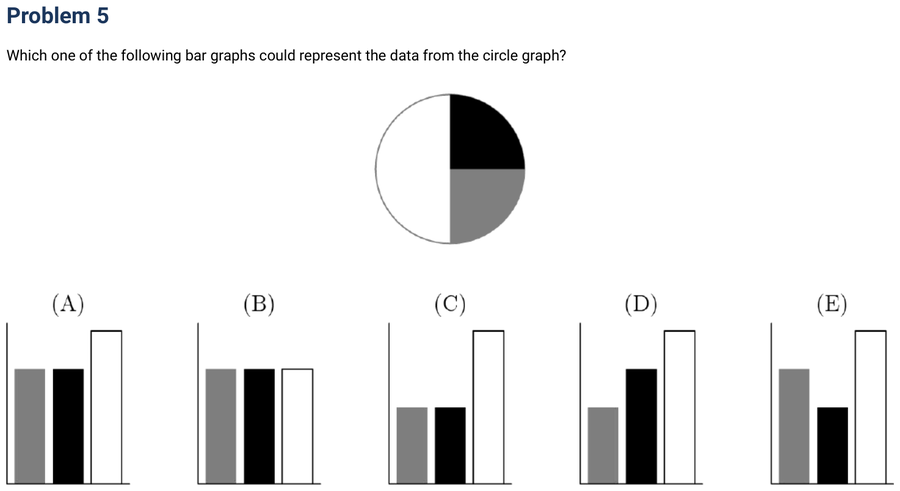
Fractions, Decimals & Percents read-graph proportion
ajhsme-1993-05
Show hint (soft nudge)
Read the three slice sizes: one is half, the other two are quarters.
Show hint (sharpest)
The matching bar graph has one bar twice as tall as the two equal ones.
Show solution
  1. The circle is half white and two equal quarters (black and gray).
  2. So the bars should show one tall bar (white) twice the height of two equal shorter bars — that's graph C.
C Bar graph C.
Mark: · log in to save
Problem 4 · 1992 AJHSME Medium
Fractions, Decimals & Percents percent

During the softball season, Judy had 35 hits. Among her hits were 1 home run, 1 triple, and 5 doubles. The rest of her hits were singles. What percent of her hits were singles?

Show hint (soft nudge)
Count the non-single hits first and subtract.
Show hint (sharpest)
Then write the singles as a fraction of 35.
Show solution
  1. Non-singles: 1 + 1 + 5 = 7, so singles = 35 − 7 = 28.
  2. 28/35 = 80%.
E 80%.
Mark: · log in to save
Problem 11 · 1992 AJHSME Medium
Fractions, Decimals & Percents read-graph percent
ajhsme-1992-11
Show hint (soft nudge)
Read every bar's frequency and add for the total.
Show hint (sharpest)
Blue's frequency over the total gives the percent.
Show solution
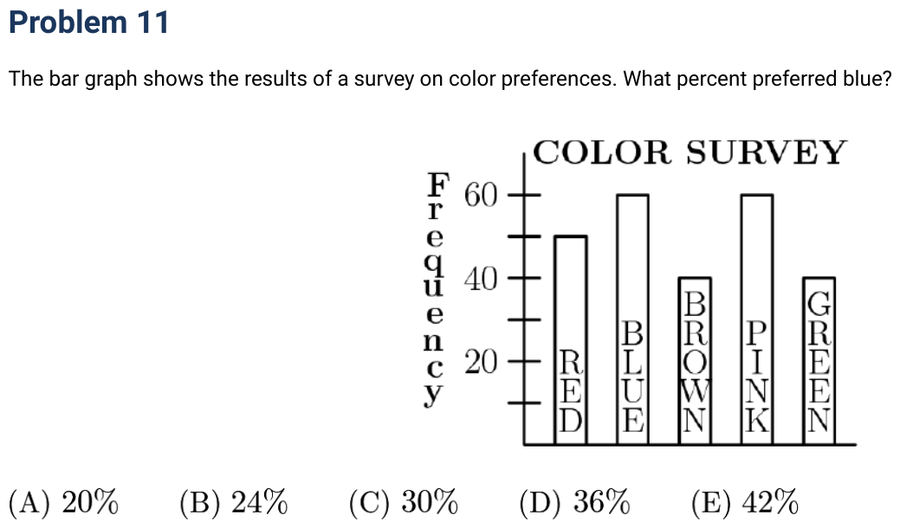
  1. The frequencies are 50, 60, 40, 60, 40, summing to 250.
  2. Blue is 60, so 60/250 = 24%.
B 24%.
Mark: · log in to save
Problem 14 · 1992 AJHSME Medium
Fractions, Decimals & Percents fraction-of

When four gallons are added to a tank that is one-third full, the tank is then one-half full. The capacity of the tank in gallons is

Show hint (soft nudge)
The 4 gallons raised the level from 1/3 to 1/2 — what fraction is that?
Show hint (sharpest)
Then scale up to the full tank.
Show solution
  1. 1/2 − 1/3 = 1/6 of the tank equals 4 gallons.
  2. So the full tank is 6 × 4 = 24 gallons.
D 24.
Mark: · log in to save
Problem 5 · 1990 AJHSME Medium
Fractions, Decimals & Percents estimation

Which of the following is closest to the product (.48017)(.48017)(.48017)?

Show hint (soft nudge)
Round .48017 to about 0.5 to estimate.
Show hint (sharpest)
Cube the rounded value.
Show solution
  1. .48017 ≈ 0.5, and 0.5³ = 0.125.
  2. That is closest to 0.110.
B 0.110.
Mark: · log in to save
Problem 6 · 1990 AJHSME Medium
Fractions, Decimals & Percents compare-operations
ajhsme-1990-06
Show hint (soft nudge)
Adding, subtracting, or appending decimals barely changes 13579.
Show hint (sharpest)
Dividing by a tiny fraction like 1/2468 multiplies by 2468.
Show solution
  1. Choices A, B, C, E all stay close to 13579 (or smaller).
  2. But dividing by 1/2468 means multiplying by 2468, giving about 33 million — by far the largest. So 13579 ÷ (1/2468).
D 13579 ÷ (1/2468).
Mark: · log in to save
Problem 8 · 1990 AJHSME Medium
Fractions, Decimals & Percents discount-tax

A dress originally priced at 80 dollars was put on sale for 25% off. If 10% tax was added to the sale price, then the total selling price (in dollars) of the dress was

Show hint (soft nudge)
Take 25% off first, then add the tax on the reduced price.
Show hint (sharpest)
25% off $80 leaves $60.
Show solution
  1. 25% off $80 is $60.
  2. Adding 10% tax: $60 × 1.10 = $66.
D 66 dollars.
Mark: · log in to save
Problem 4 · 1989 AJHSME Medium
Fractions, Decimals & Percents estimation

Estimate to determine which of the following numbers is closest to 401.205.

Show hint (soft nudge)
Round 401 to 400 and .205 to .2.
Show hint (sharpest)
Dividing by .2 is the same as multiplying by 5.
Show solution
  1. 401/.205 ≈ 400/0.2 = 400 × 5 = 2000.
  2. So it is closest to 2000.
E 2000.
Mark: · log in to save
Problem 8 · 1989 AJHSME Medium
Fractions, Decimals & Percents distribute

(2 × 3 × 4) (12 + 13 + 14) =

Show hint (soft nudge)
The product out front is 24 — multiply each fraction by it.
Show hint (sharpest)
24 × 1/2, 24 × 1/3, 24 × 1/4 are all whole numbers.
Show solution
  1. 24 × ½ = 12, 24 × ⅓ = 8, 24 × ¼ = 6.
  2. Adding: 12 + 8 + 6 = 26.
E 26.
Mark: · log in to save
Problem 6 · 1988 AJHSME Medium
Fractions, Decimals & Percents ratio-of-powers

(.2)³ ⁄ (.02)² =

Show hint (soft nudge)
Factor out (.2)² from the numerator first.
Show hint (sharpest)
(.2 ⁄ .02)² = 10².
Show solution
  1. (.2)³ ⁄ (.02)² = .2 × (.2⁄.02)² = .2 × 10² = .2 × 100.
  2. = 20.
E 20.
Mark: · log in to save
Problem 8 · 1988 AJHSME Medium
Fractions, Decimals & Percents count-decimal-places

Betty used a calculator to find the product 0.075 × 2.56. She forgot to enter the decimal points. The calculator showed 19200. If Betty had entered the decimal points correctly, the answer would have been

Show hint (soft nudge)
Count the total number of digits after the decimal point in the two factors.
Show hint (sharpest)
Move the decimal point in 19200 that many places to the left.
Show solution
  1. 0.075 has 3 decimal places, 2.56 has 2 — total 5. Move the decimal in 19200 five places to the left.
  2. 19200 → 0.19200 = 0.192.
B .192.
Mark: · log in to save
Problem 6 · 1986 AJHSME Medium
Fractions, Decimals & Percents simplify-complex-fraction

2 ⁄ (1 − 2⁄3) =

Show hint (soft nudge)
Simplify the denominator first.
Show hint (sharpest)
1 − 2⁄3 = 1⁄3.
Show solution
  1. Denominator: 1 − 2⁄3 = 1⁄3.
  2. 2 ÷ 1⁄3 = 2 × 3 = 6.
E 6.
Mark: · log in to save
Problem 9 · 1985 AJHSME Medium
Fractions, Decimals & Percents telescoping-product

The product of the 9 factors (1 − 1⁄2)(1 − 1⁄3)(1 − 1⁄4) ⋯ (1 − 1⁄10) =

Show hint (soft nudge)
Rewrite each factor as (n − 1)⁄n, then watch what telescopes.
Show hint (sharpest)
Each numerator matches the previous denominator.
Show solution
  1. (1⁄2)(2⁄3)(3⁄4) ⋯ (9⁄10). All middle factors cancel, leaving 1⁄10.
  2. = 1⁄10.
A 1⁄10.
Mark: · log in to save
Problem 10 · 1985 AJHSME Medium
Fractions, Decimals & Percents average-two-fractions

The fraction halfway between 1⁄5 and 1⁄3 (on the number line) is

Show hint
The midpoint is the average — add and halve.
Show solution
  1. 1⁄5 + 1⁄3 = 3⁄15 + 5⁄15 = 8⁄15. Halve: 8⁄30 = 4⁄15.
C 4⁄15.
Mark: · log in to save
Problem 21 · 2022 AMC 8 Hard
Fractions, Decimals & Percents percent-multiplier casework

Steph scored 15 baskets out of 20 attempts in the first half of a game, and 10 baskets out of 10 attempts in the second half. Candace took 12 attempts in the first half and 18 attempts in the second. In each half, Steph scored a higher percentage of baskets than Candace. Surprisingly they ended with the same overall percentage of baskets scored. How many more baskets did Candace score in the second half than in the first?

Show hint (soft nudge)
Steph took 20 + 10 = 30 attempts; Candace took 12 + 18 = 30. Same total, same overall % ⇒ same total makes.
Show hint (sharpest)
Steph: 15 + 10 = 25 makes. Candace must also make 25. With her per-half percentages strictly below Steph's, only one (f, s) split works.
Show solution
  1. Same total attempts (30 each) + same overall percentage ⇒ same total makes. Steph made 15 + 10 = 25, so Candace also made 25.
  2. Let Candace's makes be f (first half, out of 12) and s (second, out of 18). Per-half percentages strictly below Steph: f/12 < 15/20 = 3/4 ⇒ f ≤ 8. And s/18 < 1 ⇒ s ≤ 17.
  3. f + s = 25, f ≤ 8, s ≤ 17 ⇒ only f = 8, s = 17 fits.
  4. sf = 17 − 8 = 9.
C 9 more baskets.
Mark: · log in to save
Problem 22 · 2019 AMC 8 Hard
Fractions, Decimals & Percents percent-multiplier difference-of-squares

A store increased the original price of a shirt by a certain percent and then decreased the new price by the same amount. Given that the resulting price was 84% of the original price, by what percent was the price increased and decreased?

Show hint (soft nudge)
Multiplying by (1+p) then (1−p) gives 1 − p2. That equals 0.84.
Show hint (sharpest)
p2 = 0.16.
Show solution
  1. (1 + p)(1 − p) = 1 − p2 = 0.84.
  2. p2 = 0.16 ⇒ p = 0.4 = 40%.
E 40%.
Mark: · log in to save
Problem 20 · 1994 AJHSME Stretch
Fractions, Decimals & Percents minimize-fractions
ajhsme-1994-20
Show hint (soft nudge)
To make two fractions small, use the smallest numerators and the largest denominators.
Show hint (sharpest)
Test how to pair 1 and 2 over 8 and 9.
Show solution
  1. Use numerators 1, 2 and denominators 8, 9. Pairing as 1/8 + 2/9 = 9/72 + 16/72 = 25/72 beats 1/9 + 2/8 = 26/72.
  2. So the smallest sum is 25/72.
D 25/72.
Mark: · log in to save
Problem 25 · 1992 AJHSME Stretch
Fractions, Decimals & Percents telescoping-product

One half of the water is poured out of a full container. Then one third of the remainder is poured out. Continue the process: one fourth of the remainder for the third pouring, one fifth of the remainder for the fourth pouring, and so on. After how many pourings does exactly one tenth of the original water remain?

Show hint (soft nudge)
After each pouring, multiply by what's left: 1/2, then 2/3, then 3/4, …
Show hint (sharpest)
These products telescope to a simple fraction.
Show solution
  1. After k pourings the remaining fraction is ½ · ⅔ · ¾ · … · k/(k+1), which telescopes to 1/(k+1).
  2. Setting 1/(k+1) = 1/10 gives k = 9.
D 9.
Mark: · log in to save
Problem 21 · 1989 AJHSME Stretch
Fractions, Decimals & Percents keep-fraction percent

Jack had a bag of 128 apples. He sold 25% of them to Jill. Next he sold 25% of those remaining to June. Of those apples still in his bag, he gave the shiniest one to his teacher. How many apples did Jack have then?

Show hint (soft nudge)
Selling 25% means keeping 75% = 3⁄4.
Show hint (sharpest)
Multiply by 3⁄4 twice, then subtract 1 for the apple given to the teacher.
Show solution
  1. After Jill: 128 × 3⁄4 = 96. After June: 96 × 3⁄4 = 72.
  2. Give 1 to the teacher: 72 − 1 = 71.
D 71.
Mark: · log in to save
Problem 22 · 1988 AJHSME Stretch
Fractions, Decimals & Percents compound-percent

Tom's Hat Shoppe increased all original prices by 25%. Now the shoppe is having a sale where all prices are 20% off these increased prices. Which statement best describes the sale price of an item?

Show hint (soft nudge)
Apply each percent change as a multiplier and multiply them.
Show hint (sharpest)
1.25 × 0.80 — what does that equal?
Show solution
  1. +25% means ×1.25; −20% off means ×0.80. Combined: 1.25 × 0.80 = 1.00.
  2. So the sale price equals the original price.
E The sale price is the same as the original price.

Mark: · log in to save
Problem 21 · 1987 AJHSME Stretch
Fractions, Decimals & Percents operator-substitution

Suppose n* means 1⁄n, the reciprocal of n. For example, 5* = 1⁄5. How many of the following statements are true?

i) 3* + 6* = 9*
ii) 6* − 4* = 2*
iii) 2* · 6* = 12*
iv) 10* ÷ 2* = 5*
Show hint (soft nudge)
For 1⁄a + 1⁄b, the result is rarely 1⁄(a+b).
Show hint (sharpest)
For 1⁄a · 1⁄b = 1⁄(ab) and (1⁄a) ÷ (1⁄b) = b⁄a — both follow simple rules.
Show solution
  1. i) 1⁄3 + 1⁄6 = 1⁄2 ≠ 1⁄9 — false. ii) 1⁄6 − 1⁄4 = −1⁄12 ≠ 1⁄2 — false. iii) 1⁄2 · 1⁄6 = 1⁄12 — true. iv) (1⁄10) ÷ (1⁄2) = 1⁄5 — true.
  2. 2 statements are true.
C 2.
Mark: · log in to save
Problem 23 · 1987 AJHSME Stretch
Fractions, Decimals & Percents percent-of-row-total
ajhsme-1987-23
Show hint
Add the Black row, then take the South entry as a percent of that total.
Show solution
  1. Black population: 5 + 5 + 15 + 2 = 27 (millions). South share = 15 ⁄ 27 ≈ 0.556.
  2. Nearest percent: 56%.
D 56%.
Mark: · log in to save
Problem 21 · 1985 AJHSME Stretch
Fractions, Decimals & Percents compound-percent

Mr. Green receives a 10% raise every year. His salary after four such raises has gone up by what percent?

Show hint (soft nudge)
Each year multiplies by 1.10 — apply that four times.
Show hint (sharpest)
1.10⁴ is more than just 1 + 4(0.10) = 1.40 because compounding earns interest on interest.
Show solution
  1. (1.10)⁴ = 1.4641 — that's about 46.4% above the original.
  2. Greater than 45%, so the answer is more than 45%.
E more than 45%.
Mark: · log in to save