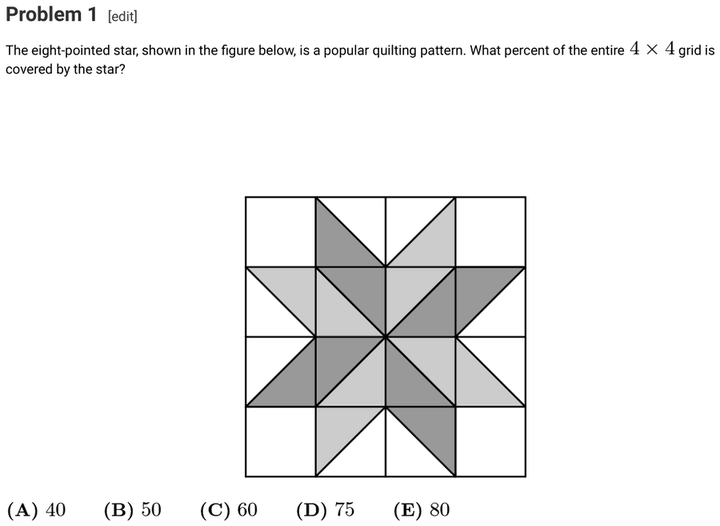
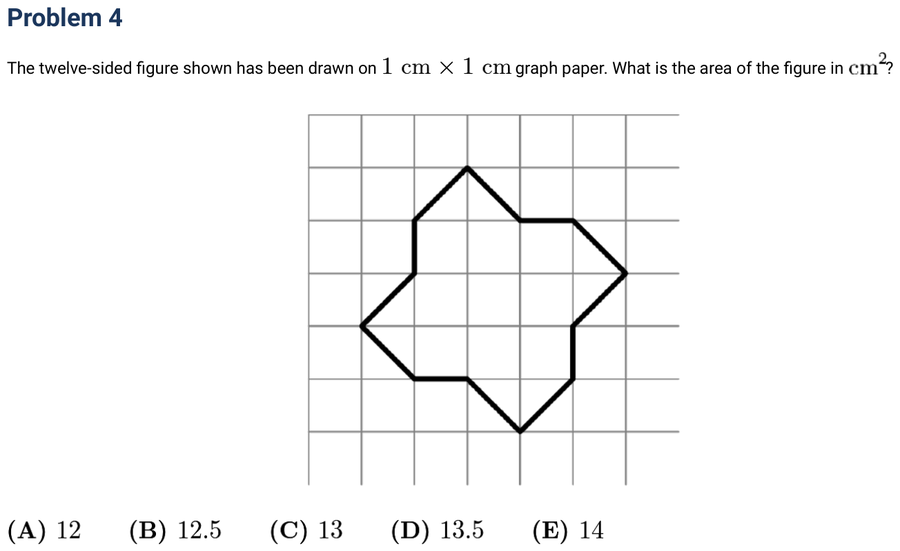
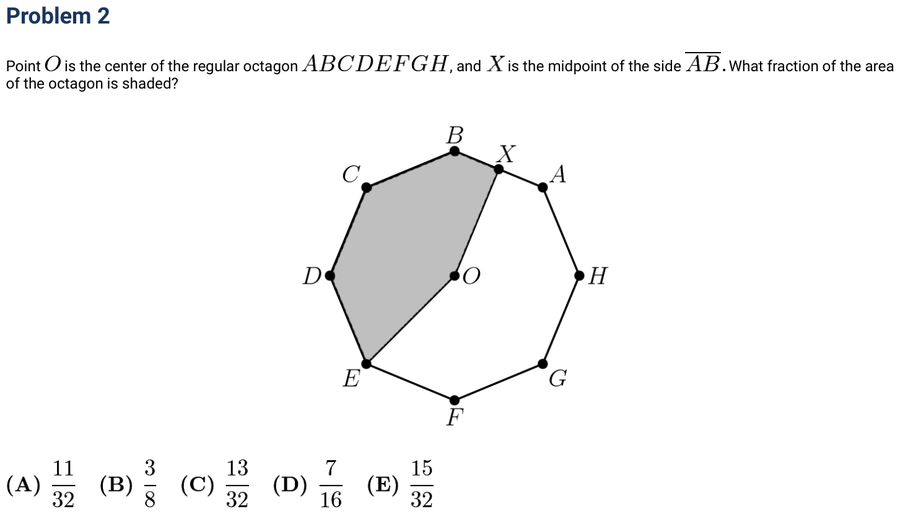
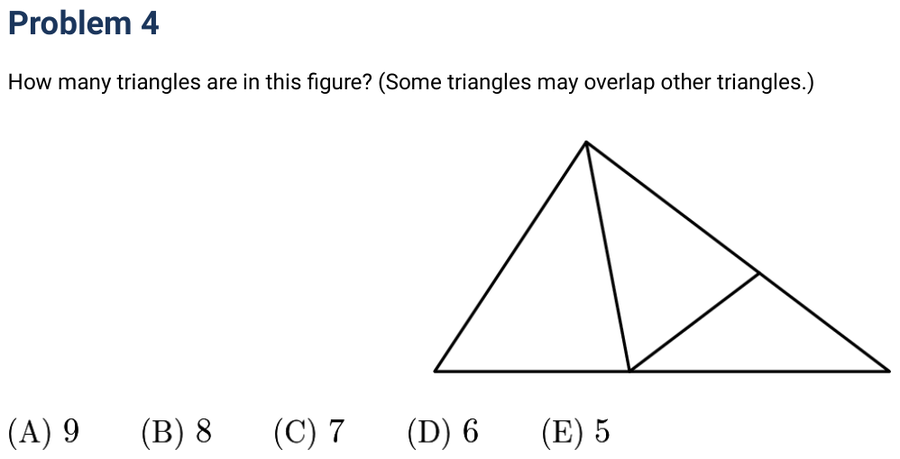
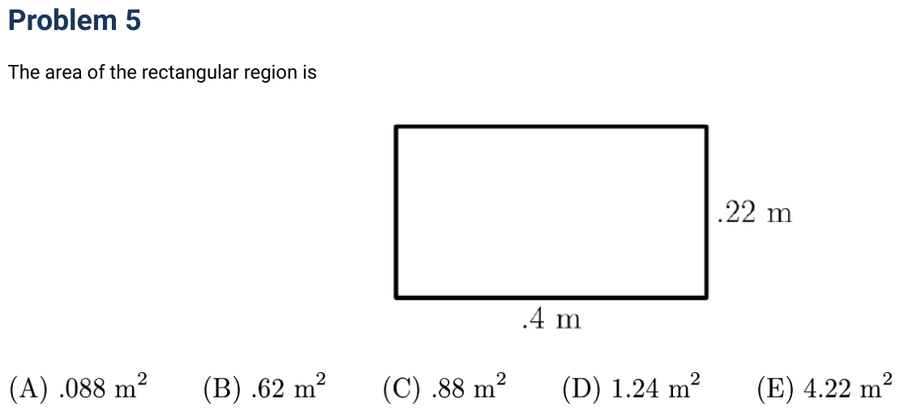
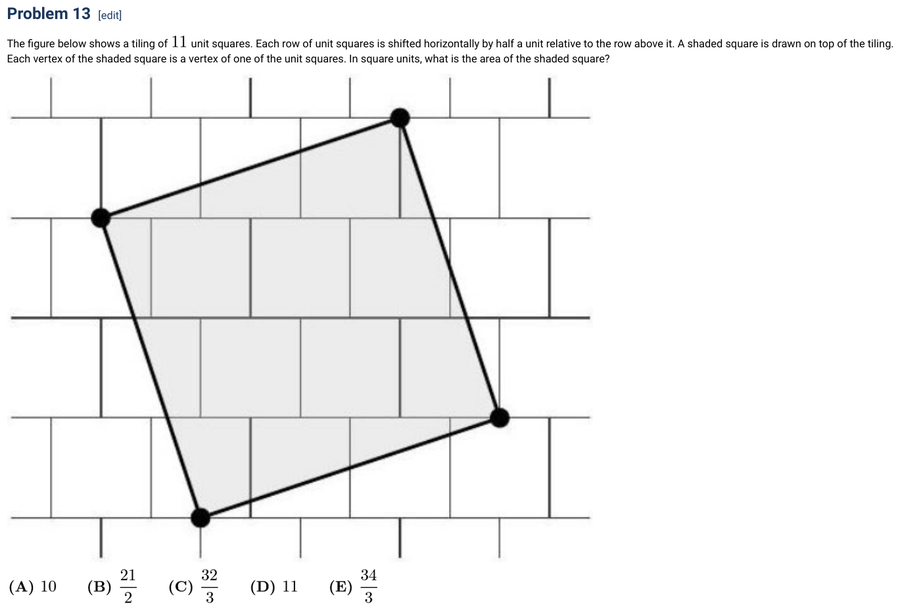
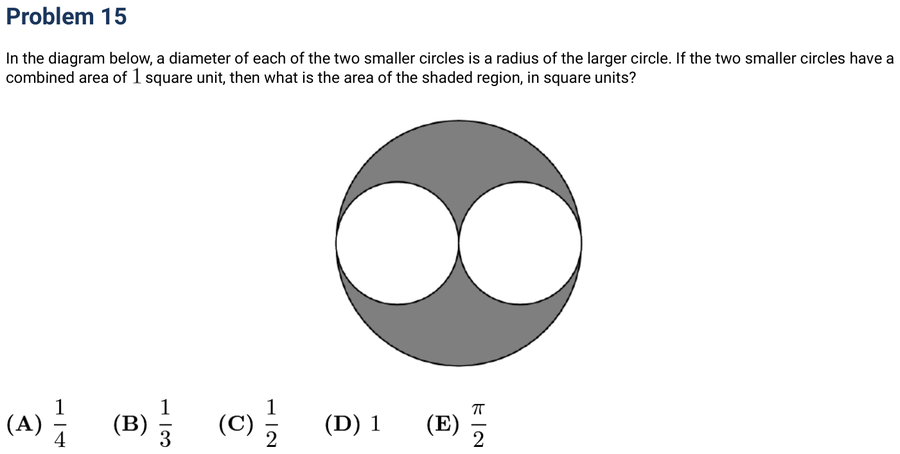
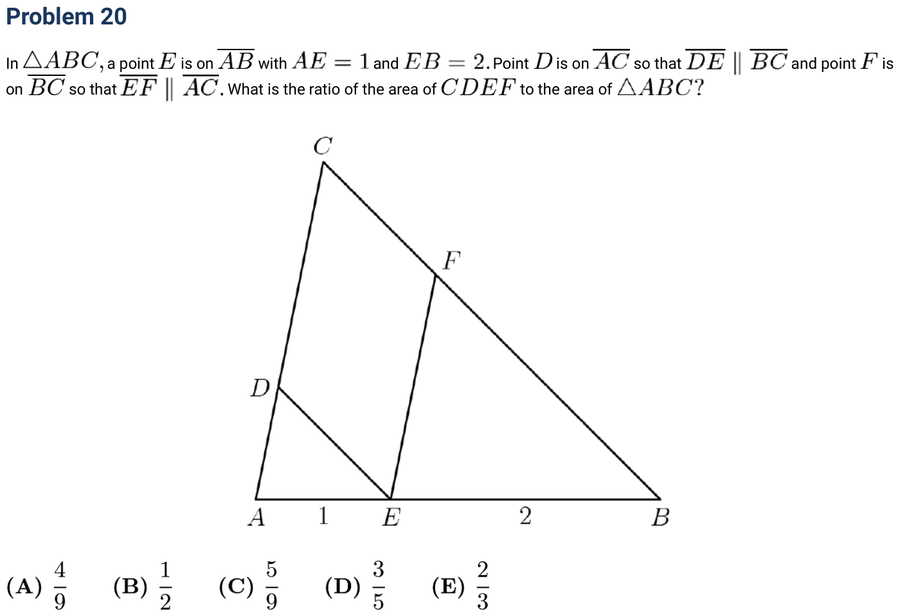
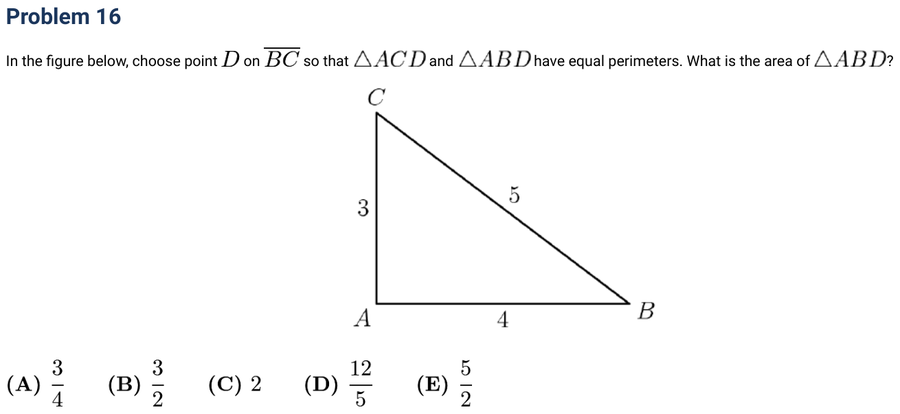
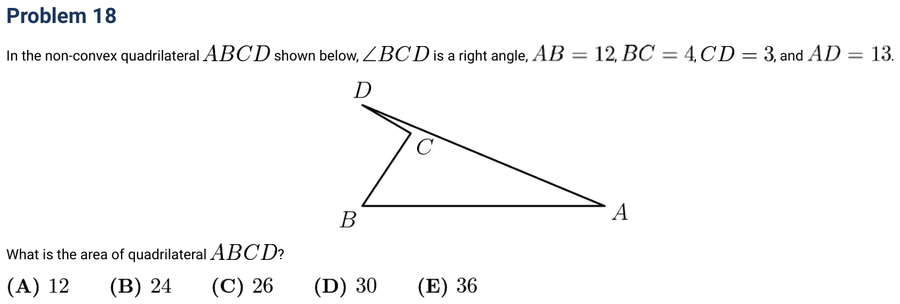
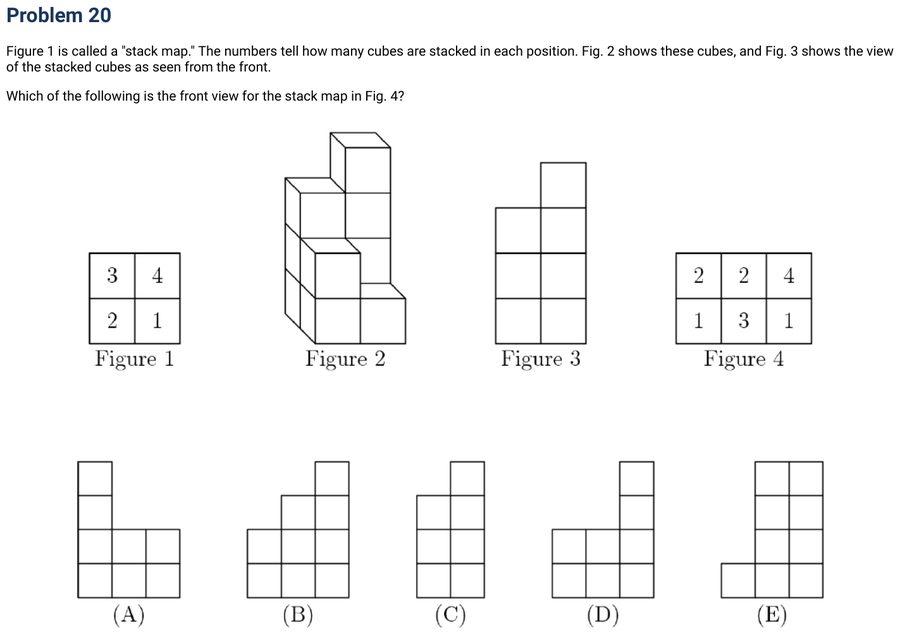
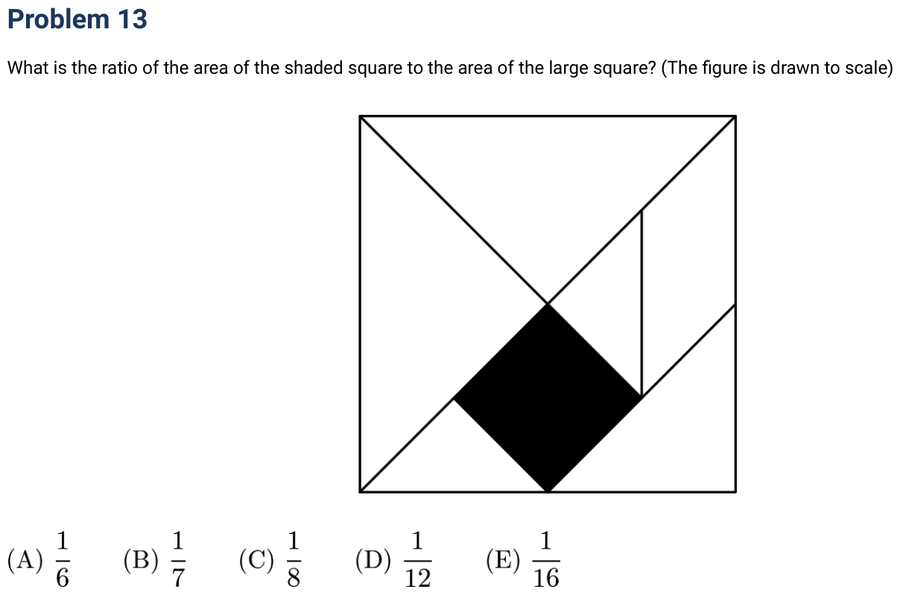
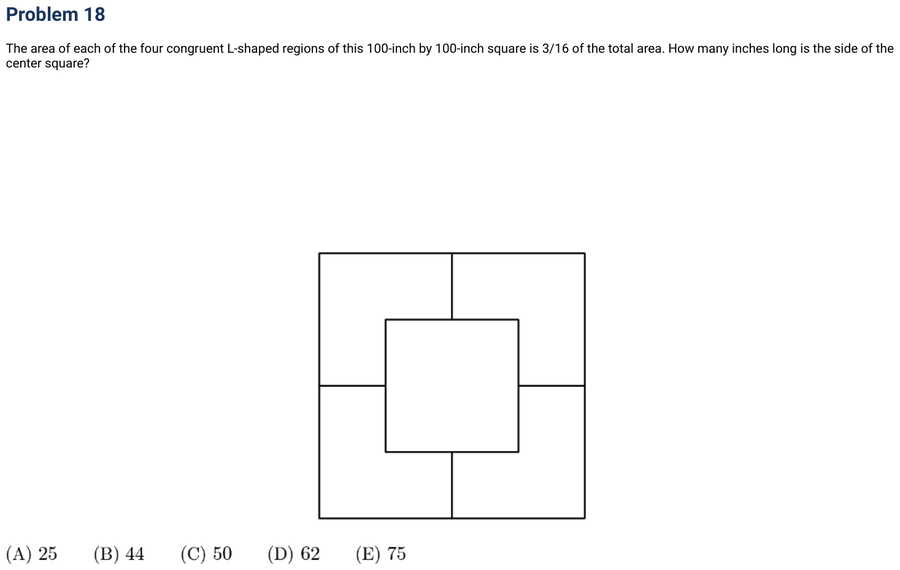
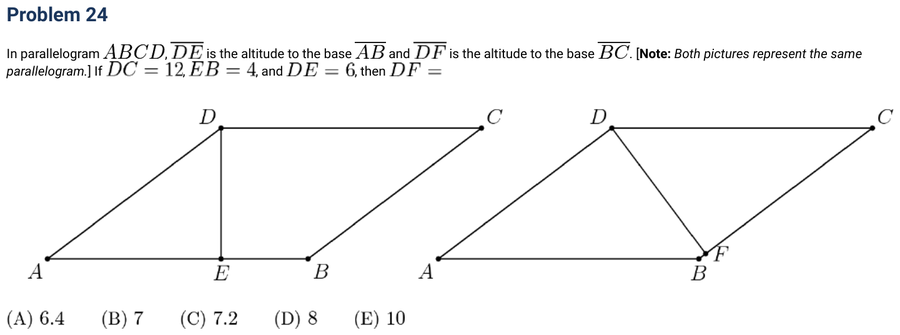
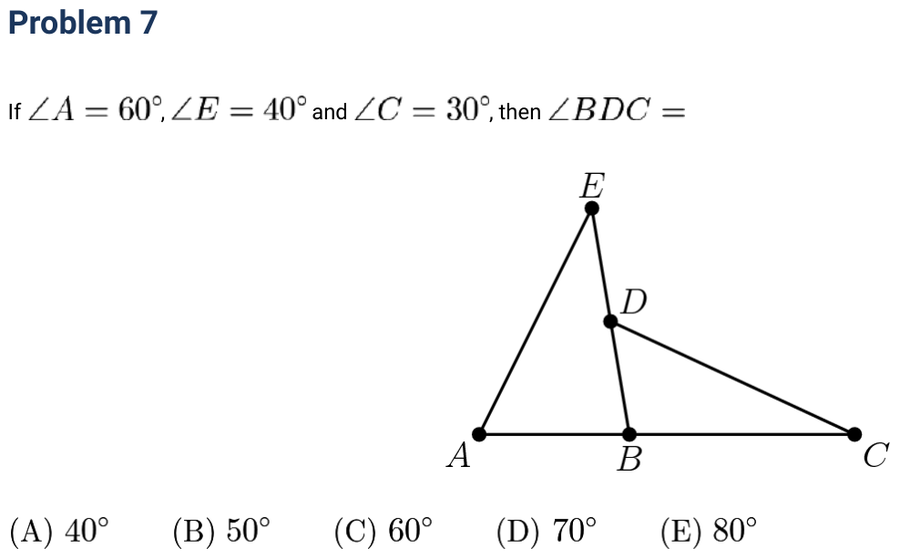
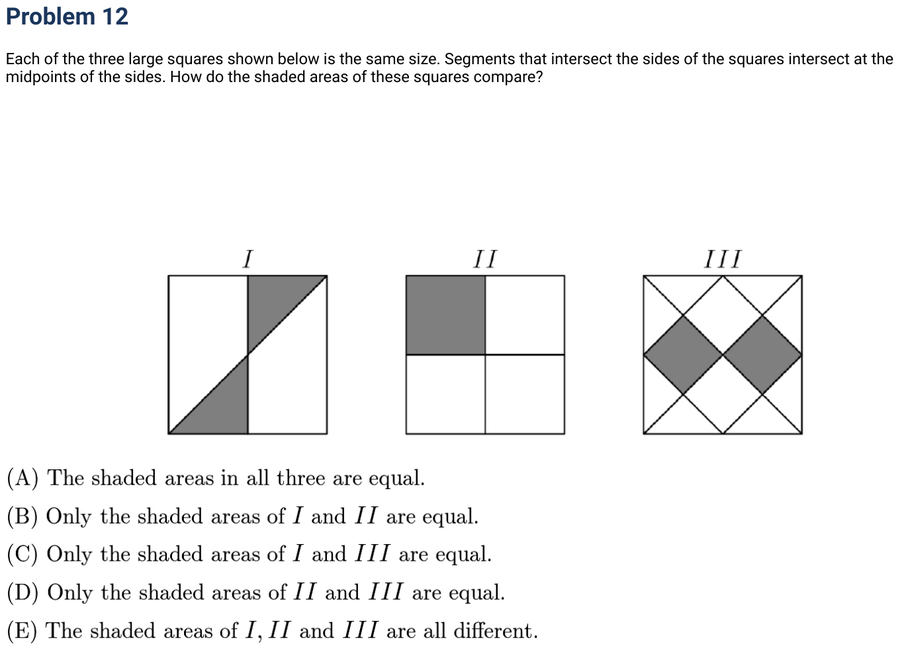
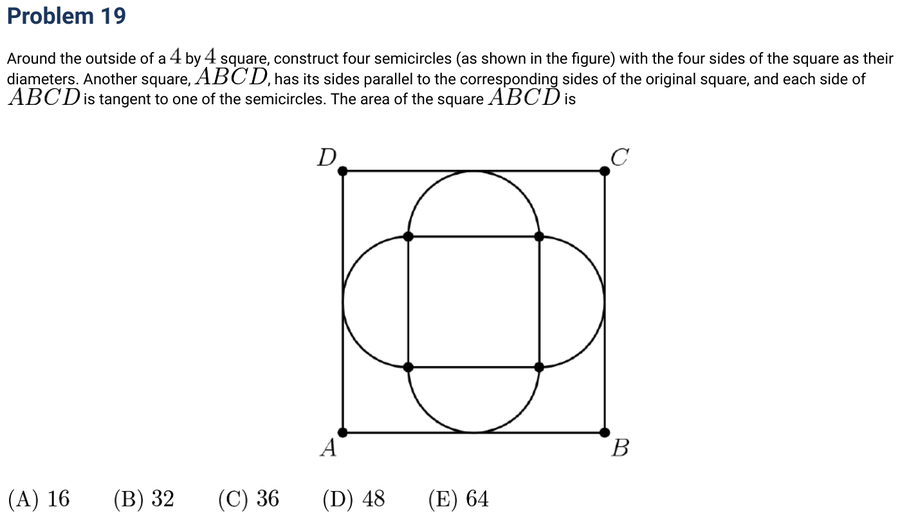
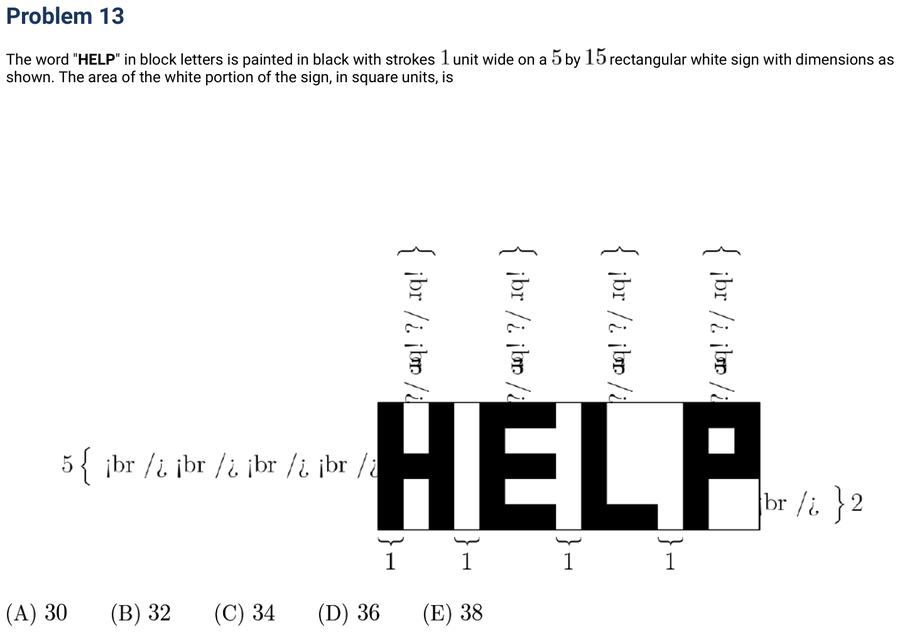
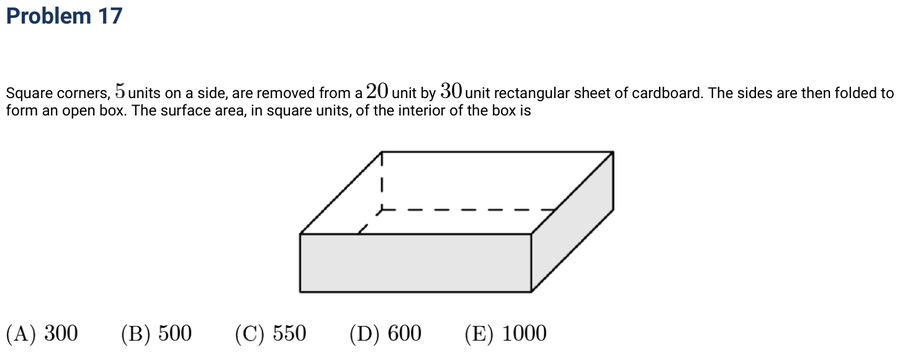
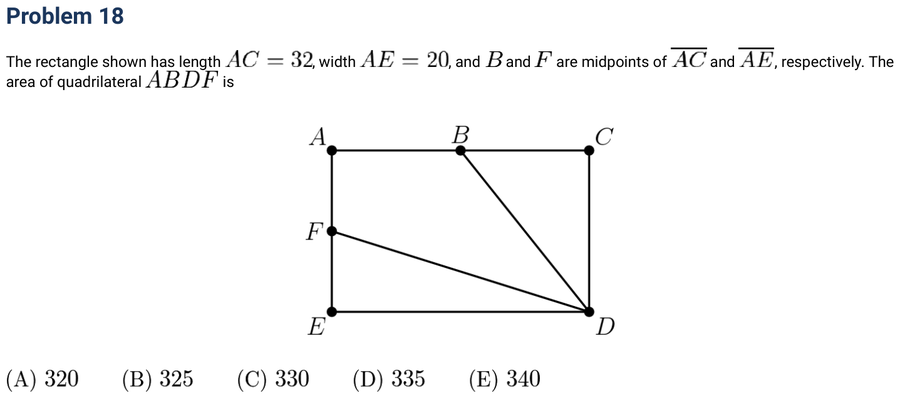
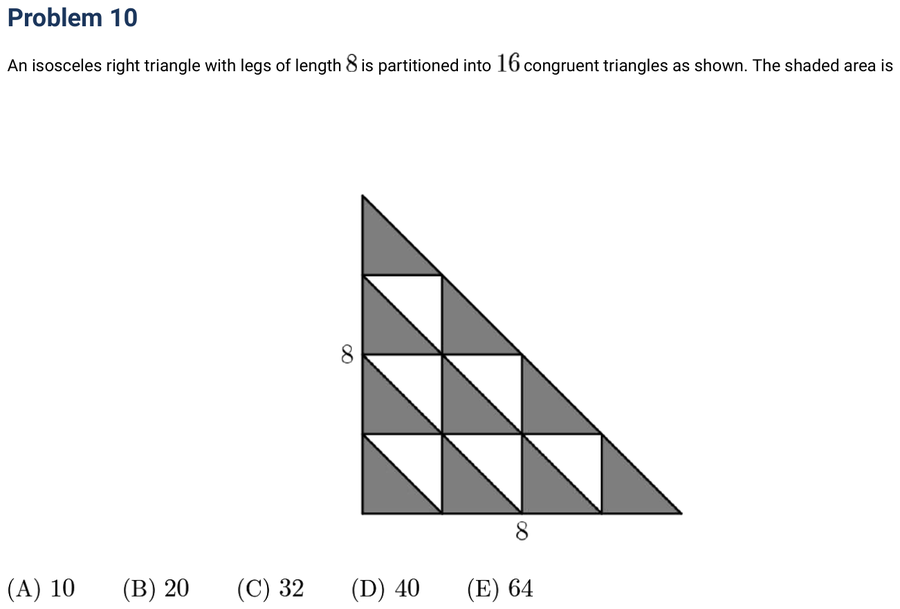
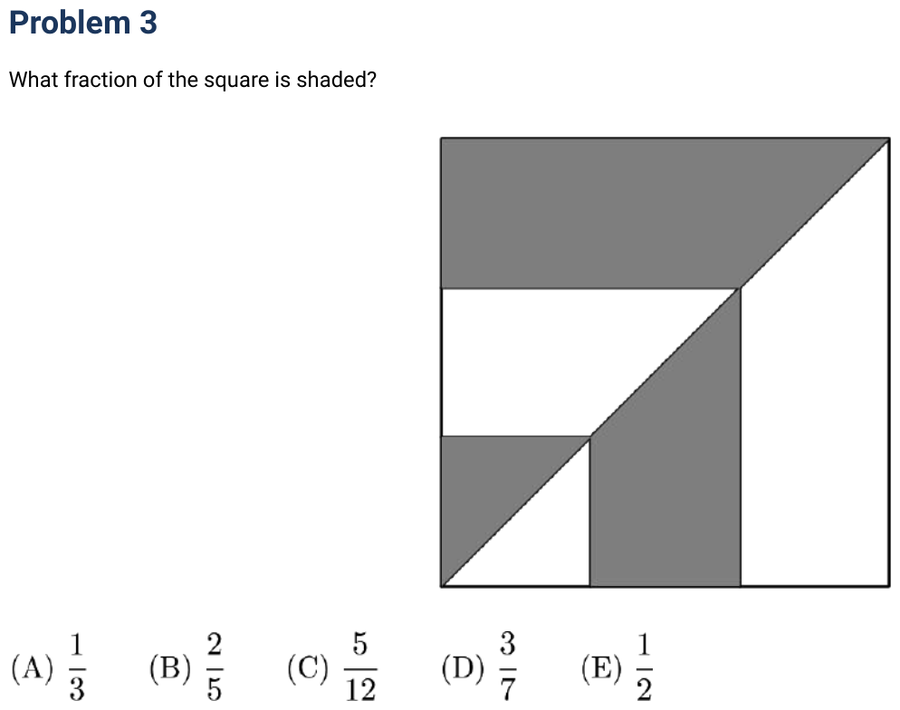
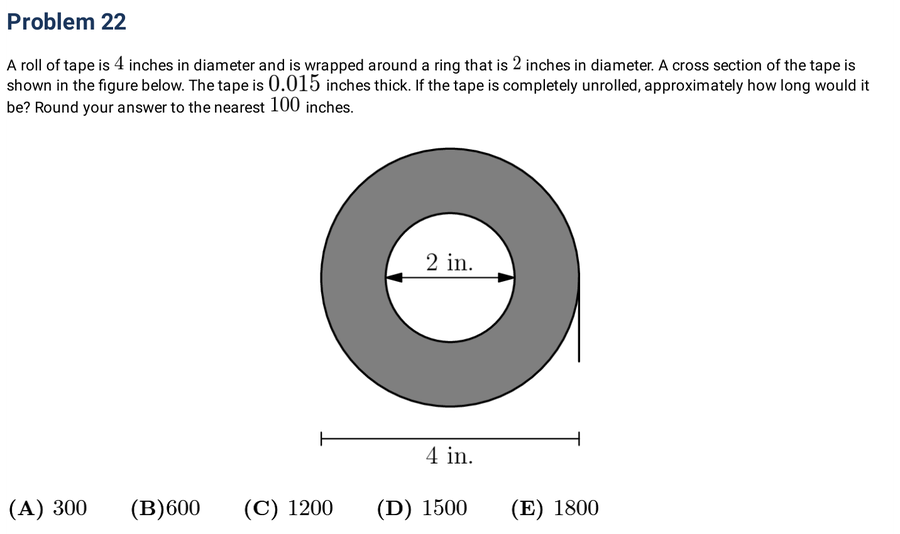
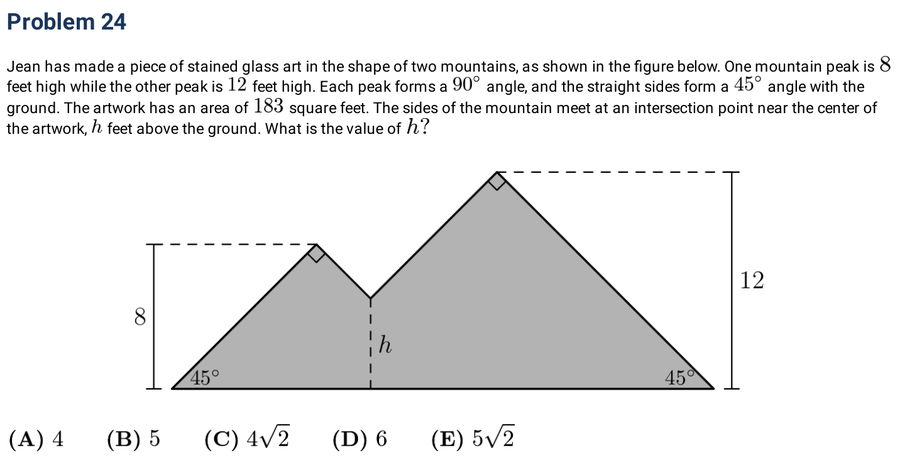
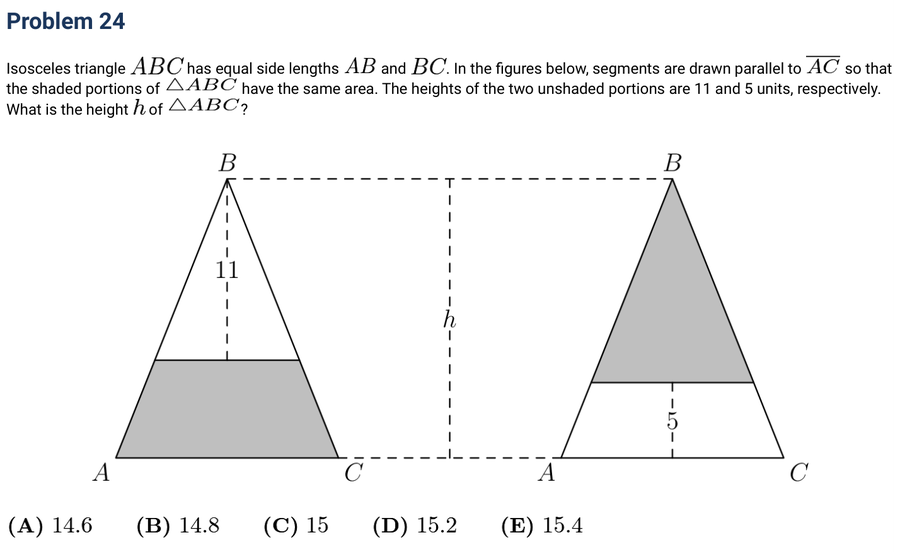
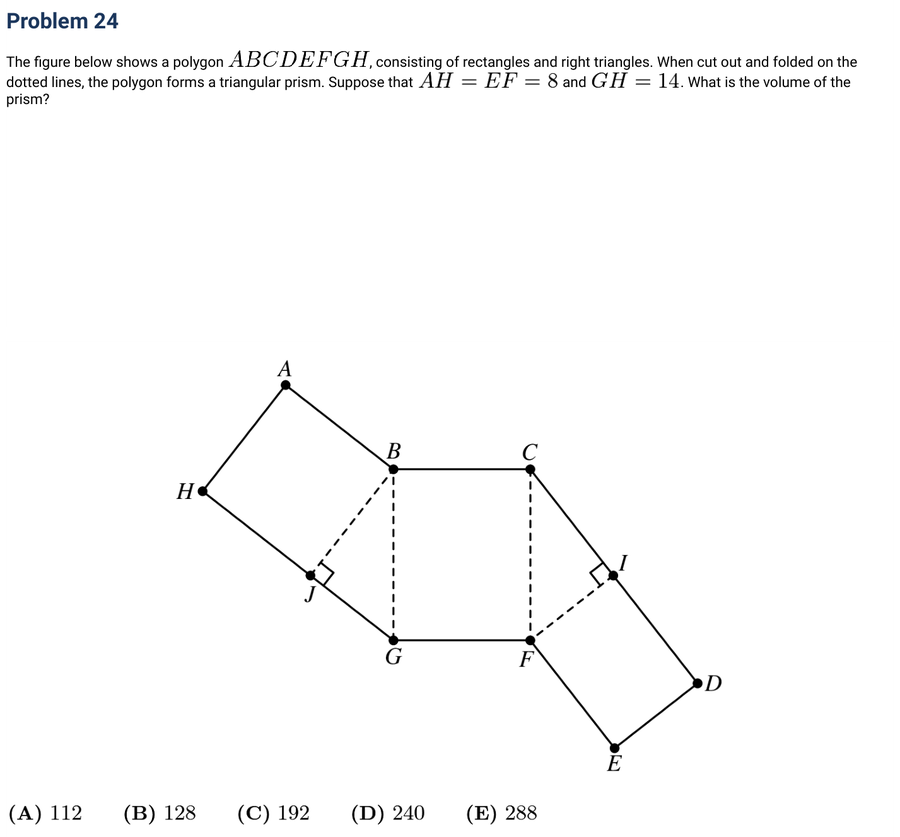
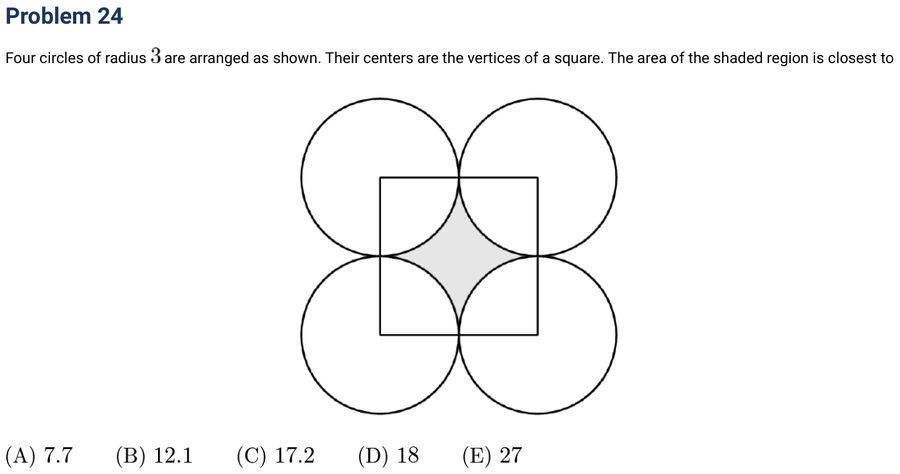
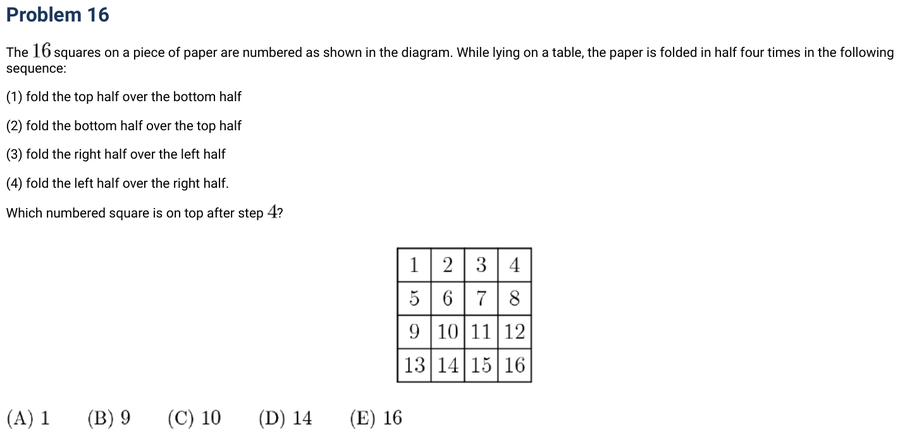
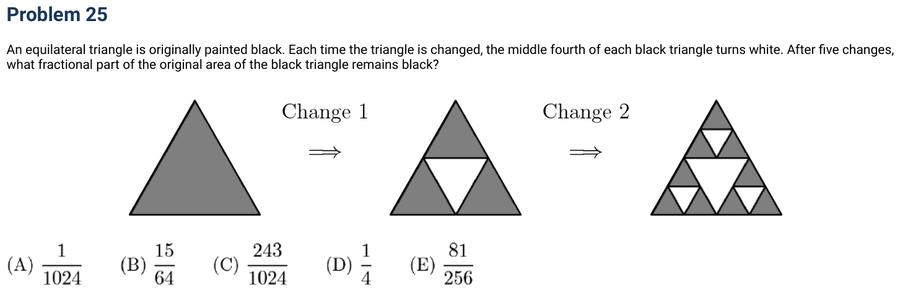
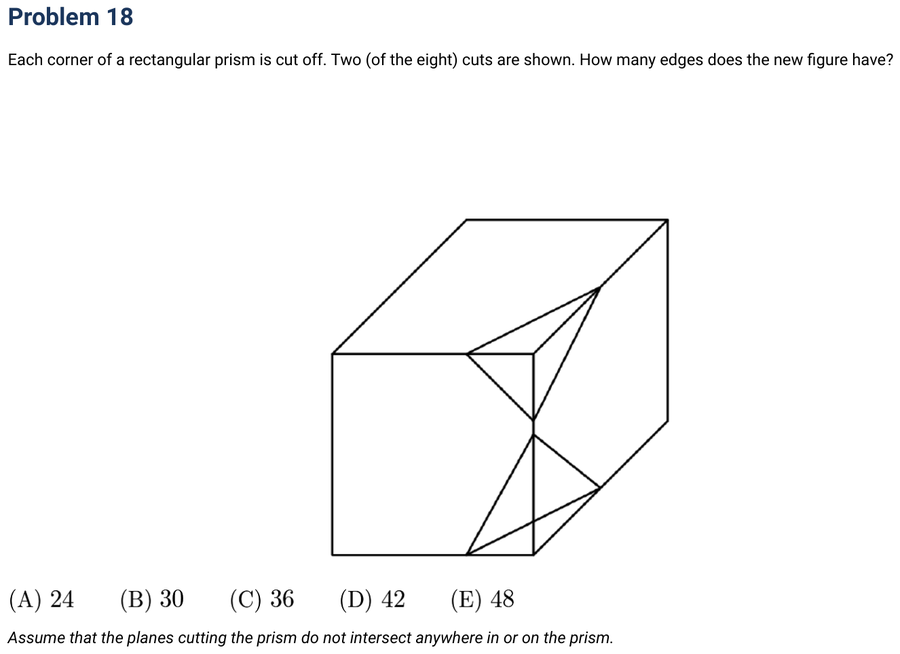
Can you pair each shaded piece with an unshaded piece of the same size?
Show hint (sharpest)
Look for symmetry. For every shaded triangle of the star, is there a matching white triangle the same size in the grid?
Show solution
The whole pattern sits on a 4 × 4 grid, so its total area is 16 unit squares.
The star is built from triangles, and each shaded triangle has a congruent white triangle as its partner — the shaded and white regions match up exactly.
So the star covers exactly half of the grid: 8 of the 16 squares, which is 50%.
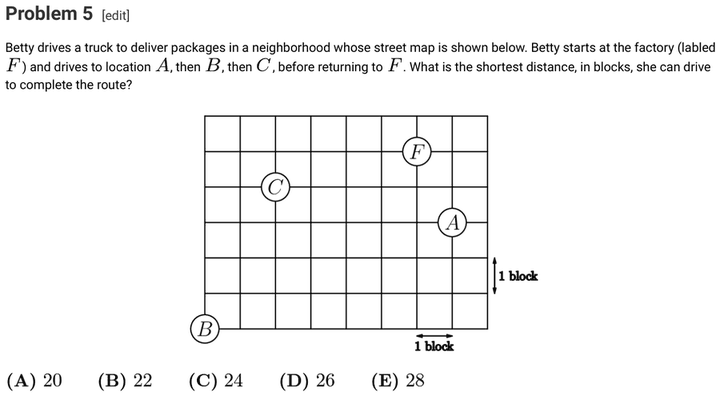
On a street grid you can't cut corners. Each leg's length is just sideways blocks + up-and-down blocks.
Show hint (sharpest)
Betty drives along streets, so each leg's length is its sideways blocks plus its up-and-down blocks (you can't cut diagonally). Add the four legs F→A→B→C→F.
Show solution
On a street grid, each leg's length = (horizontal blocks) + (vertical blocks). You can't cut diagonals, and as long as you don't backtrack, the route within a leg doesn't matter — only the start and end do.
Read the four legs off the map: F→A = 1 + 2 = 3, A→B = 7 + 3 = 10, B→C = 2 + 4 = 6, C→F = 4 + 1 = 5.
Total: 3 + 10 + 6 + 5 = 24 blocks.
C
24 blocks.
Another way: C is already on the way back (MAA)
Notice C lies on a shortest path from B back to F, so visiting C costs nothing extra. The problem reduces to F → A → B → F.
Four squares of side lengths 4, 7, 9, and 10 units are arranged in increasing size order so that their left edges and bottom edges align. The squares alternate in the color pattern white-gray-white-gray, respectively, as shown in the figure. What is the area of the visible gray region, in square units?
Sides 4, 7, 9, 10 share a bottom-left corner; smaller squares lie on top.
Show hint (soft nudge)
Each gray square is only partly visible. What shape is the gray you can actually see?
Show hint (sharpest)
Each smaller square sits on top, so every gray square shows just a frame: its area minus the square covering it. And a2 − b2 = (a+b)(a−b) makes that instant.
Show solution
Smaller squares sit on top, so each gray square shows a frame = (its area) − (the square on top of it).
Gray 10 under white 9: 102 − 92 = (10+9)(10−9) = 19.
Gray 7 under white 4: 72 − 42 = (7+4)(7−4) = 33.
Add the two frames: 19 + 33 = 52.
E
52 square units.
Another way: alternating add and subtract (MAA)
The visible gray is the 10-square minus the 9-square plus the 7-square minus the 4-square: 100 − 81 + 49 − 16.
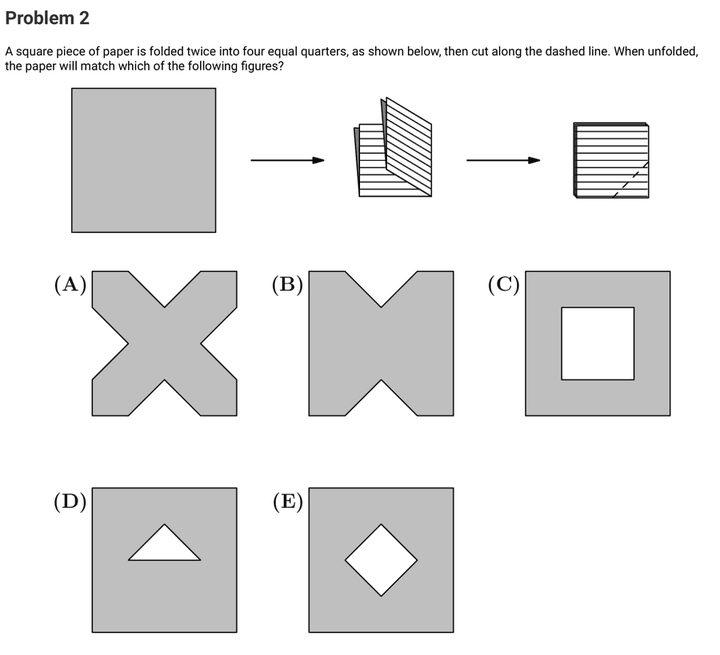
Where does each folded layer sit on the original sheet? That tells you how many spots the cut actually hits.
Show hint (sharpest)
Folding twice into quarters stacks four layers at one corner — and that corner is the center of the original sheet. Whatever the cut removes there happens four times, around the middle.
Show solution
Folding the square twice into quarters brings all four corners together; the folded corner is the center of the full sheet.
The diagonal cut slices across that folded stack, snipping a small triangle from all four layers at once.
Unfolding, those four snips open up into a single diamond-shaped hole in the middle of the paper — figure (E).
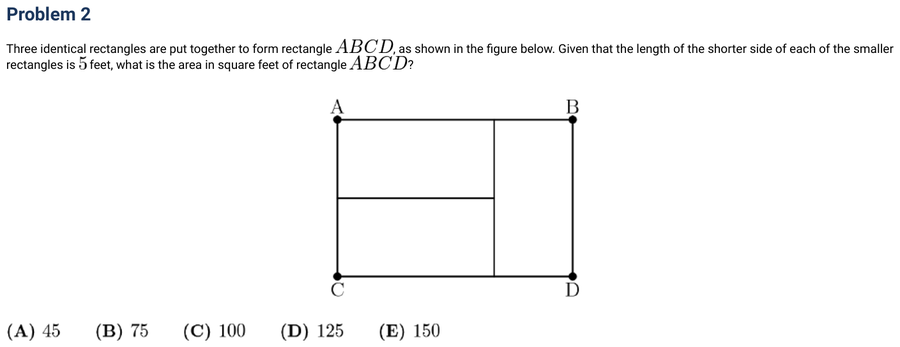
Figure out the size of one small rectangle first — the picture forces a specific shape.
Show hint (sharpest)
Two short sides stacked on the left equal one long side on the right: so long = 2 × 5 = 10.
Show solution
Each small rectangle has short side 5. From the picture, two stacked horizontals on the left have the same height as the vertical rectangle on the right — so the long side is 2 × 5 = 10.
ABCD has width 10 + 5 = 15 and height 10, so its area is 15 × 10 = 150 square feet.
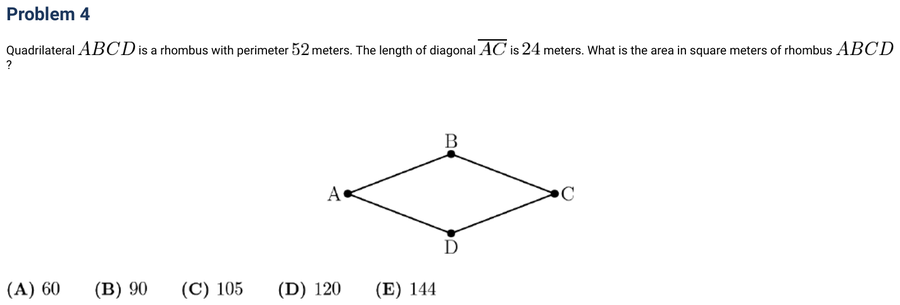
The diagonals of a rhombus cross at right angles and cut each other in half. That makes four matching right triangles.
Show hint (sharpest)
Side = 52/4 = 13, half-diagonal = 24/2 = 12. The other half-diagonal is the missing leg of a 5-12-13 right triangle.
Show solution
Side length: 52 ÷ 4 = 13. Half of AC: 24 ÷ 2 = 12.
The diagonals are perpendicular bisectors, so each quarter of the rhombus is a right triangle with leg 12 and hypotenuse 13 — a 5-12-13 triple. The other half-diagonal is 5, so BD = 10.
Area of a rhombus = d1 × d22 = 24 × 102 = 120 sq m.
In the diagram, all angles are right angles and the lengths of the sides are given in centimeters. Note the diagram is not drawn to scale. What is X, in centimeters?
Show hint
Sum of vertical segments along the left side must equal the sum along the right (same overall height).
A rectangular photograph is placed in a frame that forms a border two inches wide on all sides of the photograph. The photograph measures 8 inches high and 10 inches wide. What is the area of the border, in square inches?
Show hint
Outer dimensions add 2 inches on each of two sides ⇒ 4 inches in each direction. Subtract the photo area.
Extend the square pattern of 8 black and 17 white square tiles by attaching a border of black tiles around the square. What is the ratio of black tiles to white tiles in the extended pattern?
Show hint
Border around an n × n square has 4n + 4 tiles. White count is unchanged.
Show solution
Original is 5 × 5 = 25 tiles (8 black + 17 white). New 7 × 7 has 49 tiles.
Added border tiles: 49 − 25 = 24, all black. New black total: 8 + 24 = 32. White still 17.
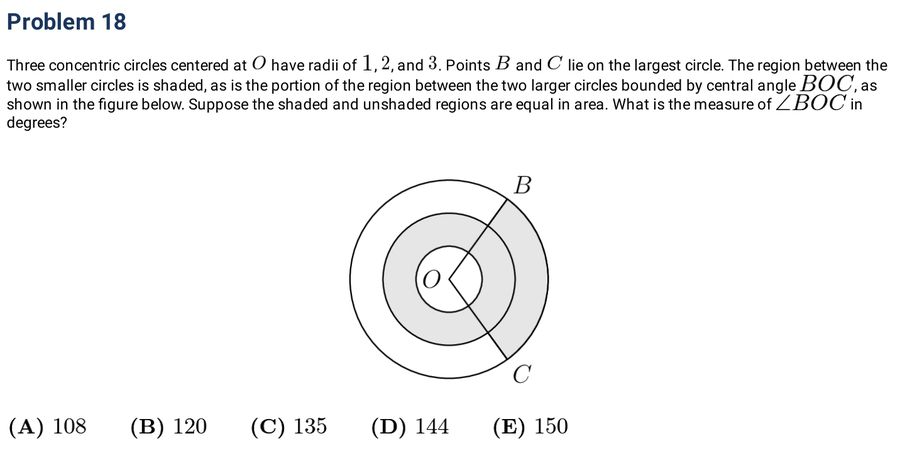
Each of the following four large congruent squares is subdivided into combinations of congruent triangles or rectangles and is partially bolded. What percent of the total area is partially bolded?
Show hint
Compute each square's shaded fraction; add; divide by 4 (since there are 4 squares of equal area).
Show solution
Shaded fractions of the four squares: 1/4, 1/8, 3/8, 1/4.
The triangular plot of ACD lies between Aspen Road, Brown Road and a railroad. Main Street runs east and west, and the railroad runs north and south. The numbers in the diagram indicate distances in miles. The width of the railroad track can be ignored. How many square miles are in the plot of land ACD?
Show hint
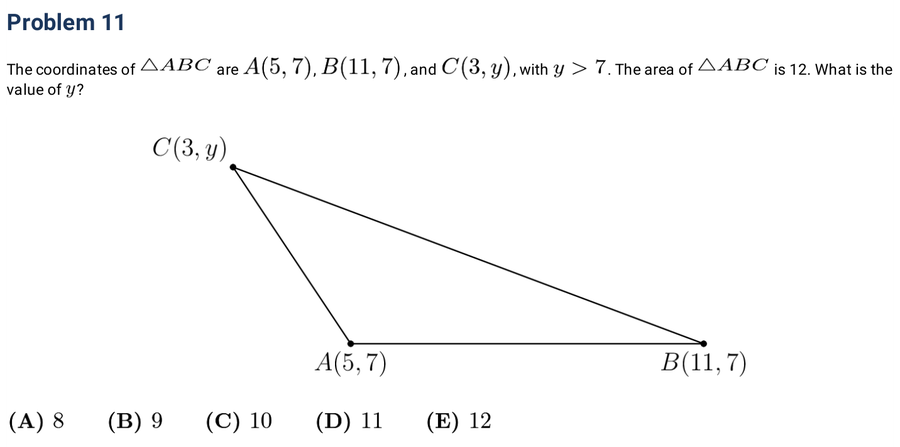
Both C and D sit on the railroad; CD = 3. The plot's base is CD with the apex at A.
Show solution
Base CD = 3 (along the railroad). Height from A to the railroad = 3 (along Main Street).
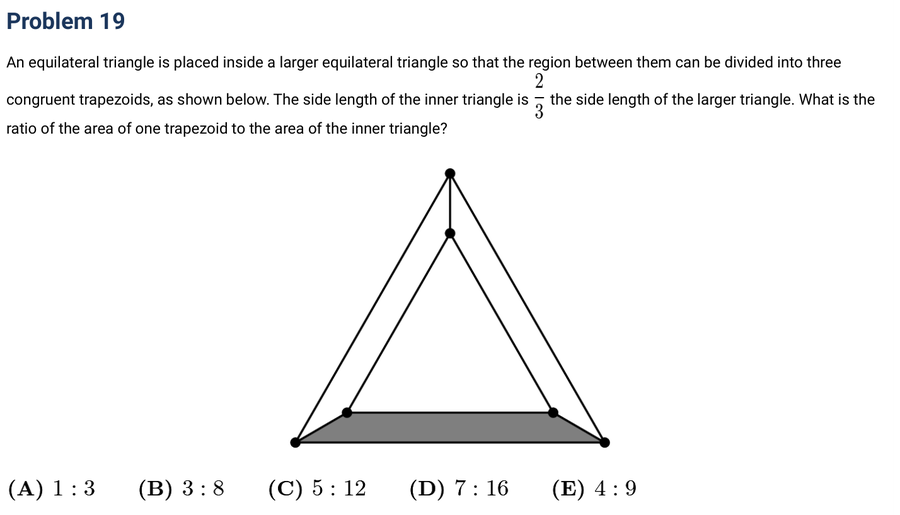
In the figure, the outer equilateral triangle has area 16, the inner equilateral triangle has area 1, and the three trapezoids are congruent. What is the area of one of the trapezoids?
The letter T is formed by placing two 2 × 4 inch rectangles next to each other, as shown. What is the perimeter of the T, in inches?
Show hint
Sum each rectangle's perimeter, then subtract the buried edges. The two rectangles share a 2-inch segment internally; that hides 2 from each rectangle's perimeter.
An aquarium has a rectangular base that measures 100 cm by 40 cm and has a height of 50 cm. The aquarium is filled with water to a depth of 37 cm. A rock with volume 1000 cm3 is then placed in the aquarium and completely submerged. By how many centimeters does the water level rise?
Show hint
Rise = displaced volume / base area = 1000 / (100 · 40).
A square and a triangle have equal perimeters. The lengths of the three sides of the triangle are 6.1 cm, 8.2 cm and 9.7 cm. What is the area of the square in square centimeters?
Jamie counted the number of edges of a cube, Jimmy counted the corners, and Judy counted the faces. They then added the three numbers. What was the resulting sum?
Show hint
A cube has 12 edges, 8 corners, and 6 faces — recall each, then add.
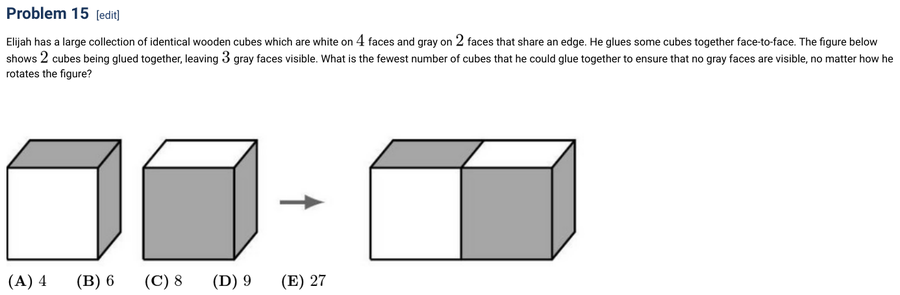
A cube's two shaded faces share an edge, so both must be glued to neighbors to hide them.
Show hint (sharpest)
Look for an arrangement where every cube has two glued faces that meet at an edge.
Show solution
To hide a cube's two shaded faces — which meet at an edge — it must be glued to neighbors on two faces sharing an edge.
Four cubes arranged in a 2 × 2 square give each cube exactly two such adjacent glued faces; with three or fewer, some cube has only one glued face (or two opposite ones), so a shaded face shows.
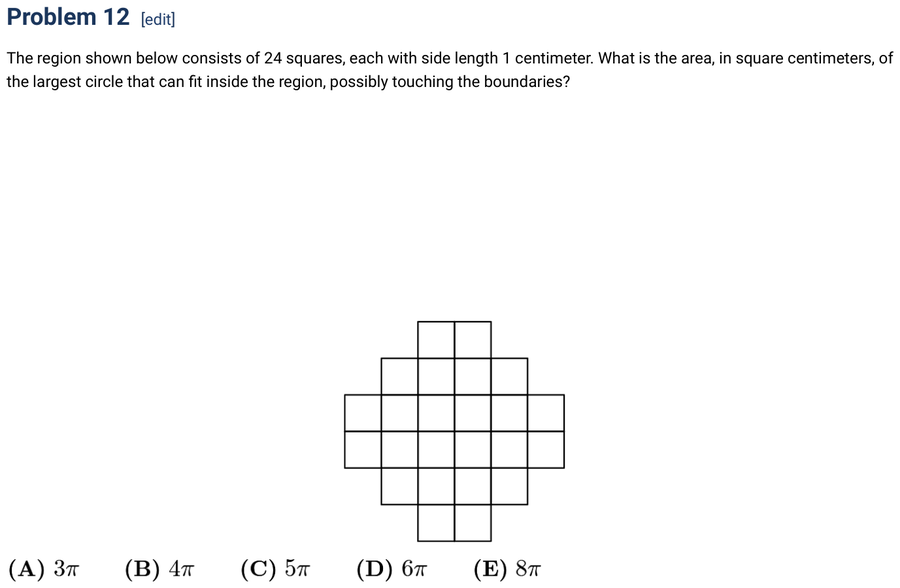
The biggest circle that fits is limited by whichever inward corners of the region poke closest to the center.
Show hint (sharpest)
Each inward corner sits 1 unit horizontally and 2 units vertically from the center. Use the Pythagorean theorem to get the radius.
Show solution
By symmetry, the largest inscribed circle is centered at the region's center. Its radius is the distance from there to the nearest inward-poking corner.
Each such corner is 1 unit across and 2 units up (or down) from the center: distance = √(12 + 22) = √5.
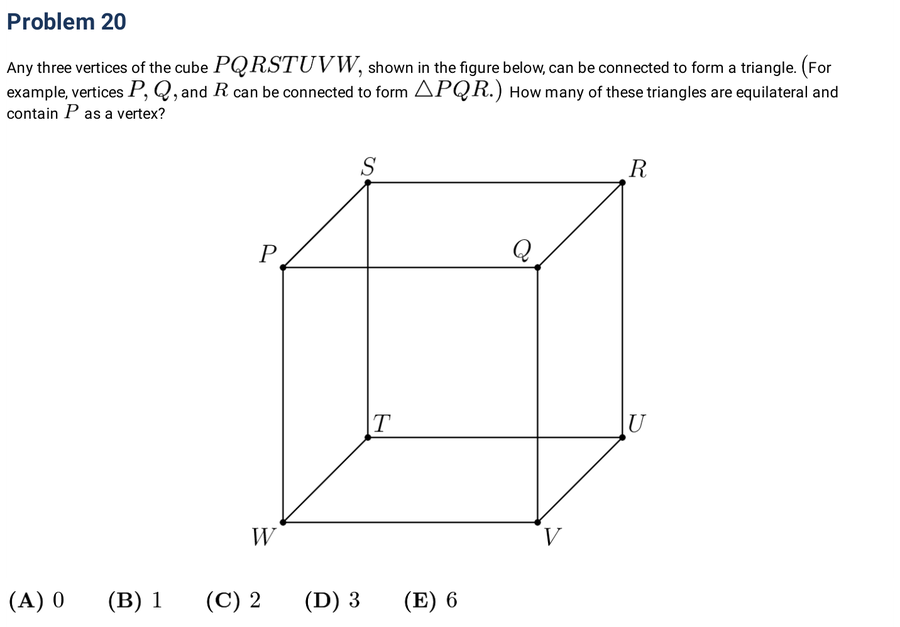
An equilateral triangle in a cube can't use edges or space diagonals as sides — only face diagonals work.
Show hint (sharpest)
P has 3 face-diagonal neighbors (one on each of P's three faces). Any 2 of those 3 are also face-diagonal apart, so each pair forms an equilateral triangle with P.
Show solution
Edges have length 1, face diagonals √2, space diagonals √3. An equilateral triangle must use sides of one length, and only face diagonals can form a closed triangle on a cube.
The vertices at face-diagonal distance from P are R, T, V (one on each of P's three faces).
Every pair of {R, T, V} is also a face diagonal (they lie on the three faces opposite to P), so {P, R, T}, {P, R, V}, {P, T, V} are all equilateral.
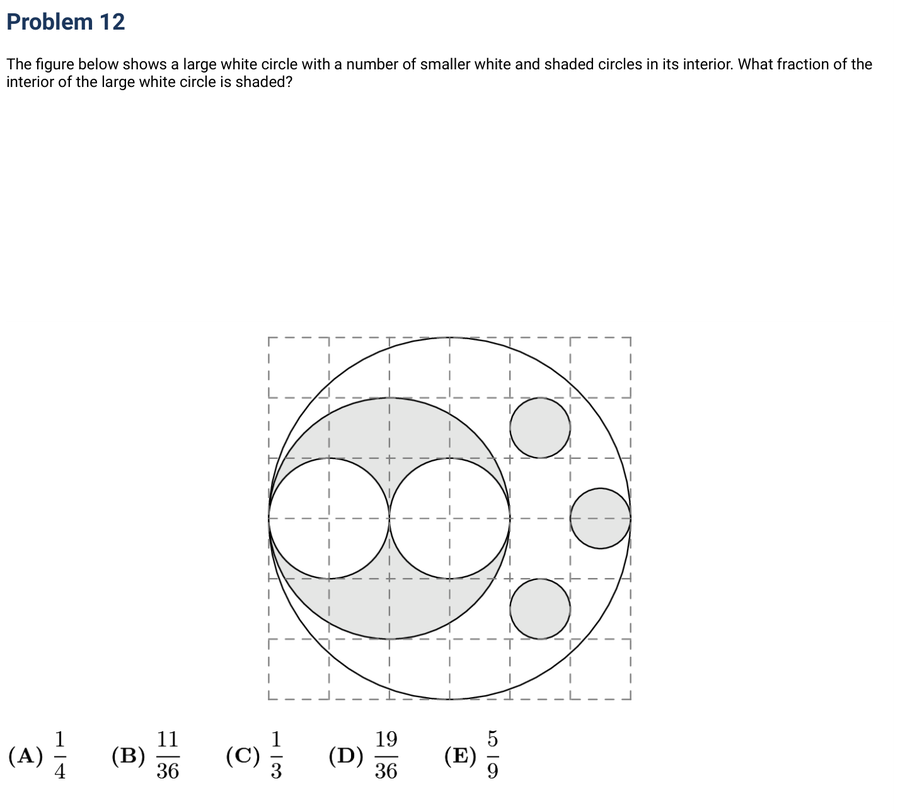
Sum the shaded areas, subtract the white circles that sit inside the big shaded disk, divide by the area of the outer circle.
Show hint (sharpest)
Outer circle area = 9π. Three small shaded circles (radius 1/2): total 3π/4. Big shaded disk (radius 2) minus 2 inner whites (radius 1 each): 4π − 2π = 2π.
Show solution
Outer white circle area: π · 32 = 9π.
Three small shaded circles (radius 12): each has area π4; together 3π4.
Big shaded disk (radius 2): area 4π, minus two white inner circles (radius 1 each, total 2π): net 2π.
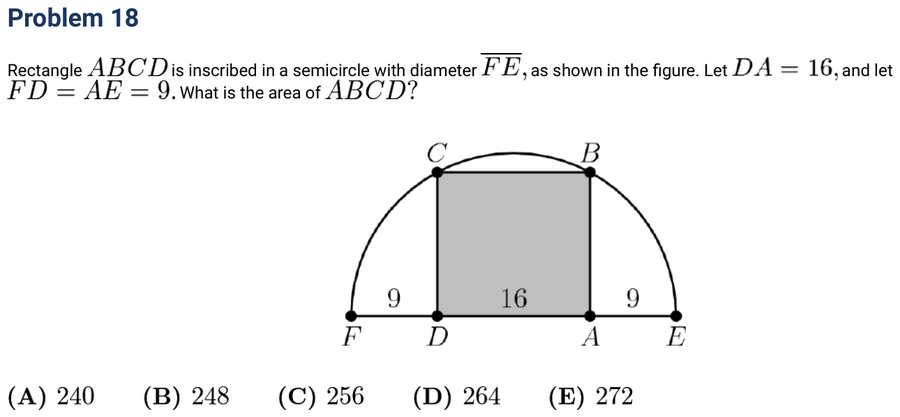
Use the center O of FE. Then OD is easy to compute, and OC equals the radius.
Show hint (sharpest)
FE = 9 + 16 + 9 = 34, so radius 17. The rectangle's center sits at O, so OD = DA/2 = 8. Triangle ODC is right with hypotenuse OC = 17. Pythagoras gives DC.
Show solution
Diameter FE = 9 + 16 + 9 = 34, radius 17. Let O be the center.
ABCD is symmetric about the perpendicular through O, so OD = AD/2 = 8. C is on the semicircle, so OC = 17.
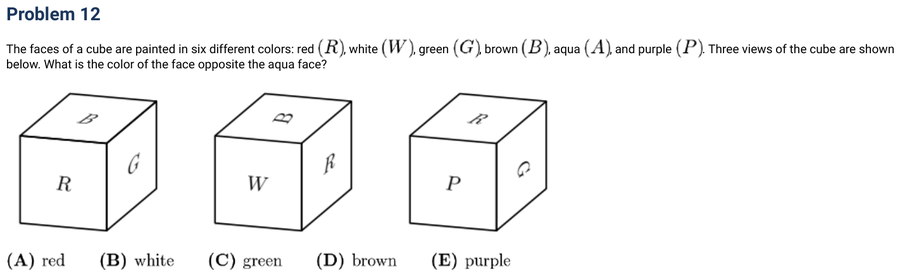
Two faces are opposite if they never appear together in any view.
Show hint (sharpest)
Pair up opposites: look across the three views to find which color is never adjacent to aqua.
Show solution
From the three views, identify pairs of opposite faces by which never share an edge:
Comparing views, white and green appear together (so they're adjacent, not opposite); brown and purple are opposite; aqua and red never share a view → opposite.
A square-shaped floor is covered with congruent square tiles. If the total number of tiles that lie on the two diagonals is 37, how many tiles cover the floor?
Show hint
Both diagonals share the center tile (the floor must be an odd-by-odd square). So diagonal tiles = 2n − 1.
Show solution
If the floor is n × n, the two diagonals share the center tile, so they cover 2n − 1 tiles.
In the given figure hexagon ABCDEF is equiangular, ABJI and FEHG are squares with areas 18 and 32 respectively, ▵JBK is equilateral and FE = BC. What is the area of ▵KBC?
Show hint (soft nudge)
Find BK from the square ABJI and the equilateral ▵JBK. Find BC from the square FEHG and the given FE = BC.
Show hint (sharpest)
Use angles at B: 90° (square) + 60° (equilateral) + ∠KBC + 120° (equiangular hexagon) = 360°. What does that make ∠KBC?
Show solution
BK = JB = √18 = 3√2 (square side, then equilateral).
One-inch squares are cut from the corners of this 5 inch square. What is the area in square inches of the largest square that can be fit into the remaining space?
Show hint (soft nudge)
An axis-aligned square fits at best with side 3 (the unblocked center column/row), giving area 9. Try a tilted square instead.
Show hint (sharpest)
Tilt a square so each vertex lies on one straight edge of the cut-out shape. Decompose it into a central 3×3 square plus 4 right triangles that stick out into the unblocked middles of the original sides.
Show solution
After cutting the corner unit squares, the middle 3 units of each side of the 5×5 are clear. Inscribe a tilted square whose four vertices each sit on the middle of one of those sides.
Decompose this square as a central axis-aligned 3×3 square (area 9) plus four congruent right triangles, one extending toward the middle of each original side.
Each triangle has legs 3 and 1, area (1/2)(3)(1) = 3/2.
A straight one-mile stretch of highway, 40 feet wide, is closed. Robert rides his bike on a path composed of semicircles as shown. If he rides at 5 miles per hour, how many hours will it take to cover the one-mile stretch? Note: 1 mile = 5280 feet.
Show hint (soft nudge)
Each semicircle replaces a straight diameter d with a half-circumference (π/2)d. So the bike path is π/2 times the straight 1-mile distance.
Show hint (sharpest)
Then time = distance / speed.
Show solution
Each semicircle's diameter lies along the highway and the curve just reaches the edge, so for any diameter d the half-circumference is (π/2)d. Stacking semicircles end-to-end multiplies the total length by π/2.
Angle ABC of ▵ABC is a right angle. The sides of ▵ABC are the diameters of semicircles as shown. The area of the semicircle on AB equals 8π, and the arc of the semicircle on AC has length 8.5π. What is the radius of the semicircle on BC?
Show hint (soft nudge)
Recover AB from the semicircle area, and AC from the semicircle arc length. Then use the Pythagorean theorem to find BC, then halve it.
Show hint (sharpest)
Semicircle area = (1/2)πr2. Semicircle arc length = πr. So radius is straightforward from each.
Show solution
Semicircle on AB: (1/2)πr2 = 8π ⇒ r = 4 ⇒ AB = 8.
Semicircle on AC: πr = 8.5π ⇒ r = 8.5 ⇒ AC = 17.
Right angle at B: BC = √(172 − 82) = √225 = 15. (8-15-17 triple.)
Squares ABCD, EFGH, and GHIJ are equal in area. Points C and D are the midpoints of sides IH and HE, respectively. What is the ratio of the area of the shaded pentagon AJICB to the sum of the areas of the three squares?
Show hint (soft nudge)
Set each square's side to 1. Place coordinates: F = (0, 0), E = (0, 1), G = (1, 0), H = (1, 1), J = (2, 0), I = (2, 1).
Show hint (sharpest)
Then D = (0.5, 1), C = (1.5, 1), A = (0.5, 2), B = (1.5, 2). Use the shoelace formula on pentagon AJICB.
Show solution
Side length 1. Vertices: A = (0.5, 2), J = (2, 0), I = (2, 1), C = (1.5, 1), B = (1.5, 2).
A ball with diameter 4 inches starts at point A to roll along the track shown. The track is comprised of 3 semicircular arcs whose radii are R1 = 100 inches, R2 = 60 inches, and R3 = 80 inches, respectively. The ball always remains in contact with the track and does not slip. What is the distance the center of the ball travels over the course from A to B?
Show hint (soft nudge)
The ball's center traces a path parallel to the track at distance = ball's radius (2 inches). On the outside of an arc the center's arc has radius R − 2; on the inside it has radius R + 2.
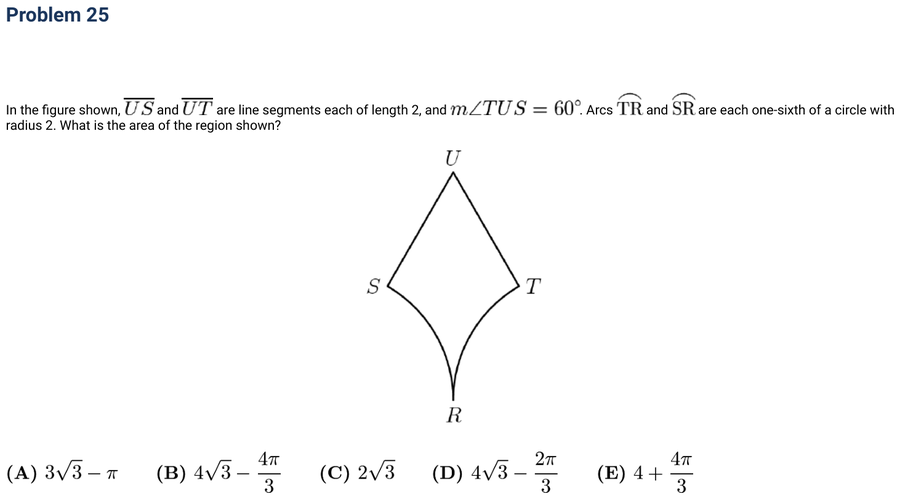
A circle of radius 2 is cut into four congruent arcs. The four arcs are joined to form the star figure shown. What is the ratio of the area of the star figure to the area of the original circle?
Show hint
Imagine the star inside a 4×4 square. The four 'bite' regions outside the star are exactly the four pieces that, when rearranged, form the original circle.
Show solution
Inscribe the star in a 4×4 square (its four points touch the four sides). The square's area is 16.
The four regions outside the star but inside the square are precisely the four arc-pieces from the circle — together their area equals the circle's area π(2)2 = 4π.
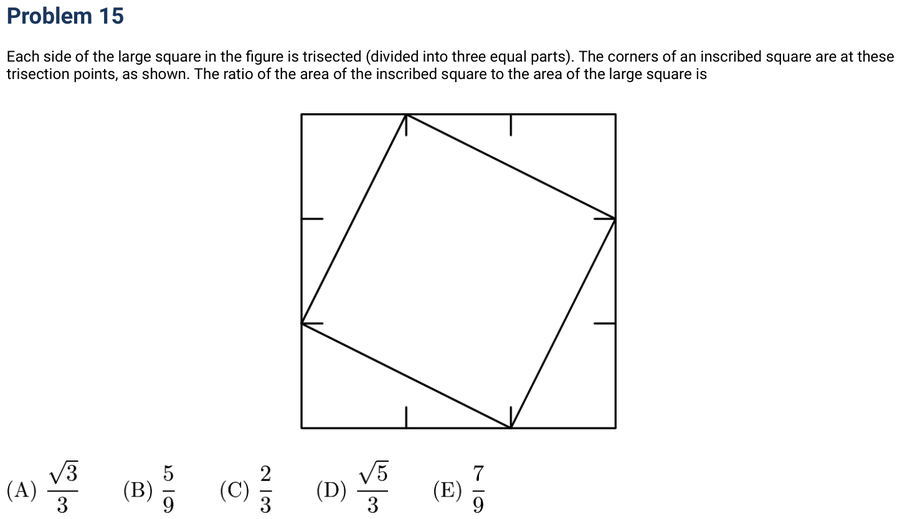
A square with area 4 is inscribed in a square with area 5, with one vertex of the smaller square on each side of the larger square. A vertex of the smaller square divides a side of the larger square into two segments, one of length a, and the other of length b. What is the value of ab?
Show hint (soft nudge)
The big square is sliced by the small square into 4 congruent right triangles plus the small square. Total leftover area = 5 − 4 = 1, split equally among the 4 triangles.
Show hint (sharpest)
Each triangle has legs a and b, area (1/2)ab.
Show solution
Big square area 5 = small square area 4 + total triangle area ⇒ triangles total 1.
By symmetry, the 4 triangles are congruent, each with area 1/4. Each has legs a and b, area (1/2)ab.
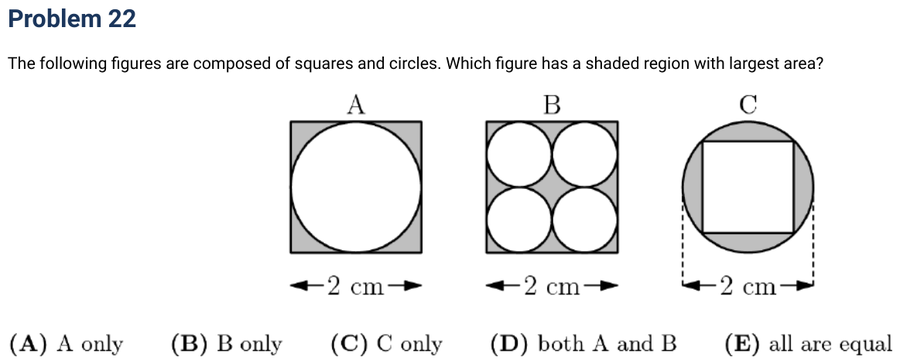
A circle with radius 1 is inscribed in a square and circumscribed about another square as shown. Which fraction is closest to the ratio of the circle's shaded area to the area between the two squares?
Show hint (soft nudge)
Inner square has diagonal = diameter = 2, so its side is √2 and area is 2.
Show hint (sharpest)
Shaded area inside the circle = π · 12 − 2 = π − 2. Area between the two squares = outer area − inner area = 4 − 2 = 2.
Show solution
Outer square: side 2, area 4. Inner square: diagonal = 2 (diameter), so side √2 and area 2.
The diagram shows an octagon consisting of 10 unit squares. The portion below PQ is a unit square and a triangle with base 5. If PQ bisects the area of the octagon, what is the ratio XQQY?
Show hint (soft nudge)
Total area = 10, so each half = 5. Below PQ: a unit square + a triangle of base 5. So the triangle has area 4 and base 5.
A one-cubic-foot cube is cut into four pieces by three cuts parallel to the top face of the cube. The first cut is 12 foot from the top face. The second cut is 13 foot below the first cut, and the third cut is 117 foot below the second cut. From the top to the bottom the pieces are labeled A, B, C, and D. The pieces are then glued together end to end as shown in the second diagram. What is the total surface area of this solid in square feet?
Show hint (soft nudge)
Look from each of the 6 directions and sum the visible areas.
Show hint (more)
Top and bottom views are each four 1×1 squares (the bases of the four pieces) = 4 sq ft each.
Show hint (sharpest)
End views show the full height of the tallest piece (1/2 sq ft each); front and back show the staircase silhouette whose total height adds to 1.
Show solution
Top view: each piece's 1×1 top is visible ⇒ 4 sq ft. Same for bottom ⇒ 4 sq ft.
Front and back views: silhouette is 4 rectangles of width 1 with heights summing to 1 ⇒ 1 sq ft each, total 2 sq ft.
End views: in the monotone-staircase arrangement, each end view equals the cross section of the tallest piece A: 1 · (1/2) = 1/2. Two ends ⇒ 1 sq ft.
Margie's winning art design is shown. The smallest circle has radius 2 inches, with each successive circle's radius increasing by 2 inches. Approximately what percent of the design is black?
Show hint
Black regions: disk of radius 2, annulus 4–6, annulus 8–10. Use area = π(R2 − r2) for each annulus.
A lemming sits at a corner of a square with side length 10 meters. The lemming runs 6.2 meters along a diagonal toward the opposite corner. It stops, makes a 90° right turn and runs 2 more meters. A scientist measures the shortest distance between the lemming and each side of the square. What is the average of these four distances in meters?
Show hint
For any point inside a square of side 10, distance to opposite sides always sums to 10.
Show solution
Lemming stays inside the square.
Distance to left + right walls = 10. Distance to top + bottom walls = 10. Total: 20.
A square with side length 2 and a circle share the same center. The total area of the regions that are inside the circle and outside the square is equal to the total area of the regions that are outside the circle and inside the square. What is the radius of the circle?
Show hint
Let I be the overlap area. Inside-circle-outside-square = πr2 − I. Outside-circle-inside-square = 4 − I. Set equal ⇒ circle area = square area.
In the figure, ABCD is a rectangle and EFGH is a parallelogram. Using the measurements given in the figure, what is the length d of the segment that is perpendicular to HE and FG?
Show hint (soft nudge)
Area of parallelogram EFGH = rectangle area − 4 corner triangles.
Show hint (sharpest)
HE is a hypotenuse of the 3-4 right triangle ⇒ HE = 5. Use Area = base · height.
Show solution
Corner triangles: at A (3, 4): area 6. At C (3, 4): area 6. At B (5, 6): area 15. At D (5, 6): area 15. Total: 42.
Two 4 × 4 squares intersect at right angles, bisecting their intersecting sides, as shown. The circle's diameter is the segment between the two points of intersection. What is the area of the shaded region created by removing the circle from the squares?
Show hint (soft nudge)
Union of the two squares: 16 + 16 − overlap. Overlap is a 2×2 square (area 4).
Show hint (sharpest)
Circle's diameter = diagonal of overlap square = 2√2 ⇒ radius √2 ⇒ area 2π.
For his birthday, Bert gets a box that holds 125 jellybeans when filled to capacity. A few weeks later, Carrie gets a larger box full of jellybeans. Her box is twice as high, twice as wide, and twice as long as Bert's. Approximately how many jellybeans did Carrie get?
Show hint (soft nudge)
Doubling every dimension does more than double the box — picture stacking copies of the small box inside the big one.
Show hint (sharpest)
Twice as long, wide, and high multiplies the volume by 2 × 2 × 2.
Show solution
Doubling all three dimensions multiplies the volume by 2 × 2 × 2 = 8.
So Carrie's box holds about 8 × 125 = 1000 jellybeans.
A square piece of paper, 4 inches on a side, is folded in half vertically. Both layers are then cut in half parallel to the fold. Three new rectangles are formed, a large one and two small ones. What is the ratio of the perimeter of one of the small rectangles to the perimeter of the large rectangle?
Show hint (soft nudge)
Track the dimensions: folding the 4×4 square makes a 4×2 rectangle.
Show hint (sharpest)
After the cut, the large rectangle is 4×2 and each small one is 4×1.
Show solution
Folding the 4×4 square in half gives a 4×2 shape; cutting parallel to the fold yields one large 4×2 rectangle and two small 4×1 rectangles.
In order for Mateen to walk a kilometer (1000 m) in his rectangular backyard, he must walk the length 25 times or walk its perimeter 10 times. What is the area of Mateen's backyard in square meters?
Show hint (soft nudge)
The '25 times' clue gives the length; the '10 times' clue gives the perimeter.
Show hint (sharpest)
Then perimeter = 2(length + width) gives the width.
Show solution
Length = 1000 ÷ 25 = 40 m; perimeter = 1000 ÷ 10 = 100 m.
From 100 = 2(40 + W) we get W = 10, so area = 40 × 10 = 400 m².
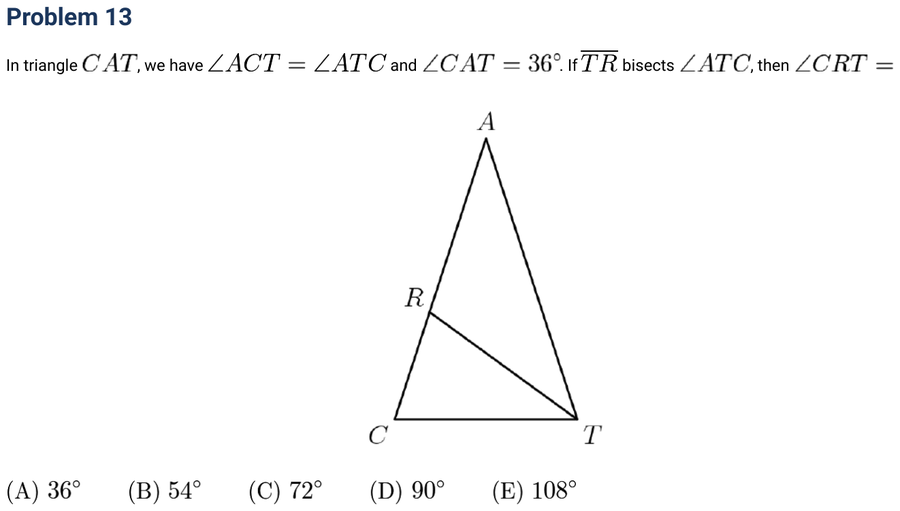
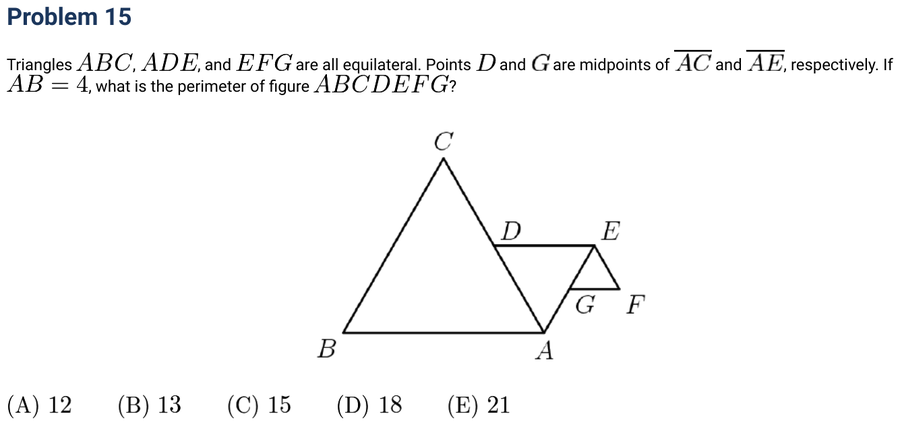
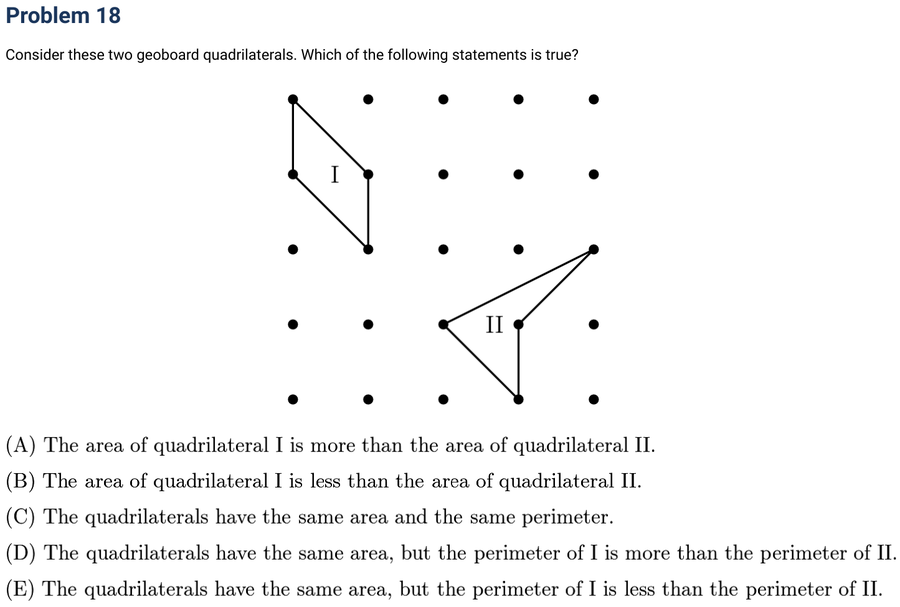
Then compare the slanted sides to see which perimeter is larger.
Show solution
Both shapes have area 1 (I is a 1×1 parallelogram; II is two triangles of area ½).
They share two equal slant sides, but I's other two sides are unit length while II has a longer slant, so II's perimeter is bigger — meaning I's is less (choice E).
E
Same area, but quadrilateral I has the smaller perimeter.
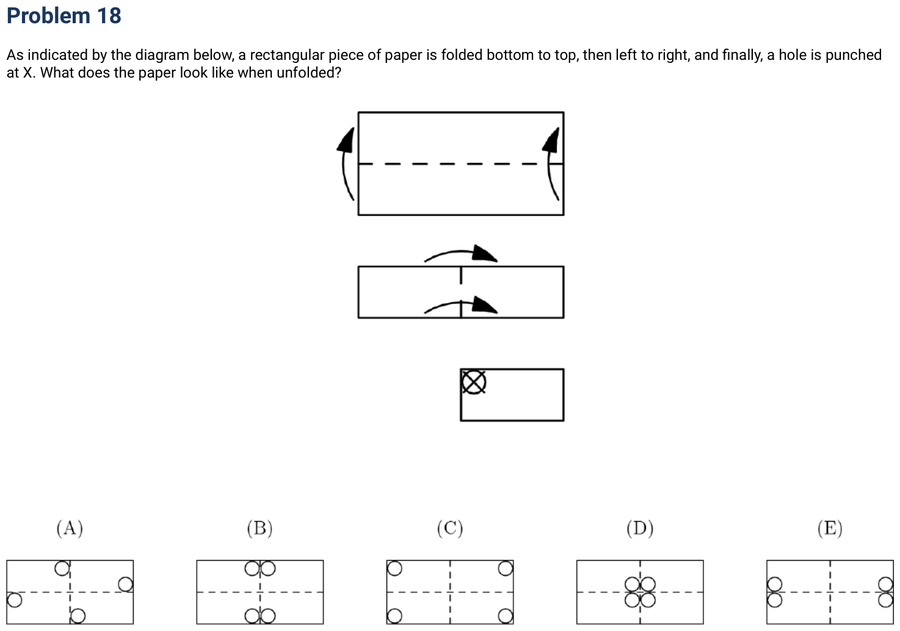
Each fold doubles the holes by reflecting across its crease.
Show hint (sharpest)
Unfold one step at a time, mirroring the punched hole each time.
Show solution
Undoing the left-to-right fold mirrors the hole across the vertical crease, and undoing the bottom-to-top fold mirrors both across the horizontal crease.
Let PQRS be a square piece of paper. P is folded onto R, and then Q is folded onto S. The area of the resulting figure is 9 square inches. Find the perimeter of square PQRS.
Show hint (soft nudge)
Each fold halves the area.
Show hint (sharpest)
After two folds the figure is one-fourth of the square's area.
Show solution
Folding P onto R halves the square, and folding Q onto S halves it again, leaving one-fourth of the area: s²/4 = 9, so s² = 36 and s = 6.
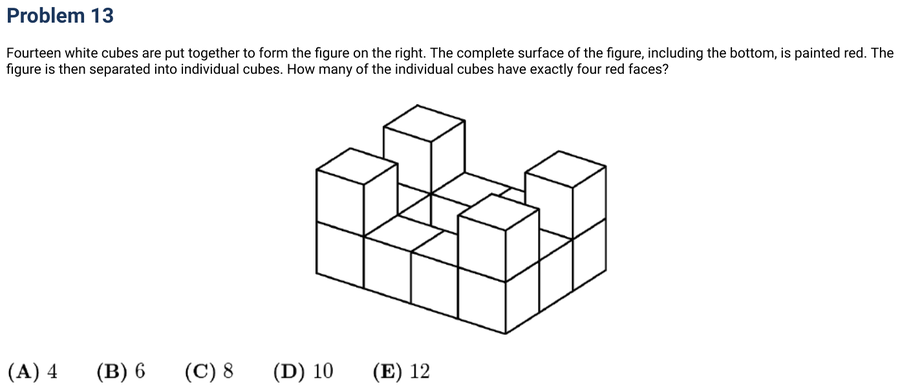
A 4 × 4 × 4 cubical box contains 64 identical small cubes that exactly fill the box. How many of these small cubes touch a side or the bottom of the box?
Show hint (soft nudge)
Count the cubes that touch nothing — not the four walls, not the bottom — and subtract.
Show hint (sharpest)
Those untouched cubes form a small block held away from every wall and the floor.
Show solution
A cube avoids all four walls and the bottom only if it lies in the inner 2 × 2 columns and above the bottom layer: 2 × 2 × 3 = 12 cubes.
A plastic snap-together cube has a protruding snap on one side and receptacle holes on the other five sides. What is the smallest number of these cubes that can be snapped together so that only receptacle holes are showing?
Show hint (soft nudge)
Every cube's single snap must be plugged into another cube's hole.
Show hint (sharpest)
Arrange the cubes so each snap points into the next one.
Show solution
Each cube has one snap that must be hidden inside a neighbor's hole.
Four cubes in a square ring, each snap pointing into the next, hide all four snaps, leaving only holes outside — and fewer than four can't absorb every snap. So 4.
A straight concrete sidewalk is to be 3 feet wide, 60 feet long, and 3 inches thick. How many cubic yards of concrete must a contractor order for the sidewalk if concrete must be ordered in a whole number of cubic yards?
Show hint (soft nudge)
Convert 3 inches to feet (1/4 ft) and find the volume in cubic feet.
Show hint (sharpest)
There are 27 cubic feet in a cubic yard; round up.
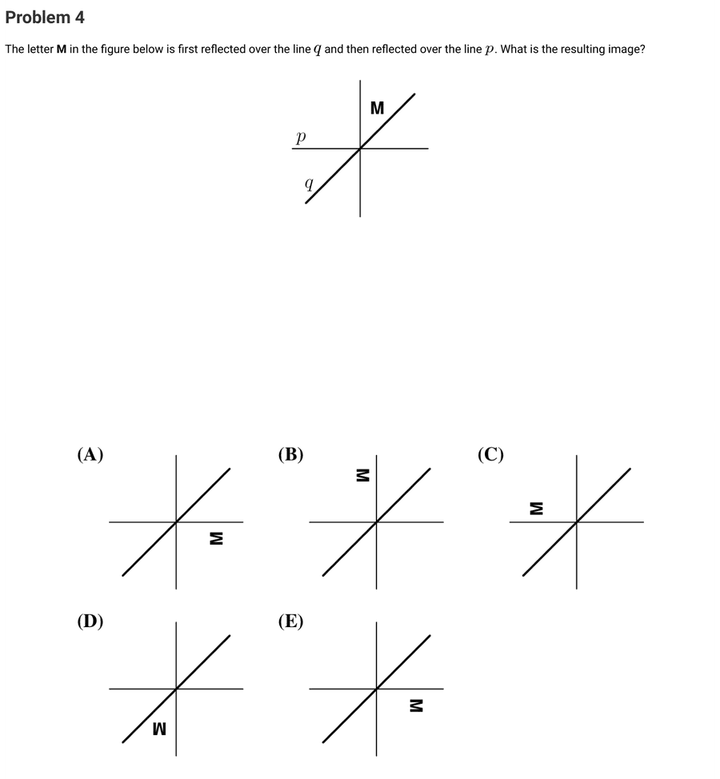
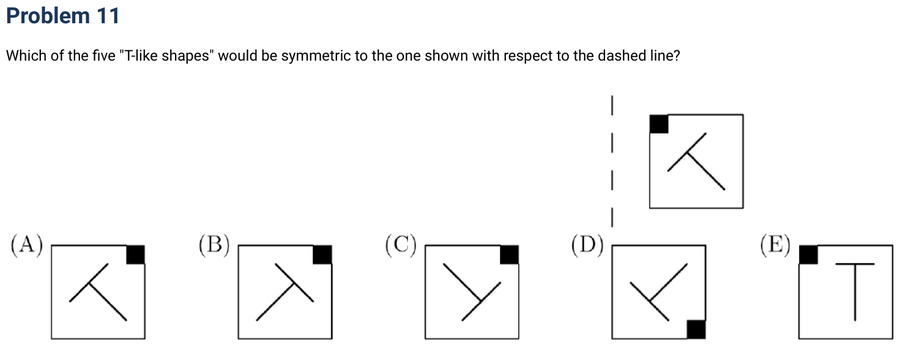
A reflection across a vertical line swaps left and right but leaves up and down alone.
Show hint (sharpest)
Hold each choice up to a mirror placed on the dashed line — only one matches the original.
Show solution
Reflecting across the vertical dashed line swaps the left and right of every feature: the corner square moves to the opposite side of its box, and the slanted arms flip their lean.
Choice B is the only T-like shape whose corner square and arms are the mirror image of the original.
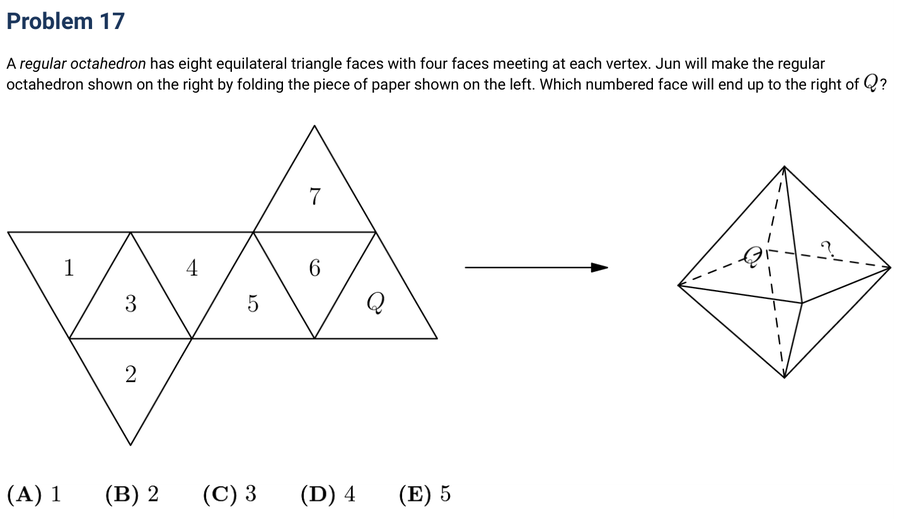
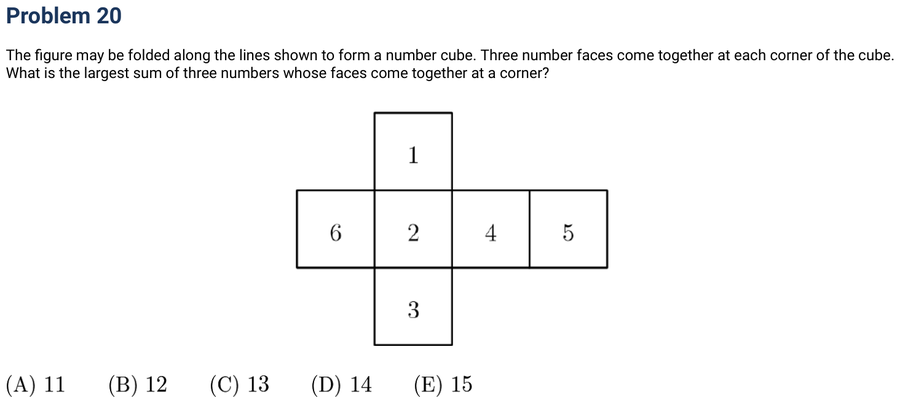
Pair up the faces that end up opposite each other after folding — opposite faces never share a corner.
Show hint (sharpest)
At every corner, the three meeting faces are one from each opposite pair, so pick the larger number from each pair.
Show solution
Fold the net with 2 as the front: 1 goes on top and 3 on the bottom (1↔3), 6 to the left and 4 to the right (6↔4), and 5 wraps around to the back opposite 2 (2↔5).
Each corner has one face from each pair, so the biggest corner sum is 5 + 3 + 6 = 14.
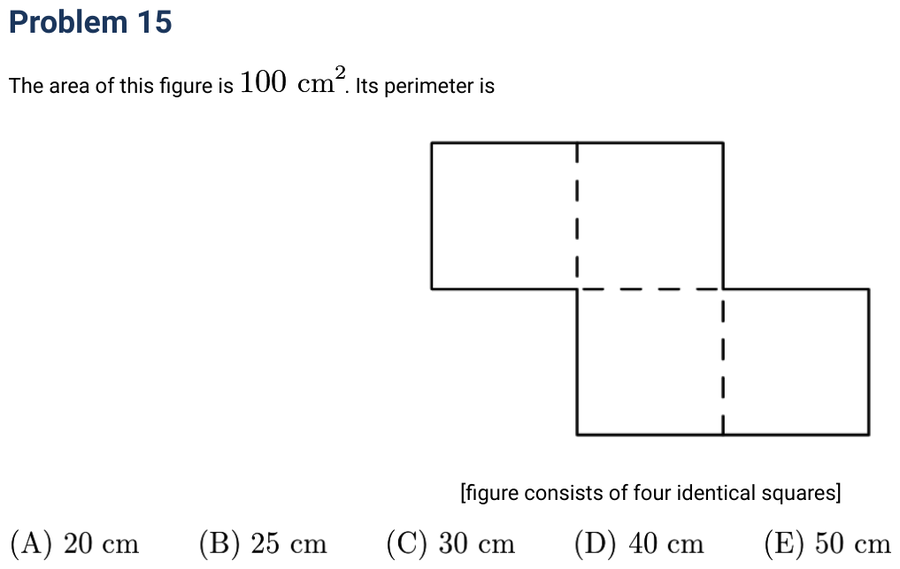
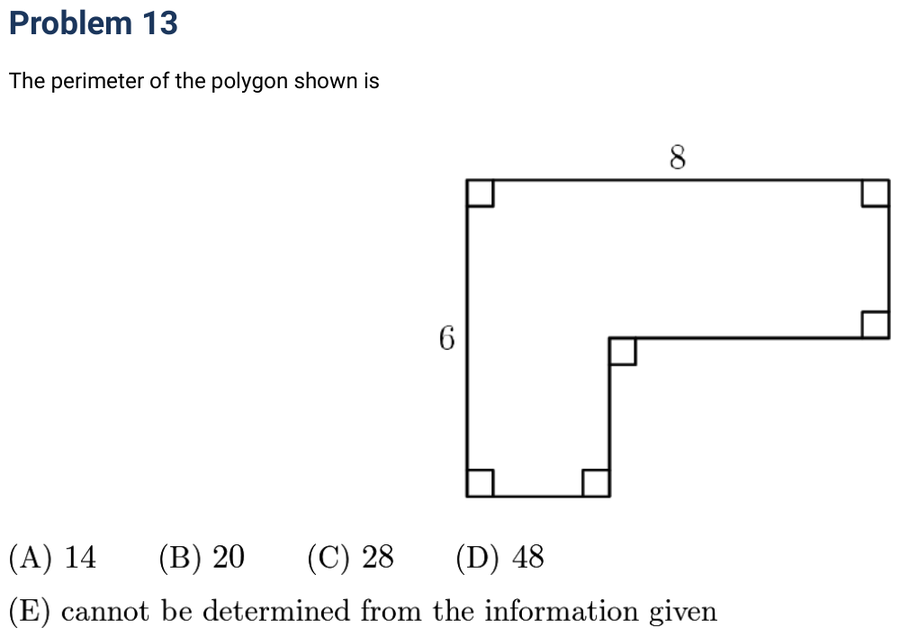
The inner step has matching horizontal and vertical pieces that line up with the outer corners — so the perimeter equals that of the bounding rectangle.
Show hint (sharpest)
Bounding rectangle: 8 wide, 6 tall.
Show solution
Slide each piece of the inward step to the matching outer edge: the horizontal step segment fits onto the top edge, the vertical step segment onto the right edge.
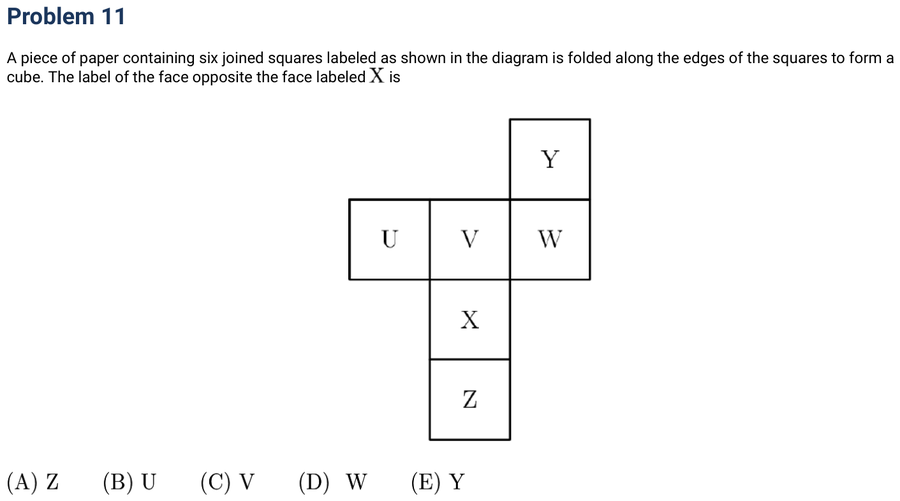
With V as the front face, fold the four neighbors of V into the four sides.
Show hint (sharpest)
Y sits across the strip from X, so they end up on opposite faces.
Show solution
Make V the front. U folds left, W folds right, X folds down to become the bottom, Z (below X) wraps around to become the back. That puts Y (the square attached to W's top) onto the top.
A square and a triangle have equal perimeters. The lengths of the three sides of the triangle are 6.2 cm, 8.3 cm, and 9.5 cm. The area of the square is
Show hint
Triangle perimeter ÷ 4 = square side.
Show solution
Triangle perimeter = 6.2 + 8.3 + 9.5 = 24, so square side = 24 ⁄ 4 = 6.
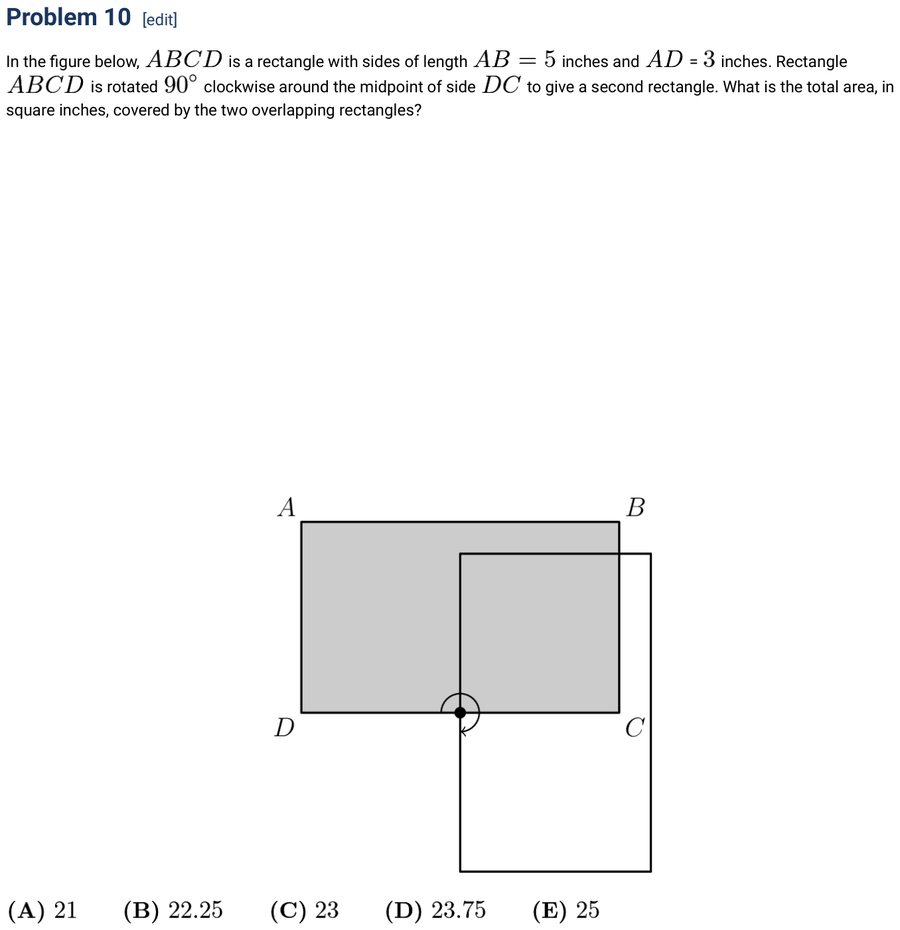
When two shapes overlap, adding their areas counts the overlap twice. What's the shape of that overlap?
Show hint (sharpest)
Inclusion–exclusion: (area of one) + (area of the other) − (area of overlap). The overlap is a square of side 2.5.
Show solution
Each rectangle has area 5 × 3 = 15.
Rotated 90° about the midpoint of DC, the second rectangle's lower-left quarter overlaps the first rectangle's lower-right quarter — a 2.5 by 2.5 square (half of DC = 2.5), area 2.52 = 6.25.
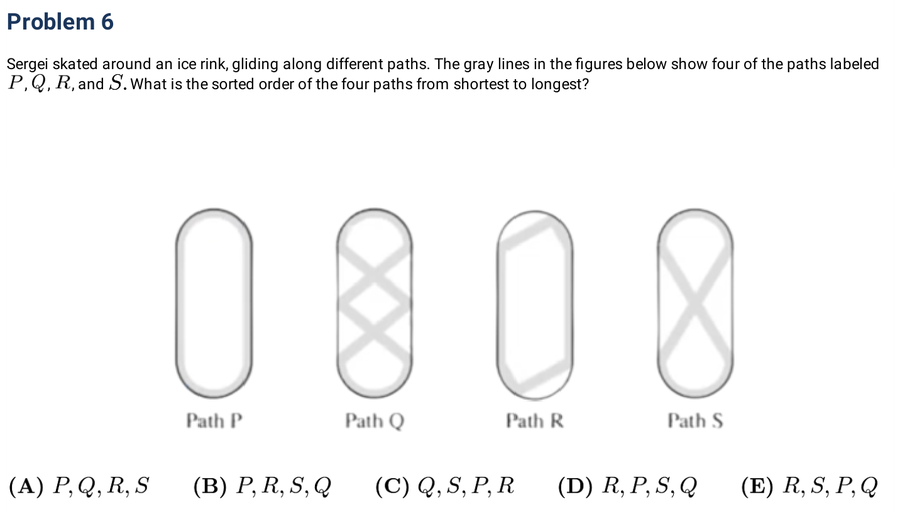
Use the plain oval P as a baseline. Which paths cut corners (shorter) and which add diagonals (longer)?
Show hint (sharpest)
R uses straight shortcuts across the rounded ends — shorter than P. S and Q swap edges for diagonals; a diagonal is a hypotenuse, always longer than the legs it replaces.
Show solution
R cuts the rounded ends with straight chords, so R is strictly shorter than P. Shortest.
S adds one diagonal X inside the oval — the diagonal is a hypotenuse, longer than the legs P would take. So S > P.
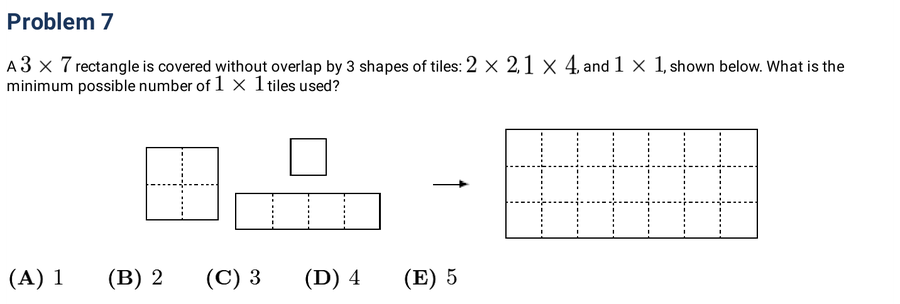
The 2×2 and 1×4 tiles each cover 4 squares. What does that tell you about the number of 1×1 tiles needed?
Show hint (sharpest)
21 squares total, and the 2×2 + 1×4 tiles fill a multiple of 4. So the 1×1 count is 1, 5, 9, … Try the smallest that actually fits.
Show solution
Each 2×2 and 1×4 tile covers 4 unit squares, so together they fill a multiple of 4. The 1×1 count must equal 21 − (multiple of 4) ≡ 1 (mod 4): possible values 1, 5, 9, …
Can we cover 20 of the 21 squares with 2×2 and 1×4 tiles, leaving just one 1×1? Trying shows it doesn't fit (a 3×7 rectangle with one cell removed can't be partitioned into 2×2's and 1×4's).
5 works: place four 2×2 and 1×4 tiles covering 16 squares, with the 5 remaining cells filled by 1×1's. Minimum = 5.
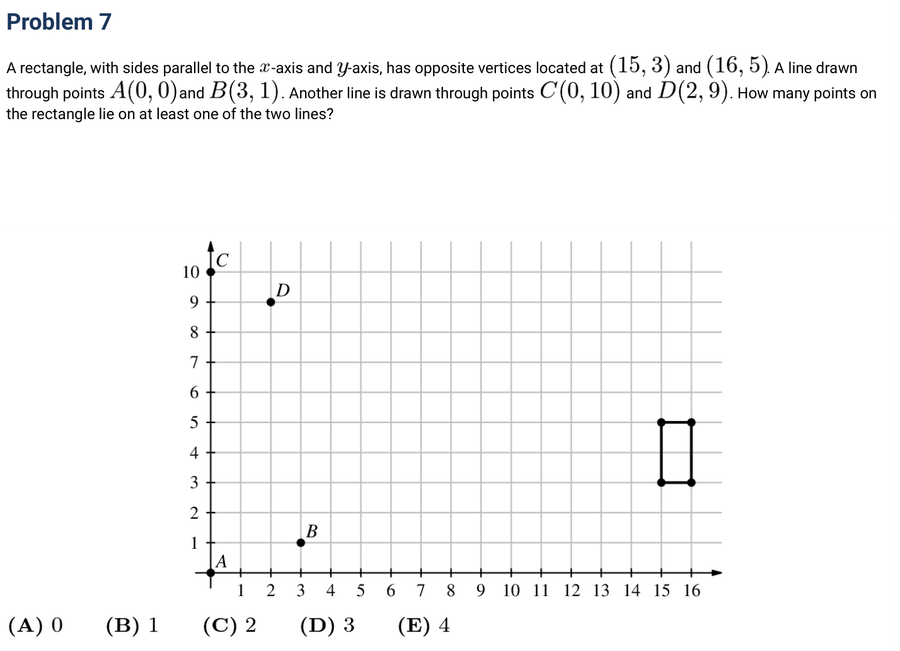
Each line has a simple equation. Plug in x = 15 and x = 16 (the rectangle's left and right sides) and see whether the resulting y falls between 3 and 5.
Show hint (sharpest)
Line AB: y = x/3. Line CD: y = 10 − x/2. Test each at x = 15 and 16.
Show solution
Rectangle: x ∈ [15, 16], y ∈ [3, 5].
Line AB: y = x/3. At x = 15: y = 5 ✓ (hits the corner (15, 5)). At x = 16: y ≈ 5.33, above the rectangle.
Line CD: y = 10 − x/2. At x = 15: y = 2.5, below. At x = 16: y = 2, below.
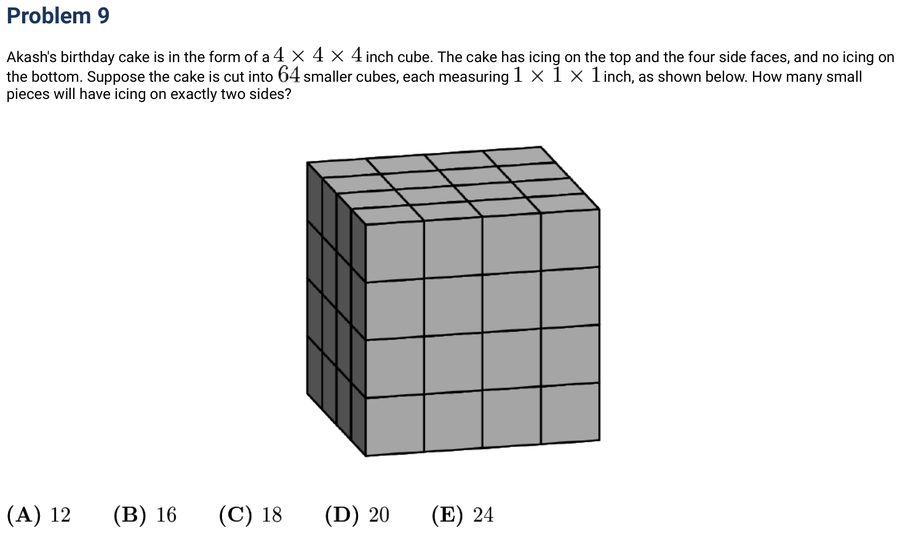
Icing is on the top and the 4 sides; the bottom has none. Count where exactly two of these meet on a small cube.
Show hint (sharpest)
Top-edge cubes (not corners): top + one side = 2 sides. Bottom-corner vertical edges: side + side = 2 sides. Add them up.
Show solution
Top non-corner edge cubes (k=4, exactly one of i,j at the boundary): touch top + one side → 2 iced sides. There are 4 top edges × 2 non-corner cubes per edge = 8.
Vertical-edge cubes (both i and j at a side boundary, but k < 4): touch 2 side faces, and bottom has no icing → 2 iced sides. 4 vertical edges × 3 cubes per edge = 12.
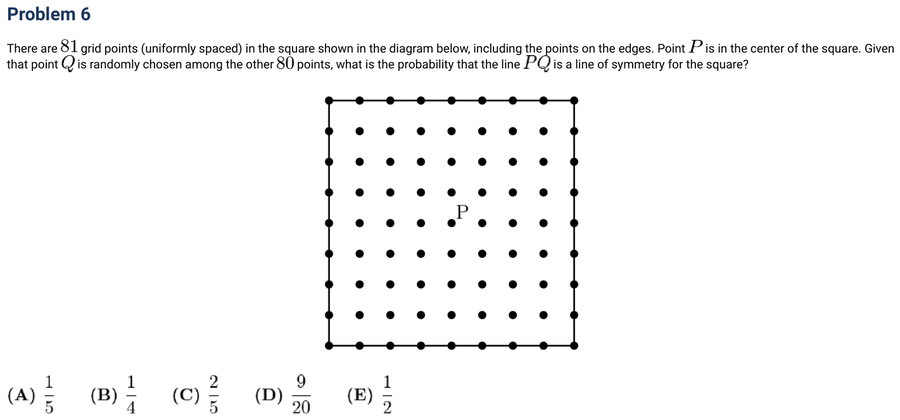
A square has only 4 lines of symmetry — the two diagonals and the two perpendicular bisectors. Q must lie on one of those.
Show hint (sharpest)
Each line passes through 9 grid points including P. So 4 × 9 = 36, minus the 4 occurrences of P itself = 32 valid Qs out of 80.
Show solution
A square has exactly 4 axes of symmetry through its center P: the two diagonals and the two perpendicular bisectors.
Each axis contains 9 of the 81 grid points (including P). Counting Q across all 4: 4 × 9 = 36 spots, but P appears 4 times and Q can't equal P, so subtract 4 → 32 valid choices.
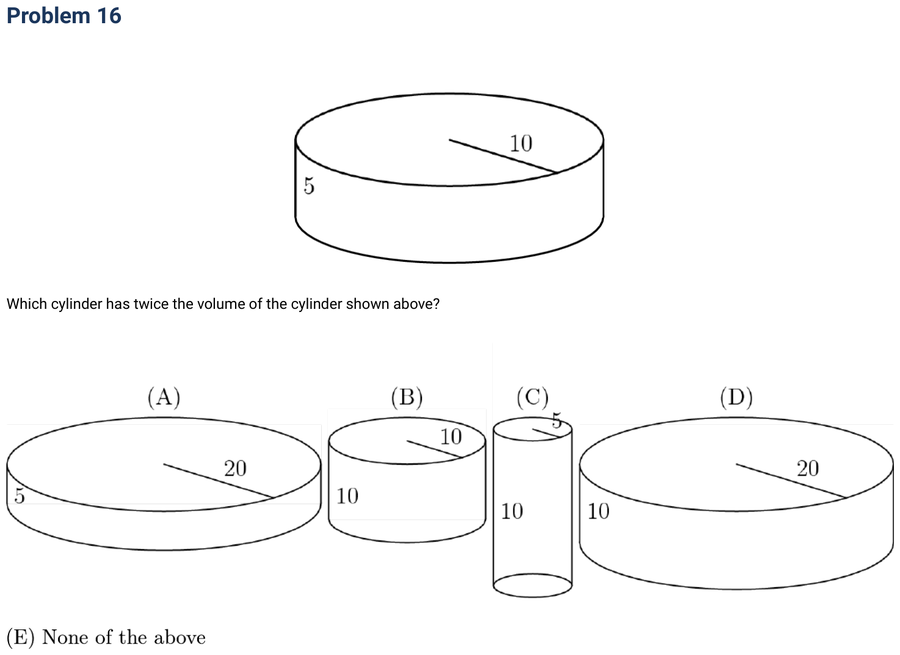
Alex and Felicia each have cats as pets. Alex buys cat food in cylindrical cans that are 6 cm in diameter and 12 cm high. Felicia buys cat food in cylindrical cans that are 12 cm in diameter and 6 cm high. What is the ratio of the volume of one of Alex's cans to the volume of one of Felicia's cans?
Show hint (soft nudge)
Cylinder volume = πr2h. Felicia's radius is doubled (so radius2 ×4) and her height is halved.
Show hint (sharpest)
Net effect on Felicia vs Alex: ×4 from radius, ×1/2 from height = ×2. So Alex : Felicia = 1 : 2.
Show solution
Going from Alex (radius 3, height 12) to Felicia (radius 6, height 6): radius doubles → radius2 × 4; height halves → × 1/2.
Combined: Felicia's volume = Alex's × (4 × 1/2) = 2×. So ratio Alex : Felicia = 1 : 2.
Tyler is tiling the floor of his 12 foot by 16 foot living room. He plans to place one-foot by one-foot square tiles to form a border along the edges of the room and to fill in the rest of the floor with two-foot by two-foot square tiles. How many tiles will he use?
Show hint (soft nudge)
Border (1×1 tiles): walk around the rectangle — total = 2×(12+16) − 4 for shared corners.
Show hint (sharpest)
Inner area is 10 × 14 (one foot off each side), filled with 2×2 tiles.
Show solution
Border: 2(12) + 2(16) − 4 = 52 unit tiles (subtract 4 because each corner is shared by two sides).
Interior: 10 ft × 14 ft = 140 sq ft, filled by 2×2 tiles → 140 / 4 = 35 tiles.
The circumference of the circle with center O is divided into 12 equal arcs, marked the letters A through L as seen below. What is the number of degrees in the sum of the angles x and y?
Show hint (soft nudge)
Each of the 12 arcs spans 360°/12 = 30° at the center.
Show hint (sharpest)
Each triangle has two sides that are radii, so it is isosceles. The apex angle is the central angle ⇒ base angles are (180 − central)/2.
Show solution
Arcs from A to E: 4 arcs ⇒ central angle ∠AOE = 4 × 30° = 120°. Triangle OAE is isosceles, so x = (180 − 120)/2 = 30°.
Arcs from G to I: 2 arcs ⇒ ∠GOI = 60°. Triangle OIG isosceles, so y = (180 − 60)/2 = 60°.
A cube with 3-inch edges is to be constructed from 27 smaller cubes with 1-inch edges. Twenty-one of the cubes are colored red and 6 are colored white. If the 3-inch cube is constructed to have the smallest possible white surface area showing, what fraction of the surface area is white?
Show hint (soft nudge)
The 27 unit cubes break into types by how many faces are exposed: 1 interior (0 exposed), 6 face-centers (1 each), 12 edges (2 each), 8 corners (3 each). Hide white cubes in the lowest-exposure positions first.
Show hint (sharpest)
Total surface = 6 · 9 = 54. Compute the white area; divide.
Show solution
Hide one white cube in the very center (0 faces showing).
Place the remaining 5 white cubes at the 6 face-centers (1 face showing each) ⇒ 5 white faces visible.
Rectangle ABCD has sides CD = 3 and DA = 5. A circle of radius 1 is centered at A, a circle of radius 2 is centered at B, and a circle of radius 3 is centered at C. Which of the following is closest to the area of the region inside the rectangle but outside all three circles?
Show hint (soft nudge)
Each circle contributes a quarter-circle inside the rectangle (radius fits in the rectangle without overlapping the others). Compute the rectangle's area minus the three quarter-circles.
Isabella uses one-foot cubical blocks to build a rectangular fort that is 12 feet long, 10 feet wide, and 5 feet high. The floor and the four walls are all one foot thick. How many blocks does the fort contain?
Show hint
Outer block-volume = 12 · 10 · 5. Subtract the hollow inside. Inside shrinks by 1 in each wall direction and 1 in the floor (no ceiling).
A square with an integer side length is cut into 10 squares, all of which have integer side length and at least 8 of which have area 1. What is the smallest possible value of the length of the side of the original square?
Show hint (soft nudge)
Lower bound: total area ≥ 10 (each piece has integer side ≥ 1). So side ≥ √10 ⇒ side ≥ 4.
Show hint (sharpest)
Upper bound: find an explicit dissection of a 4×4 square into 10 integer-side squares, with 8 of them 1×1.
Show solution
Side ≥ 4: total area is at least 10 (each of 10 pieces ≥ 1), so side2 ≥ 10 ⇒ side ≥ 4.
Construction for side 4: cover the top half (a 4×2 strip) with two 2×2 squares; tile the bottom half (4×2 strip) with 8 unit squares. Total: 2 + 8 = 10 squares, eight of area 1. ✓
Marla has a large white cube that has an edge of 10 feet. She also has enough green paint to cover 300 square feet. Marla uses all the paint to create a white square centered on each face, surrounded by a green border. What is the area of one of the white squares, in square feet?
Show hint
Total surface area is 6 × 10². Split it into the green and the white parts.
Show solution
Total: 6 · 100 = 600 sq ft. Green covers 300, so white covers 300.
Six congruent white squares share that 300: each is 300 / 6 = 50 sq ft.
Two congruent squares, ABCD and PQRS, have side length 15. They overlap to form the 15 by 25 rectangle AQRD shown. What percent of the area of rectangle AQRD is shaded?
Show hint (soft nudge)
Together the two squares cover area 2 · 152, but the rectangle is only 25 · 15 — the overlap is counted twice.
Show hint (sharpest)
Overlap area = (sum of both squares) − (rectangle).
Show solution
Each square has area 225, total 450. Rectangle area = 25 × 15 = 375.
Let A be the area of the triangle with sides of length 25, 25, and 30. Let B be the area of the triangle with sides of length 25, 25, and 40. What is the relationship between A and B?
Show hint (soft nudge)
Each triangle is isosceles. Drop the altitude to the unequal side and use the Pythagorean theorem.
Show hint (sharpest)
Look for 15-20-25 (3-4-5 scaled) in both pictures.
Show solution
Triangle with base 30: half-base 15, hypotenuse 25 ⇒ height = √(252 − 152) = 20. Area A = (1/2)(30)(20) = 300.
Triangle with base 40: half-base 20, hypotenuse 25 ⇒ height = √(252 − 202) = 15. Area B = (1/2)(40)(15) = 300.
Six pepperoni circles will exactly fit across the diameter of a 12-inch pizza when placed. If a total of 24 circles of pepperoni are placed on this pizza without overlap, what fraction of the pizza is covered by pepperoni?
Show hint
Each pepperoni has diameter 12/6 = 2, so its area is π, compared to the pizza's 36π. Each pepperoni is 1/36 of the pizza.
Show solution
Pepperoni radius: 1. Pizza radius: 6. Area ratio: (1/6)2 = 1/36 per pepperoni.
A decorative window is made up of a rectangle with semicircles on either end. The ratio of AD to AB is 3 : 2, and AB is 30 inches. What is the ratio of the area of the rectangle to the combined areas of the semicircles?
Show hint (soft nudge)
Two semicircles of diameter 30 combine to a single circle of diameter 30 ⇒ area 225π.
The two circles pictured have the same center C. Chord AD is tangent to the inner circle at B, AC is 10, and chord AD has length 16. What is the area between the two circles?
Show hint (soft nudge)
CB ⊥ AD at the tangent point and B bisects AD, so AB = 8.
Show hint (sharpest)
Annulus area = π(AC2 − CB2) = π · AB2 by Pythagoras.
Show solution
Tangent ⇒ CB ⊥ AD at B, so B is the midpoint of AD: AB = 8.
Construct a square on one side of an equilateral triangle. On one non-adjacent side of the square, construct a regular pentagon, as shown. On a non-adjacent side of the pentagon, construct a hexagon. Continue to construct regular polygons in the same way, until you construct an octagon. How many sides does the resulting polygon have?
Show hint
Each interior polygon loses 2 sides to the chain (one to the previous, one to the next). The first and last lose only 1.
Show solution
End polygons (triangle, octagon) contribute all but 1: (3 − 1) + (8 − 1) = 2 + 7 = 9.
Two circles that share the same center have radii 10 meters and 20 meters. An aardvark runs along the path shown, starting at A and ending at K. How many meters does the aardvark run?
Show hint
Decompose the path: quarter-arcs of the big circle, quarter-arcs of the small circle, the diameter of the small circle, and radial segments between the two circles.
Show solution
Big-circle quarter-arc (one piece): (1/4)(2π)(20) = 10π. Two such arcs ⇒ 20π.
Small-circle quarter-arc (one piece): (1/4)(2π)(10) = 5π. Two such arcs ⇒ 10π... but the path uses just enough small arcs and a small-circle diameter to traverse the inner ring.
Per the figure: 2 big-quarter arcs (total 20π) + 2 radial segments of length 10 (total 20) + a diameter of the small circle of length 20.
Jerry cuts a wedge from a 6-cm cylinder of bologna as shown by the dashed curve. Which answer choice is closest to the volume of his wedge in cubic centimeters?
Show hint
The wedge is exactly half the cylinder. Cylinder volume = πr2h.
A unit hexagram is composed of a regular hexagon of side length 1 and its 6 equilateral triangular extensions, as shown in the diagram. What is the ratio of the area of the extensions to the area of the original hexagon?
Show hint
A regular hexagon of side 1 decomposes into 6 equilateral triangles of side 1 — the same triangles as the extensions.
Show solution
Hexagon = 6 equilateral triangles of side 1.
Extensions = 6 equilateral triangles of side 1 (one on each edge).
A cube with 3-inch edges is made using 27 cubes with 1-inch edges. Nineteen of the smaller cubes are white and eight are black. If the eight black cubes are placed at the corners of the larger cube, what fraction of the surface area of the larger cube is white?
Show hint
Symmetry: each face has the same pattern. Count white unit squares on one face.
Show solution
Each face is 3 × 3 = 9 unit squares. Corners (4 of them) show the black corner cubes ⇒ 4 black, 5 white.
Triangle ABC is an isosceles triangle with AB = BC. Point D is the midpoint of both BC and AE, and CE is 11 units long. Triangle ABD is congruent to triangle ECD. What is the length of BD?
Show hint
From the congruence, AB = EC = 11. Isosceles gives BC = AB = 11. D is the midpoint of BC.
In quadrilateral ABCD, sides AB and BC both have length 10, sides CD and DA both have length 17, and the measure of angle ADC is 60°. What is the length of diagonal AC?
Show hint
▵ADC is isosceles with DA = DC = 17 and apex angle 60°. The base angles are equal, and they sum to 120° ⇒ each is 60°.
Show solution
▵ADC: DA = DC = 17, ∠ADC = 60°.
Base angles each = (180 − 60)/2 = 60° ⇒ triangle is equilateral.
Isosceles right triangle ABC encloses a semicircle of area 2π. The circle has its center O on hypotenuse AB and is tangent to sides AC and BC. What is the area of triangle ABC?
Show hint
Full circle area: 2 · 2π = 4π ⇒ radius 2. Each leg equals the diameter (twice the radius) by symmetry of the inscribed semicircle in a 45-45-90.
Art, Roger, Paul, and Trisha bake cookies that are all the same thickness, in the shapes shown below (dimensions in inches). Each friend uses the same amount of dough, and Art's batch makes exactly 12 cookies.
Who makes the fewest cookies from one batch of dough?
Show hint (soft nudge)
With the same dough, whoever has the biggest cookie makes the fewest of them.
Show hint (sharpest)
Find each cookie's area; the largest area wins.
Show solution
Everyone uses equal dough, so the person with the largest cookie makes the fewest.
Areas (square inches): Art ½(3 + 5)(3) = 12, Roger 2 × 4 = 8, Paul 3 × 2 = 6, Trisha ½(3)(4) = 6.
Art's cookie is the biggest, so Art makes the fewest.
To promote her school's annual Kite Olympics, Genevieve makes a small kite and a large kite for a bulletin board display. The kites look like the one in the diagram. For her small kite Genevieve draws the kite on a one-inch grid (shown below). For the large kite she triples both the height and width of the entire grid.
What is the number of square inches in the area of the small kite?
Show hint (soft nudge)
A kite's area is half the product of its two diagonals.
Show hint (sharpest)
Read the diagonal lengths straight off the grid.
Show solution
On the grid the kite's diagonals measure 6 and 7 inches.
To promote her school's annual Kite Olympics, Genevieve makes a small kite and a large kite for a bulletin board display. The kites look like the one in the diagram. For her small kite Genevieve draws the kite on a one-inch grid (shown below). For the large kite she triples both the height and width of the entire grid.
Genevieve puts bracing on her large kite in the form of a cross connecting opposite corners of the kite. How many inches of bracing material does she need?
Show hint (soft nudge)
The cross of bracing is just the kite's two diagonals.
Show hint (sharpest)
Tripling the grid triples each diagonal's length.
Show solution
The small kite's diagonals are 6 and 7 units; tripling the grid makes them 18 and 21 inches.
To promote her school's annual Kite Olympics, Genevieve makes a small kite and a large kite for a bulletin board display. The kites look like the one in the diagram. For her small kite Genevieve draws the kite on a one-inch grid (shown below). For the large kite she triples both the height and width of the entire grid.
The large kite is covered with gold foil. The foil is cut from a rectangular piece that just covers the entire grid. How many square inches of waste material are cut off from the four corners?
Show hint (soft nudge)
The kite fills exactly half of the rectangle that surrounds it.
Show hint (sharpest)
So the waste is the other half — equal to the large kite's area.
Show solution
The large grid is (3×6) by (3×7) = 18 × 21 = 378 square inches.
The kite covers exactly half, so the four corners cut away are the other half: 378 ÷ 2 = 189 square inches.
A rectangular garden 50 feet long and 10 feet wide is enclosed by a fence. To make the garden larger, while using the same fence, its shape is changed to a square. By how many square feet does this enlarge the garden?
Show hint (soft nudge)
The fence length stays the same, so find the square's side from that perimeter.
Show hint (sharpest)
Then compare the two areas.
Show solution
The fence is 2(50 + 10) = 120 ft, so the square has side 120 ÷ 4 = 30 ft and area 30² = 900.
The original area was 50 × 10 = 500, so the gain is 900 − 500 = 400 square feet.
The perimeter of one square is 3 times the perimeter of another square. The area of the larger square is how many times the area of the smaller square?
Show hint (soft nudge)
Perimeter scales with the side, so the sides are in the same 3 : 1 ratio.
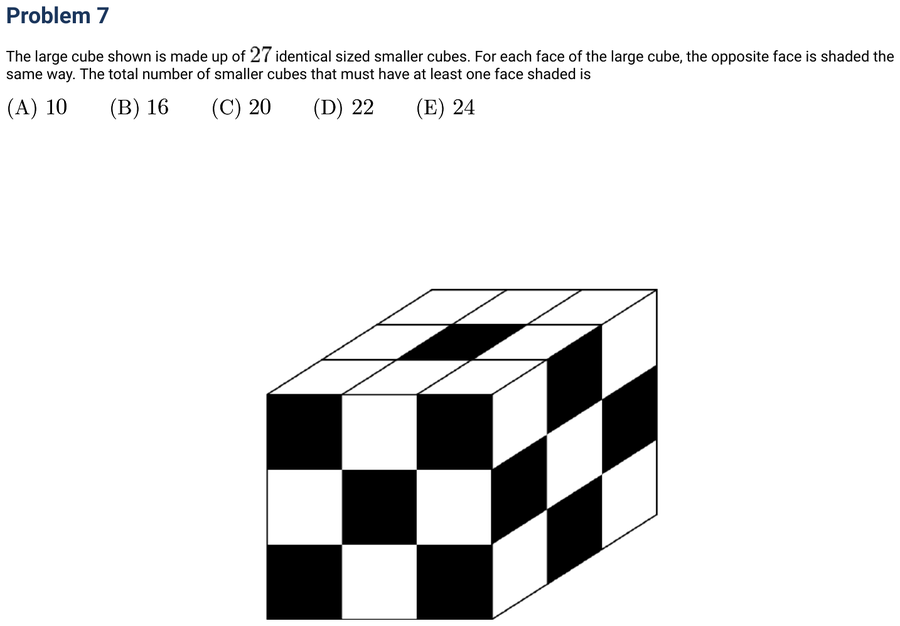
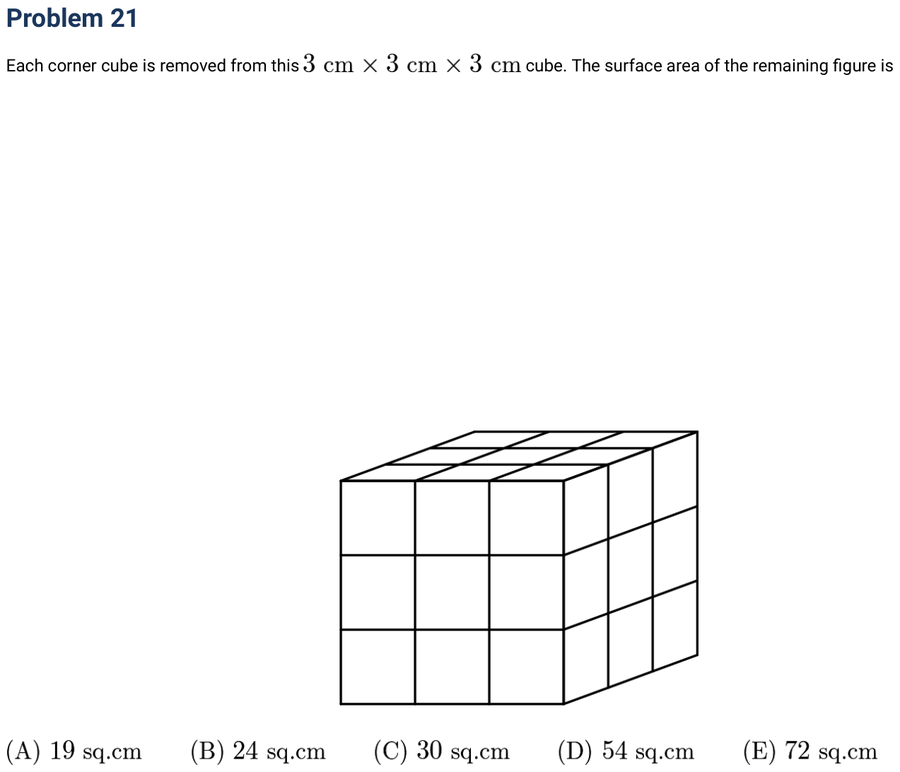
Group the 27 small cubes by where they sit: 8 corners, 12 edges, 6 face-centers, 1 internal.
Show hint (sharpest)
On each face, only the very center square sits at a face-center sub-cube — and only those (plus the internal cube) escape being shaded.
Show solution
Each face is shaded everywhere except its center square. So 8 corner sub-cubes and 12 edge sub-cubes each show at least one shaded square; only the 6 face-center sub-cubes and the 1 internal cube show none.
8 + 12 = 20 small cubes have at least one shaded face.
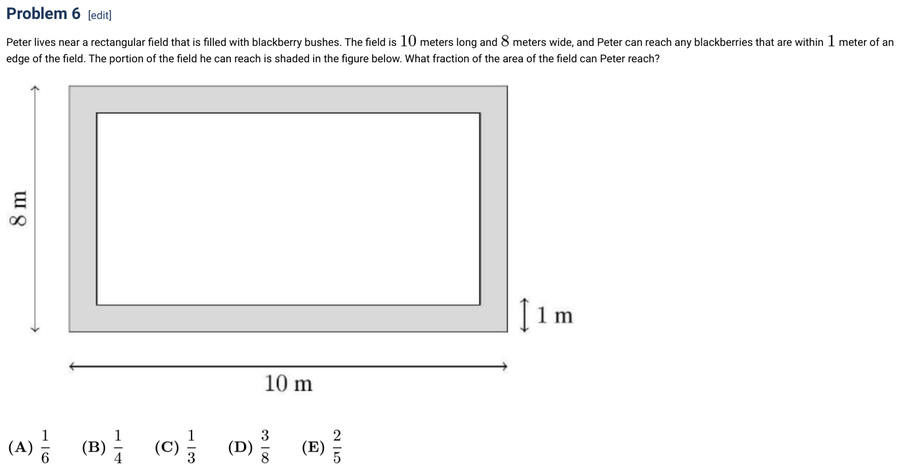
A picture 3 feet across is hung in the center of a wall that is 19 feet wide. How many feet from the end of the wall is the nearest edge of the picture?
Show hint
The leftover wall is split evenly on both sides of the picture.
Show solution
Leftover wall = 19 − 3 = 16 feet, split into two equal margins.
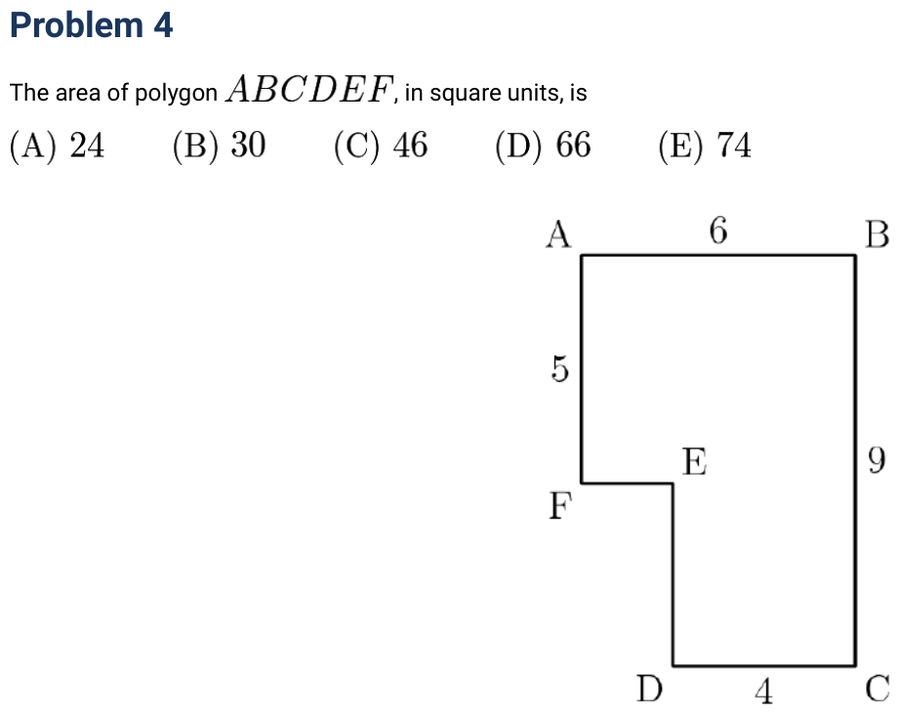
Inscribe the polygon in a 6-by-9 rectangle and subtract the missing notch.
Show hint (sharpest)
Notch is 2 wide × 4 tall.
Show solution
The shape fits inside a 6 × 9 = 54 rectangle. The notch removed is 2 × 4 = 8 (from AB length 6, FE = 6−4 = 2 wide, and AF = 5 minus the matching segment to the bottom run leaves a 4-tall step).
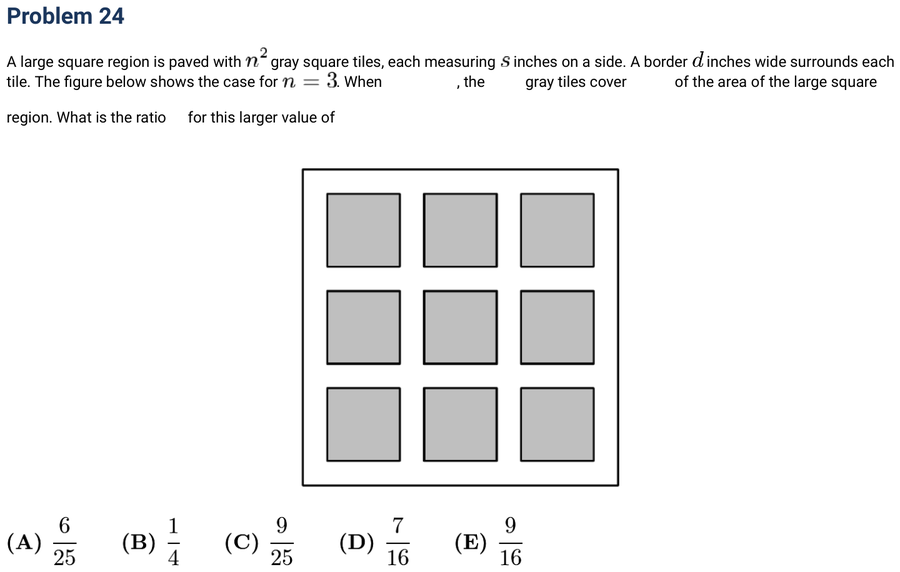
Set the large square's side to 1. Gray tiles cover 64% ⇒ total tile area = 64/100, so each tile is (64/100)/576 = (1/30)2. So each tile's side s = 1/30.
Show hint (sharpest)
Along a side: 24 tiles + 25 borders = 1. With 24/30 = 0.8 in tiles, the borders share 0.2 across 25 of them ⇒ d = 0.2/25.
Show solution
Total gray area as a fraction of the large square: 64% = (4/5)2. So each of 576 = 242 tiles has area (4/5)2 / 242 = (1/30)2.
So each tile's side s = 1/30 (with large side = 1).
Along a side: 24 tile widths + 25 border widths sum to 1: 24/30 + 25d = 1 ⇒ 25d = 6/30 = 1/5 ⇒ d = 1/125.
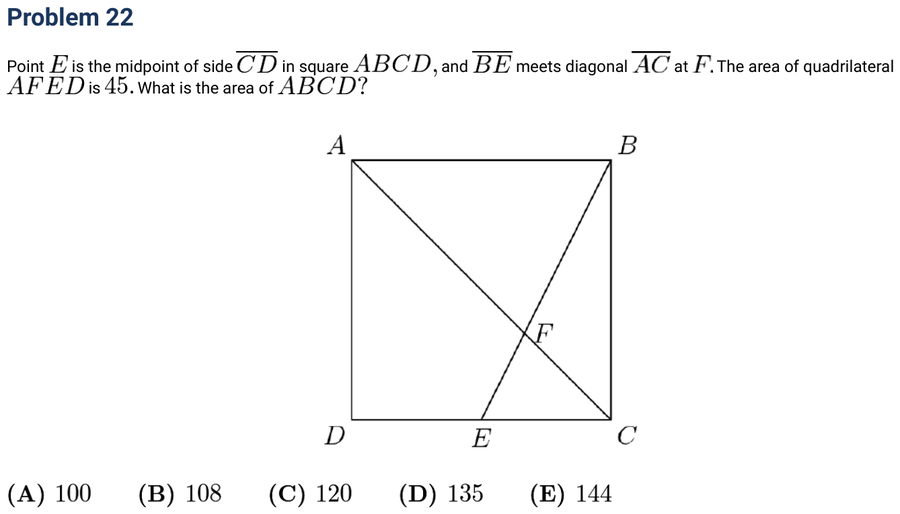
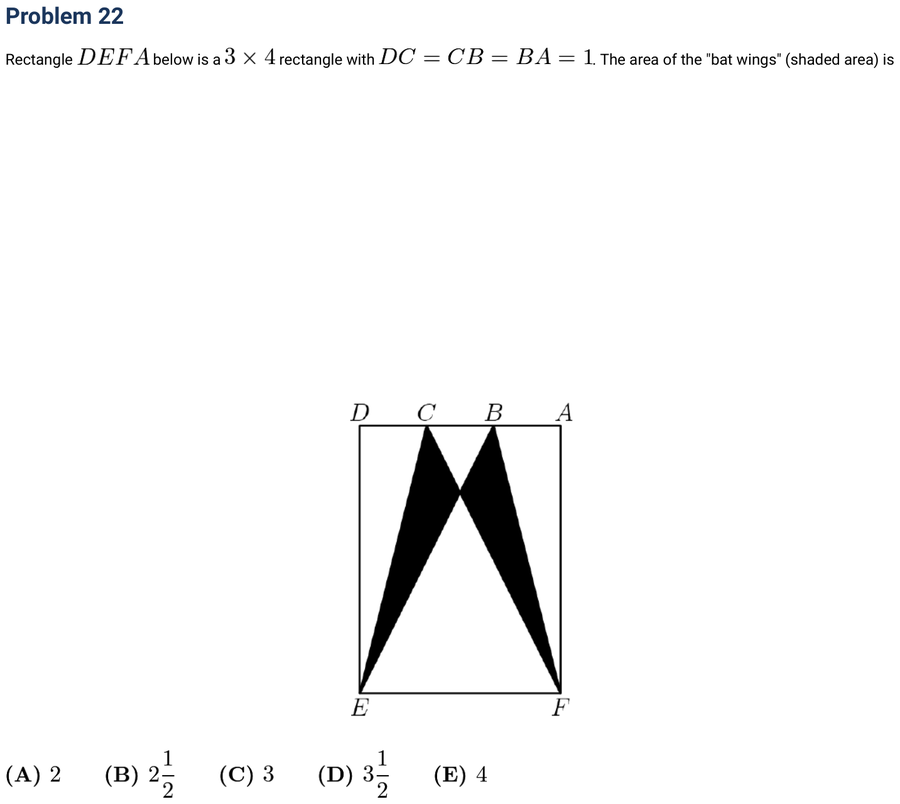
Use similar triangles. F lies on diagonal AC, where BE crosses it. The ratio AF:FC follows from the parallel sides.
Show hint (sharpest)
AB ∥ DE? No, but consider triangles ▵BFC and ▵EFA on the diagonal AC — they're similar with ratio AB:EC = 2:1. So AF/AC = 2/3.
Show solution
Let the square have side s. EC = s/2 (E midpoint of CD), and AB = s.
Triangles ▵AFB and ▵CFE share vertex F on diagonal AC, with AB ∥ EC. Similar with ratio AB : EC = 2 : 1, so AF : FC = 2 : 1, meaning F is 2/3 of the way from A to C.
Area of ▵CEF: take ▵BCE (area (s/2)·s/2 = s2/4) and subtract ▵BCF (similar argument). Net ▵CEF area = s2/12.
Two congruent circles centered at points A and B each pass through the other circle's center. The line containing both A and B is extended to intersect the circles at points C and D. The circles intersect at two points, one of which is E. What is the degree measure of ∠CED?
Show hint (soft nudge)
▵AEB is equilateral (all sides are radii). So ∠AEB = 60°.
Show hint (sharpest)
CA and BD are diameters of their circles, so the inscribed angles ∠CEA and ∠BED are 90° each.
Show solution
AE = EB = AB (all radii of congruent circles passing through each other's center) ⇒ ▵AEB equilateral, so ∠AEB = 60°.
CA is a diameter of the first circle, so the inscribed angle ∠CEA = 90°. Similarly ∠BED = 90°.
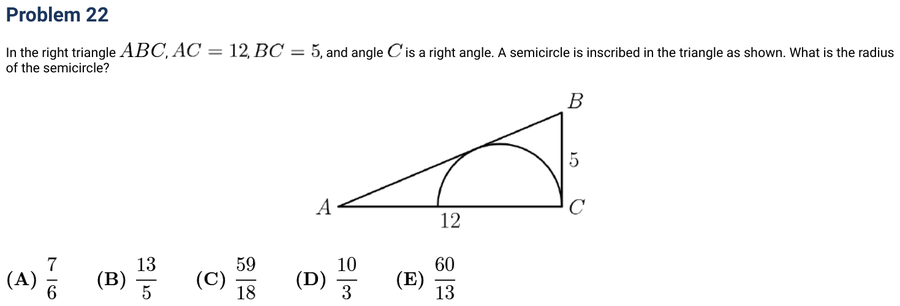
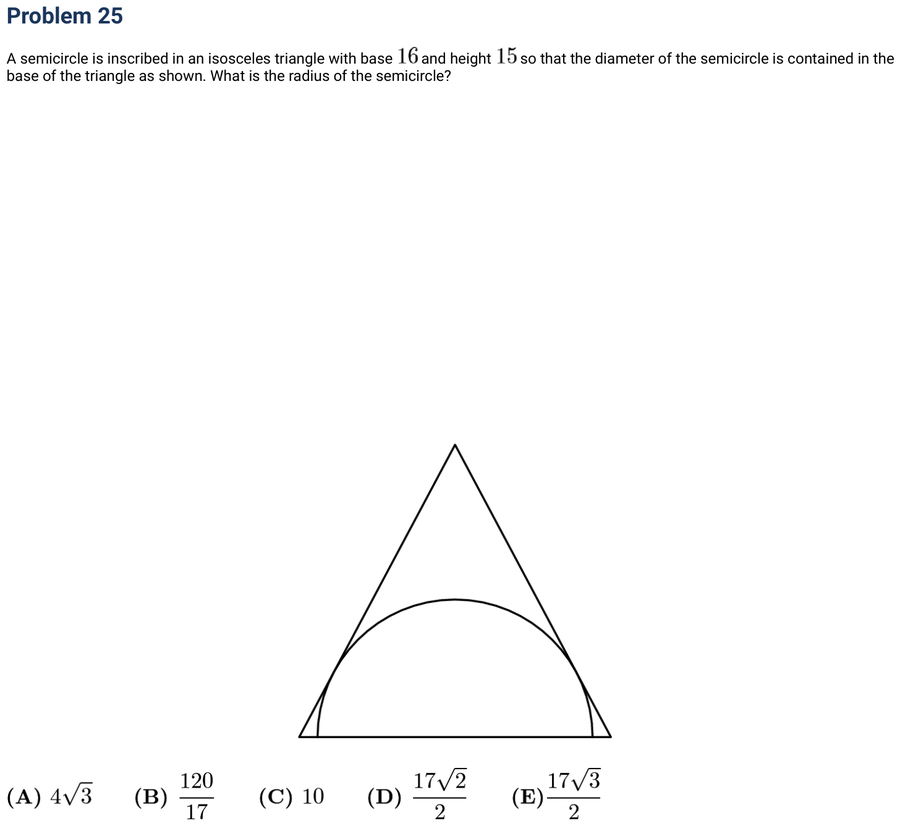
The slant side of the triangle is tangent to the semicircle, so its distance from the semicircle's center equals the radius.
Show hint (sharpest)
Slant length: half-base 8 + height 15 → an 8-15-17 right triangle. The slant line is 17 long; use the distance-from-point formula.
Show solution
The center of the semicircle is the midpoint of the base. By symmetry, both slant sides are tangent to the semicircle, so the perpendicular distance from the center to a slant side equals the radius.
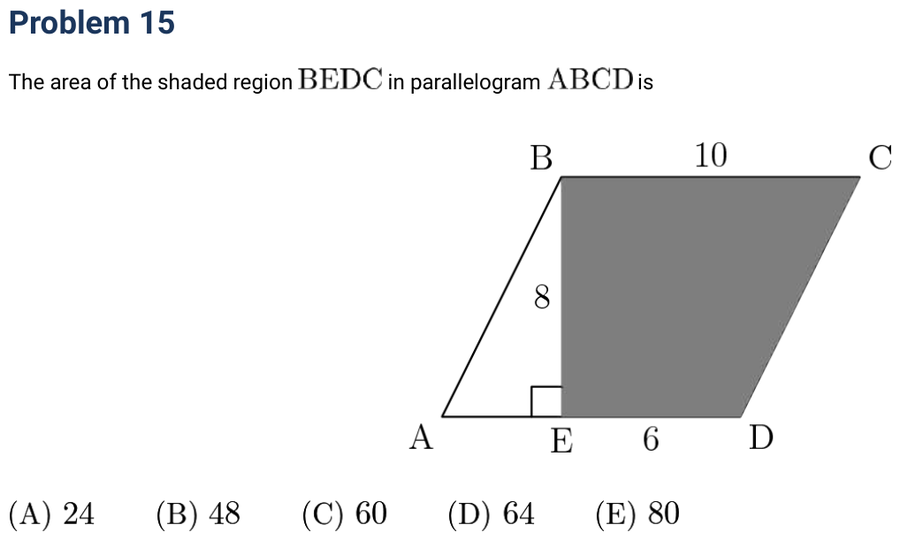
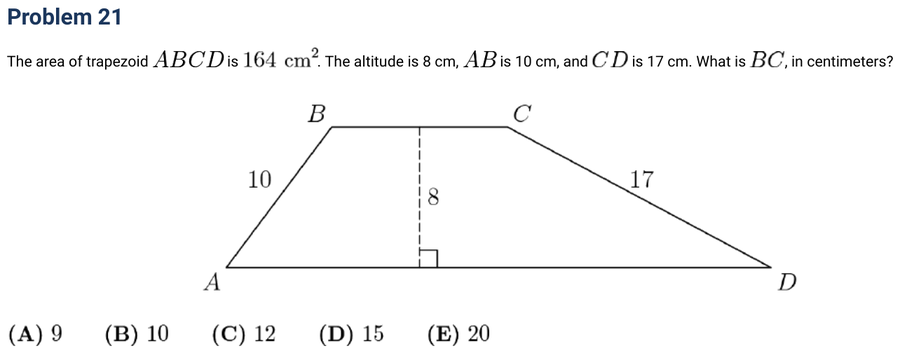
Drop perpendiculars from the short side down to the long side — the two slanted legs become familiar right triangles.
Show hint (sharpest)
The 10-8 and 17-8 legs hint at the 6-8-10 and 8-15-17 triples; that tells you how much the bottom overhangs the top.
Show solution
Drop perpendiculars from B and C to the long side AD. The legs give right triangles: AB = 10 with height 8 leaves a base of 6 (a 6-8-10 triangle), and CD = 17 with height 8 leaves 15 (an 8-15-17 triangle).
So AD = BC + 6 + 15 = BC + 21.
Area: ½(BC + AD)(8) = 164, so BC + AD = 41.
Then BC + (BC + 21) = 41, giving 2·BC = 20, so BC = 10.
Points R, S, and T are vertices of an equilateral triangle, and points X, Y, and Z are midpoints of its sides. How many noncongruent triangles can be drawn using any three of these six points as vertices?
Show hint (soft nudge)
Many of the small triangles are just rotations or reflections of one another — count distinct shapes, not positions.
Show hint (sharpest)
By symmetry, every triangle you can form matches one found in half of the figure.
Show solution
Choosing 3 of the 6 points gives many triangles, but rotations and reflections make most of them congruent, so only distinct shapes count.
There are exactly four shapes: the big equilateral RST; a small equilateral like XYZ; a 30-60-90 right triangle like R-T-Z (two corners and a midpoint); and an obtuse isosceles like R-X-Z (a corner and two midpoints).
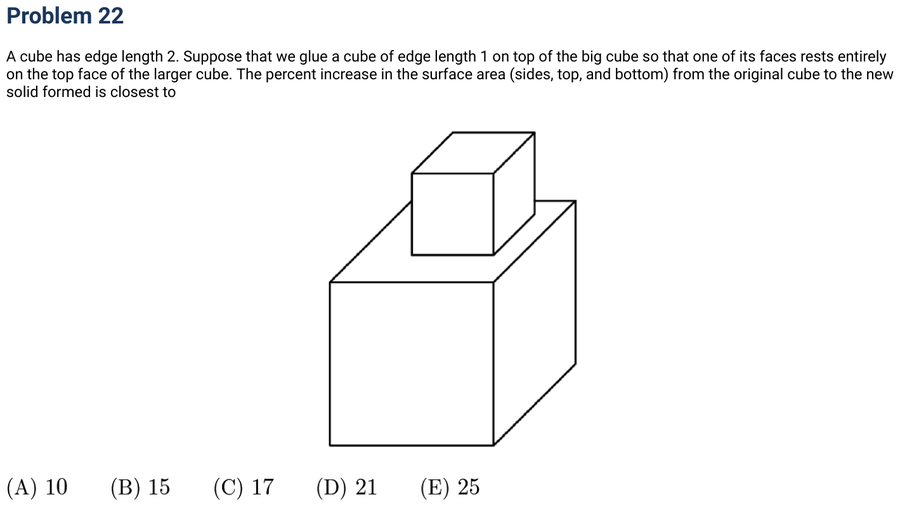
The little cube hides part of the big top, but its own top covers exactly that hidden patch — so what area is genuinely new?
Show hint (sharpest)
Only the four side walls of the small cube add surface; the top is a wash.
Show solution
The original cube's surface area is 6 · 2² = 24.
The small cube hides a 1 × 1 patch of the big top, but its own top sits directly above that patch, so the upward-facing area is unchanged. Only its 4 side walls are new, adding 4.
The increase is 4 / 24 = ⅙ ≈ 16.7%, closest to 17%.
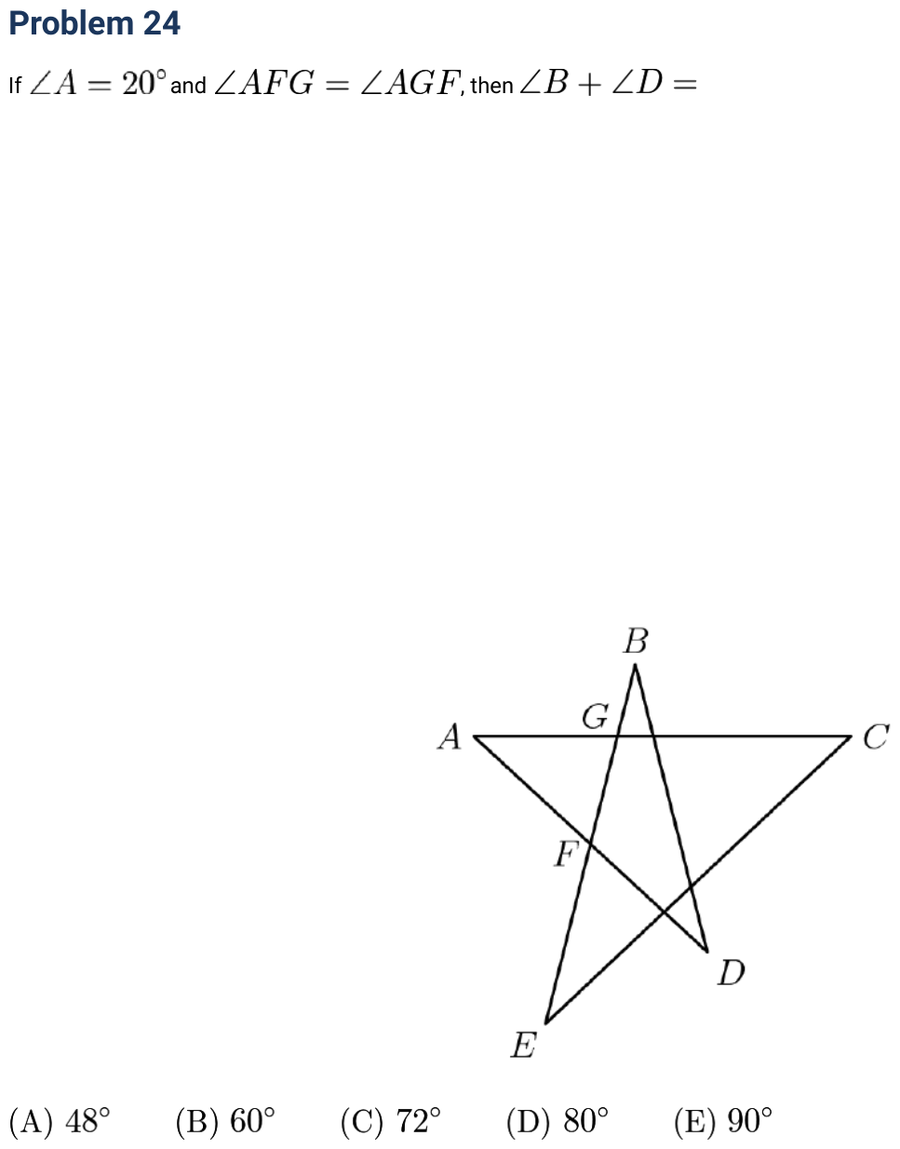
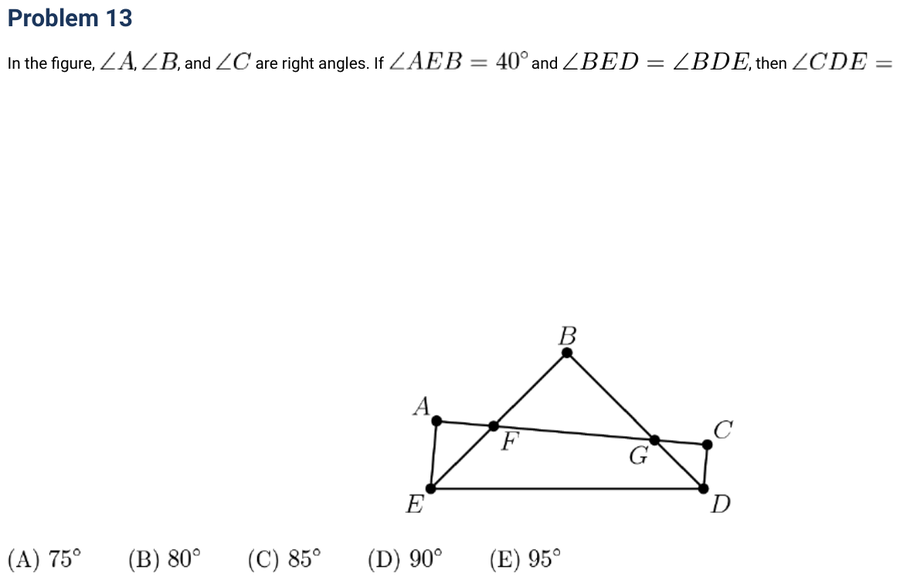
Triangle AFG is isosceles with apex angle A — that pins both of its base angles.
Show hint (sharpest)
The base angle at F is the exterior angle of triangle BFD, so it already equals ∠B + ∠D.
Show solution
In triangle AFG the apex ∠A = 20° and the two base angles are equal, so each is (180° − 20°) / 2 = 80°.
Lines AD and BE cross at F, so ∠AFG is the exterior angle of triangle BFD at F. An exterior angle equals the sum of the two remote angles, which here are exactly ∠B and ∠D.
Therefore ∠B + ∠D = 80°.
D
80°.
Another way: supplement, then angle sum (as MAA presents it)
From the isosceles triangle, ∠AFG = 80°, so the angle inside triangle BFD at F is its supplement, 180° − 80° = 100°.
The angles of triangle BFD sum to 180°, so ∠B + ∠D = 180° − 100° = 80°.
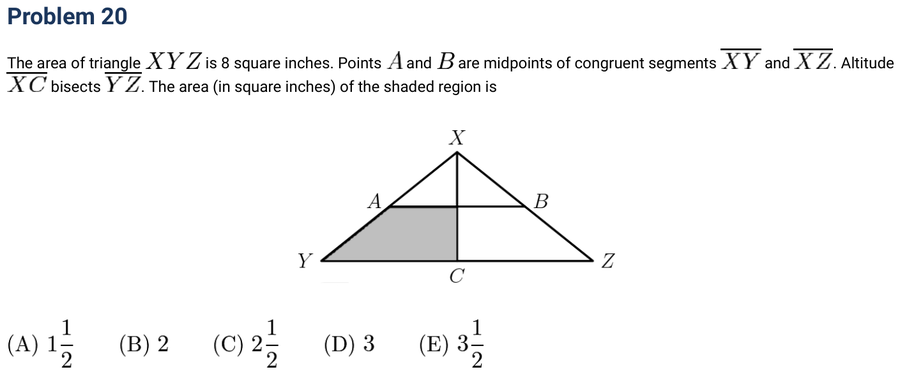
The area of rectangle ABCD is 72. If point A and the midpoints of sides BC and CD are joined to form a triangle, the area of that triangle is
Show hint (soft nudge)
Slice the triangle out by removing the three right triangles in the corners — each is a clean fraction of the whole rectangle.
Show hint (sharpest)
Two corners take a quarter each and the third takes an eighth; whatever's left is the answer.
Show solution
The triangle is what remains after cutting off the three corner right triangles. Measured against the whole rectangle, the ones at corners B and D are ¼ each (a full side and a half-side as legs), and the one at corner C is ⅛ (two half-sides).
Together the corners take ¼ + ¼ + ⅛ = ⅝ of the rectangle, leaving ⅜.
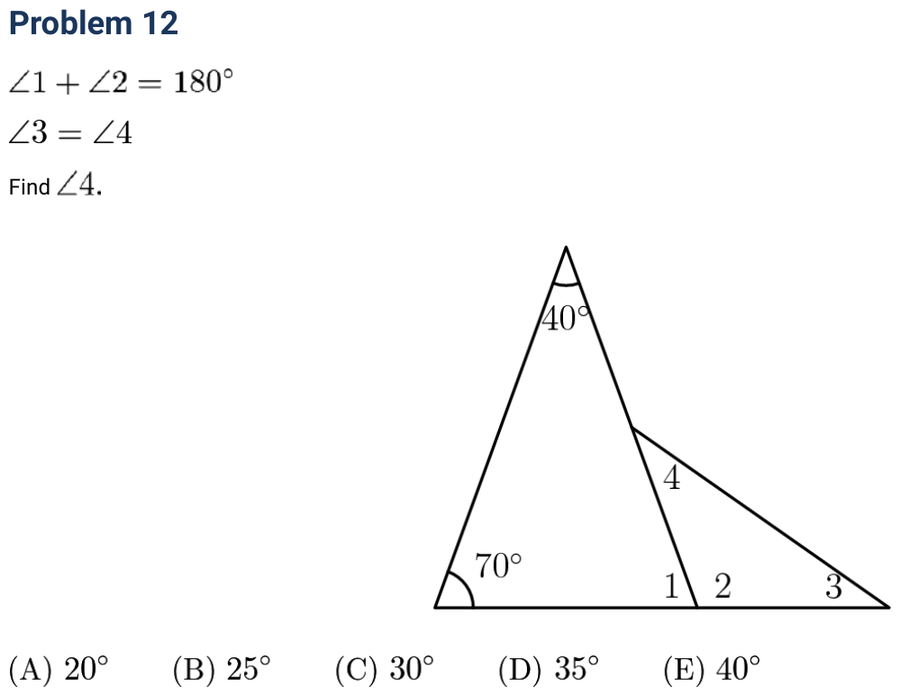
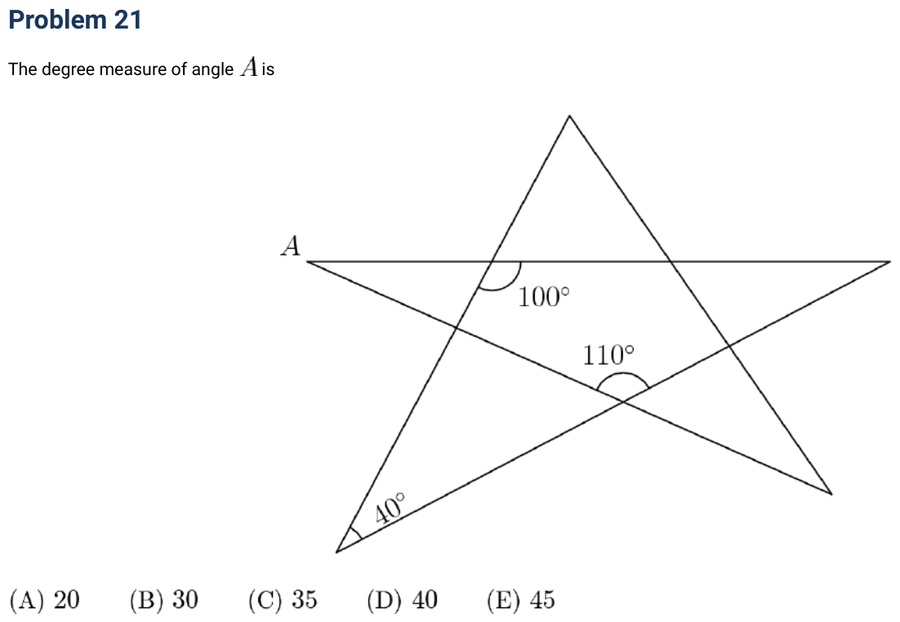
Each marked angle has a supplement along its line — start by finding those.
Show hint (sharpest)
Chase through the small triangles, using vertical angles where lines cross, until you reach A.
Show solution
The 100° and 110° marks have supplements 80° and 70° along their lines.
In the triangle holding the 40° tip and that 70°, the third angle is 180° − 70° − 40° = 70°, and its vertical angle at the crossing near A is also 70°.
A point is chosen at random from within a circular region. What is the probability that the point is closer to the center of the region than it is to the boundary of the region?
Show hint (soft nudge)
A point at distance r from the center is r from the center and R − r from the boundary.
Show hint (sharpest)
Closer to the center means r < R − r, i.e. r < R/2.
Show solution
Being closer to the center than the boundary means r < R − r, so r < R/2 — the point lies in the inner circle of radius R/2.
Its area is a fraction (R/2)² / R² = 1/4 of the whole.
A checkerboard consists of one-inch squares. A square card, 1.5 inches on a side, is placed on the board so that it covers part or all of the area of each of n squares. The maximum possible value of n is
Show hint (soft nudge)
Don't keep the card lined up with the grid — tilt it.
Show hint (sharpest)
A tilted card pokes its corners into many extra squares.
Show solution
Lined up, the 1.5-inch card touches only up to a 3 × 3 block (9 squares).
But tilting it lets its corners reach into still more squares, so it can cover 12 or more.
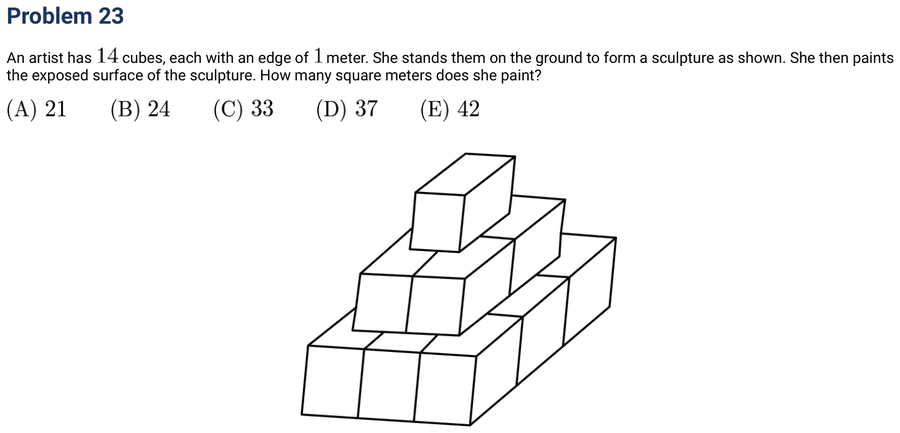
Each cube face is 1 m². Count only the faces that are visible — none of those touching the ground or another cube.
Show hint (sharpest)
Sum the exposed faces from the top, front, back, left, right; faces hidden by neighbors don't count.
Show solution
Top faces (one per cube whose top isn't covered) total 10. Front-facing exposed faces total 6, back 6, and the two side walls together account for the remaining 11.
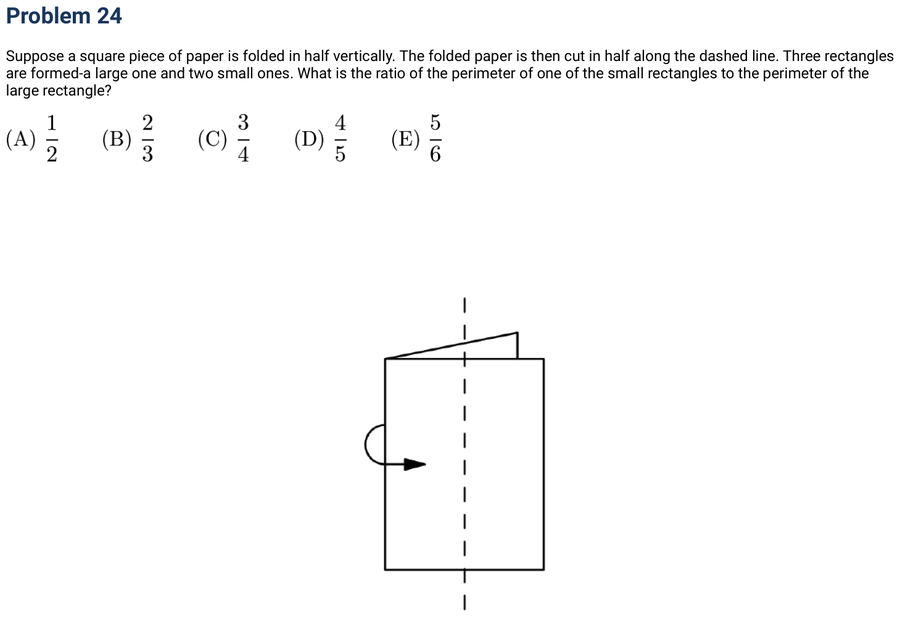
Pick a convenient side length for the square (say 4) so the pieces have whole-number sides.
Show hint (sharpest)
The cut parallel to the fold leaves the fold-side as one rectangle; the open side falls apart into two.
Show solution
Take the square 4 × 4. Folding halves the width to a 2 × 4 stack; cutting it in half parallel to the fold means the cut sits at 1 from the fold. The fold-side unfolds back into one 2 × 4 large rectangle; the open side becomes two separate 1 × 4 small rectangles.
Small perimeter 2(1 + 4) = 10, large perimeter 2(2 + 4) = 12, ratio 10⁄12 = 5⁄6.
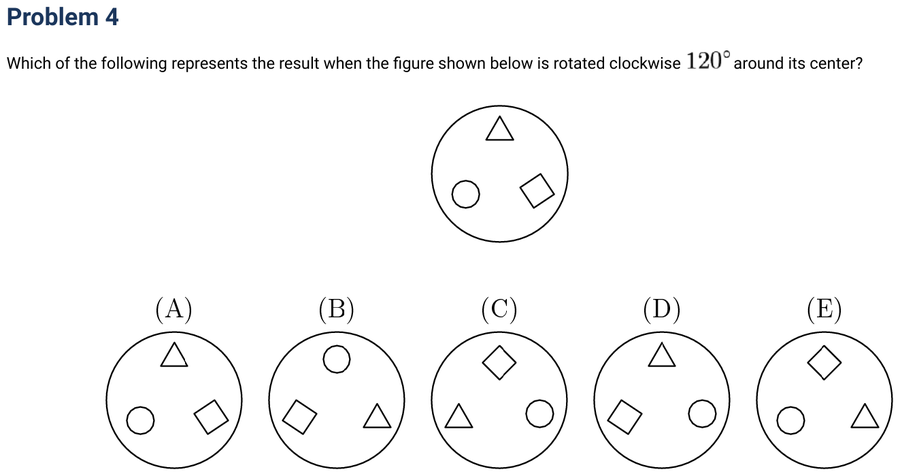
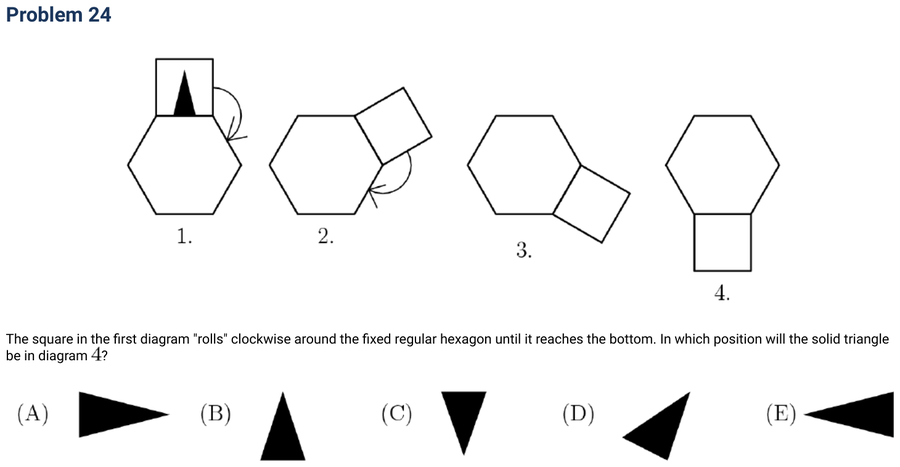
When a square rolls around a hexagon's corner, it pivots through the hexagon's exterior angle.
Show hint (sharpest)
Total rotation from position 1 to position 4 = 3 × 60° = 180°.
Show solution
Each pivot at a hexagon corner rotates the square by the exterior angle 60°. Three pivots take it from the top to the bottom, so the square has rotated 3 × 60° = 180° clockwise.
Rotating the original triangle by 180° gives the orientation in choice A.