Logic & Word Problemsageswork-backwardsum-constraint
Anna and Bella are celebrating their birthdays together. Five years ago, when Bella turned 6 years old, she received a newborn kitten as a birthday present. Today the sum of the ages of the two children and the kitten is 30. How many years older than Bella is Anna?
Show hint (soft nudge)
Don't solve for ages directly — figure out who is how old today first.
Show hint (sharpest)
Work out each one's age today first. Bella was 6 five years ago; the kitten was newborn five years ago. The leftover part of 30 is Anna's age.
Show solution
Bella today: 6 + 5 = 11. Kitten today: 0 + 5 = 5.
The three ages sum to 30, so Anna = 30 − 11 − 5 = 14.
Students Arn, Bob, Cyd, Dan, Eve, and Fon are arranged in that order in a circle. They start counting: Arn first, then Bob, and so forth. When the number contains a 7 as a digit (such as 47) or is a multiple of 7 that person leaves the circle and the counting continues. Who is the last one present in the circle?
Show hint (soft nudge)
List the early 'bad' numbers: 7, 14, 17, 21, 27, 28, 35, … Track who lands on each as the circle shrinks.
Show hint (sharpest)
After each elimination, continue counting from the next person in the shrunken circle.
Show solution
Counts that eliminate: 7, 14, 17, 21, 27, 28, … (7 itself, 14, multiples of 7, or any number with a 7 digit).
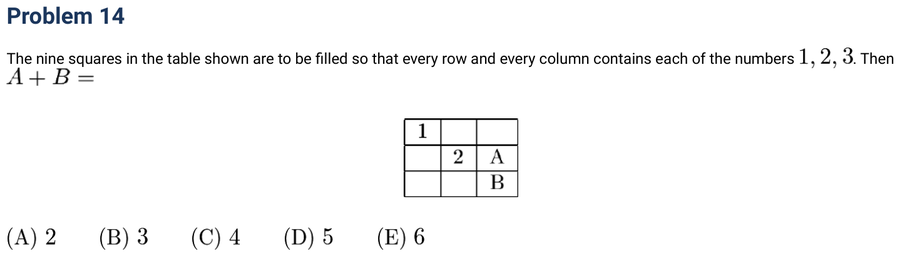
To complete the grid below, each of the digits 1 through 4 must occur once in each row and once in each column. What number will occupy the lower right-hand square?
Show hint
Column 4 already has a 4. Row 1 col 4 must be 3 (not 4, not 1 or 2 elsewhere). Then row 2 col 4 must be 1. So col 4 needs a 2 in row 4.
Show solution
Column 4 already contains 4 in row 3. Row 1's missing digits are 3 and 4 (col 2 and col 4), and col 4 can't take 4 ⇒ row 1 col 4 = 3.
Row 2 needs 1 and 4 in cols 3 and 4. Col 4 can't take 4 ⇒ row 2 col 4 = 1.
A five-legged Martian has a drawer full of socks, each of which is red, white or blue, and there are at least five socks of each color. The Martian pulls out one sock at a time without looking. How many socks must the Martian remove from the drawer to be certain there will be 5 socks of the same color?
Show hint
Worst case: 4 of each color (12 socks) without yet getting 5 of one color.
Show solution
After 12 socks, possible to have 4 red, 4 white, 4 blue (no color has 5).
Ms. Hamilton's eighth-grade class wants to participate in the annual three-person-team basketball tournament. The losing team of each game is eliminated from the tournament. If sixteen teams compete, how many games will be played to determine the winner?
Show hint
Each game eliminates exactly one team. 15 must be eliminated.
Show solution
Need 15 teams eliminated (everyone except the winner).
Logic & Word Problemswork-backwardcareful-counting
Each principal of Lincoln High School serves exactly one 3-year term. What is the maximum number of principals this school could have during an 8-year period?
Show hint (soft nudge)
Line the terms up so a changeover happens as early and as late in the 8 years as possible.
Show hint (sharpest)
Start mid-term and end mid-term to squeeze in extra principals.
Show solution
Let year 1 be the last year of one principal's term. Two full 3-year terms then fill years 2–7.
A fourth principal starts in year 8, for 4 principals.
Bo, Coe, Flo, Jo, and Moe have different amounts of money. Neither Jo nor Bo has as much money as Flo. Both Bo and Coe have more than Moe. Jo has more than Moe, but less than Bo. Who has the least amount of money?
Show hint (soft nudge)
You don't need the full ranking — just find who everyone beats.
Show hint (sharpest)
Every clue that names Moe places someone above him.
Show solution
Bo, Coe, and Jo are each said to have more than Moe, and Flo has more than Bo, so Flo beats Moe too.
In a tournament there are six teams that play each other twice. A team earns 3 points for a win, 1 point for a draw, and 0 points for a loss. After all the games have been played it turns out that the top three teams earned the same number of total points. What is the greatest possible number of total points for each of the top three teams?
Show hint (soft nudge)
Maximize top 3 by having them sweep the bottom 3.
Show hint (sharpest)
Each top team plays 6 games vs the bottom 3 (3 opponents × 2 games), earning 6 × 3 = 18 points. Among themselves, balance wins.
Show solution
Have each top-3 team win all 6 of its games against the bottom 3 (3 opponents × 2 games each) → 6 × 3 = 18 points per top team.
Among the top 3, each pair plays twice. To tie all three, give each pair a 1-win, 1-loss split — each team in a pair gains 3 points (one win) and loses 3 points worth (one loss = 0).
Each top team is in 2 pairs and wins one game in each → +3 + 3 = 6 more points.
Peter, Emma, and Kyler played chess with each other. Peter won 4 games and lost 2 games. Emma won 3 games and lost 3 games. If Kyler lost 3 games, how many games did he win?
Show hint
Every game has one winner and one loser, so total wins across all players = total losses.
In an All-Area track meet, 216 sprinters enter a 100-meter dash competition. The track has 6 lanes, so only 6 sprinters can compete at a time. At the end of each race, the five non-winners are eliminated, and the winner will compete again in a later race. How many races are needed to determine the champion sprinter?
Show hint
Don't count races by tracking winners. Count eliminations: each race eliminates exactly 5 sprinters.
Show solution
To leave one champion, 215 sprinters must be eliminated.
Each race eliminates 5, so number of races = 215 / 5 = 43.
Three members of the Euclid Middle School girls' softball team had the following conversation. Ashley: I just realized that our uniform numbers are all 2-digit primes. Bethany: And the sum of your two uniform numbers is the date of my birthday earlier this month. Caitlin: That's funny. The sum of your two uniform numbers is the date of my birthday later this month. Ashley: And the sum of your two uniform numbers is today's date. What number does Caitlin wear?
Show hint (soft nudge)
All three pairwise sums of the uniform numbers are dates (1–31), so the three primes are small two-digit primes. List candidates.
Show hint (more)
Pairwise sums ≤ 31 force the primes to be in {11, 13, 17, 19}. Find a triple whose three pairwise sums are all distinct.
Show hint (sharpest)
Then Bethany's date is the smallest sum (earlier in the month), Caitlin's is the largest (later), today is between.
Show solution
Each pairwise sum is a date 1–31, so each is ≤ 31. Two-digit primes: 11, 13, 17, 19, 23, 29. Pairs that sum to ≤ 31: only those from {11, 13, 17, 19} (any pair including 23 or 29 exceeds 31 for the larger sums).
Among the triples in {11, 13, 17, 19} we need three distinct pairwise sums. {11, 13, 17}: 24, 28, 30 — distinct. ✓
Bethany's birthday = smallest sum = 24, so Ashley + Caitlin = 24 ⇒ {A, C} = {11, 13}.
Caitlin's birthday = largest sum = 30, so Ashley + Bethany = 30 ⇒ {A, B} = {13, 17}.
Ashley is in both sets, so Ashley = 13. Then Caitlin = 11, Bethany = 17. Today = Bethany + Caitlin = 28 (between 24 and 30 — consistent).
One day the Beverage Barn sold 252 cans of soda to 100 customers, and every customer bought at least one can of soda. What is the maximum possible median number of cans of soda bought per customer on that day?
Show hint (soft nudge)
Order the counts smallest to largest. Median = average of 50th and 51st values. To make those big, push the first 49 down to the minimum (which is 1).
Show hint (more)
After setting the first 49 to 1, 203 cans remain for 51 customers; each from 51st onward must be ≥ 51st value.
Show hint (sharpest)
Let 50th = a, 51st = b, with a ≤ b. Make the last 50 all equal to b. Constraint: a + 50b ≤ 203.
Show solution
Set customers 1–49 to 1 can each: uses 49 cans, leaves 252 − 49 = 203 for the last 51.
Let the 50th value be a and the 51st value be b (a ≤ b). Make customers 51–100 all equal to b: total of last 51 = a + 50b ≤ 203.
Maximize (a + b)/2 over integers with a ≤ b. Try b = 4: a + 200 ≤ 203 ⇒ a ≤ 3, so a = 3 (still ≤ b). Median = (3 + 4)/2 = 3.5.
Try b = 5: a + 250 ≤ 203 — impossible. So 3.5 is the max.
A certain calculator has only two keys [+1] and [×2]. When you press one of the keys, the calculator automatically displays the result. For instance, if the calculator originally displayed "9" and you pressed [+1], it would display "10." If you then pressed [×2], it would display "20." Starting with the display "1," what is the fewest number of keystrokes you would need to reach "200"?
Show hint (soft nudge)
Work backwards. If the current number is even, the last move was likely ×2 (divide by 2). If odd, the last was +1 (subtract 1).
Show hint (sharpest)
Each step backwards corresponds to one keystroke forward.
Five friends compete in a dart-throwing contest. Each one has two darts to throw at the same circular target, and each individual's score is the sum of the scores in the target regions that are hit. The scores for the target regions are the whole numbers 1 through 10. Each throw hits the target in a region with a different value. The scores are: Alice 16, Ben 4, Cindy 7, Dave 11, Ellen 17. Who hits the region worth 6 points?
Show hint
Each region is used exactly once. Start with the smallest score (Ben = 4): the only pair from 1–10 is {1, 3}.
Show solution
Ben (4): only 1 + 3.
Cindy (7): from remaining digits {2, 4, 5, 6, 7, 8, 9, 10}, the only pair is 2 + 5.
Dave (11): only 4 + 7.
Remaining for Alice and Ellen: {6, 8, 9, 10}. Alice 16 = 6 + 10. Ellen 17 = 8 + 9.
In this addition problem, each letter stands for a different digit.
    T W O
  + T W O
  -------
  F O U R
If T = 7 and the letter O represents an even number, what is the only possible value for W?
Show hint (soft nudge)
Two 3-digit numbers add to a 4-digit number, so F must be 1.
Show hint (sharpest)
Look at the hundreds column with T = 7: it forces O to be 4 or 5, and "O is even" picks one.
Show solution
Two 3-digit numbers sum to the 4-digit number FOUR, so the leading carry makes F = 1.
Hundreds column: 7 + 7 = 14 (plus any carry from the tens) makes the hundreds digit O equal to 4 or 5; since O is even, O = 4, and nothing carried out of the tens.
Units: 4 + 4 = 8 gives R = 8 with no carry, so the tens column is simply W + W = U, again with no carry.
So 2W = U must stay below 10 and avoid the digits already used (7, 1, 4, 8): W = 3 gives U = 6, the only option. W = 3.
The six children listed below are from two families of three siblings each. Each child has blue or brown eyes and black or blond hair. Children from the same family have at least one of these characteristics in common. Which two children are Jim's siblings?
Child
Eye Color
Hair Color
Benjamin
Blue
Black
Jim
Brown
Blond
Nadeen
Brown
Black
Austin
Blue
Blond
Tevyn
Blue
Black
Sue
Blue
Blond
Show hint (soft nudge)
Write down Jim's two traits, then see who could even be in his family.
Show hint (sharpest)
Three of the other children share one trait among themselves — that locks in both families.
Show solution
Jim has brown eyes and blond hair, so a sibling must share one of those: only Nadeen (brown eyes), Austin (blond), or Sue (blond) qualify.
But Benjamin, Nadeen, and Tevyn all have black hair, so those three already form a valid family.
That forces Jim's family to be Jim, Austin, and Sue (all blond) — his siblings are Austin and Sue.
Last summer 100 students attended basketball camp. Of those, 52 were boys and 48 were girls. Also, 40 students were from Jonas Middle School and 60 were from Clay Middle School. Twenty of the girls were from Jonas Middle School. How many of the boys were from Clay Middle School?
Show hint (soft nudge)
Make a boys/girls by Jonas/Clay table and fill it in.
Show hint (sharpest)
Find the Clay girls first, then the Clay boys.
Show solution
Girls from Clay = 48 − 20 = 28.
Clay has 60 students, so boys from Clay = 60 − 28 = 32.
Abby, Bret, Carl, and Dana are seated in a row of four seats numbered #1 to #4. Joe looks at them and says:
"Bret is next to Carl."
"Abby is between Bret and Carl."
However each one of Joe's statements is false. Bret is actually sitting in seat #3. Who is sitting in seat #2?
Show hint (soft nudge)
Both statements are false — turn each one into a 'not'.
Show hint (sharpest)
If Bret (#3) and Carl aren't adjacent, Carl must be in seat #1.
Show solution
Bret is in #3, and "Bret next to Carl" is false, so Carl isn't in #2 or #4 — Carl is in #1. Then "Abby between Bret and Carl" being false rules Abby out of #2, the only spot strictly between them.
Five runners finished a race: Luke, Melina, Nico, Olympia, and Pedro. Nico finished 11 minutes behind Pedro. Olympia finished 2 minutes ahead of Melina but 3 minutes behind Pedro. Olympia finished 6 minutes ahead of Luke. Which runner finished fourth?
Show hint (soft nudge)
Place everyone on a timeline measured from Pedro.
Show hint (sharpest)
Then read off who is fourth from the front.
Show solution
Measuring minutes behind Pedro: Olympia +3, Melina +5 (2 behind Olympia), Luke +9 (6 behind Olympia), Nico +11.
The order is Pedro, Olympia, Melina, Luke, Nico, so fourth is Luke.
Aaron, Darren, Karen, Maren, and Sharon rode on a small train that has five cars that seat one person each. Maren sat in the last car. Aaron sat directly behind Sharon. Darren sat in one of the cars in front of Aaron. At least one person sat between Karen and Darren. Who sat in the middle car?
Show hint (soft nudge)
Place the fixed constraints first: Maren is in car 5; Sharon→Aaron is a glued-together pair; Darren is somewhere ahead of Aaron.
Show hint (sharpest)
Try Sharon−Aaron in cars 2−3, then 3−4. The 2−3 case fails (no room for Darren ahead of Aaron with Karen ge 2 apart); 3−4 forces Darren in 1, Karen in 4 — wait that's Aaron. Recheck.
Show solution
Maren is in car 5. Place the Sharon−Aaron pair (S in car k, A in k+1) and have Darren somewhere strictly less than k+1.
S, A in cars 1, 2: Darren must be ahead of car 2 — only car 1, taken. Fail.
S, A in cars 2, 3: Darren must be in car 1. Karen in car 4. But Karen (4) and Darren (1) have cars 2, 3 (Sharon, Aaron) between them — 2 people between — satisfies "at least one" constraint. Configuration: Darren, Sharon, Aaron, Karen, Maren. Middle car = Aaron.
S, A in cars 3, 4: Darren must be in car 1 or 2. Karen fills the other, and they'd be in cars 1 and 2 with no one between — fails the spacing rule.
Only the middle case works: Aaron sits in the middle car.
Bridget, Cassie, and Hannah are discussing the results of their last math test. Hannah shows Bridget and Cassie her test, but Bridget and Cassie don't show theirs to anyone. Cassie says, 'I didn't get the lowest score in our class,' and Bridget adds, 'I didn't get the highest score.' What is the ranking of the three girls from highest to lowest score?
Show hint
Both Cassie and Bridget saw Hannah's score. Why can each be sure of her own ranking only after seeing Hannah's?
Show solution
Cassie's claim is only certain if her score > Hannah's (otherwise Hannah's lower score below Cassie's could be the lowest, and Cassie wouldn't know). So Cassie > Hannah.
Bridget's claim is only certain if her score < Hannah's. So Hannah > Bridget.
Students guess that Norb's age is 24, 28, 30, 32, 36, 38, 41, 44, 47, and 49. Norb says, "At least half of you guessed too low, two of you are off by one, and my age is a prime number." How old is Norb?
Show hint (soft nudge)
"At least half too low" with 10 guesses means age > 5th-smallest guess = 36, so age ≥ 37.
Show hint (sharpest)
"Two off by one" means age is squeezed between two guesses that differ by 2. The only such pair above 36 is 36 and 38, or 47 and 49.
Show solution
Sorted guesses: 24, 28, 30, 32, 36, 38, 41, 44, 47, 49. "At least half too low" ⇒ age > 36.
"Two are off by one" ⇒ age sits between two guesses 2 apart. Candidates: 37 (between 36 and 38) or 48 (between 47 and 49).
Using only pennies, nickels, dimes, and quarters, what is the smallest number of coins Freddie would need so he could pay any amount of money less than a dollar?
Show hint (soft nudge)
Greedy: start with pennies (need 4 to cover 1–4 cents), then nickels, dimes, quarters — one of each value up to the next.
Show hint (sharpest)
After 4 pennies + 1 nickel, you can pay anything up to 9 cents. Each new coin should extend the reachable range as much as possible.
Tiles I, II, III and IV are translated so one tile coincides with each of the rectangles A, B, C and D. In the final arrangement, the two numbers on any side common to two adjacent tiles must be the same. Which of the tiles is translated to Rectangle C?
Show hint (soft nudge)
Look for unique numbers that anchor placement. Tile III is the only tile with 0 and 5 ⇒ it must be on an edge of the arrangement and matched accordingly.
Show hint (sharpest)
Then match adjacent tiles by their shared edge numbers.
Show solution
Tile III is the only tile with 0 and 5. These numbers must be on the outer perimeter (no other tile has them). The arrangement forces III into rectangle D.
Tile IV's left edge (9) matches III's right edge (5)? No — check edges. By matching: IV's edges (top 2, right 1, bottom 6, left 9) match III's (top 7, right 5, bottom 0, left 1) where IV's left 9 ... actually the matching is best traced from LIVE: IV ends up in rectangle C.
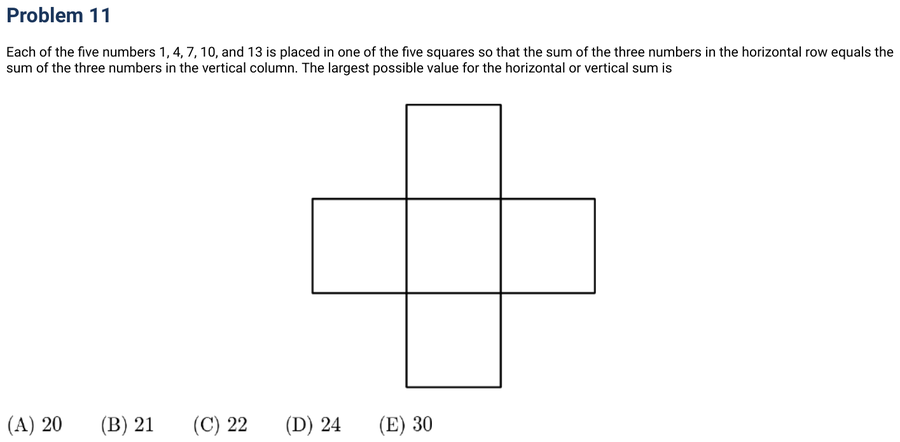
The numbers −2, 4, 6, 9 and 12 are rearranged according to these rules: The largest isn't first, but it is in one of the first three places. The smallest isn't last, but it is in one of the last three places. The median isn't first or last. What is the average of the first and last numbers?
Show hint
Largest (12) and smallest (−2) and median (6) all cannot be the first or last. That leaves 4 and 9 for the endpoints.
Show solution
12 (largest) not first or last (must be in 2nd or 3rd). −2 (smallest) not last (4th or 3rd). 6 (median) not first or last.
First and last cannot be 12, −2, or 6, so they're 4 and 9.
Amy, Bill and Celine are friends with different ages. Exactly one of the following statements is true. I. Bill is the oldest. II. Amy is not the oldest. III. Celine is not the youngest. Rank the friends from the oldest to the youngest.
Show hint (soft nudge)
If I is true, II is also true (Bill oldest ⇒ Amy isn't); that's two trues, forbidden. So I is false.
Show hint (sharpest)
Then Bill is not oldest. If II is true (Amy not oldest), Celine must be oldest ⇒ III also true (since the youngest can't be the oldest); forbidden again.
Show solution
I true ⇒ II also true. Two trues forbidden ⇒ I false.
II true ⇒ Celine oldest, making III true. Forbidden ⇒ II false.
So III is the only true one and I, II are false. Bill not oldest (I false); Amy is oldest (II false). Then by III, Celine is not youngest, so Bill is youngest.
The integers 1 through 25 are arbitrarily separated into five groups of 5 numbers each. The median of each group is found, and M is the median of those five medians. What is the least possible value of M?
Show hint (soft nudge)
M is the 3rd-smallest of the five medians, so you want three groups with small medians.
Show hint (sharpest)
Each small median needs two even-smaller numbers beneath it, and small numbers are in limited supply.
Show solution
To make M small, three groups need small medians, each requiring two smaller numbers below it. Using 1–6 as those "below" numbers lets three groups have medians 7, 8, and 9, while the other two groups absorb the large numbers.
Trying for M = 8 fails: three medians ≤ 8 would need six distinct numbers below them all drawn from {1,…,5}, which isn't enough.
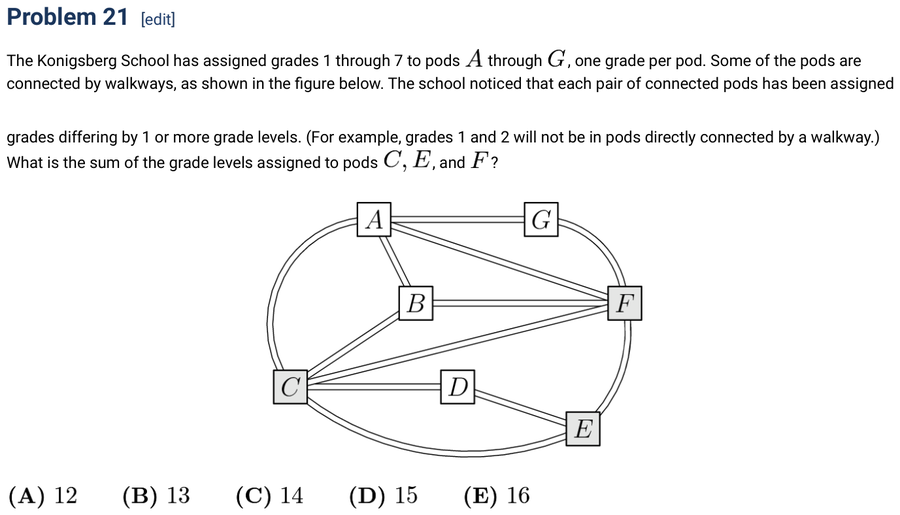
Look at the largest group of pods that are all directly connected to each other — their grades are forced into a small set.
Show hint (sharpest)
Pods A, B, C, F form a 4-clique. The only 4-element subset of {1,…,7} with every pair differing by at least 2 is {1, 3, 5, 7}.
Show solution
Among A, B, C, F every pair is directly connected, so all four pairs differ by ≥ 2. The only way to pick 4 numbers from 1–7 with that property is the set {1, 3, 5, 7}.
G connects to A and F. If G = 2, then A, F ≠ 1 or 3, forcing {A, F} ⊂ {5, 7} and {B, C} = {1, 3}.
D and E only touch C and F. The extreme grades 1 and 7 each have just one neighbor in this clique, so place 1 at C and 7 at F. The remaining {4, 6} go to D, E.
Filling in: D = 6 (avoids 7 enough), E = 4 (avoids 1 and 7), B = 3 (next to C = 1), A = 5. All constraints hold.
Kaleana shows her test score to Quay, Marty, and Shana, but the others keep theirs hidden. Quay thinks, "At least two of us have the same score." Marty thinks, "I didn't get the lowest score." Shana thinks, "I didn't get the highest score." List the scores from lowest to highest for Marty (M), Quay (Q), and Shana (S).
Show hint (soft nudge)
Quay can only see Kaleana's score — what must be true for him to be sure two scores match?
Show hint (sharpest)
That fixes Quay = Kaleana; then read Marty's and Shana's thoughts relative to Kaleana.
Show solution
Quay only knows Kaleana's score, so to be certain two match he must equal her: Q = K.
Marty isn't lowest, so M > K; Shana isn't highest, so S < K. Replacing K with Q gives S < Q < M.
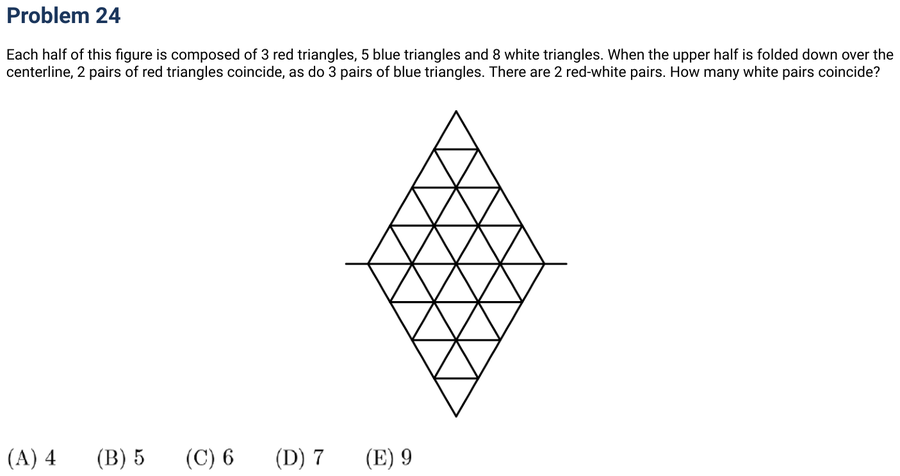
Track what's left on each half after the red and blue pairs are used up.
Show hint (sharpest)
Each half starts with 3 red, 5 blue, 8 white; subtract the coinciding pairs and the red-white pairs.
Show solution
Each half has 3 red, 5 blue, 8 white. The 2 red pairs use 2 reds per half (1 red left); the 3 blue pairs use 3 blues per half (2 blue left).
The 2 red-white pairs use that last red and 1 white per half, and the 2 leftover blues must pair with whites (no more blue-blue allowed), using 2 more whites.
That leaves 8 − 1 − 2 = 5 whites per half, which coincide as 5 white pairs.
You have nine coins: a collection of pennies, nickels, dimes, and quarters having a total value of $1.02, with at least one coin of each type. How many dimes must you have?
Show hint (soft nudge)
Start with one of each coin (41¢) and work out what the other 5 coins make.
Show hint (sharpest)
The leftover must end in a 1, which pins the number of pennies.
Show solution
One of each coin uses 1 + 5 + 10 + 25 = 41¢, leaving 61¢ in 5 more coins. To end in a 1, exactly one more is a penny, leaving 60¢ in 4 coins.
Those 4 must include quarters (4 dimes reach only 40¢); two quarters leave 10¢ = two nickels.
No extra dimes are needed, so there is just the original 1 dime.
Five runners, P, Q, R, S, T, have a race. P beats Q, P beats R, Q beats S, and T finishes after P and before Q. Who could NOT have finished third in the race?
Show hint (soft nudge)
Combine the clues into chains: P is ahead of Q, R, and T, and S is behind Q.
Show hint (sharpest)
Count how many runners must be ahead of each person.
Show solution
P beats Q, R, and T, and P < T < Q < S, so P is always first — it can't be third.
S comes after Q, which comes after both P and T, so at least three runners beat S, putting it 4th or later — also never third. So the answer is P and S.
Alan, Beth, Carlos, and Diana were discussing their possible grades in mathematics class this grading period. Alan said, "If I get an A, then Beth will get an A." Beth said, "If I get an A, then Carlos will get an A." Carlos said, "If I get an A, then Diana will get an A." All of these statements were true, but only two of the students received an A. Which two received A's?
Show hint (soft nudge)
Each statement says: A getting an A forces the next person to get one too.
Show hint (sharpest)
If Alan got an A, the chain would force at least three more A's; same for Beth.
Show solution
Alan's getting an A would force Beth, then Carlos, then Diana — 4 A's, too many. Beth's getting an A would force Carlos and Diana — 3 A's, still too many. So Alan and Beth don't get A's.
If Carlos gets an A, Diana must too — and that's exactly 2 A's: Carlos and Diana.